
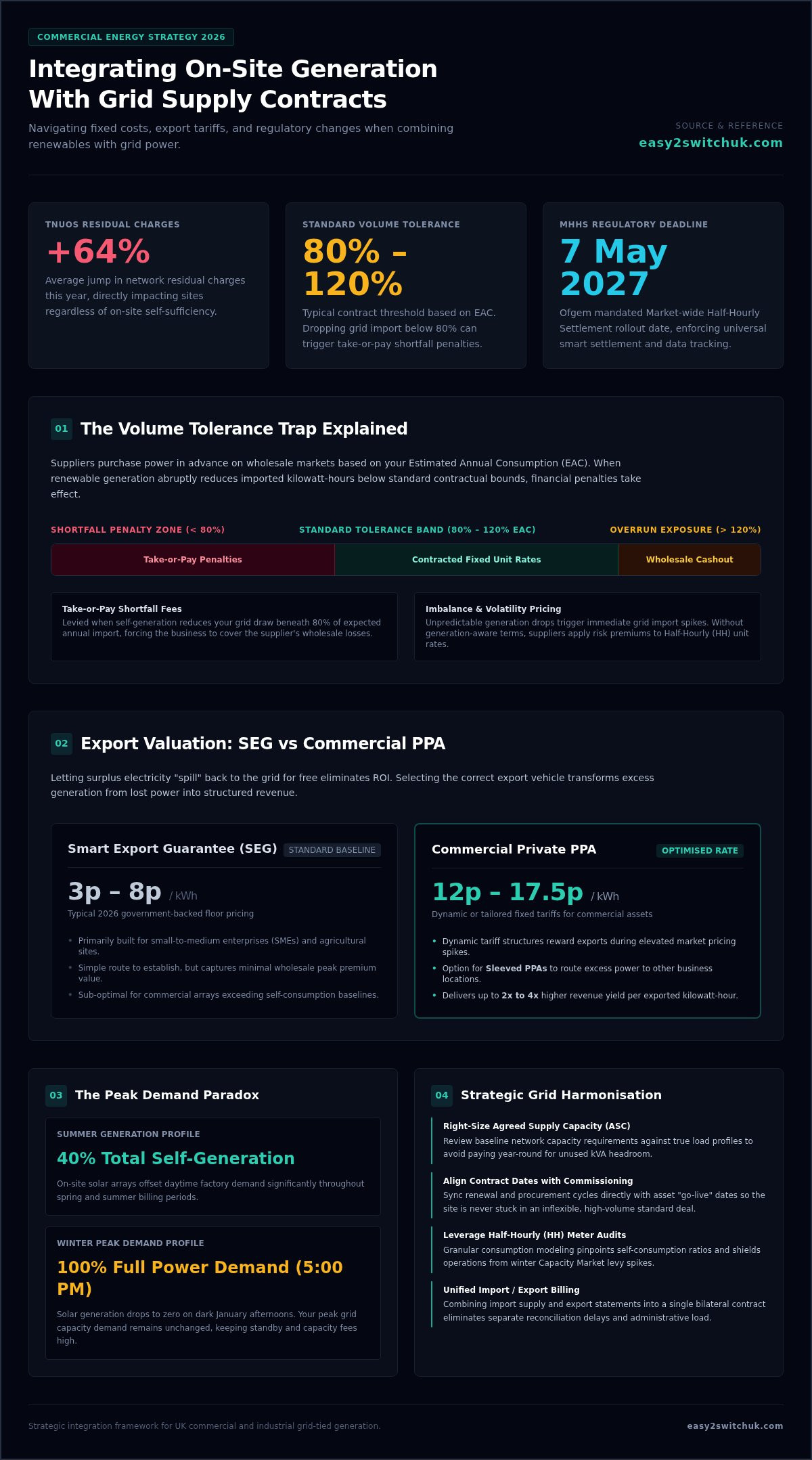
Many UK businesses believe that installing solar panels or wind turbines automatically slashes their energy overheads, but the reality of the 2026 market is far more complex. You’ve likely noticed that even when your on-site generation is at its peak, your fixed costs remain stubbornly high. Successfully integrating on-site generation with grid supply contract terms is now essential, especially as TNUoS residual charges have jumped by an average of 64% this year, impacting even the most self-sufficient sites.
We understand the anxiety of facing “take-or-pay” penalties or feeling stuck between low SEG rates and high retail prices. This guide will show you how to harmonise your generation with your supply agreement to maximise ROI and eliminate hidden standby costs. We’ll explore how to right-size your Agreed Supply Capacity, navigate the shift to private PPAs, and ensure your grid connection acts as a cost-effective backup rather than a financial burden. By taking control of your contract structure, you can turn complex market variables into a streamlined path for business independence.
Key Takeaways
- Stop paying for grid capacity you don’t use by auditing your current contract against your actual on-site generation profile.
- Learn the essential steps for integrating on-site generation with grid supply contract frameworks to protect your business from unexpected volume tolerance penalties.
- Compare Smart Export Guarantee (SEG) rates against commercial PPAs to ensure you’re getting the best return for every kilowatt-hour you send back to the grid.
- Discover how to use your Half-Hourly meter data to accurately predict your self-consumption ratio and avoid costly Capacity Market levies during winter peaks.
- Find out how an independent specialist can handle the complex negotiations and paperwork needed to secure generation-friendly tariffs that aren’t available on the open market.
Understanding the Shift: Why On-Site Generation Changes Your Grid Requirements
Installing renewables isn’t just a technical upgrade; it’s a fundamental shift in your relationship with the energy market. In the past, the grid was your sole provider. Now, as you adopt distributed generation, the grid evolves into a strategic backup. This transition requires a delicate balancing act where you must harmonise your self-generated power with supplemental supply to avoid financial friction.
Many UK businesses fall into the “Standard Contract” trap. Most fixed-rate deals include a volume tolerance clause, typically between 80% and 120% of your Estimated Annual Consumption (EAC). If your new solar array or wind turbine reduces your grid import below that 80% threshold, your supplier may levy “take-or-pay” penalties or volume shortfall fees. They’ve already bought that power on the wholesale market for you; if you don’t use it, they lose money, and those costs are passed straight back to your bill.
Suppliers also closely monitor your Half-Hourly (HH) data to build a risk profile. A site that suddenly shows a “lumpy” or unpredictable load is harder to price. If you don’t manage the process of integrating on-site generation with grid supply contract terms correctly, you might find yourself paying higher unit rates to compensate for this perceived volatility. In 2026, the grid’s role is no longer just about delivering kWh; it’s about providing the reliability you need when the sun isn’t shining or the wind drops.
The Conflict Between Fixed Tariffs and Variable Generation
Solar and wind are inherently volatile. If your generation drops unexpectedly, you rely on the grid to fill the gap instantly. Without a generation-aware contract, these sudden spikes can trigger “imbalance charges.” It’s also vital to remember that your peak demand might not drop as much as your total consumption. A factory still needs its full power at 5:00 PM on a dark January afternoon, even if it produced 40% of its own power during the summer. Aligning your contract end-date with your generation commissioning ensures you aren’t stuck in an inflexible deal when your new assets go live.
Regulatory Context: Ofgem and the 2026 Smart Grid
Ofgem is driving a rapid shift toward a more responsive energy system. The Market-wide Half-Hourly Settlement (MHHS) deadline of 7 May 2027 means every business site is moving toward mandatory smart metering and granular data tracking. This allows the National Energy System Operator (NESO) to manage small-scale commercial exports more efficiently, but it also means there’s nowhere to hide for inefficient load profiles. We define Grid-Tied Integration as a strategic financial hedge against market volatility. By integrating on-site generation with grid supply contract structures that acknowledge your export capacity, you move from being a passive consumer to an active, resilient market participant.
Navigating Export Tariffs and Power Purchase Agreements (PPAs)
Choosing how to handle your surplus energy is just as critical as integrating on-site generation with grid supply contract terms for your import needs. For many small-to-medium enterprises and farms, the Smart Export Guarantee (SEG) provides a straightforward route, with 2026 rates typically averaging between 3p and 8p per kWh. However, larger installations often find better value in commercial Power Purchase Agreements (PPAs). These private contracts can offer optimised dynamic tariffs reaching 12p to 17.5p per kWh, significantly outperforming standard SEG terms.
Flexible PPAs allow you to benefit from market peaks, while fixed PPAs offer price certainty in a fluctuating 2026 market. If your business operates across multiple locations, a sleeved PPA might be the answer. This structure allows you to “transport” your generated power via the grid to your other sites, reducing import costs elsewhere. For administrative ease, we often recommend combined contracts that handle both import and export on a single statement. This simplifies your bookkeeping and ensures your energy management remains efficient.
Maximising the Value of Excess Energy
Your “spill” rate refers to the energy you neither consume on-site nor sell through a formal agreement. Letting power spill back to the grid for free is a lost revenue opportunity. Using a business energy comparison helps identify suppliers offering high export floor prices that suit your specific scale. Pairing your panels with battery storage allows you to time your exports, holding back power until the grid demand and the price are at their highest. It’s about making your assets work harder for your bottom line.
Negotiating PPA Terms for Farms and SMEs
When negotiating, watch out for “Take-or-Pay” clauses that might penalise you if your generation doesn’t meet forecast levels. In the fast-moving 2026 landscape, shorter export contracts of one to two years often provide better agility than long-term deals. You can also link your export revenue directly to your grid supply bill, essentially using your generation to offset your standing charges. Successfully integrating on-site generation with grid supply contract structures requires a clear understanding of these trade-offs. If you want to ensure your export rates are working in your favour, our independent energy brokerage team can help you navigate the hundreds of supplier offers available.
The Financial Impact: Managing Standby Charges and Capacity Market Costs
A common frustration for UK businesses in 2026 is seeing a significant drop in imported units but only a minor decrease in the total bill. This happens because non-commodity fixed charges now make up over 50% to 60% of commercial electricity costs. When integrating on-site generation with grid supply contract structures, you must address the “Standby Charge.” This is a fee suppliers levy for maintaining the infrastructure required to support your full load, even if your solar or wind assets are covering most of your needs. Essentially, you’re paying for the grid to wait in the wings as a backup.
The risk of double-charging is real. You’ve invested in on-site generation, yet you’re often still paying for the transmission network capacity you used before the installation. This is largely due to the Targeted Charging Review (TCR), which shifted network residual charges into fixed daily bands. If you don’t formally reapply to lower your Agreed Supply Capacity (ASC), you’ll remain in a higher charging band despite your reduced reliance on the grid. However, lowering your kVA too far is risky. If your generation fails during a peak period and you breach your contracted capacity, DCP 161 penalties can be two to three times the standard rate.
Standby Charges vs. Standard Standing Charges
Standard SMEs pay a standing charge based on their meter type. Integrated sites often face a different reality. Suppliers justify higher fixed costs because they must guarantee reliability for your site’s maximum potential draw. To lower these costs, you need to right-size your ASC. By analysing your Half-Hourly data, you can identify the absolute minimum capacity you need to keep the lights on if your renewables go offline. This allows you to negotiate a lower fixed band without risking site “trips” or expensive overages.
Avoiding Triad and Peak-Time Penalties
Your on-site assets are powerful tools for “peak lopping.” Capacity Market levies are calculated based on your import during the winter window: weekdays between 4:00 PM and 7:00 PM from November through February. By discharging battery storage or running CHP during these hours, you can dramatically reduce these levies. Modern contracts often reward this flexibility. In 2026, DUoS charges are also heavily weighted toward these “Red Band” periods. Successfully integrating on-site generation with grid supply contract terms means ensuring your supplier recognises this reduced peak-time pressure, effectively lowering your overall system costs.
Step-by-Step: Auditing Your Contract for Renewable Integration
Auditing your current position is the only way to avoid the “standard contract” traps discussed earlier. It’s a logical process that moves from historical data to future projections. Start by reviewing your Half-Hourly (HH) data to establish a solid consumption baseline. This shows exactly when your business draws power and where the peaks occur. Next, project your self-consumption ratio. If you install 100kW of solar but your weekend demand is near zero, your ratio drops and your exportable surplus rises. Identifying this surplus early allows you to obtain a competitive PPA quote before the system even goes live. Finally, consult a commercial energy broker to identify suppliers that support integrated billing, ensuring your import and export work in tandem.
The Pre-Installation Audit
You must notify your supplier before commissioning any new asset. Many commercial contracts contain exclusivity clauses that forbid you from sourcing power from elsewhere, including your own roof, without prior consent. Breach of these terms can lead to significant penalties. You also need to ensure your meter is export-ready. While micro-generation under 16A per phase follows a simple notification process, almost all commercial systems require a formal G99 application and prior DNO approval. Successfully integrating on-site generation with grid supply contract frameworks depends on clearing these regulatory hurdles before the hardware is even bolted down.
Post-Installation Optimization
The first 90 days of integrated data are the most valuable. This period reveals the gap between theoretical modelling and real-world yields. Use this data to adjust your grid contract, specifically your Agreed Supply Capacity (ASC). If your battery storage consistently covers your morning peak, you may be able to drop a capacity band and save on fixed charges. For agricultural businesses, refining your farm electricity prices UK strategy is essential to account for seasonal variations. A dairy farm’s profile in July looks very different in December, and your contract must be flexible enough to handle both. To ensure your audit covers every contractual detail, request a free contract review from our specialist team today.
By following this structured path, you move away from guesswork and toward data-driven procurement. Integrating on-site generation with grid supply contract terms isn’t a one-time event; it’s an ongoing process of refinement. Monitoring your export performance alongside your import costs ensures you’re always on the most cost-effective tariff for your specific generation profile.
How an Energy Broker Simplifies the Integration Process
The 2026 energy market is a maze of technicalities. Attempting a DIY approach to integrating on-site generation with grid supply contract terms often leads to expensive oversights. Suppliers are increasingly strict about volume tolerances and capacity breaches. Without expert oversight, you might find your solar savings wiped out by standing charge increases or imbalance fees. Easy2switch UK Ltd acts as your Reliable Specialist, handling the paperwork headache so you can focus on running your business. We bridge the gap between your technical generation data and the supplier’s rigid contract structures.
Our brokerage service is free for your business because we’re paid by the suppliers. This removes any financial barrier to expert consultancy. We provide access to “Generation-Friendly” tariffs that simply aren’t listed on public comparison websites. These deals are specifically designed for integrated sites, offering better flexibility for fluctuating import needs and more competitive export rates. We ensure there’s no gap in your payments or supply during the transition, managing the move from a standard meter to an export-ready setup with calm efficiency.
Expert Negotiation vs. Automated Comparison
Standard comparison tools are built for simple import-only profiles. They fail to account for the nuances of integrating on-site generation with grid supply contract conditions, such as PPA floor prices or seasonal load shifting. Working with an impartial business energy consultant gives you a significant advantage. We understand the technical language of G99 applications and ASC bandings. We handle the dialogue with suppliers on your behalf, ensuring they view your site as a low-risk, modern energy player rather than a volatile liability.
Taking Control of Your Energy Future
We believe energy management should empower you. By moving away from passive consumption, you become a proactive participant in the UK’s smart grid. Our goal is to provide a streamlined experience that replaces anxiety with confidence. You’ll have the peace of mind that your complex market variables are being handled by capable hands. Our specialists focus on finding the best individual fit for your farm or SME rather than a one-size-fits-all solution. Ready to integrate? Contact Easy2switch UK Ltd for a free energy review and let us simplify your path to energy independence.
Securing Your Energy Independence in a Smart Grid World
Taking control of your own power generation is a vital step toward long-term resilience, but it’s only half the journey. The real value lies in integrating on-site generation with grid supply contract terms that reflect your new reality. By right-sizing your agreed capacity and navigating the shift from standard tariffs to dynamic PPAs, you can turn the grid into a cost-effective partner rather than a source of hidden penalties.
Managing these 2026 smart grid regulations doesn’t have to be a paperwork headache. At Easy2switch, we bring a specialist focus to the UK farming and business sectors, ensuring your transition is handled with calm efficiency. Our service is entirely no-cost to you, as we’re funded by supplier commissions; this allows us to focus on finding your perfect fit from hundreds of market offers. Ready to stop overpaying for backup infrastructure? Get a free, impartial review of your integrated energy contract today. You’ve done the hard work of installing renewables; let us ensure your grid contract works just as hard for your bottom line.
Frequently Asked Questions
Can I keep my current grid contract if I install solar panels?
You can technically keep your current deal, but it’s often a financial risk. Most business contracts include volume tolerance thresholds. If your solar panels reduce your grid import by more than 20%, your supplier might charge fees for the “missing” consumption. It’s better to notify them early and move to a contract that acknowledges your new generation profile to avoid these hidden penalties.
What is the difference between a PPA and a Smart Export Guarantee (SEG)?
The Smart Export Guarantee (SEG) is a basic, government-mandated scheme for smaller generators. Commercial Power Purchase Agreements (PPAs) are private contracts that often yield higher returns. While SEG rates in 2026 average between 3p and 8p, a well-negotiated PPA can offer significantly more. PPAs are usually better for larger commercial installations that require bespoke terms and more sophisticated market tracking.
Will I still have to pay standing charges if I generate 100% of my own power?
Yes, you’ll still face daily standing charges. These fees pay for the maintenance of the physical wires and transformers that connect you to the UK network. Under the Targeted Charging Review (TCR) rules, these are now fixed daily costs based on your voltage and capacity band. Even if you’re entirely self-sufficient, the grid remains your essential backup, and you pay for that reliability.
What is a G99 application and why does my contract depend on it?
A G99 application is the formal request to your Distribution Network Operator (DNO) to connect a generation system exceeding 16A per phase. It ensures your equipment is safe and won’t cause local power surges. You cannot secure an export MPAN or a specialist supply deal without an approved G99. It’s the technical foundation that allows your supplier to legally recognise and pay for your exported power.
How long does it take to switch to an integrated grid and export contract?
The process usually takes between 4 and 8 weeks to complete. You first need to register an Export MPAN, which often takes around 15 working days. Once that’s active, the switch to a new supplier follows the standard industry timeline. When you’re integrating on-site generation with grid supply contract terms, using a broker speeds this up by ensuring all technical paperwork is correct before the application starts.
Can an energy broker help me sell my excess farm electricity?
Yes, helping farms manage their energy is our core specialism. We understand that agricultural sites have unique seasonal peaks and troughs. We’ll compare hundreds of offers to find an export deal that maximises your revenue from surplus power. Our service is free to you because we’re paid by the suppliers, so you get expert advice on selling your excess electricity without any upfront consultancy fees.
What happens to my grid contract if my generation system breaks down?
If your system fails, the grid automatically takes over the full load. This is the primary benefit of a grid-tied system. However, you’ll be importing 100% of your power at your contracted unit rate. You must ensure your Agreed Supply Capacity (ASC) is high enough to cover this total load. If you’ve downsized your capacity too much to save on standing charges, a breakdown could trigger expensive DCP 161 penalties.
Are there specific suppliers in the UK that specialise in on-site generation integration?
Several specialist UK suppliers now focus exclusively on the renewable and “smart” business sectors. These firms offer dynamic tariffs and are much more comfortable with the “lumpy” load profiles of sites with on-site generation. They often provide better volume tolerance than traditional suppliers. We maintain relationships with these specialist providers to ensure our clients can access tariffs that are specifically tailored for integrated renewable systems.
