
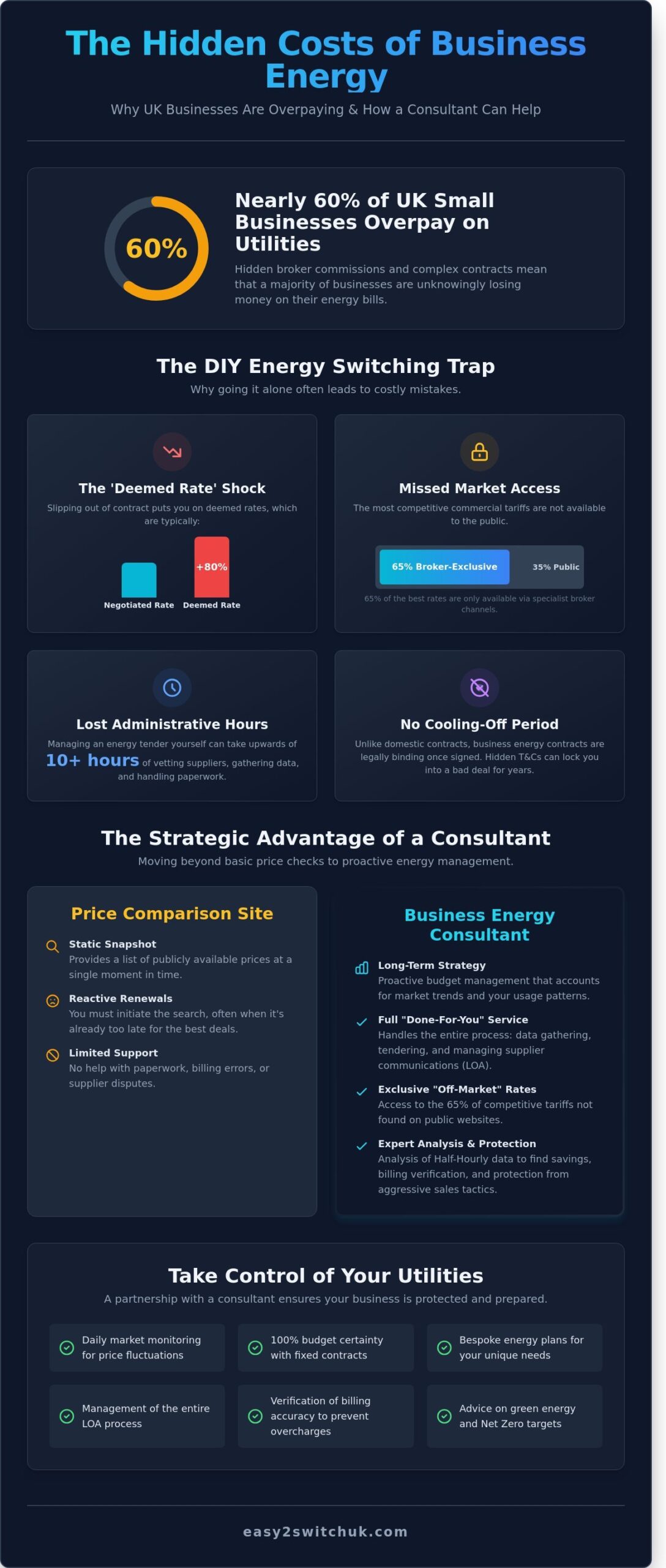
Did you know that nearly 60% of UK small businesses are currently overpaying for their utilities because of hidden broker commissions buried in the fine print? It’s a staggering figure that highlights why the 2026 energy market feels so daunting for many business owners. Most directors find that partnering with professional business energy consultants is no longer a luxury, but a necessity to avoid these financial traps. You likely feel that managing unpredictable overheads is a full-time job you didn’t sign up for, especially when facing complex terms that seem to hide the true cost of your power.
We understand that you want transparency and stability rather than a constant battle with rising costs. We’ll show you how a specialist can demystify the UK market, strip out those unfair fees, and arrange bespoke energy contracts tailored specifically to your operations. You’ll discover our streamlined, done-for-you switching process and learn how to secure expert advice on green energy levies to ensure your firm or farm stays competitive and sustainable for years to come.
Key Takeaways
- Understand the vital difference between basic price comparison and strategic consultancy to ensure your business secures the most favourable rates in the 2026 market.
- Navigate the complexities of the UK’s Net Zero targets and market volatility with expert insights that help stabilise your commercial energy spend.
- Discover how professional business energy consultants provide a transparent, fee-free service by leveraging supplier-paid commissions to find your ideal contract.
- Learn how to access bespoke energy solutions designed specifically for the unique operational requirements of UK farms, charities, and SMEs.
- Take control of your utility management with a simple, expert-led review process that eliminates hidden fees and simplifies commercial energy procurement.
What are business energy consultants and why does your company need one?
A business energy consultant acts as a specialised intermediary between your organisation and commercial energy suppliers. Unlike domestic energy setups, the commercial sector is complex and lacks the safety nets found in home energy contracts. To understand the basics, What is energy consulting? It is the process of providing expert advice to help businesses reduce their energy spending and carbon footprint through strategic procurement and efficiency measures.
There is a significant difference between a basic price comparison and strategic consultancy. A comparison site provides a static snapshot of the market at a single moment. In contrast, business energy consultants provide a long term strategy that accounts for market trends and your specific usage patterns. For Worcester’s charities and local businesses, this means moving away from reactive renewals and toward proactive budget management. With energy prices in 2024 showing fluctuations of up to 15% within a single month, having a specialist who watches these trends is vital for financial stability.
For busy directors and farm owners across Worcestershire, time is a finite resource. Managing an energy tender can take upwards of 10 hours of administrative work, from gathering historical data to vetting supplier credit requirements. A consultant handles this entire process, allowing you to focus on your core mission. This provides essential peace of mind as we approach a volatile 2026 energy market. Market analysts suggest that geopolitical factors and the transition to renewable sources will continue to cause price swings, making expert guidance a necessity rather than a luxury.
The core role of a commercial energy consultant
Consultants provide daily market monitoring to track wholesale gas and electricity fluctuations. They help you choose between fixed contracts, which offer 100% budget certainty, and flexible contracts that allow you to buy energy in tranches. Crucially, they manage the Letter of Authority (LOA) process. This document gives the consultant permission to communicate with suppliers on your behalf, removing the burden of endless phone queues and technical disputes from your desk.
Why DIY energy switching often fails for businesses
Many organisations fall into the “Hidden T&C” trap. Business energy contracts do not have a cooling-off period; once you sign, you are legally bound. DIY switchers often miss the best rates because 65% of the most competitive commercial tariffs are only available through specialist broker channels. Without professional help, businesses often slip onto “Deemed Rates” at the end of a contract. These out of contract rates are typically 80% more expensive than negotiated prices, causing immediate and avoidable financial strain. Taking the time to compare business gas rates with a specialist before your contract ends is one of the most effective ways to avoid these costly pitfalls.
Working with business energy consultants ensures your charity or business is protected by:
- Access to “off-market” rates not found on public websites.
- Expert analysis of your Half-Hourly (HH) data to identify waste.
- Protection against aggressive supplier sales tactics.
- Verification of billing accuracy to prevent overcharging.
By partnering with a UK-based specialist, you gain a reliable partner who understands the local landscape. We don’t just find a cheap deal; we build a bespoke energy plan that supports your organisation’s growth and sustainability goals for years to come. It’s about taking control of your utilities so they stop being a source of stress and start being a managed, predictable cost.
Navigating the 2026 UK energy market: Trends and challenges
By 2026, the UK energy market will have moved into a phase of structured volatility. While the extreme price shocks seen in 2022 and 2023 have subsided, the market remains sensitive to global supply shifts and the decommissioning of older nuclear assets. For Worcester’s charities, this means that the era of “set and forget” energy contracts is over. The UK government’s commitment to a 68% reduction in emissions by 2030 has fundamentally altered how suppliers price their commercial tariffs. Carbon-heavy energy is becoming more expensive as levies increase, making green energy a financial necessity rather than a luxury. Most grant-giving bodies and local authorities now require proof of a low-carbon footprint before awarding funding, which makes your choice of tariff a core part of your charity’s viability.
Professional business energy consultants provide the oversight needed to identify greenwashing in supplier offers. Many providers claim their energy is 100% renewable by purchasing cheap Renewable Energy Guarantees of Origin (REGO) certificates, even if the actual power comes from fossil fuels. A specialist consultant scrutinises the fuel mix disclosure to ensure your charity is supporting genuine renewable generation. This transparency protects your organisation’s reputation and ensures that every pound spent on utilities aligns with your ethical mission.
Understanding the Energy Transition for SMEs
The Energy Transition is the shift from fossil-fuel reliance to diversified, sustainable procurement by 2026. For smaller charities and SMEs, this transition often begins with moving away from standard variable rates to renewable-backed fixed tariffs that offer protection against market spikes. Larger commercial users are increasingly looking at Power Purchase Agreements (PPAs) to secure energy directly from renewable generators for five to ten years. These agreements offer a level of price certainty that traditional contracts cannot match. When you start exploring these options, following Ofgem guidance for businesses will help you understand how to work effectively with intermediaries to find the right fit for your specific needs.
Levies, taxes, and the Climate Change Levy (CCL)
The Climate Change Levy (CCL) is a tax on commercial energy use designed to encourage energy efficiency. As of 2024, the rates have continued to climb, adding a significant amount to the average monthly bill. However, many charities don’t realise they’re often eligible for a 5% VAT rate on their energy instead of the standard 20%. If your organisation qualifies for this reduced rate, you’re also automatically exempt from paying the CCL entirely. This can lead to a 15% reduction in total costs, yet many suppliers default to the higher rate unless challenged.
- VAT Exemptions: Charities involved in non-business activities can often claim back years of overpaid tax.
- CCL Relief: Ensuring your certificates are up to date prevents unnecessary tax charges on every kWh used.
- Bill Validation: Since roughly 20% of commercial utility bills contain errors, business energy consultants use specialised software to catch overcharging before the payment leaves your account.
Managing these technicalities requires a proactive approach to procurement. You can request a free bill review to ensure your charity isn’t overpaying on hidden levies or incorrect tax brackets. Taking control of these costs now ensures that more of your budget stays where it belongs: supporting the Worcester community.
Transparency and trust: How the ‘Free’ consultancy model works
The most frequent question we hear from Worcester charity directors is simple: “How do you get paid if you don’t charge us a fee?” It’s a fair point. In a world of hidden costs, the idea of a free service often raises eyebrows. The reality is straightforward. Professional business energy consultants operate on a supplier-paid commission model. This means you’ll never receive an invoice for the time spent analysing your usage or negotiating with providers. Instead, the energy supplier pays a fee to the consultant once your new contract goes live.
This system works because it removes the financial risk for non-profit organisations. You get the expertise of a specialist without dipping into your fundraising reserves. Since 1st October 2022, transparency in these payments has become a strict requirement for micro-businesses and many small charities. Following Ofgem’s business energy guidance, consultants must clearly disclose the commission they earn if you ask. This regulation ensures that the advice you receive is honest and that any fees are proportional to the work performed.
There’s a significant difference between an independent consultant and a “tied” broker. Tied brokers often have partnerships with a limited panel of perhaps three or four suppliers. This narrow focus can be costly. If those specific suppliers aren’t competitive that week, you lose out. A truly independent consultant scans the whole market, comparing rates from 25 or more different providers. This breadth of choice is what drives down costs and helps you find a contract that actually fits your charity’s specific operational hours.
The benefits of a commission-based service
Charities frequently operate on tight monthly budgets where every penny is accounted for. The commission model ensures there are no upfront costs, which lowers the barrier for smaller organisations needing professional help. It creates a system of aligned interests. The consultant only receives payment if they successfully find a deal that you’re happy to sign. The fee itself is typically built into the unit rate, often as little as 0.2p or 0.5p per kilowatt-hour. This keeps your billing simple and ensures your energy costs remain predictable for the duration of your contract.
How to vet a business energy consultant
Not all business energy consultants provide the same level of care. When choosing a partner, start by asking for a list of their supplier panel. If they can’t access the whole market, they aren’t giving you the full picture. You should also look for UK-based support. When a billing query arises on a Friday afternoon, you want a dedicated account manager you can call directly, not an automated switchboard. Finally, check their track record with the third sector. Charities have specific VAT requirements and Climate Change Levy (CCL) exemptions. An experienced consultant will know how to ensure you’re only paying the 5% VAT rate rather than the standard 20% if you qualify.
Sector-specific guidance: Farming, charities, and SMEs
A one-size-fits-all approach to utility management fails because a Worcester community hall doesn’t operate like a high-tech dairy farm. By 2026, the energy gap between industrial, agricultural, and third-sector needs has widened significantly. Standard commercial contracts often overlook these nuances, leaving organisations with “off-the-shelf” rates that don’t match their actual consumption patterns. This is where business energy consultants provide the most value; they look beyond the unit price to understand the operational heartbeat of your organisation.
Energy consultancy for the farming industry
Modern UK farms in 2026 are complex energy hubs. High-demand periods like autumn harvesting, daily milking cycles, and grain drying create massive, short-term spikes in power usage. If a farm stays on a standard flexible tariff, these peaks often trigger expensive “rachet” charges from suppliers. Our team helps agricultural clients align their capacity requirements with these specific windows of activity to avoid penalties.
Diversification is now a standard part of the rural economy. We’ve seen a 15% increase in farms integrating on-site solar or wind generation since 2024. Easy2switch UK Ltd has a deep heritage in agricultural energy, helping farmers manage the technical transition of feeding surplus power back into the National Grid. We ensure your export contracts are as lucrative as your import contracts are affordable. This bespoke approach turns energy from a volatile overhead into a manageable, predictable resource.
- Load shifting: Advice on moving high-energy tasks to off-peak periods.
- Grid integration: Seamlessly connecting on-site renewables with commercial supply.
- Agricultural heritage: Decades of experience specifically tailored to the UK’s rural landscape.
Solutions for charities and non-profit organisations
Charities face unique financial hurdles that most commercial suppliers don’t automatically address. Many registered non-profits are entitled to a reduced VAT rate of 5% on their energy bills, rather than the standard 20%. Despite this, a 2025 audit found that 1 in 4 small charities were still being incorrectly billed at the higher rate. Professional business energy consultants rectify these errors by auditing historical billing and securing backdated rebates for up to four years of overpayments.
Eligible non-profits also qualify for exemptions from the Climate Change Levy (CCL). We manage the complex “PP11” certificates required to claim these exemptions so you don’t have to. For a charity, every pound saved on utilities is a pound that goes directly to frontline services. We recommend fixed-rate contracts for this sector because they provide the absolute budget certainty required for rigid annual financial planning. It’s about protecting your mission from the unpredictability of the wholesale market.
SMEs with seasonal fluctuations, such as tourism-heavy businesses in the Malvern Hills, also benefit from this tailored strategy. Instead of paying for high capacity year-round, we negotiate contracts that reflect your quietest months. This level of detail ensures you aren’t subsidising the energy company’s profits during your off-season. Businesses that regularly compare business gas rates across multiple suppliers consistently secure better terms and avoid the seasonal cost spikes that catch many SMEs off guard.
Don’t let generic contracts drain your vital resources. You can request a bespoke energy audit to see exactly how much your organisation could save through sector-specific optimisation.
Taking control: How to start your energy review with Easy2switch
Charities in Worcester often operate on razor-thin margins where every penny counts. Every pound spent on a bloated utility bill is a pound taken away from essential community services. Working with experienced business energy consultants removes the guesswork from procurement and puts the power back into your hands. Easy2switch operates as a UK-based, independent partner, providing a service that’s fundamentally different from the high-pressure call centres many organisations dread. We don’t use pushy sales tactics or aggressive follow-ups. Our team provides expert advice tailored to your specific charity’s footprint, ensuring you never pay more than necessary for your gas and electricity.
Starting your review is a straightforward process that respects your time. We only require two pieces of information to begin a comprehensive market analysis. You’ll need to provide a copy of a recent energy bill from within the last three months and your total annual consumption figures in kWh. These documents allow our team to verify your current contract end dates, meter profiles, and standing charges accurately. Since 2022, energy prices have fluctuated by over 40 per cent, so having precise data is the only way to secure a competitive rate for 2024 and beyond. We act as your advocate, using our industry relationships to access pricing that isn’t always available to the general public.
Our independence is our greatest asset. Because we aren’t tied to any single provider, we offer an unbiased view of the entire UK market. This transparency means you get a clear comparison of the “big six” alongside smaller, specialist suppliers who might offer better terms for non-profit organisations. For a deeper understanding of how to structure your procurement strategy, our guide to comprehensive business energy solutions for UK firms outlines the full range of options available to commercial organisations in 2026. We focus on the human element of the service, ensuring you feel supported rather than processed. It’s about finding the right fit for your building, whether you run a small community hub or a large multi-site operation.
Your 3-step path to energy savings
Step 1: The Initial Consultation. We start by discussing your specific goals. Some Worcester charities prioritise 100 per cent renewable energy to match their environmental mission, while others require the lowest possible fixed rate to aid long-term budgeting. We listen first and advise second.
Step 2: The Market Search. Easy2switch compares hundreds of tariffs from over 30 commercial suppliers. We look beyond the headline price to check for hidden clauses or unfavourable terms. This deep-dive analysis ensures the quotes you see are realistic and achievable for your specific meter type.
Step 3: The Seamless Switch. Once you’ve selected a tariff, we handle the administrative burden. Our team manages the paperwork and liaises with both your old and new suppliers. We ensure the transition happens on time so you don’t drop onto expensive out-of-contract rates, which can be 50 per cent higher than standard fixed terms.
Ready to optimise your business energy?
Managing utilities shouldn’t be a source of stress for your charity’s leadership team. We invite you to a no-obligation review of your current gas and electricity contracts to see where savings can be made. Our “done-for-you” promise means we take on the technical challenges of the energy market, leaving you free to focus on your core mission in Worcester. By auditing your current spend now, you can protect your organisation from future price spikes and ensure your funds stay where they are needed most.
Take Control of Your 2026 Energy Strategy Today
The 2026 UK energy market presents specific challenges for businesses, ranging from shifting wholesale price points to new regulatory demands. Engaging with professional business energy consultants allows your company to bypass the stress of manual price comparisons and focus on your daily operations. Whether you manage a high-demand agricultural site or a growing SME, bespoke procurement is the most effective way to ensure you aren’t overpaying on unit rates. Our 100% independent and UK-based team provides direct access to hundreds of commercial tariffs that aren’t always available on the open market.
Easy2switch brings pragmatic clarity to an often opaque industry. As specialists in UK farm and agricultural energy, we understand the unique load profiles and seasonal demands of rural businesses. We handle the complex negotiations so you don’t have to, providing a seamless path to lower overheads and long-term budget stability. Organisations seeking a complete overview of their options will find that exploring tailored business energy solutions designed for the 2026 UK market is an essential step toward securing long-term financial stability. You deserve a partner who prioritises your bottom line over supplier commissions. Take the first step toward a more transparent utility strategy and start your journey toward significant savings today.
Secure your free, no-obligation business energy review with Easy2switch
Let’s get your commercial rates optimised so you can enjoy genuine peace of mind and move forward with confidence.
Frequently Asked Questions
What exactly does a business energy consultant do?
A business energy consultant manages your utility procurement by auditing your current consumption and negotiating with suppliers to find the most cost-effective contracts. At Easy2Switch UK, we handle the administrative burden of comparing dozens of commercial tariffs so you can focus on your charitable work in Worcester. We review your historical billing data to identify overcharges and ensure your charity isn’t paying more than the 5% VAT rate usually applicable to non-profit organisations.
Is it really free to use a business energy consultant?
Yes, most consultants operate on a commission-based model where the supplier pays a fee that’s already built into your unit rate. This means there are no upfront costs or hidden bills for your charity to pay us directly. We provide full transparency regarding these commissions, which typically amount to less than 1p per kilowatt-hour. This setup ensures our interests align with yours: finding the most competitive deal to secure your long-term partnership.
How much can a consultant typically save a UK business?
UK businesses and charities typically save between 20% and 45% on their annual energy bills by switching from out-of-contract rates to a negotiated fixed-term deal. For a small Worcester charity spending £5,000 annually, this can represent a direct saving of £1,000 or more. Because the energy market fluctuates daily, our consultants monitor price drops in real-time to lock in lower rates before they expire. These savings provide vital extra funds for your core community projects.
Can a consultant help if I’m currently in a contract?
We can start the procurement process up to 12 months before your current contract expires to protect you from future price hikes. While you usually can’t exit a fixed-term commercial contract early without penalty, we’ll track your renewal window to ensure you don’t roll onto expensive deemed rates. We manage the termination notice on your behalf, a process that must often be completed 30 to 90 days before the contract ends to avoid automatic extensions.
Do consultants only work with the ‘Big Six’ suppliers?
No, we compare prices from over 30 different UK energy suppliers, ranging from the household names to specialist commercial providers. While the Big Six still hold a 70% share of the domestic market, smaller independent suppliers often offer more competitive rates and better customer service for Worcester’s non-profit sector. By accessing this wider pool of providers, we ensure your charity benefits from bespoke pricing that isn’t available on the standard public market.
What is the difference between an energy broker and a consultant?
An energy broker primarily focuses on the transaction of switching suppliers, while business energy consultants provide a broader range of long-term management services. As consultants, we don’t just find a low price; we also provide energy audits, VAT declarations, and carbon footprint reporting. This holistic approach ensures your charity’s energy strategy is sustainable and compliant with current UK regulations, rather than just being a one-off price comparison.
How long does the switching process take for a commercial property?
The physical switch between suppliers usually takes between 15 and 28 days once the contract is signed, though the entire administrative process takes about 5 weeks. This timeline includes the mandatory cooling-off period and the transfer of meter data through national databases. We handle all the communication with both your old and new suppliers to ensure the transition is seamless. You won’t experience any interruption to your power or gas supply during this administrative changeover.
Can a consultant help my business with green energy and Net Zero targets?
We help charities achieve their Net Zero goals by sourcing 100% renewable energy tariffs backed by REGO certificates. Currently, about 40% of the UK’s electricity comes from renewable sources, and we can help you select suppliers that invest directly in wind, solar, or hydro projects. Choosing a green tariff not only reduces your carbon footprint but also demonstrates your commitment to environmental responsibility to your donors and the Worcester community.
