
For many UK business owners and farmers, the energy market can feel like a moving target. Between opaque pricing structures and the looming threat of expensive “deemed rates,” the time spent negotiating with multiple suppliers is often a drain on your most valuable resource: your focus. As we look toward 2026, conducting a strategic business energy comparison has never been more critical. You deserve transparency and a procurement plan that protects your bottom line from unnecessary market volatility.
In this guide, we demystify the complexities of the 2026 energy landscape to help you secure the most competitive electricity and gas rates bespoke to your industry. Whether you are managing a high-output farm or a growing SME, you will learn how to lock in predictable energy costs for the next 12 to 36 months. Our goal is to provide the expert validation you need for a seamless, “done-for-you” transition. It is time to move away from the frustration of out-of-contract penalties and toward the peace of mind that comes with professional optimization and local, UK-based accountability.
Key Takeaways
- Understand the critical differences in commercial contracts, including the absence of cooling-off periods, to ensure you lock in the right deal the first time.
- Gain insights into the 2026 UK market landscape and how the shift toward renewables is reshaping standing charges for small businesses and farms.
- Master a streamlined business energy comparison process using our five-step framework to identify your specific consumption profile and potential savings.
- Learn why industry-specific procurement is vital for sectors with seasonal demands, such as harvesting or cooling, to avoid overpriced generic tariffs.
- Discover the benefits of a “done-for-you” brokerage approach to secure bespoke rates and professional advocacy against aggressive supplier pricing.
What is Business Energy Comparison and Why is it Different in 2026?
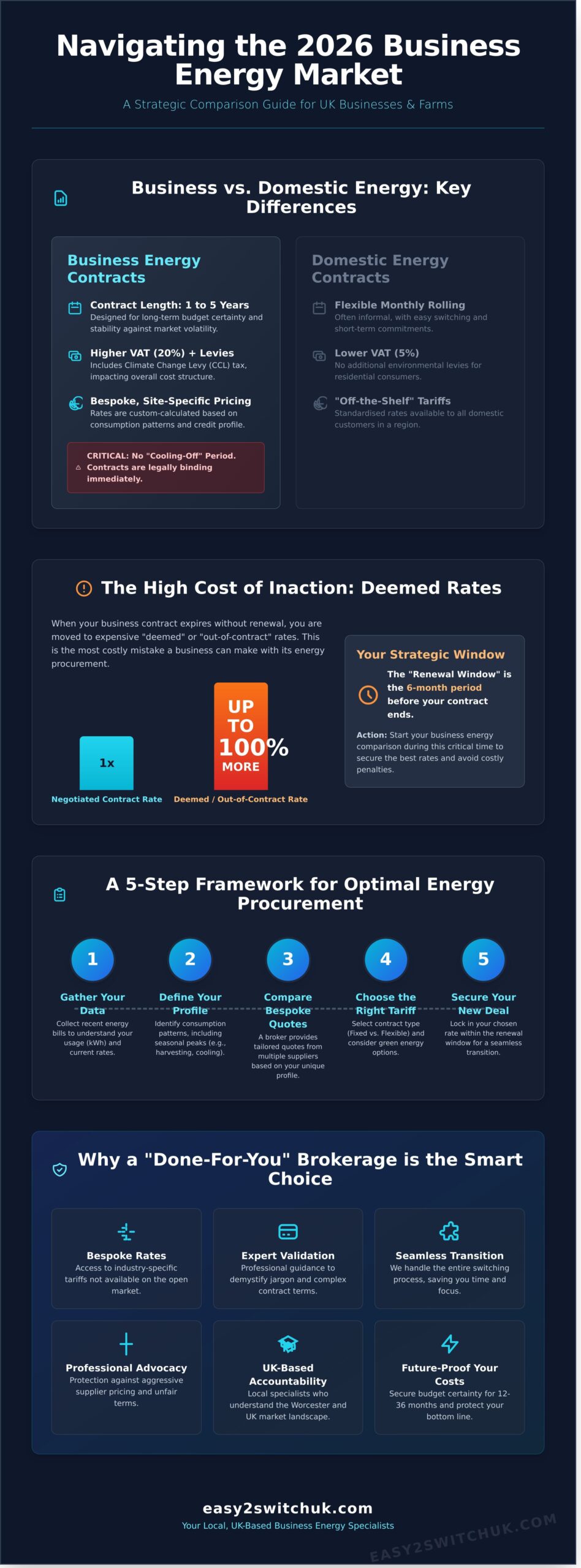
At its core, business energy comparison is a specialized procurement process designed to secure commercial gas and electricity rates tailored specifically to your business operations. Unlike the domestic market, where switching is relatively informal, business energy is a professional commitment. One of the most critical distinctions is that business contracts have no “cooling-off” period; once you agree to a rate, the contract is legally binding immediately. This makes the initial comparison phase vital for protecting your bottom line.
As we move through 2026, the market has evolved. With shifts in UK energy policy and increased volatility, Worcester SMEs are now faced with a strategic choice: the security of a long-term fixed rate or the potential agility of flexible-rate contracts. At Easy2switch UK Ltd, we act as your reliable specialist, demystifying supplier jargon and providing the transparency needed to navigate these complex options with peace of mind.
Business vs. Domestic Energy: Key Differences
Understanding the commercial landscape is the first step toward optimization. Business energy differs from domestic supply in three primary ways:
- Contract Length: While domestic users often roll month-to-month, business deals typically span 1 to 5 years to provide long-term budget certainty.
- VAT and Levies: Businesses usually pay 20% VAT (versus 5% for domestic) and must account for the Climate Change Levy (CCL), a tax aimed at encouraging energy efficiency.
- Bespoke Pricing: There are no “off-the-shelf” prices. Rates are calculated on a per-site basis, factoring in your specific consumption patterns and credit profile.
The Cost of Inaction: Deemed and Out-of-Contract Rates
The “cost of doing nothing” is higher than ever. If your contract expires without a new agreement in place, your supplier will move you to “deemed rates.” These are typically the most expensive tariffs available, often costing 80% to 100% more than a negotiated contract. While 2026 regulations have tightened the rules around the “rollover” trap-where businesses were historically auto-renewed into expensive deals-the responsibility to switch still rests with the business owner.
Practical Tip: The “renewal window” is the critical 6-month period before your current contract ends when you should begin your business energy comparison to secure the most competitive rates for the following term.
Understanding the 2026 Energy Market Landscape
Entering 2026, the UK energy market has moved from the extreme volatility of previous years into a phase of “structured uncertainty.” While wholesale gas prices have stabilised due to improved LNG infrastructure, geopolitical tensions continue to create price floors that remain higher than pre-2022 levels. For Worcester SMEs, performing a regular business energy comparison is no longer just about finding a cheaper rate; it’s about securing budget stability in a market where non-commodity costs-such as standing charges-are rising to fund the UK’s renewable energy transition.
Furthermore, “green energy” tariffs are no longer a niche choice. As supply chains tighten their ESG (Environmental, Social, and Governance) requirements, having a certified renewable contract is often a mandatory prerequisite for winning local tenders and corporate contracts. Consulting Ofgem’s business energy guidance can help you understand your rights and the protections available to your firm when navigating these increasingly complex green mandates.
Fixed-Rate vs. Flexible Energy Contracts
Choosing the right contract structure is the foundation of effective utility management. We typically categorise these into two main paths based on your appetite for risk:
- Fixed-Rate: Ideal for most SMEs, these contracts lock in a set price per kWh for 1-3 years. They offer total budget certainty and protect your bottom line from sudden market spikes.
- Flexible/Pass-Through: Generally reserved for larger consumers, these allow you to buy energy in “tranches” throughout the year. While they offer the potential to capitalise on market dips, they require active management and carry higher risk.
For the majority of Worcester businesses, the peace of mind and “set-and-forget” nature of a fixed-rate deal remains the most pragmatic choice.
Half-Hourly Metering and P272 Regulations
The P272 regulation transitioned many mid-sized businesses onto Half-Hourly (HH) metering. This technology records consumption every 30 minutes, providing a granular view of your energy habits. When you perform a business energy comparison, this HH data is invaluable; it allows suppliers to provide bespoke quotes tailored to your specific “load profile” rather than relying on industry averages.
To check if your business is already on HH metering, look at the “S-number” on your latest bill. If the box in the top left starts with “00”, you are on a Half-Hourly contract. Leveraging this accurate data ensures you receive the most competitive, transparent quotes during your next renewal cycle.
How to Compare Business Energy: A 5-Step Framework
Navigating a business energy comparison shouldn’t be a headache. For Worcester SMEs, the goal is to move beyond generic quotes and secure a bespoke deal that matches your specific operational hours. By following this structured framework, you can transform a complex task into a seamless, cost-saving exercise.
Step 1: The Information Gathering Phase
To begin, you only need a recent bill and your postcode. Your bill contains two vital “fingerprints”: the MPAN (Electricity) and MPRN (Gas) numbers. These ensure we are quoting for the correct meters. Most importantly, identify your contract end date. Knowing exactly when your current deal expires is the most powerful tool you have; it prevents you from being rolled onto expensive “out-of-contract” rates. If you aren’t sure who currently provides your power, you can check our guide on How to Find Your Current Energy Supplier.
Step 2: Analyzing the Quotes
When you receive quotes, don’t just look at the unit price. A low unit rate paired with a high standing charge (the fixed daily fee) can actually increase costs for low-usage sites like small offices or boutiques. Conversely, larger industrial sites in Worcester must monitor their “KVA” or agreed capacity to avoid over-limit penalties. Always insist on transparency regarding broker commissions to ensure the “savings” presented are genuine and optimized for your bottom line.
Step 3: Comparing the Whole Market
Checking three major suppliers isn’t enough to guarantee the best value. The UK market is diverse, and often the best rates for SMEs come from smaller, specialist providers. A comprehensive business energy comparison should scan the entire market to ensure no stone is left unturned in your search for peace of mind.
Step 4: Reviewing the “Hidden” Terms
Before signing, review the contract for “hidden” clauses such as volume tolerances. Following Ofgem’s energy advice for businesses will help you understand your rights regarding contract lengths and termination notices. This step ensures you aren’t locked into a deal that lacks flexibility as your business grows.
Step 5: Executing the Switch
Once you’ve selected a deal, the final step is the Letter of Authority (LOA). This simple document allows us to manage the transition on your behalf, handling the paperwork and liaising with suppliers so you can focus on running your business. It is a hassle-free way to take control of your utility management.
Industry-Specific Guidance: Farms, Charities, and SMEs
Generic comparison sites often fail specialized sectors because they rely on “average” usage profiles. For many Worcester-based organisations, there is no such thing as an average day. A standard business energy comparison tool may overlook the nuances of multi-meter sites or specific tax exemptions, leading to missed savings and administrative headaches. At Easy2Switch UK, we believe in a bespoke approach that reflects your actual operational reality.
Specialist Energy for the Farming Industry
For agricultural clients near Worcester, such as those operating around Breach Farm, energy demand is highly seasonal. High-intensity periods during harvesting or grain cooling require contracts that can handle significant spikes without punitive “capacity” charges. Furthermore, many farms operate across multi-meter sites where the farmhouse, outbuildings, and processing units are billed differently.
- Multi-meter management: Consolidating bills for different buildings to improve transparency.
- Seasonal optimization: Securing rates that account for heavy autumn/winter usage.
- Local Insight: Read our Worcester Farm Energy Prices: A 2026 Guide for deeper regional data.
Maximizing Savings for Charities and Non-Profits
Charities and non-profit organisations in Worcestershire are frequently overcharged by default. Because many suppliers automatically apply the standard 20% VAT rate, non-profits often pay thousands more than necessary. A professional business energy comparison should always confirm your eligibility for the reduced 5% VAT rate and exemptions from the Climate Change Levy (CCL).
To ensure you aren’t overpaying, follow these steps:
- Verify Status: Submit a VAT declaration form to your current supplier to confirm your non-profit status.
- Audit Past Bills: A bespoke review can often uncover years of overpayments, which can be reclaimed as a rebate.
- Stabilize Overheads: We focus on long-term fixed contracts to provide the budget certainty that trustees require.
Whether you are a small SME balancing tight overheads or a specialized operation requiring a complex setup, our goal is to provide a seamless, hassle-free transition. By taking control of your procurement today, you can protect your bottom line for years to come. Explore your options at easy2switchuk.com.
Why a “Done-For-You” Brokerage is the Smartest Choice
Many Worcester business owners believe that “free” comparison sites provide a complete market view. In reality, these platforms often prioritize suppliers that pay the highest commissions, leaving better deals hidden. A professional business energy comparison through a dedicated broker like Easy2switch offers a far more transparent and bespoke alternative. We don’t just find a price; we act as your UK-based advocate, navigating the complexities of the energy market to ensure you are never overcharged.
The “No-Stress” switching process is designed with the busy SME owner in mind. While we handle the heavy lifting-from managing the technical paperwork to terminating your old contract-your daily operations remain entirely unaffected. There is no disruption to your supply, just a seamless transition to better rates. Furthermore, our relationship doesn’t end when the contract is signed; we provide ongoing support to protect you from future price spikes.
The Easy2switch Advantage
- Exclusive Rates: Access “broker-only” tariffs and bespoke pricing structures that are never published on public comparison websites.
- True Impartiality: By working with hundreds of UK suppliers, we ensure the fit is based on your specific usage patterns, not a platform’s algorithm.
- Expert UK Consultants: Forget frustrating call centers. You will speak directly with professional consultants who understand the UK energy landscape and the specific needs of local businesses.
Taking Control of Your Business Overheads
As we look toward 2026, energy procurement has become a vital pillar of business optimization. A strategic business energy comparison is no longer just about the next twelve months; it is about securing long-term stability in a volatile market. We help you lock in prices that safeguard your margins, providing the peace of mind necessary to grow your enterprise.
Switching is entirely seamless. There are no new pipes to lay, no wires to change, and absolutely no downtime for your business. You keep the lights on and the machines running while we ensure you pay less for the privilege. It is time to move away from passive renewals and take an active stance on your utility spend.
Take control of your energy costs today with a free Easy2switch review and discover how much your Worcester business could be saving.
Secure Your Business Energy Strategy for 2026
Navigating the 2026 energy market requires more than just a quick look at rates; it demands a strategic approach to procurement. Whether you are managing a busy SME or a specialized agricultural operation, understanding the shifts in the UK landscape is essential to protecting your bottom line from price volatility. By moving beyond manual searches and embracing a comprehensive business energy comparison, you can unlock bespoke rates that align perfectly with your specific consumption patterns and operational needs.
At Easy2Switch UK, we act as your independent, UK-based consultancy, removing the administrative burden from your shoulders. We are proud specialists in farm and charity energy, providing a “done-for-you” switching service that guarantees zero downtime and total transparency. Our goal is to provide you with the peace of mind that comes from knowing your utility costs are being handled by capable hands, allowing you to focus on growing your organization with confidence.
Get your free, impartial business energy comparison now
Take control of your overheads today and ensure your business remains resilient, optimized, and competitive for the years ahead.
Frequently Asked Questions
Is there a fee for using a business energy comparison service?
No, there is typically no direct fee for Worcester SMEs using our service. We receive a commission from the supplier once your switch is successfully completed. This ensures our business energy comparison service remains accessible and transparent. You gain expert market access and bespoke quotes without any upfront costs, allowing you to focus on running your business while we handle the heavy lifting.
How long does it actually take to switch business energy suppliers?
Most switches are completed within 15 days, though the actual timeline depends on your current contract’s end date and notice period. We manage the entire transition to ensure it is seamless and hassle-free. There will be no interruption to your power or gas supply during the move; the only change you will notice is a lower bill from your new, more competitive supplier.
Can I compare business energy prices if I am currently in a contract?
Absolutely. In fact, we highly recommend it. You can perform a business energy comparison up to 12 months before your current contract expires. By securing a future rate today, you protect your business against market volatility and price hikes. We lock in the best available rates now, and the switch automatically activates the moment your current deal ends, providing long-term peace of mind.
What happens if my energy supplier goes bust after I switch?
You are fully protected by Ofgem’s “Safety Net” regulations. If a supplier fails, the regulator will automatically move your account to a “Supplier of Last Resort.” Your energy supply will never be cut off, and any credit balance is usually protected. Our team can then help you review this new arrangement to ensure you aren’t stuck on an expensive emergency tariff, ensuring optimization of your costs.
Do I need to install a new meter to switch to a cheaper supplier?
No physical changes are required to your premises. Your existing pipes, wires, and meters stay exactly as they are. Switching is purely an administrative process where we move your account to a more cost-effective provider. If you choose to upgrade to a smart meter for better data transparency and billing accuracy, your new supplier can often arrange this for you at no extra cost.
What is the Climate Change Levy (CCL) and does my business have to pay it?
The Climate Change Levy (CCL) is a UK government tax on energy delivered to non-domestic users to encourage energy efficiency. Most businesses pay this at a flat rate per kWh, though charities and “micro-businesses” using very low amounts of energy may be exempt. We ensure your quotes reflect your specific CCL obligations so you have total transparency over the final price you pay per unit.
Can I get a better deal by going direct to a supplier?
While you can go direct, it is rarely the most efficient route for SMEs. Suppliers often provide specialized “broker-only” rates to partners like Easy2Switch UK that aren’t available to the general public. By using our service, you gain a comprehensive view of the entire market at once, ensuring you don’t miss out on bespoke deals that offer significant savings compared to standard direct-to-consumer rates.
What is a Letter of Authority (LOA) and why do I need to sign one?
A Letter of Authority (LOA) is a simple document that gives us legal permission to speak to energy suppliers on your behalf. It does not allow us to sign contracts without your final consent; it simply enables us to gather your usage data and negotiate the best possible rates. It is a vital tool that makes the procurement process truly hassle-free and efficient for your business.
