
Another month, another surprisingly high electricity bill for the farm. It’s a familiar frustration for many UK farmers: complex tariffs, hidden charges, and the nagging feeling that you’re paying far more than you should be. Trying to make sense of farm electricity prices UK can feel like a full-time job you simply don’t have time for, especially when your focus needs to be on the land, not the latest market fluctuations.
This complete 2026 guide is designed to change that. We cut through the jargon to give you a clear, straightforward look at what really drives your energy costs. We’ll uncover the factors influencing your bills and, most importantly, provide practical, proven strategies to help you secure a better, more stable electricity contract for your agricultural business.
Our goal is simple: to provide the clarity you need to manage your energy with confidence. Let us help you find a hassle-free path to lower costs and gain the peace of mind that comes from knowing your farm is on the best possible rate.
Key Takeaways
- Understand why your farm’s unique energy profile requires a business contract and how this impacts your overall electricity costs.
- Choosing the right tariff is crucial for managing farm electricity prices UK; learn to compare fixed, variable, and flexible options for your operations.
- Take control of your spending by decoding your bill and learning the distinct roles of the unit rate (per kWh) and the daily standing charge.
- Discover how a specialist broker simplifies the process of comparing the market to find bespoke rates that are often unavailable directly from suppliers.
Why Are Farm Electricity Bills So Complex and Costly?
For many farm owners in Worcester and across the country, deciphering an electricity bill can feel like a full-time job. Unlike a simple domestic tariff, agricultural energy contracts are complex business agreements designed for high, often unpredictable, consumption patterns. Understanding the factors that drive these costs is the first step toward taking control and finding significant savings.
The Unique Energy Profile of UK Farms
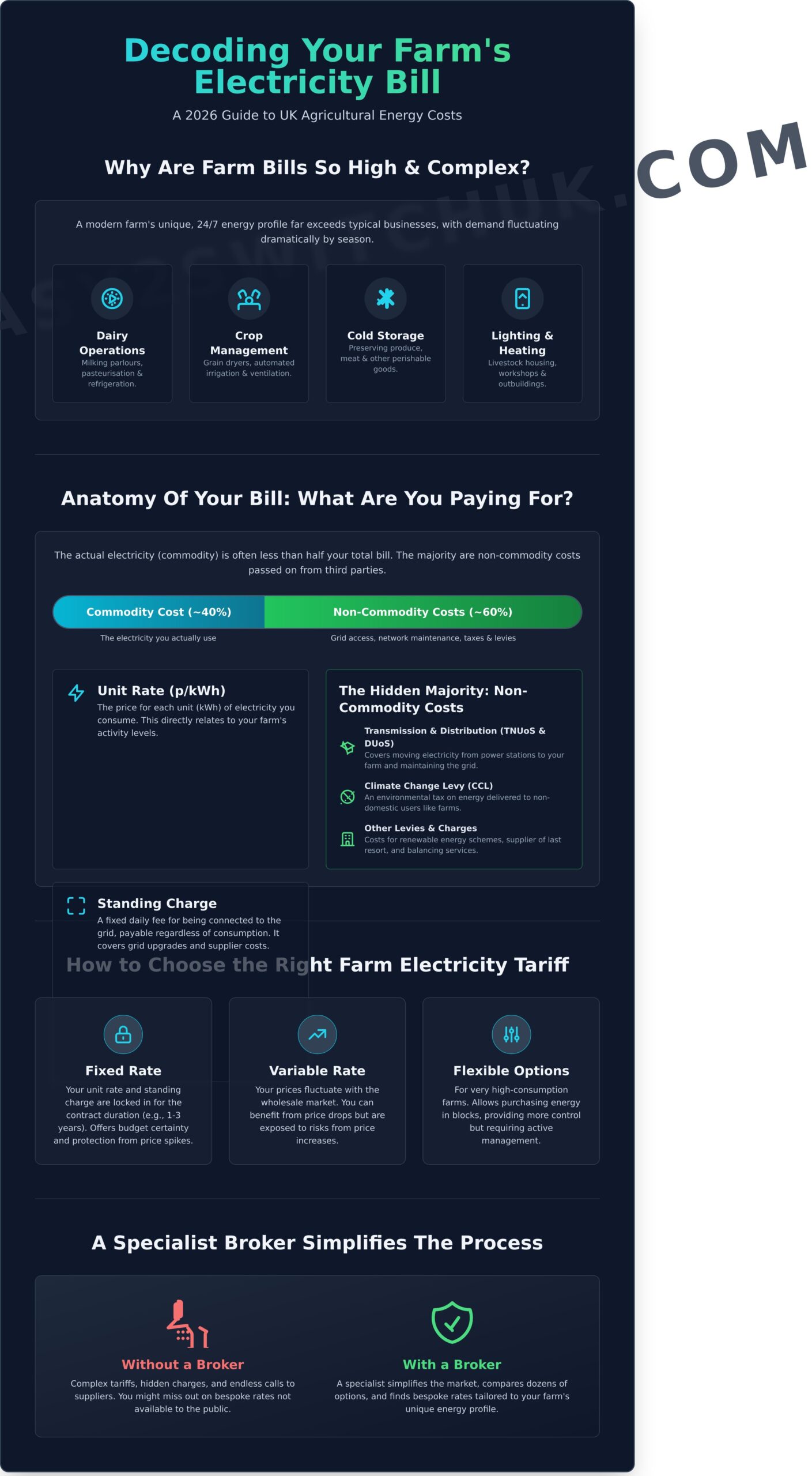
A modern farm is an energy-intensive operation, often running 24/7 and far exceeding the demands of a typical commercial business. This unique profile is a major factor in the high farm electricity prices UK businesses face. Key areas of high consumption include:
- Dairy Operations: Milking parlours, pasteurisation, and refrigerated bulk tanks.
- Crop Management: Energy for grain dryers, automated irrigation, and ventilation systems.
- Cold Storage: Essential for preserving produce, meat, and other perishable goods.
- Lighting and Heating: For livestock housing, workshops, and outbuildings, especially during winter.
This demand fluctuates dramatically with the seasons. A surge during harvest or a cold snap in winter places significant strain on the grid, leading to higher peak-time charges. Furthermore, as farms diversify into areas like holiday lets or farm shops, their energy needs become a complicated mix of commercial and sometimes even domestic usage, making a one-size-fits-all tariff inefficient and costly.
From Wholesale Market to Your Meter: A Simple Breakdown
The price you pay per kilowatt-hour (kWh) isn’t arbitrary; it’s the end result of a long journey. Electricity is first produced by generators (from sources like wind, gas, or nuclear), then transported across the country via the high-voltage National Grid network, and finally delivered to your farm by your chosen energy supplier. Every step in this chain has an associated cost.
Crucially, your supplier buys this energy on the wholesale market, where prices can change rapidly due to global events, weather patterns, and shifts in UK energy policy. This volatility is passed directly onto your bill, making it essential to secure a contract at the right time. Understanding this journey helps demystify why farm electricity prices UK-wide can be so variable and sets the stage for breaking down the non-commodity costs that make up the rest of your bill.
Decoding Your Farm’s Electricity Bill: What Are You Actually Paying For?
Opening a farm electricity bill can feel like deciphering a complex code. Between the kilowatt-hours, levies, and various charges, it’s easy to lose track of what you’re truly paying for. To take control of your farm’s energy costs, the first step is understanding every line item. This breakdown demystifies your bill, giving you the clarity needed to make smarter procurement decisions and accurately forecast future farm electricity prices UK.
[Image: A sample farm electricity bill with key sections like ‘Unit Rate’, ‘Standing Charge’, and ‘Non-Commodity Costs’ highlighted to guide the reader.]
Unit Rate (p/kWh) vs. Standing Charge
These are the two headline figures on any energy quote. The unit rate is the price you pay for each kilowatt-hour (kWh) of electricity you use-powering your milking parlours, grain dryers, and lighting. The standing charge is a fixed daily fee for simply being connected to the grid, payable regardless of your consumption. Standing charges have been rising across the UK to cover essential grid upgrades and the costs of recent supplier failures. Some tariffs offer a lower unit rate in exchange for a higher standing charge, a trade-off that requires careful analysis of your farm’s unique usage patterns.
Non-Commodity Costs: The Hidden Majority
The biggest surprise for many is that the actual electricity you use (the ‘commodity’) often accounts for less than 40% of your total bill. The rest is made up of non-commodity costs, which are passed through from third parties and are unavoidable for all consumers. Knowing what these are is essential for a realistic budget.
- Transmission & Distribution (TNUoS & DUoS): These charges cover the cost of moving electricity from power stations to your farm, maintaining the national grid and local networks.
- Climate Change Levy (CCL): An environmental tax on energy delivered to non-domestic users. While this is a mandatory charge, it’s worth noting that there is ongoing government support for business energy costs which can sometimes offset these levies for certain industries.
- Renewables Obligation (RO): This cost supports the development of large-scale renewable energy projects across the UK.
Because these non-commodity costs are applied by all suppliers, finding a competitive rate on the wholesale energy portion of your bill becomes even more critical for managing your bottom line. Exploring the best energy deals in the UK can help you identify where genuine savings are available on the commodity portion of your costs.
Key Factors Driving UK Agricultural Electricity Prices in 2026
To effectively manage your farm’s energy budget in 2026, it’s crucial to understand the complex forces at play. The price you pay for electricity isn’t set in a vacuum; it’s the result of global markets, national infrastructure projects, and government policy. This volatility can make planning difficult, but understanding the key drivers gives you back control over your costs.
Global Wholesale Energy Markets
The largest single component of your bill is the wholesale energy cost. In the UK, electricity prices remain closely tied to the price of natural gas, as gas-fired power stations are often used to meet demand during peak times. This means that international conflicts, global supply chain disruptions, or shifts in demand for Liquefied Natural Gas (LNG) imports can cause sudden and significant spikes in what UK farms pay for power.
UK Grid Infrastructure and Investment
The UK’s national grid is undergoing a once-in-a-generation upgrade. This essential investment is needed to support the transition to renewable energy sources like wind and solar and to handle increased demand from sectors like electric vehicles. While vital for long-term energy security, the costs of this modernisation are passed on to consumers through network charges on bills, contributing to the overall farm electricity prices UK farms are facing. As a recent UK Government report on farm energy use highlights, many agricultural businesses are now also generating their own power, adding another layer of complexity to grid management.
Government Policy and Ofgem Regulations
Government policy adds another layer to your final costs. Key factors include:
- Green Levies: Taxes like the Climate Change Levy (CCL) are designed to fund renewable energy projects and encourage energy efficiency. While these support the UK’s net-zero goals, they appear as non-commodity costs on business energy bills.
- Ofgem’s Role: As the energy regulator, Ofgem’s decisions shape how suppliers operate and structure their tariffs. Their regulations influence market competition and pricing strategies, which indirectly impacts the deals available to agricultural businesses.
Staying aware of future policy shifts is key to anticipating changes in your farm’s energy expenditure and making informed procurement decisions.
Strategic Options: How to Choose the Right Farm Electricity Tariff
Navigating the complexities of farm electricity prices UK can be daunting, but choosing the right tariff is the most effective way to take control of your overheads. Your contract structure determines not just what you pay per unit, but also your exposure to market volatility. Understanding the core options is the first step toward securing a deal that works for your farm’s unique operational and financial goals.
Fixed-Term Contracts: Security and Budget Certainty
This is the most popular choice for UK businesses, including farms. A fixed-term contract locks in your unit rate (p/kWh) and standing charge for a set period, typically between one and five years. This provides invaluable peace of mind and makes financial planning straightforward.
- Pros: Complete protection from sudden market price hikes and predictable bills for easier budgeting.
- Cons: You won’t benefit from savings if wholesale energy prices fall during your contract term.
This tariff is ideal for farms that prioritise stability and want to eliminate the risk of unexpected cost increases, especially when the market is volatile.
Variable & Flexible Tariffs: Risk vs. Potential Reward
Unlike fixed deals, variable or flexible tariffs tie your electricity rates directly to the fluctuating wholesale market. This approach offers the potential for significant savings but comes with a much higher degree of risk.
- Pros: When market prices are low, your bills can be substantially cheaper than a fixed rate.
- Cons: You are completely exposed to price spikes, which can lead to cripplingly high bills during turbulent periods.
These contracts are generally better suited to very large, energy-intensive operations with the capacity to monitor the market and manage financial risk effectively.
Green & Renewable Tariffs
A green tariff ensures that the electricity you use is matched with power generated from 100% renewable sources like wind, solar, or hydro. Suppliers prove this by purchasing Renewable Energy Guarantees of Origin (REGO) certificates for every unit of electricity you consume.
Opting for a green tariff can significantly boost your farm’s sustainability credentials, strengthen your brand image with environmentally-conscious customers, and help you meet modern supply chain requirements.
Not sure which tariff is right for your agricultural business? Our experts offer free, impartial advice. We handle the complexities of comparing the market so you can secure a bespoke contract with confidence.
How a Specialist Broker Simplifies Finding the Best Farm Electricity Prices
Managing a farm is demanding enough without adding the complex task of navigating the volatile energy market. Trying to contact multiple suppliers, compare complex tariffs, and decipher jargon can drain valuable time. This is where an independent business energy broker like Easy2switch UK Ltd becomes an essential partner, simplifying the entire process of securing competitive farm electricity prices UK.
Instead of you spending hours researching, we do the heavy lifting, acting as your expert guide to find a contract that fits your farm’s specific needs.
Saving Time and Hassle
Imagine replacing dozens of sales calls and lengthy comparison tasks with a single, dedicated point of contact. We handle the comprehensive market analysis, supplier negotiations, and all the administrative paperwork for you. This straightforward approach gives you back your most valuable asset-time-letting you focus on running your agricultural business, not energy admin.
Access to Better Deals and Market Expertise
Our established relationships with a wide panel of UK energy suppliers often grant us access to preferential rates that aren’t available to the public. More importantly, we bring deep market expertise. We understand the nuances of contract terms, can negotiate on your behalf, and provide professional insight into the optimal time to lock in a new contract, helping to protect your farm from future price shocks.
The Easy2switch UK Ltd Process: Simple, Transparent, and Free
We believe in a straightforward, hassle-free approach. Our process is designed to give you complete peace of mind and find a great deal with minimal effort on your part:
- Step 1: Share a recent bill. Provide us with a copy of a recent electricity bill for a free, no-obligation analysis of your current spending and usage.
- Step 2: We compare the market. Our UK-based team compares hundreds of bespoke tariffs from our panel of trusted suppliers to find the best options for your farm’s unique consumption patterns.
- Step 3: You choose, we switch. We present the top choices in a clear, easy-to-understand format. Once you decide, we manage the entire switch seamlessly from start to finish.
You might wonder how this service is free. It’s simple: we are paid a commission by the supplier you choose. This fee is built into the energy price, meaning our goals are aligned with yours-to find you an excellent, sustainable deal. Ready to take control of your energy costs? Visit easy2switchuk.com to get started.
Secure Lower Farm Electricity Prices and Power Your Future
Navigating your farm’s energy costs doesn’t have to be a constant struggle. As we’ve explored, understanding the complex components of your bill and the market factors influencing farm electricity prices UK is the first step towards significant savings. While choosing the right tariff can feel overwhelming, you don’t have to manage it alone.
As specialists in the UK farming industry, Easy2Switch UK provides independent advice and access to hundreds of tariffs to find a bespoke solution for your farm. We offer a simple, done-for-you switching process, handling the complexities so you can focus on what you do best: running your business.
Stop overpaying and start optimising your energy spend. Get your free, no-obligation farm energy review today. Take control of your overheads and invest those savings back into your business for a more profitable tomorrow.
Frequently Asked Questions About Farm Energy
What is a typical electricity price per kWh for a farm in the UK?
While prices fluctuate, a typical fixed-rate contract for a farm in 2026 is projected to be between 20p and 28p per kWh. However, this figure can vary significantly based on your farm’s annual consumption, location, and the type of contract you secure. The most effective way to understand the current market and find a competitive deal is by comparing the latest farm electricity prices UK from a range of trusted suppliers, ensuring you don’t pay more than necessary.
Is business electricity cheaper than domestic for a farm?
Generally, the unit rate (price per kWh) for business electricity is lower than for domestic supply because businesses often use more energy and can lock in fixed-term deals. However, business tariffs also include additional costs like the Climate Change Levy and are not protected by a price cap. It’s crucial to compare the total cost, not just the unit rate, to ensure you’re on the most cost-effective tariff for your farm’s specific operational needs. Our comprehensive guide to finding the best energy deals in the UK can help you understand how to compare tariffs effectively and make a confident switch.
How can I find out when my current farm energy contract ends?
The simplest way to find your contract end date is by looking at a recent energy bill from your supplier, where it should be clearly stated. If you can’t find it on your bill, you can call your supplier directly and ask them to confirm the date. Knowing this is vital as it marks the beginning of your switching window, allowing you to arrange a new, better-value contract without incurring any penalties and avoiding costly out-of-contract rates.
What is the Climate Change Levy (CCL) and do I have to pay it?
The Climate Change Levy (CCL) is a tax on the energy used by businesses in the UK, designed to encourage energy efficiency. As a farm is a commercial operation, you will likely have to pay it. However, some farming activities may qualify for a reduced rate, and businesses with very low consumption can be exempt. We can help you determine if any exemptions apply to your farm, potentially reducing your overall energy costs.
How long does it take to switch my farm’s electricity supplier?
Switching your farm’s electricity supplier is a straightforward and surprisingly quick process. Thanks to industry improvements, the actual switch can be completed in as little as 5 working days. Our UK-based team manages all the admin for you, from comparing quotes to liaising with your old and new suppliers. This ensures a seamless, hassle-free transition with no interruption to your power supply, giving you complete peace of mind.
Can I have one energy contract for my farmhouse and the farm itself?
It’s not possible to have a single contract for both. Your farmhouse is a domestic property and requires a domestic energy tariff, while the farm’s operational buildings (like barns and workshops) are classified as a business and need a commercial energy contract. The two are treated differently for pricing, VAT, and regulatory purposes. Keeping them separate ensures that both your home and your business are on the most appropriate and cost-effective tariffs.
What happens if I don’t arrange a new contract when my old one expires?
If you don’t secure a new deal before your current contract ends, your supplier will automatically place you on “out-of-contract” or “deemed” rates. These variable rates are almost always significantly more expensive than a fixed-term tariff and can cause a sudden, sharp increase in your energy bills. Being proactive and arranging a new contract in advance is the best way to maintain control over your farm’s energy expenditure and avoid these punitive charges.
