
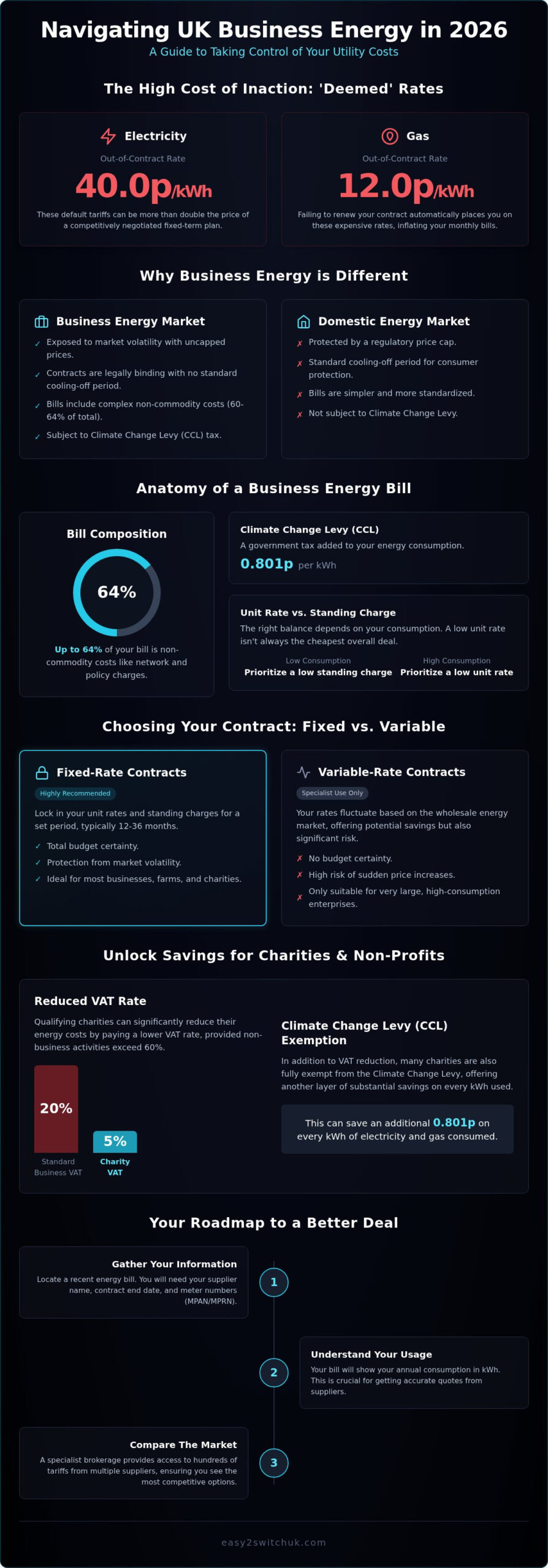
If your organisation is currently rolling on a “deemed” or out-of-contract rate, you could be paying over 40.0p per kWh for electricity and 12.0p for gas. For many, the prospect of a charity energy comparison UK search feels like a daunting task, especially with the 2026 market showing such volatility. You likely feel the pressure of rising costs while struggling to decode complex jargon like Climate Change Levy (CCL) rates or standing charges. It’s a common anxiety; you aren’t alone in wanting a clearer, more predictable way to manage your utility spend.
We’ve designed this guide to help you take control of your commercial energy costs. You’ll discover how to navigate the current UK market, compare hundreds of supplier offers effectively, and secure the most competitive rates for your business, farm, or charity. We’ll simplify the entire process, from understanding the new 0.801p per kWh CCL rate to managing the transition through our supplier-funded brokerage. This article provides a straightforward roadmap to lower monthly bills and the confidence that your procurement is in expert hands.
Key Takeaways
- Understand why 2026 is a pivotal year for UK energy contracts and how to shield your organisation from ongoing market volatility.
- Learn to balance unit rates against standing charges to ensure your tariff structure matches your specific daily energy consumption.
- Discover how a professional brokerage provides expert market access at no direct cost to you through transparent, supplier-paid commissions.
- Maximise your savings by performing a specialized charity energy comparison UK search that accounts for unique VAT exemptions and lower CCL obligations.
- Identify the essential data required from your current bill to simplify the switching process and take control of your future utility costs.
The State of UK Business Energy Comparison in 2026
Commercial energy comparison is the process of evaluating gas and electricity tariffs across multiple UK suppliers. In 2026, this task has become a critical necessity for financial stability. Wholesale prices remain high, and global conflicts continue to inject volatility into the market. Unlike domestic customers who benefit from a price cap, the business market is uncapped. This leaves your organisation directly exposed to price swings unless you secure a fixed-rate deal. Taking a proactive stance is the only way to manage these risks and prevent your budget from being derailed by sudden market shifts.
Why Commercial Energy is Different from Home Energy
Charity energy comparison UK searches often reveal that commercial contracts lack the consumer protections found in domestic settings. For instance, there is no standard cooling-off period. Once you agree to a contract, you’re legally bound. Understanding various electricity pricing models is vital because your total bill includes complex non-commodity costs. These charges, including network and policy costs, now make up around 60-64% of a typical business electricity bill. Specifically, Transmission Network Use of System (TNUoS) charges rose by over 60% in April 2026. For many non-profits, VAT is reduced to 5% instead of the 20% business rate, provided non-business activities exceed 60%. Additionally, the Climate Change Levy (CCL) adds 0.801p per kWh to both gas and electricity bills as of April 2026.
The Risks of Doing Nothing: Deemed and Out-of-Contract Rates
Doing nothing is the most expensive strategy an organisation can take. When a contract ends without a new agreement in place, suppliers move you to “deemed rates.” Deemed rates are the default tariff applied when a contract expires. These rates are significantly higher than negotiated deals. In August 2026, out-of-contract electricity can cost around 40.0p per kWh, while gas can reach 12.0p per kWh. These prices are often double what you’d pay on a competitive fixed-term plan. Beyond the financial penalty, some suppliers may automatically renew your agreement into a restrictive 12-month term if you miss the specific notice window. A successful charity energy comparison UK strategy ensures you avoid these traps by identifying renewal dates early and preparing for the transition well in advance.
Understanding Business Energy Tariffs: Unit Rates vs. Standing Charges
Your energy bill is built on two primary figures: the unit rate and the daily standing charge. The unit rate is the price you pay for every kilowatt-hour (kWh) of gas or electricity consumed. In contrast, the standing charge is a fixed daily fee that covers the cost of maintaining the connection to the grid. A low unit rate doesn’t guarantee a low bill. Choosing the right balance depends entirely on your usage profile. For instance, a micro-business might see an average electricity rate of 27.8p/kWh with a 54.9p daily charge, while a large site might secure 26.9p/kWh but face a much higher standing charge of 148.0p per day. If your organisation has low consumption, a high standing charge could outweigh any savings on the unit rate.
When performing a charity energy comparison UK, it’s essential to look beyond the headline pence-per-kWh figure. A thorough charity energy comparison UK will highlight these nuances. You can find more detail on contract types in Ofgem’s business energy guidance, which explains how these structures impact your bottom line. Larger sites, including extensive agricultural operations or multi-building charities, often use half-hourly (HH) metering. Following the P272 regulation, these meters provide precise data to suppliers every thirty minutes. This precision allows for more tailored tariffs, but it also requires a deeper level of analysis during procurement to ensure you aren’t overpaying during peak demand periods.
Fixed-Rate vs. Variable-Rate Commercial Contracts
Fixed-rate deals are currently the most popular choice for 2026. They offer total budget certainty by locking in your rates for 12, 24, or even 36 months. This protection is vital given the current market volatility. While variable-rate or flexible contracts allow you to buy energy in ‘tranches’ as market prices change, they are generally only cost-effective for very large enterprises or charities with massive, complex portfolios. For most, the peace of mind provided by a fixed term is the safer route to take control of overheads.
Pass-Through Costs and Non-Energy Charges
Your statement also includes “pass-through” costs that cover the physical delivery of energy. These include:
- DUoS: Distribution Use of System charges for the local network.
- TNUoS: Transmission Network Use of System charges for the national grid.
- RO/CfD: Government policy costs related to renewable energy.
These charges vary depending on where your site is located. They aren’t always transparent in initial quotes. Some suppliers might offer a low headline rate but exclude these non-energy charges, leading to a shock when the first bill arrives. To avoid these hidden costs, it’s helpful to compare fully inclusive energy quotes that account for every line item from the start.
The Energy Brokerage Model: How Expert Advice Stays Free
Many managers wonder how a specialist service remains free for the end user. It’s a fair question. In the UK, energy brokers operate on a commission basis funded directly by the suppliers. This means when you perform a charity energy comparison UK search through a consultant, you don’t receive an invoice for their time. Instead, a small “unit rate uplift” is built into the per-unit cost of the energy. Since October 2024, Ofgem has required all brokers to disclose these commission details in the principal terms of every non-domestic contract. This transparency ensures you know exactly what is being paid, allowing you to focus on the savings rather than the fees.
To act on your behalf, a broker uses a Letter of Authority (LOA). This simple document allows them to gather your historical usage data and negotiate with suppliers without you having to be on every call. It provides access to “broker-only” rates. These are specific tariffs that suppliers don’t offer to the general public; they’re often reserved for high-volume partners who provide them with reliable, well-managed accounts. By using a specialist, you’re essentially leveraging their industry relationships to secure a deal you couldn’t find on your own.
Comparing Brokers vs. Going Direct to Suppliers
Calling 20 or more suppliers individually is a full-time job that most busy managers can’t afford. An expert broker does this work in a single session. Suppliers frequently reserve their most competitive pricing for brokerage partners who understand the technical requirements of complex sites. For a deeper look at these market dynamics and how to find the right fit for your organisation, you can consult our Commercial Energy Broker Guide 2026. This resource explains how to avoid common pitfalls when dealing with different supplier structures.
The ‘Done-for-You’ Switching Process
The value of a broker extends far beyond the initial price discovery. Switching involves strict deadlines and administrative hurdles. If you miss your termination window, you risk being rolled onto expensive “deemed” rates. A broker manages these dates for you. They also handle the friction of meter read disputes and final bill reconciliations during the handover. At Easy2switch, we take over this entire administrative burden. This creates a streamlined, stress-free transition, allowing you to take control of your costs while focusing on your organisation’s core mission. A successful charity energy comparison UK outcome isn’t just about the rate; it’s about the ease of the entire journey.
Strategic Comparison for Specialised Sectors: Farms and Charities
Generic comparison tools often miss the nuances of agricultural and non-profit operations. For these sectors, a standard quote doesn’t reflect actual consumption patterns. Farms, for example, have energy profiles that fluctuate wildly with the seasons. High-power machinery used for grain drying or intensive climate control for livestock creates massive peaks in demand. If you’re on a tariff that penalises peak-time usage, your annual costs will skyrocket. It’s vital to find suppliers who understand the agricultural business cycle rather than just offering a one-size-fits-all SME rate. You can find more detail on sector-specific benchmarks in our Farm Electricity Prices UK guide.
A successful charity energy comparison UK strategy requires even more attention to detail. Many non-profits are unintentionally paying the standard 20% VAT rate on their utility bills. If your organisation’s activities are at least 60% non-business, you’re entitled to a reduced VAT rate of 5%. This status also grants you a lower Climate Change Levy (CCL) obligation, which is a significant saving given the current 2026 rate of 0.801p per kWh. A skilled business energy consultant can audit your historical statements to identify where you’ve overpaid. These audits often uncover thousands of pounds in reclaimable tax that can be fed back into your core mission.
Farming Industry Energy Procurement
Agricultural sites require a specialist eye to manage meter types and seasonal peaks. We look at your specific equipment, such as milking parlours or cold storage units, to ensure your standing charges don’t outweigh your unit rate savings during quieter months. By analysing these specific energy demands, we can identify suppliers who offer the flexibility needed for the UK farming industry. This tailored approach prevents you from being locked into a contract that doesn’t account for your busiest times of the year.
Charity and Non-Profit Energy Savings
Beyond VAT exemptions, charities often face the challenge of tight annual budgets and grant-funding cycles. We tailor contracts to fit these specific financial windows, providing long-term price stability that makes forecasting much easier. Our service includes a full audit of your past bills to ensure every exemption has been applied correctly. Managing multiple sites adds another layer of complexity; if your charity operates across several locations, consolidating these into a single portfolio can simplify your administration and increase your purchasing power. To ensure you aren’t overpaying on your next renewal, request a specialised charity energy comparison UK quote today.
How to Start Your Business Energy Comparison Today
Taking the first step toward a successful charity energy comparison UK shouldn’t feel like a burden. Our process is designed to be low-friction, moving you from uncertainty to a fixed-rate contract with minimal effort. By following a structured approach, you can take control of your overheads and ensure your 2026 budget is protected from market volatility. Here is how you can start today:
- Step 1: Locate your most recent energy bill. This document contains your MPAN (electricity) or MPRN (gas) numbers, which are essential for identifying your meters accurately.
- Step 2: Identify your current contract end date. You must also check your required notice period; missing this window can lead to automatic renewals or expensive “deemed” rates.
- Step 3: Contact a specialist broker. We scan the market for 2026 prices, comparing hundreds of offers to find the fit that matches your specific usage profile.
- Step 4: Review and sign your new agreement. This is often handled digitally, allowing you to secure a competitive rate quickly before the market shifts.
- Step 5: Relax while we manage the handover. We handle the termination notice for your current supplier and resolve any meter read disputes during the transition.
What Information Do You Need for an Accurate Quote?
To provide a precise forecast, we need your annual consumption data in kWh. This allows us to balance unit rates against standing charges effectively. Your business postcode is also a key factor, as it dictates the regional delivery charges and the list of suppliers available to your site. A recent bill is the most vital tool for comparison. With this single document, we can extract all the technical data required to perform a comprehensive charity energy comparison UK and secure your next contract.
Timing Your Switch: The Renewal Window
You don’t have to wait until your current contract expires to look for a better deal. In the 2026 market, many organisations are securing new rates up to 12 months in advance. This “forward-buying” strategy allows you to beat potential price hikes and lock in certainty when wholesale costs are stable. There is often a “sweet spot” for switching before seasonal demand drives prices higher in the autumn and winter months. For more detailed advice on market cycles, consult our Business Energy Comparison 2026 pillar. Planning early ensures you aren’t forced into a rushed decision when your renewal window finally opens.
Take Control of Your 2026 Energy Strategy
The 2026 UK energy market requires more than just a quick search; it demands a strategic approach to procurement. We’ve explored how balancing unit rates against standing charges protects your bottom line. You’ve also seen why a specialized charity energy comparison UK is the only way to capture the VAT exemptions and lower CCL rates your organisation deserves. Whether you’re managing seasonal farming peaks or a multi-site charity, having the right specialist in your corner makes the process effortless.
You don’t have to handle these complex market variables alone. We offer a completely free service for our clients, providing access to hundreds of supplier offers. Our team combines specialist knowledge of the UK farming industry with a deep understanding of the non-profit sector to find your perfect fit. We manage the entire handover, including termination notices, so you can stay focused on your work. Take control of your costs with a free business energy review from Easy2switch UK Ltd today. It’s time to move from market anxiety to total confidence.
Frequently Asked Questions
Is business energy comparison really free for the customer?
Business energy comparison is free for you because the supplier pays a commission to the broker. This fee is a small uplift built into your unit rate, so you don’t receive an invoice for our consultancy time. At Easy2switch, we use this model to provide impartial advice and access to hundreds of offers. Performing a charity energy comparison UK search this way ensures you get expert market access without any upfront costs.
How long does it take to switch business energy suppliers in 2026?
Switching a business supplier typically takes around five working days once the new contract is signed. However, the preparation phase should begin much earlier. We recommend starting your comparison at least six months before your current deal expires. This proactive approach allows us to manage the termination notice and lock in a 2026 rate before price volatility affects your next billing cycle and budget planning.
Can I switch my business energy if I am currently in a contract?
You can’t physically leave a fixed-term contract before its end date without paying significant exit fees. However, you can secure your next deal today. Most suppliers allow you to sign a contract for a future start date up to 12 months in advance. This is a vital strategy for charities and farms to take control of their future overheads while current market prices are relatively stable.
What is a Letter of Authority (LOA) and why does a broker need it?
A Letter of Authority is a legal document that gives your broker permission to act on your behalf. It allows us to request your historical usage data from your current supplier and negotiate with the wider market. Without an LOA, we can’t see your specific meter data or manage the termination of your old contract. It doesn’t commit you to a switch; it simply enables us to do the groundwork.
Are green energy tariffs more expensive for businesses in 2026?
Green energy tariffs are increasingly competitive in 2026 and aren’t always the most expensive option. Many suppliers now offer renewable plans that are comparable to standard brown energy rates. For organisations with solar panels, specialized tariffs like Octopus Panel Power pay 12p for each unit sold back to the grid. We include these sustainable options in every charity energy comparison UK search to help you balance environmental goals.
What happens if my business energy supplier goes bust?
If your supplier ceases trading, Ofgem will move your account to a “Supplier of Last Resort” to ensure your energy isn’t cut off. While your supply is safe, you’ll likely be placed on a standard variable rate, which is often more expensive. If this happens, we recommend contacting us immediately to compare the market and move you onto a competitive fixed-term contract as quickly as possible to avoid overpaying.
Do I need a new meter installed when I switch energy suppliers?
You don’t need a new meter installed when you switch suppliers. The wires, pipes, and physical infrastructure remain exactly the same. The only thing that changes is the company that bills you for the energy you consume. The only exception is if you choose to upgrade to a smart meter or a half-hourly meter to get more accurate data, which can help in lowering your long-term costs through better monitoring.
Can I compare business gas and electricity at the same time?
You can certainly compare both gas and electricity simultaneously, though they will usually be treated as two separate contracts. Unlike domestic “dual fuel” deals, business energy is typically procured individually. We manage both processes for you to ensure the start dates align where possible. This simplifies your administration and ensures that every part of your organisation’s energy portfolio is optimized for the best possible rates across the market.
