
What if your energy portfolio wasn’t just an unavoidable overhead, but a strategic lever to protect your 2026 profit margins? For many UK directors, managing multi-site business energy contracts feels like a constant battle against fragmented renewal dates and unpredictable price swings. It’s frustrating when the board views energy as a fixed cost rather than a variable you can actually control. We understand the anxiety that comes with market volatility affecting dozens of sites at once; it’s a complex puzzle that requires more than just a spreadsheet to solve.
This guide provides the exact financial and risk-based arguments you need to secure executive approval for a consolidated strategy. We’ll show you how to move away from the administrative chaos of individual site renewals and toward a streamlined, portfolio-wide approach. It’s about taking control. You’ll gain a clear framework for a board-level proposal that leverages specialist brokerage expertise to simplify your operations. We’re going to explore how data-backed consolidation doesn’t just save time, it builds the long-term resilience your business needs for the years ahead.
Key Takeaways
- Shift the board’s focus from simple unit rates to a Total Cost of Ownership (TCO) model to better protect 2026 profit margins.
- Identify the hidden costs of inaction, such as expensive deemed rates and the operational burden of managing dozens of disconnected renewal dates.
- Follow a structured roadmap to audit your portfolio and benchmark multi-site business energy contracts against the entire UK market.
- Position energy procurement as a strategic risk-management tool rather than a fixed overhead to secure faster executive buy-in.
- Leverage an impartial broker to provide the data-backed due diligence and “done-for-you” execution that alleviates board-level administrative concerns.
Why Multi-Site Energy Strategy Has Moved to the Boardroom
A multi-site energy strategy is no longer just a collection of utility bills; it’s a proactive risk-management framework for your entire business portfolio. In the past, individual site managers might have handled their own renewals. Today, that fragmented approach creates massive financial exposure. Managing multi-site business energy contracts at the group level allows your executive team to shift from passive consumption to strategic oversight. This transition is essential because energy volatility in 2026 has transformed a formerly “fixed” overhead into a top-three executive concern that directly impacts your EBITDA and overall business valuation.
When you consolidate your energy approach, you’re doing more than just simplifying admin. You’re building a shield against market shocks. Boards now recognise that energy efficiency and procurement timing are competitive advantages. A well-timed contract execution across twenty sites can protect margins in a way that few other operational changes can. By treating energy as a strategic lever, you ensure that every kilowatt-hour consumed is an investment in your company’s long-term stability.
The Evolving UK Energy Landscape in 2026
The UK energy market has reached a turning point where Net Zero targets are mandatory for corporate reporting. For sectors like farming and manufacturing, market fluctuations aren’t just annoying; they’re a threat to the supply chain. Businesses are now required to provide granular data on their carbon footprint and energy usage as part of standard annual disclosures. The Strategic Energy Gap is the financial cost of unmanaged portfolio volatility.
Closing this gap requires a move away from 12-month reactive cycles. Many organisations are now exploring more sophisticated options, such as a Power Purchase Agreement, to lock in long-term price certainty and meet sustainability goals simultaneously. This level of planning is what separates resilient businesses from those constantly reacting to the next price spike.
From Utility Bill to Strategic Business Asset
Consolidated energy data is a powerful tool for any CFO. It improves cash flow predictability by removing the “surprise” of out-of-contract rates or uncoordinated price hikes across different regions. This visibility is also vital for modern ESG (Environmental, Social, and Governance) scores. Investors and lenders now look at energy management as a proxy for overall management quality.
Because of this, boards are demanding a higher level of “energy literacy” from their operations leads. They want to see a clear roadmap that explains how multi-site business energy contracts will be managed over the next three to five years. It’s about taking control of your data to ensure that energy remains a business asset rather than an unpredictable liability. This strategic shift ensures your business remains attractive to stakeholders while keeping operational costs firmly under your command.
The Three Pillars of a Multi-Site Energy Proposal
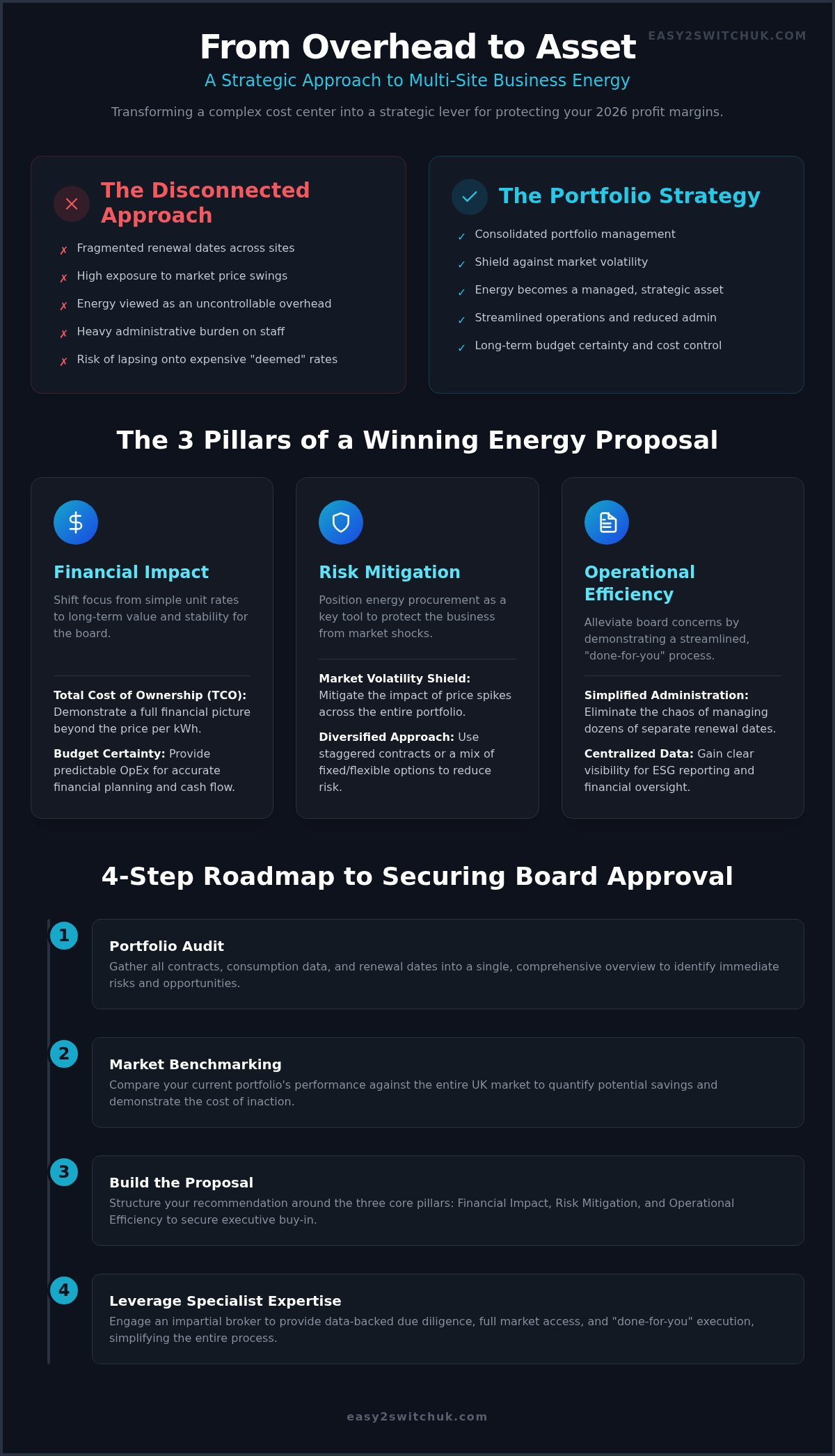
Securing board approval requires a shift in language. Executives aren’t just looking for a cheaper unit rate; they’re looking for a robust value proposition that protects the bottom line. By structuring your proposal around three core pillars, you transform multi-site business energy contracts from a procurement task into a strategic financial asset. These pillars-Financial Impact, Risk Mitigation, and Operational Efficiency-provide the data-backed assurance that the executive team needs to sign off on a consolidated portfolio strategy.
Financial Metrics That Win Executive Approval
The board’s primary concern is the company’s financial health over the next three to five years. Instead of highlighting small “year-one savings,” focus on long-term cost avoidance. Present your energy expenditure as a percentage of total Operating Expenditure (OpEx). This demonstrates the scale of the cost and why it deserves board-level attention. Budget certainty is often more valuable to a CFO than a slightly lower, but highly volatile, variable rate. When you can guarantee a fixed cost across twenty sites, you provide the stability needed for accurate financial planning and cash flow management.
Risk Management and Market Volatility
A common fear in the boardroom is the risk of “locking in” an entire portfolio at the top of the market. You can alleviate this anxiety by proposing a diversified approach. This might include staggered contract lengths or a mix of fixed and flexible options across different sites. Conducting a thorough business energy comparison is an essential part of your due diligence. It proves to the board that you’ve surveyed the market and selected the most resilient path forward. This proactive risk management protects the portfolio from sudden market shocks and the punitive costs of deemed rates that occur when individual site contracts slip through the cracks.
Operational Efficiency and Compliance
Managing dozens of different renewal dates is an administrative nightmare that leads to human error. Consolidating your multi-site business energy contracts into a single, coordinated framework streamlines the entire process. This isn’t just about saving time; it’s about data integrity. With a unified strategy, you can easily collect the energy data required for ESG reporting and 2026 Net Zero compliance. This operational clarity reduces the burden on your internal teams and ensures that no site is ever left exposed to out-of-contract pricing. If you’re unsure where your current portfolio stands, you can partner with a specialist energy brokerage to gain immediate visibility into your meter data.
The Cost of Inaction: Portfolio Strategy vs. The Status Quo
Choosing to do nothing is still a decision, and it’s often the most expensive one a board can make. For companies with multiple locations, sticking with the status quo usually means staying trapped in a cycle of reactive, short-term renewals. When you manage multi-site business energy contracts individually, you’re constantly exposed to uncoordinated market spikes. One site might renew during a market dip, while three others are hit by a price peak just weeks later. This lack of a cohesive portfolio strategy doesn’t just waste time; it actively erodes your margins through deemed rates that are significantly higher than negotiated terms.
The misconception that waiting for the market to drop is a viable strategy often leads to paralysis. For a large portfolio, the risk of being caught on out-of-contract rates far outweighs the potential gain from perfectly timing a market bottom. A proactive strategy moves your business away from this “firefighting” mentality. It replaces the chaos of 12-month rolling renewals for 20 or more sites with the visibility of a coordinated three-year plan, allowing you to lock in stability when the data says the time is right.
Evaluating the “Do Nothing” Scenario
The financial risk of inaction is easy to quantify. In the UK market, out-of-contract or deemed rates are frequently two to three times higher than a standard fixed tariff. If even a single meter in your portfolio slips out of contract because a renewal notice was missed, the resulting cost spike can wipe out the savings achieved across your other sites. Aligning your contract end dates through co-terminus agreements is the only way to regain full control over these variables. Beyond the direct costs, failing to act impacts your 2026 carbon reporting. An unmanaged portfolio makes it almost impossible to track your environmental footprint accurately, which can damage your reputation with stakeholders and investors who now demand transparency.
Strategy Benefits: Beyond the Bottom Line
A unified strategy offers operational benefits that go far beyond the balance sheet. Think about the hours your team spends every month chasing bill disputes or managing data across twenty different locations. Consolidating your data into a single strategy simplifies this process and frees up internal resources for more productive work. When your energy costs are predictable, your board can plan capital investments with much greater confidence. You aren’t just buying energy; you’re buying the certainty needed to scale your operations. For a deeper look at how to navigate these complexities, our commercial energy broker guide provides the essential market context your executive team will need. This approach moves your business from a state of constant procurement anxiety to one of calm, efficient management.
A Step-by-Step Roadmap to Securing Board Sign-Off
Moving from a fragmented energy approach to a unified strategy requires a clear, logical path that executives can trust. Your proposal shouldn’t just be about price; it must be a project plan that demonstrates control and foresight. Securing approval for multi-site business energy contracts is about proving that you have a handle on the data and a reliable mechanism for execution. By following this structured roadmap, you can transform a complex procurement task into a straightforward board decision.
- Step 1: Portfolio Audit. Start by gathering every MPAN (electricity) and MPRN (gas) number across your sites. You’ll also need current contract end dates for each meter to identify where your biggest risks lie.
- Step 2: Market Benchmarking. Partner with a specialist broker to get a “whole of market” view. This ensures your proposal is based on the entire 2026 landscape rather than a single supplier’s biased offer.
- Step 3: Executive Summary. Draft a one-page document. Avoid technical jargon and focus on risk mitigation, ROI, and how this strategy protects the company’s EBITDA.
- Step 4: The Presentation. Prepare to answer the “Top 3 Board Objections” regarding complexity, timing, and administrative burden.
- Step 5: Execution. Outline a clear transition plan. Show the board that the switch will be handled externally, ensuring zero operational disruption to individual sites.
Gathering the Right Data for Your Proposal
Estimated bills are the enemy of board approval. If your proposal is based on “best guesses,” your CFO will likely reject it due to the lack of financial precision. Accurate data is the foundation of any successful strategy. By using a Letter of Authority (LOA), you can allow a broker to pull actual historical usage data directly from the meters. This level of detail is essential for a credible energy comparison that shows you’ve explored every possible option for the group.
Handling Board Objections with Confidence
You can effectively neutralise the “it is too complex” objection by explaining that a “done-for-you” model shifts the entire administrative burden to an external specialist. It’s also vital to address sector-specific costs like the Climate Change Levy (CCL). For industries such as farming, certain exemptions may apply that significantly lower the total cost of ownership. Providing a transparent timeline for the portfolio transition alleviates fears of administrative chaos, showing the board that the process is controlled, logical, and low-risk. If you’re ready to start building your business case, you can request a portfolio audit from our specialists to get the accurate data you need.
Leveraging an Energy Broker to Simplify Multi-Site Approval
A specialist broker isn’t just a middleman; they function as an outsourced energy department for your executive team. When you’re presenting multi-site business energy contracts to a board of directors, a single quote from your current supplier isn’t sufficient for due diligence. Directors require evidence of a whole-of-market search to satisfy their fiduciary responsibilities. Easy2switch UK Ltd acts as your data engine, providing the impartial analysis and data-rich reports that turn a complex procurement decision into a clear, evidence-based choice. We handle the heavy lifting of market analysis, allowing you to focus on the strategic outcomes rather than the administrative minutiae.
Our service is designed to be cost-neutral, which is a significant advantage when presenting to a CFO. Because our commissions are paid by the suppliers, your business gains access to high-level consultancy without adding to your internal overheads. This “no fee” model makes it much easier to secure sign-off, as you’re essentially adding an expert risk-management team to your business at no direct cost. It’s a pragmatic way to ensure your portfolio is protected against the market volatility expected throughout 2026 while keeping your budget focused on core operations.
The Role of Independent Consultancy
Easy2switch UK Ltd accesses hundreds of supplier offers that aren’t available to the general public or through standard comparison sites. This deep market access is vital for securing the best possible terms across a diverse portfolio. We also bring sector-specific expertise to the table. If you’re managing a group of agricultural sites, understanding the nuances of farm electricity prices UK is essential for accurate budgeting and 2026 cost forecasting. Our business energy consultants take the “switching headache” away from the board by managing every aspect of the transition, from meter registration to contract validation, ensuring zero operational downtime.
Securing Your 2026 Multi-Site Strategy Today
The transition to a consolidated strategy doesn’t have to be a long, drawn-out process. We start with a simple portfolio review over the telephone to understand your current site list, meter types, and renewal dates. From there, we build the business case you need to win executive approval. By explaining the commission-based model to your CFO, you can demonstrate that this is a low-risk, high-reward move for the company. Taking control of your energy costs now ensures you aren’t left scrambling when market shifts occur. Take control of your multi-site energy today with a free review from Easy2switch UK Ltd.
Future-Proofing Your Portfolio Strategy
Moving your energy procurement from a reactive administrative task to a board-level priority is the most effective way to protect your margins in 2026. By focusing on the total cost of ownership and building a roadmap based on accurate meter data, you replace procurement anxiety with financial certainty. We’ve explored how a unified approach to multi-site business energy contracts eliminates the risk of expensive deemed rates and streamlines your path to Net Zero compliance. It’s about shifting the narrative from “unit price” to long-term portfolio resilience.
You don’t have to handle this complex transition alone. Easy2switch UK provides the impartial advice and data-rich reporting your board needs to make informed decisions. As specialists in the farm, SME, and charity sectors, we access hundreds of UK supplier offers to ensure you get the best individual fit for your portfolio. Our service is 100% free for your business, providing a low-friction way to gain professional authority over your energy costs without adding to your overheads.
Secure your board-ready multi-site energy strategy with a free consultation from Easy2switch UK today. Taking control of your energy future is a powerful step toward long-term business resilience and operational peace of mind.
Frequently Asked Questions
What are multi-site business energy contracts?
These contracts are consolidated agreements that allow a business to manage the gas and electricity supply for all its locations under a single strategic framework. Instead of dealing with separate suppliers and renewal dates for every office, farm, or shop, you group them together. This approach simplifies administration and often provides better negotiating leverage with UK suppliers who value the higher total volume of energy being procured across your entire portfolio.
How much data do I need to provide to my board for an energy proposal?
Your board requires high-precision data to make a strategic decision. You should provide a comprehensive list of all MPAN and MPRN numbers, historical annual consumption figures, and a clear timeline of existing contract expiry dates. Using estimated bills is a common mistake that leads to rejection. Executives need to see the total cost of ownership and how the new strategy protects the company’s EBITDA against 2026 market fluctuations.
How does a business energy broker help with board-level due diligence?
A broker acts as an independent data engine that conducts a whole of market search across hundreds of UK supplier offers. This provides the impartial evidence directors need to fulfill their fiduciary duties. By delivering comparative reports on risk and ROI, the broker proves that the proposed multi-site business energy contracts are the most resilient option available. This external validation gives the board confidence that all market variables have been handled by capable hands.
Is a fixed or flexible energy contract better for multi-site risk management?
The choice depends on your company’s specific risk appetite and financial goals. Fixed contracts are often preferred for multi-site portfolios because they provide absolute budget certainty and protect against sudden price spikes. Flexible contracts allow you to buy energy in tranches, which can be beneficial during market dips but requires more active management. Many boards in 2026 opt for fixed terms to ensure cash flow predictability across all their different business locations.
What is the Climate Change Levy and how does it affect our multi-site strategy?
The Climate Change Levy (CCL) is a government-imposed tax on commercial energy usage designed to encourage efficiency. For a multi-site strategy, it’s a significant cost factor that must be accounted for in your 2026 financial forecasting. Certain sectors, such as farming or charities, may be eligible for CCL exemptions or discounts. Including these specific tax calculations in your proposal demonstrates a high level of fiscal literacy and ensures your budget projections are accurate.
Can we get board approval if our sites have different contract end dates?
Yes, you can secure approval by proposing a transition to co-terminus contracts. This involves aligning the end dates of all site agreements so they renew at the same time in the future. While your current sites may have scattered expiry dates, a broker can help you bridge these gaps using short-term extensions or staggered starts. This long-term alignment is a key selling point for boards who want to end the administrative chaos of fragmented renewals.
How long does the multi-site energy switching process take for a UK business?
The initial market benchmarking and proposal stage usually takes one to two weeks once your meter data is gathered. However, the full transition for a large portfolio can take several months depending on your existing contract notice periods. Starting the process early is vital for 2026 planning. A done-for-you brokerage service manages the entire timeline, ensuring that every site switches seamlessly without any interruption to your daily operations or internal resource drain.
Why is energy strategy considered a resilience issue for UK boards in 2026?
Energy has shifted from a simple utility to a strategic resilience issue because of continued market volatility and mandatory Net Zero reporting. Boards now recognise that unmanaged energy costs are a direct threat to business stability and valuation. By securing multi-site business energy contracts, a company protects itself against external shocks that could otherwise derail capital investment plans. It’s about taking control of a variable that is no longer considered a fixed overhead.
