
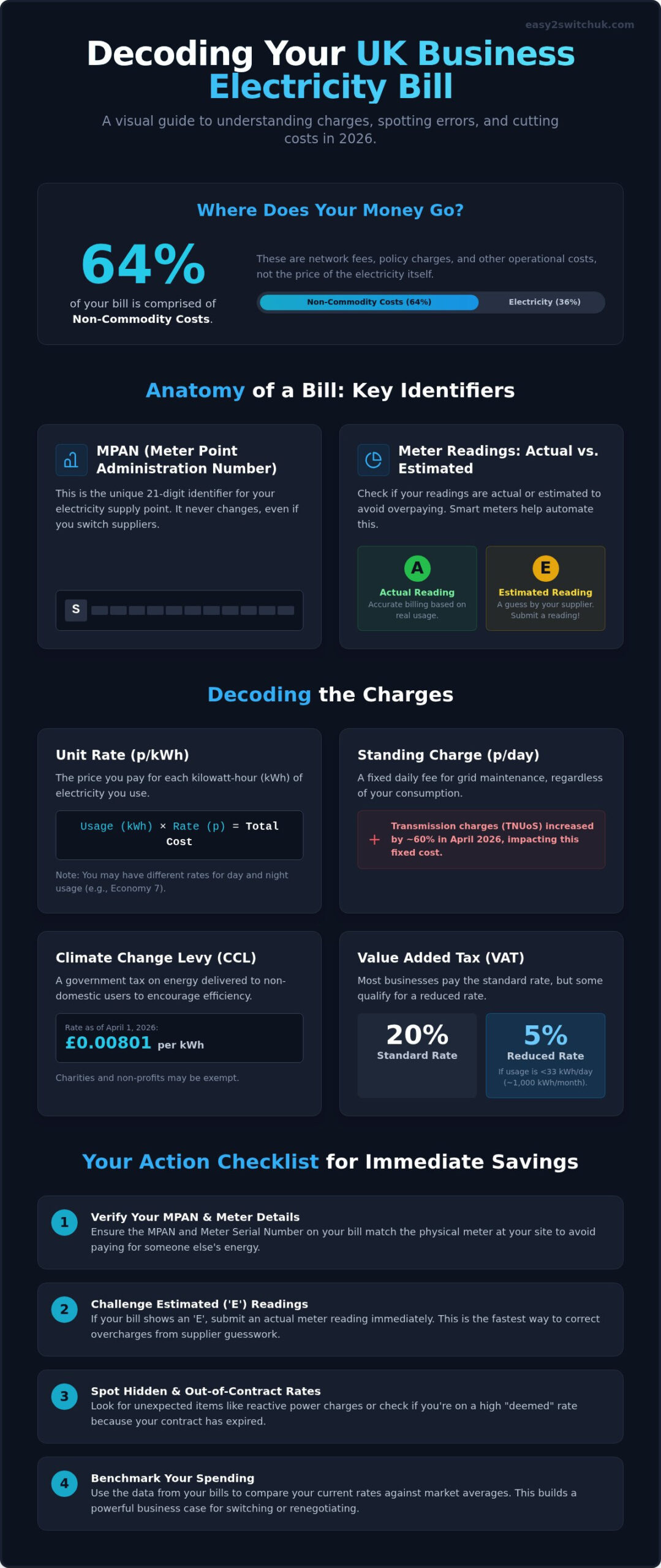
Did you know that non-commodity costs, including network and policy charges, now make up about 64% of your typical commercial energy statement? When you combine these hidden fees with the fact that transmission charges rose by approximately 60% in April 2026, it’s no wonder your overheads feel out of control. Most business owners feel a sense of dread when they see a wall of acronyms like MPAN, CCL, and KVA. You’re likely wondering if you’re stuck on an expensive “deemed” rate or if there’s a simple way to slash these mounting costs without spending hours on the phone.
We understand that your time is better spent growing your company than decoding supplier jargon. That’s why we’ve created this 2026 guide on how to read a business electricity bill UK to help you reclaim control. You’ll learn how to master the complexities of your statement and turn those confusing numbers into a persuasive, data-backed business case for your board. We’ll walk you through every specific line item, from the latest Climate Change Levy rates to capacity management, giving you a professional framework to identify and secure immediate savings.
Key Takeaways
- Identify your MPAN and verify if your readings are “Actual” or “Estimated” to stop overpaying for usage you haven’t actually consumed.
- Learn how to read a business electricity bill UK to understand the fixed daily fees and variable unit rates that make up your total monthly spend.
- Spot hidden costs like reactive power charges and expensive out-of-contract rates that often penalize businesses that haven’t recently reviewed their agreements.
- Create a compelling business case for your board by using your billing data to benchmark current spending against available market averages.
- Streamline your procurement process by leveraging specialist advice that decodes complex contracts and finds the best fit for your specific industry.
The Anatomy of a UK Business Electricity Bill
Opening your monthly invoice shouldn’t feel like deciphering an ancient script. To master how to read a business electricity bill UK, you must first separate your account details from your supply information. While your account number identifies your business for billing, your supply data tells the story of how power actually reaches your site. This distinction is vital for internal audits and when tracking seasonal usage spikes. UK farms, for instance, often see massive consumption increases during harvest, while SMEs might peak during the winter months. If your billing period doesn’t align with these operational cycles, your budget forecasts will be consistently inaccurate.
Locating Your MPAN and Meter Serial Number
Look for a box starting with a large ‘S’ containing 21 digits. This is your Meter Point Administration Number (MPAN). It’s the unique fingerprint for your supply within the UK electricity market. This number never changes, even if you switch providers. You’ll also see a Meter Serial Number (MSN), which is the physical ID printed on your meter box. Always ensure these match; if they don’t, you could be paying for a neighbor’s usage. Keeping a clear record of your MPAN is the essential first step for any business energy comparison, as it allows specialists to pull accurate historical data for your specific site.
Decoding Bill Terminology: Estimated vs. Actual
One of the most common ways businesses overpay is by ignoring the small letters next to their meter readings. An ‘E’ stands for Estimated. This means your supplier is guessing your usage based on past trends. In the volatile market of 2026, these guesses are often high to protect the supplier’s cash flow, which directly impacts yours. Conversely, an ‘A’ signifies an Actual reading. If you see an ‘E’ on your bill, submit a manual reading immediately to correct the invoice. By 2026, most businesses have transitioned to smart meters, which provide real-time data to ensure billing accuracy and eliminate the guesswork that plagues older systems.
Understanding these foundational elements prevents simple administrative errors from turning into significant financial losses. Once you’ve verified that your supply details are correct and your readings are based on reality rather than a supplier’s best guess, you can begin the deeper work of analyzing the actual costs of the energy you consume.
Decoding Unit Rates, Standing Charges, and CCL
Once you’ve verified your meter readings, it’s time to look at the financial breakdown. Understanding the core charges is essential for anyone learning how to read a business electricity bill UK because these figures determine your monthly overheads. While the layout varies between suppliers, the fundamental components remain the same: you’re paying for the energy you use and the infrastructure that delivers it to your door. In 2026, the balance between these costs has shifted significantly, making it more important than ever to check that every line item is accurate.
The Math Behind the kWh Charge
Your unit rate is the price per kilowatt-hour of electricity used. To verify your subtotal, simply multiply your total consumption by this rate. If you operate on an Economy 7 or multi-rate meter, you’ll see separate lines for day and night usage. Night rates are typically lower, making them ideal for high-energy processes like industrial refrigeration or charging electric fleets. This breakdown is clearly explained in this Ofgem guide to business energy costs, which highlights how these variable charges fluctuate based on market demand. Beyond the unit rate, you’ll see the standing charge. This is a fixed daily fee that covers grid maintenance. In April 2026, many businesses saw this cost rise due to a 60% increase in Transmission Network Use of System (TNUoS) charges, meaning fixed costs now take up a larger portion of your budget.
VAT and Climate Change Levy (CCL) Exemptions
The Climate Change Levy (CCL) is a tax designed to encourage energy efficiency. As of April 1, 2026, the main rate for electricity is £0.00801 per kWh. While most businesses pay the standard 20% VAT, some qualify for a 5% reduced rate. This “de minimis” rule applies if you use less than 33kWh per day, or roughly 1,000kWh per month. Charities and non-profits are also often eligible for this lower rate and may be entirely exempt from the CCL. For agricultural businesses, farm electricity prices UK can be significantly reduced by ensuring these exemptions are correctly applied to the bill. If you suspect you’re being overcharged on tax or that your business qualifies for a lower rate, a quick review with a business energy specialist can often rectify the issue and secure a refund for past overpayments. Taking control of these tax elements is a simple way to reduce your effective unit rate without changing your consumption habits.
By mastering how to read a business electricity bill UK, you move from passive payment to active management. This clarity is the foundation of a strong business case for switching, as it allows you to see exactly where your money is going and where it can be saved.
Identifying Errors and Overcharges in Your Billing
Finding the right numbers on your invoice is only half the battle. Ensuring those numbers are fair is where the real savings begin. When learning how to read a business electricity bill UK, the most expensive discovery you can make is that you’re paying “ghost” fees. These are charges for energy you didn’t use or penalties for administrative lapses you weren’t aware of. For many UK businesses, these errors go unnoticed for months, quietly draining budgets that could be better spent on growth or equipment.
The Trap of Deemed and Out-of-Contract Rates
If you’ve recently moved into a new premises or let your previous agreement lapse, you might be on a “deemed” or “out-of-contract” rate. Suppliers use these as default tariffs, and they’re designed to be expensive. In 2026, out-of-contract standing charges can reach as high as 254.0p per day, which is nearly five times the rate of a standard micro-business contract. These rates can be 80% higher than a competitive fixed-term deal. You can identify these by looking for terms like “Standard Variable” or “Default” in the tariff description. Taking control of this situation usually requires a commercial energy broker to negotiate an exit and move you onto a contract that reflects current market value.
Hidden Technical Charges: kVA and Reactive Power
Large industrial sites and farms often see technical charges that SMEs do not. One of the most common is Agreed Capacity, measured in kilovolt-amperes (kVA). This is essentially a fee for “renting” a certain amount of space on the local grid. If your operational needs have changed but your kVA remains at an old, higher level, you’re paying for capacity you never use. Similarly, reactive power charges appear when your equipment, such as large motors or refrigeration units, doesn’t use electricity efficiently. It’s often described as “waste” energy. Auditing these technical line items is essential because they represent fixed costs that don’t go away even if you reduce your actual kWh consumption.
Beyond these technical fees, always scan your bill for duplicate entries or incorrect VAT applications. While we’ve discussed the 5% vs 20% VAT split, suppliers sometimes default to the higher rate even for eligible charities or low-use sites. A quick monthly check ensures that your hard-earned revenue isn’t being lost to simple clerical errors or outdated grid agreements. By identifying these leaks now, you build a much stronger case for a total energy strategy overhaul.
Presenting Energy Cost Savings to a Board
Once you’ve mastered how to read a business electricity bill UK, the next challenge is translating those technical line items into a language the board understands: profitability. Most stakeholders aren’t interested in kVA or CCL rates in isolation. They care about how these costs impact EBITDA and operational efficiency. Your goal is to move energy from an “unavoidable overhead” column to a “controlled strategic asset” one. By presenting a data-backed case, you demonstrate financial leadership and a clear path to reclaiming lost margin.
Step 1: Visualising the Savings Potential
Start by gathering your data to build a consumption profile. A 12-month historical view is required to account for seasonal peaks, such as harvest surges on a farm or increased heating requirements for an SME during winter. Create a simple comparison chart that shows your current “out-of-contract” spend against the market averages for fixed-term deals. In 2026, where standing charges have risen by 60%, showing the contrast between a default daily fee and a negotiated rate is a powerful visual. It’s also vital to emphasize the zero-cost nature of the transition. Since brokers are paid via supplier commission, the business can secure these savings without adding a new expense to the procurement budget.
Step 2: Addressing Board Objections
Boards often fear operational downtime or hidden administrative burdens. You should address these concerns head-on by explaining that the switching process is entirely “done-for-you” and happens in the background with no interruption to the physical power supply. If directors question market impartiality, you can use business energy consultants to provide a transparent map of hundreds of supplier offers. This evidence proves that you’ve conducted thorough due diligence across the whole market. By moving from a volatile variable rate to a stable fixed contract, you provide the board with long-term budget certainty, which is a critical risk mitigation strategy in the current economic climate.
Presenting these findings isn’t just about cutting costs; it’s about demonstrating a proactive approach to business independence. When you can show exactly how much revenue is being recovered from utility waste, the business case becomes undeniable. To get a professional audit of your current invoices and start building your case, you can request a free energy health check today. Focusing on the bottom line ensures that your energy strategy aligns with the broader goals of the organization.
Simplifying Your Energy Strategy with Easy2switch UK
You now have the tools to understand the specific charges on your invoice, but we know that managing commercial energy is a heavy administrative burden. While learning how to read a business electricity bill UK is a vital skill for any director or farm manager, you shouldn’t have to spend your weekends auditing meter readings or chasing suppliers for refunds. Our role is to take that complexity off your desk. We provide a done-for-you service that decodes your statement, identifies overcharges, and secures a more competitive deal at no direct cost to your business.
Why an Independent Broker is Your Best Ally
Unlike a single energy supplier that only wants to sell you their own products, we act as an impartial partner for your business. We work for you, not the big energy companies. This independence is crucial in the 2026 market, where variables like the 60% hike in transmission charges and fluctuating out-of-contract rates make procurement a minefield. We have access to hundreds of offers from a vast network of suppliers, allowing us to find the specific contract that fits your consumption profile. Whether you need a specialist Farm Energy Brokerage to handle seasonal peaks or a Charity Energy Brokerage to ensure you aren’t paying unnecessary VAT, we bring a personalized, reliable specialist approach that avoids the corporate coldness of a faceless call centre.
Get Started with a Free Bill Review
Taking control of your overheads starts with a simple audit. When you submit your latest bill to us, our consultants perform a professional review of every line item we’ve discussed in this guide. We’ll check for “E” vs “A” reading discrepancies, verify your CCL exemptions, and see if your kVA capacity is set too high for your actual needs. Once we identify the potential for savings, the switching process is streamlined and effortless. We handle the paperwork and the supplier communication, ensuring a smooth transition with zero operational downtime. The timeline is brisk; from the moment you send us your bill, we can often provide a comparative market analysis within 48 hours.
Don’t let a confusing invoice dictate your business margins for another month. By letting us handle the technical details of how to read a business electricity bill UK, you can focus on what you do best. Ready to simplify? Let our specialists review your business electricity bill for free today. We’ll help you turn that wall of jargon into a clear, cost-saving strategy that supports your long-term independence.
Take Control of Your Commercial Energy Strategy
Mastering how to read a business electricity bill UK is more than just an administrative task; it’s a strategic move that protects your bottom line. By verifying your MPAN, auditing meter readings, and identifying hidden technical charges like kVA capacity, you’ve already taken the first step toward financial independence. You now have the framework to present a compelling cost-saving case to your board that turns confusing jargon into clear operational efficiency.
You don’t have to manage this transition alone. Our team provides specialist support for UK farmers, SMEs, and charities, offering impartial access to rates from hundreds of UK suppliers. Because our commission is paid entirely by the energy companies, there are no hidden fees for our consultancy. We handle the complex market variables and the “done-for-you” switching process so you can stay focused on your core operations. Secure your free business energy review with Easy2switch UK today to see exactly where your revenue can be recovered. Let’s move your business away from expensive out-of-contract rates and into a more secure, predictable future.
Frequently Asked Questions
Where can I find my MPAN number on a business electricity bill?
You will find your MPAN in a box starting with a large ‘S’, typically located on the second page or the summary section of your invoice. This 21-digit number acts as your supply’s unique identifier and remains the same regardless of which supplier you use. Locating this is the first step in learning how to read a business electricity bill UK effectively, as it ensures you are looking at the correct meter data for your specific site.
Why is my business electricity bill so much higher than my home bill?
Business bills are generally higher because they include costs that domestic customers don’t face, such as the Climate Change Levy and 20% VAT. Commercial standing charges also increased by roughly 60% in April 2026 due to network infrastructure costs. Unlike households, most businesses are not protected by a price cap, meaning you are fully exposed to market fluctuations. This makes proactive contract management essential for controlling your monthly overheads and protecting your margins.
What is the Climate Change Levy (CCL) and do I have to pay it?
The Climate Change Levy is a tax on energy delivered to non-domestic users to encourage efficiency. As of April 1, 2026, the main rate for electricity is £0.00801 per kWh. Most businesses must pay this, but you might be exempt if your usage falls below the “de minimis” threshold or if you have charity status. Checking your eligibility for these exemptions can significantly lower your effective unit rate and reduce your total annual energy spend.
What happens if I don’t have a contract with an energy supplier?
If you don’t have a contract, your supplier will place you on “deemed” or “out-of-contract” rates. These are significantly more expensive than fixed-term deals, with standing charges reaching as high as 254.0p per day in 2026. You aren’t tied into a notice period on these rates, so you can switch immediately. Moving to a negotiated contract is the fastest way to reduce your daily operational spend and secure long-term budget certainty.
Can a business energy broker really save my company money for free?
Yes, a specialist broker can save you money without charging you a direct fee. Easy2switch UK Ltd earns a commission from the supplier you choose to switch to, which is built into the energy tariff. This allows us to provide impartial advice and access to rates from hundreds of suppliers at no upfront cost to you. We handle the entire “done-for-you” switching process, saving you both time and the administrative stress of procurement.
How often should I check my business electricity bill for errors?
You should review your invoice every month to ensure your readings are “Actual” rather than “Estimated.” Suppliers often over-estimate usage to protect their cash flow, which can lead to significant overpayments. Monthly checks also help you spot incorrect VAT applications or duplicate billing errors early. Consistent monitoring is a core part of knowing how to read a business electricity bill UK and maintaining tight control over your company’s utility budget throughout the year.
What is the difference between a standing charge and a unit rate?
The standing charge is a fixed daily fee you pay for being connected to the national grid, regardless of how much energy you use. In contrast, the unit rate is the variable cost for every kilowatt-hour (kWh) of electricity your business actually consumes. While you can reduce your unit rate costs by improving energy efficiency, the standing charge remains constant. Balancing these two figures is key to finding the most cost-effective tariff for your specific needs.
How do I know if my business qualifies for the 5% VAT rate?
Your business qualifies for the 5% reduced VAT rate if your average daily usage is less than 33kWh, or roughly 1,000kWh per month. This is known as the “de minimis” threshold. Charities also typically qualify for this lower rate for energy used for non-business purposes. If you are currently paying 20% VAT but meet these criteria, you may be eligible to claim back overpayments from your supplier for previous years of service.
