
Could your business be paying for a consultant’s hidden commissions without even knowing it? While many energy specialists provide an essential service, industry reports indicate that over a million small businesses in the UK have been trapped in high-cost tariffs due to misleading sales tactics. Identifying the signs of a bad business energy broker is the first step toward taking control of your overheads. It is common to feel frustrated by bills that don’t match your expectations or trapped in a multi-year agreement with no obvious exit. You deserve a transparent partnership that prioritises your bottom line over a broker’s hidden uplift.
We’ve designed this guide to alleviate the anxiety of dealing with complex energy contracts. You’ll learn how to spot red flags, uncover hidden broker fees, and follow a clear path to reclaiming your costs. We will also explain the 2026 regulations that empower businesses of all sizes to demand full commission disclosure from their suppliers. By following our structured audit checklist, you can move from uncertainty to confidence, ensuring your next renewal is handled with the integrity and clarity your business requires.
Key Takeaways
- Identify the 2026 Ofgem regulations that protect UK businesses from misleading contracts and predatory sales tactics.
- Recognise the signs of a bad business energy broker, such as high-pressure sales calls or a refusal to provide a clear commission breakdown.
- Learn how to audit your current agreement by comparing your tariff against supplier base rates to uncover hidden uplifts.
- Follow a clear, step-by-step process for gathering evidence and submitting formal disputes to regain control of your energy costs.
- Gain the confidence to vet future partners by asking specific questions about their commission structure and supplier impartiality.
Defining Business Energy Mis-selling in the UK (2026)
Energy mis-selling occurs when a broker or supplier uses false, incomplete, or misleading information to induce a business into a contract. By 2026, the UK regulatory landscape has shifted significantly to protect small and medium enterprises (SMEs). Ofgem now acts as the primary regulator for third-party intermediaries, requiring mandatory registration and stricter transparency. This change follows years of predatory practices that left many firms, particularly in the agricultural sector, trapped in expensive agreements. Small businesses with fewer than 50 employees now have the right to escalate disputes to the Energy Ombudsman, a protection previously reserved only for micro-businesses. Mis-selling is the act of securing a commercial energy agreement through the provision of inaccurate data or the intentional omission of key financial details, effectively stripping the business owner of their right to informed consent.
Farms and micro-businesses are often targeted because they frequently lack dedicated procurement departments. Brokers may assume these owners don’t have the time to scrutinise the small print. There’s a clear legal distinction between persuasive selling and fraudulent misrepresentation. While a broker can highlight the benefits of a specific deal, they cannot lie about the underlying costs or contract length. High-profile cases, such as the BES Utilities fraud trial, demonstrate the serious legal consequences when suppliers or brokers cross into criminal deception.
Common Tactics Used by Unscrupulous Brokers
Spotting the signs of a bad business energy broker often starts during the initial sales pitch. You should be wary of any consultant who uses high-pressure tactics to force a quick decision. Common red flags include:
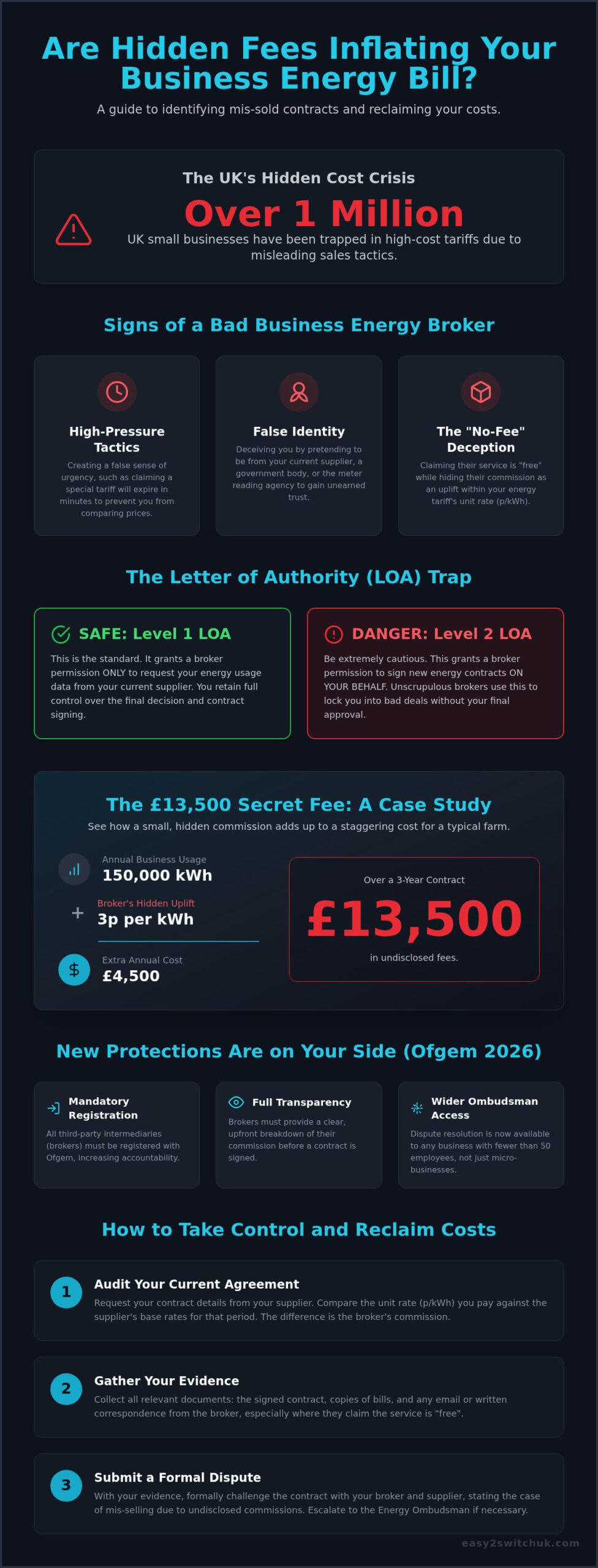
- The “urgent deadline” myth: Brokers may claim a tariff expires in minutes to stop you from comparing prices elsewhere.
- False supplier identity: Some unscrupulous agents pretend to be from your current supplier or a government body to gain your trust.
- The “no-fee” deception: They might claim the service is free of charge, failing to mention the commission added to every kilowatt-hour you use.
The Importance of the Letter of Authority (LOA)
A Letter of Authority (LOA) is a standard document that permits a broker to gather data from your supplier. It’s a useful tool, but it shouldn’t be a blank cheque. One of the clearest signs of a bad business energy broker is their request for a “Level 2” LOA without explaining that it allows them to sign contracts on your behalf. Many businesses discover they’ve been switched to a new provider only after the contract is live because the broker used an LOA to bypass the final approval stage. Always ensure you only sign a “Level 1” LOA if you want to retain final control over the switching process.
The Secret Commission Scandal: Is Your Broker Hiding Fees?
The majority of business energy brokers don’t send you a direct invoice for their time. Instead, they’re typically paid via a “p/kWh” uplift model. This means a small fee is added to the unit price of every kilowatt-hour of gas or electricity your business consumes. While this is a standard industry practice, it only works ethically when it’s fully disclosed. Recognising the signs of a bad business energy broker is crucial because hidden fees directly erode your profit margins. A “disclosed” commission is one where you know exactly how much the broker is making from your agreement. A “secret” commission, however, is buried within the tariff without your knowledge. Under UK law, brokers have a fiduciary duty to put your interests first. Hiding these fees isn’t just poor practice; it’s often a legal breach that allows you to challenge the contract.
The financial impact on a small business or farm can be staggering. For example, if a broker adds a hidden 3p/kWh uplift to a contract for a farm using 150,000 kWh per year, that business pays an extra £4,500 annually. Over a typical three-year term, that’s £13,500 in costs that were never agreed upon. Significant government and Ofgem changes introduced in October 2024, and strengthened throughout 2026, have reinforced the rights of SMEs to see these figures upfront. These regulations ensure that the “middleman” cost is no longer a mystery.
Transparency Requirements for Energy Brokers
The TPI Code of Practice was updated to ensure that by 2026, every broker must provide a clear breakdown of their earnings before any contract is signed. This disclosure should include the total commission expected over the life of the agreement. If your broker was vague about their payment or claimed their service was “free,” you may have grounds for a dispute. You have the right to request a full commission disclosure retrospectively for any contract signed in the last six years. Legitimate consultants won’t hesitate to provide this data; they understand that trust is built on honesty.
Calculating the Cost of Hidden Fees
One of the clearest signs of a bad business energy broker is a flat refusal to explain how they’re being paid. Reliable brokers are happy to show you the “base rate” from the supplier versus the “contract rate” you’re being offered. If the gap between these two numbers is more than 2p per kWh for a small business, you might be overpaying significantly. You can work with professional business energy consultants to audit your existing agreements and identify where these hidden costs might be hiding. If you’re unsure about your current rates, our team can help you review your contract transparency to ensure you aren’t being overcharged.
Identifying the Signs: Was Your Contract Actually Mis-sold?
Determining whether you’ve been a victim of poor practice requires a look at the data behind your agreement. Identifying the signs of a bad business energy broker involves more than just looking at the final total on your bill. You should start by auditing the gap between the supplier’s base rate and the contract rate you’re currently paying. If your broker failed to present a fair range of options, they might have been motivated by a higher commission from a specific provider rather than finding you the best deal. Ofgem warns businesses to be careful of anyone who might be mis-selling, especially if they pressured you into a deal without allowing for a proper price comparison.
Another critical step is requesting the sales recording or “compliance call” from the broker. This recording is often the only evidence of what was actually promised during the sale. If the broker claimed you were on a “special government rate” or that your current contract had already expired when it hadn’t, these are clear indicators of fraudulent misrepresentation. You should also check if you were rolled onto “Deemed Rates” or “Out of Contract” tariffs because the broker failed to manage your renewal window correctly. These rates can be significantly higher than standard fixed terms, yet bad brokers often ignore them to focus on new sales commissions.
Mis-selling vs. Market Volatility
It’s vital to distinguish between genuine market price rises and an artificially inflated broker tariff. If the wholesale market jumped but your unit rate increased at a disproportionate level, the difference might be an undisclosed uplift. High bills alone don’t prove mis-selling, but a lack of transparency about how those bills were calculated does. You can use a professional business energy comparison to benchmark your current rates against the 2026 market average. This helps you understand if your costs are a result of global trends or a broker’s hidden padding.
Red Flags Specific to the Farming Industry
UK agriculture faces unique challenges that many generalist brokers overlook. A common red flag is a broker who ignores seasonal usage patterns, such as the massive electricity spikes during harvest or grain drying. If they’ve locked you into a flat-rate contract that penalises high peak usage, they haven’t acted in your best interest. We also see many farms mis-sold “Green” tariffs that don’t actually meet REGO standards, meaning you’re paying a premium for environmental benefits that don’t exist. Managing multiple meters across different barns and outbuildings is complex; if your broker hasn’t consolidated these into a logical multi-site agreement, you’re likely paying multiple unnecessary standing charges.
Step-by-Step: How to Dispute a Mis-sold Energy Contract
If you’ve identified the signs of a bad business energy broker in your recent dealings, taking structured action is the only way to recover lost funds. The process is logical but requires attention to detail. Start by gathering your evidence. You’ll need the original contract, the signed Letter of Authority (LOA), and any email correspondence where the broker made specific financial promises or claims about “free” services. Having a clear paper trail is essential for proving that you weren’t given the full facts before signing.
Once your evidence is ready, follow these four steps to resolve the dispute:
- Step 1: Gather Documentation. Secure copies of every document mentioned above, including any sales scripts or recordings if you can obtain them.
- Step 2: Submit a Formal Complaint. You must send a written complaint to both the energy supplier and the broker simultaneously. This ensures the supplier is aware of the intermediary’s conduct.
- Step 3: The 8-Week Rule. Under UK regulations, the broker and supplier have eight weeks to resolve your issue. If they fail to provide a satisfactory solution, or if they send a “deadlock letter” stating they won’t take further action, you can move to the next stage.
- Step 4: Escalation. Depending on your business size, you can then escalate the case to the Energy Ombudsman or seek specialist legal advice for a civil claim.
Drafting an Effective Complaint Letter
Your complaint letter should be factual and direct. Use professional terminology like “failure to disclose commission” and “breach of fiduciary duty” to show you understand your rights. Avoid emotional language; instead, focus on the specific discrepancies between what was promised and what was delivered. A strong sample sentence to include is: “I am formally requesting a full, transparent breakdown of all commissions, unit-rate uplifts, and fees built into this contract, as these were not disclosed at the point of sale.”
Escalating to the Energy Ombudsman
By 2026, the Energy Ombudsman’s jurisdiction has expanded to support more businesses. You qualify for this free service if you meet the ‘small business’ threshold, which currently includes firms with fewer than 50 employees or an annual electricity consumption under 200,000 kWh. The Ombudsman can order a broker to provide an apology, a detailed explanation, or financial compensation, though there are caps on the total amount they can award. If your business exceeds these thresholds, you may need to pursue legal litigation through the courts to recover significant hidden costs. If you’re feeling overwhelmed by the dispute process, you can request a free contract audit from our specialists to help clarify your position.
Protecting Your Business: Finding a Transparent Energy Partner
Finding a reliable partner doesn’t have to be a gamble. While we’ve detailed the signs of a bad business energy broker in previous sections, the solution lies in asking the right questions before any agreement is signed. A transparent consultant will never hesitate to explain their commission structure. If they avoid the topic or claim they don’t have that information to hand, it’s a clear signal to walk away. You should also apply the “Impartial Advice” test. Ask the broker how many suppliers they actually compare. If the answer is only a handful of preferred partners, they aren’t truly searching the market for your best interests.
A “done-for-you” switching process is incredibly valuable for busy business owners, but it must include full transparency at every stage. You should see the raw supplier quotes alongside the broker’s proposed uplift. You can learn more about how a professional commercial energy broker should handle this process to ensure you’re getting a fair deal. This level of clarity ensures you remain in control of your overheads without having to manage the technical procurement yourself.
The Benefits of Independent Energy Consultancy
Independent consultants offer a level of security that volume-based sales brokers often lack. Because they aren’t tied to specific supplier kickbacks, their recommendations are based on your specific needs. They provide ongoing account management rather than disappearing once the contract is signed. This long-term relationship is vital for keeping suppliers honest. Regular reviews ensure you’re always on the most competitive tariff and prevent the dreaded “rollover” traps that occur when a renewal window is missed. A reliable specialist will act as an extension of your team, constantly monitoring the market to protect your bottom line.
Future-Proofing Your Energy Strategy
Taking control of your energy costs requires a proactive approach. Set up automated alerts for your contract renewal windows at least six months in advance. This prevents you from falling onto expensive deemed rates when your current term ends. Always read the small print on any Letter of Authority (LOA) you sign; ensure it doesn’t grant the broker permission to sign contracts without your final written approval. This simple check keeps the power in your hands.
For those in the agricultural sector, generic advice often falls short. Farmers should look for consultants who understand the nuances of the industry, such as seasonal demand and multi-meter sites. Having access to specific farm electricity price expertise ensures that your procurement strategy accounts for grain drying, milking parlours, and other high-energy activities. This specialised knowledge is the best defence against the signs of a bad business energy broker, ensuring your farm remains profitable and protected.
Take Control of Your Business Energy Future
Uncovering the truth about your energy contract is the first step toward significant savings. We’ve explored how undisclosed commissions and misleading sales tactics can impact your bottom line, particularly within the UK farming and SME sectors. Recognising the signs of a bad business energy broker empowers you to challenge unfair costs and transition to a more transparent model of procurement. With 2026 regulations now requiring full disclosure, there’s no reason to remain in an agreement that doesn’t serve your interests.
You don’t have to manage this transition alone. As an independent consultancy, we provide impartial advice and compare hundreds of supplier offers instantly to find the best fit for your specific needs. We specialise in supporting the UK farming industry, ensuring that unique usage patterns are always respected without hidden fees or corporate coldness. Taking control of your utility costs should be a straightforward, empowering experience that leaves you free to focus on running your business.
Get a transparent, stress-free energy review from Easy2switch UK Ltd today and start your journey toward honest, reliable energy management. You’ve worked hard for your business; it’s time your energy broker did the same for you.
Frequently Asked Questions
Can I cancel my business energy contract if I was mis-sold?
Yes, you can terminate a contract if you can prove it was secured through fraudulent misrepresentation or a breach of fiduciary duty. This usually involves showing that the broker failed to disclose their commission or provided misleading information about rates. You must first follow the formal complaint process with your supplier. If they don’t resolve the issue within eight weeks, you can escalate the matter to the Energy Ombudsman for a final ruling.
How much compensation can I claim for a mis-sold energy contract?
Compensation typically aims to put your business back in the financial position it would have been in if the mis-selling hadn’t occurred. This often involves reclaiming the full value of the hidden commission added to your unit rates. While the Energy Ombudsman has specific award limits for micro-businesses, civil court claims can recover the total financial loss over the entire contract term. Each case is unique, so auditing your specific tariff is the first step.
What is a “hidden commission” in an energy broker agreement?
A hidden commission is an uplift added to your unit price per kilowatt-hour (p/kWh) that the broker doesn’t disclose to you. While many brokers, including Easy2switch UK Ltd, earn commissions paid by suppliers, these must be transparent. One of the clearest signs of a bad business energy broker is their failure to mention this fee during the sales process. If you weren’t told exactly how the broker was being paid, the commission is considered hidden.
Does the 14-day cooling-off period apply to business energy contracts?
No, the 14-day cooling-off period that protects domestic consumers doesn’t apply to business energy contracts. Once a commercial agreement is signed or verbally agreed upon during a recorded call, it’s legally binding. This is why it’s vital to review all terms before committing. If you feel you were pressured into a deal without a chance to review the details, this could form the basis of a mis-selling claim at a later date.
How do I know if my energy broker was truly impartial?
True impartiality means the broker searches a wide range of suppliers to find the best fit for your specific needs. You should ask your broker for a list of the suppliers they compared and why they recommended one over the others. Legitimate consultants, such as the team at Easy2switch UK Ltd, have access to hundreds of supplier offers. If a broker only works with a small panel of providers, they may be prioritising their own commission rates.
What should I do if my energy broker has gone out of business?
You can still pursue a claim even if the brokerage firm has ceased trading. In many mis-selling cases, the energy supplier is held jointly responsible because they facilitated the hidden commission and failed to ensure the broker’s transparency. You should direct your formal complaint to the energy supplier’s compliance department. They are legally required to investigate the circumstances of the contract and provide a resolution, regardless of the broker’s current status.
Is it worth using a No-Win-No-Fee lawyer for an energy claim?
No-Win-No-Fee lawyers can be helpful for complex, high-value claims, but they typically take a significant percentage of any compensation awarded. For most small businesses and farms, the Energy Ombudsman is a better first step because it’s a free service. If your claim exceeds the Ombudsman’s thresholds or involves a particularly large financial loss, legal representation might be necessary. Always check the solicitor’s success fees and any hidden costs before signing an agreement.
How can I find out exactly how much commission my broker earned?
You have the right to request a full commission disclosure from your supplier or broker under current UK regulations. Since October 2024, suppliers must provide this information for all non-domestic contracts upon request. To get a clear answer, ask for the p/kWh uplift applied to your unit rates and the total expected commission over the contract’s duration. If they refuse to provide this data, it’s one of the primary signs of a bad business energy broker.
