
Is a single missed utility payment enough to pull the plug on your entire operation? If you’re staring at a balance you can’t cover, you aren’t just facing a financial hurdle; you’re seeing a sign that your current procurement strategy needs a professional reset. Many directors feel a genuine sense of dread about what happens if my business can’t pay its energy bill, fearing immediate disconnection or personal liability for company debts. It’s a stressful position to be in, but it’s one that can be managed with the right steps and a calm, pragmatic approach.
We agree that the complexity of modern energy contracts makes these situations feel overwhelming. You’ll discover exactly what happens when business energy arrears mount and how to protect your company through negotiation, grants, and strategic switching. This guide previews the 2026 Ofgem rules regarding debt, explains how to secure a manageable repayment plan, and shows you how to lower future bills to ensure your business remains resilient. From understanding your legal rights to finding specialist brokerage support, we provide the practical tools you need to move from financial anxiety to long term stability.
Key Takeaways
- Understand the immediate impact of arrears, including late payment penalties and the long term risk to your company’s credit score.
- Learn why proactive communication is your best defense and how to prepare the specific cash flow data needed for a successful repayment plan negotiation.
- Identify current 2026 government support options and industry-specific grants available to help UK farms and high-energy businesses manage rising costs.
- Get a clear roadmap of what happens if my business can’t pay its energy bill, ensuring you stay ahead of potential disconnection notices.
- Discover how to leverage a free consultancy service to move away from expensive default rates and secure a contract that fits your budget.
The Immediate Consequences of Business Energy Arrears in 2026
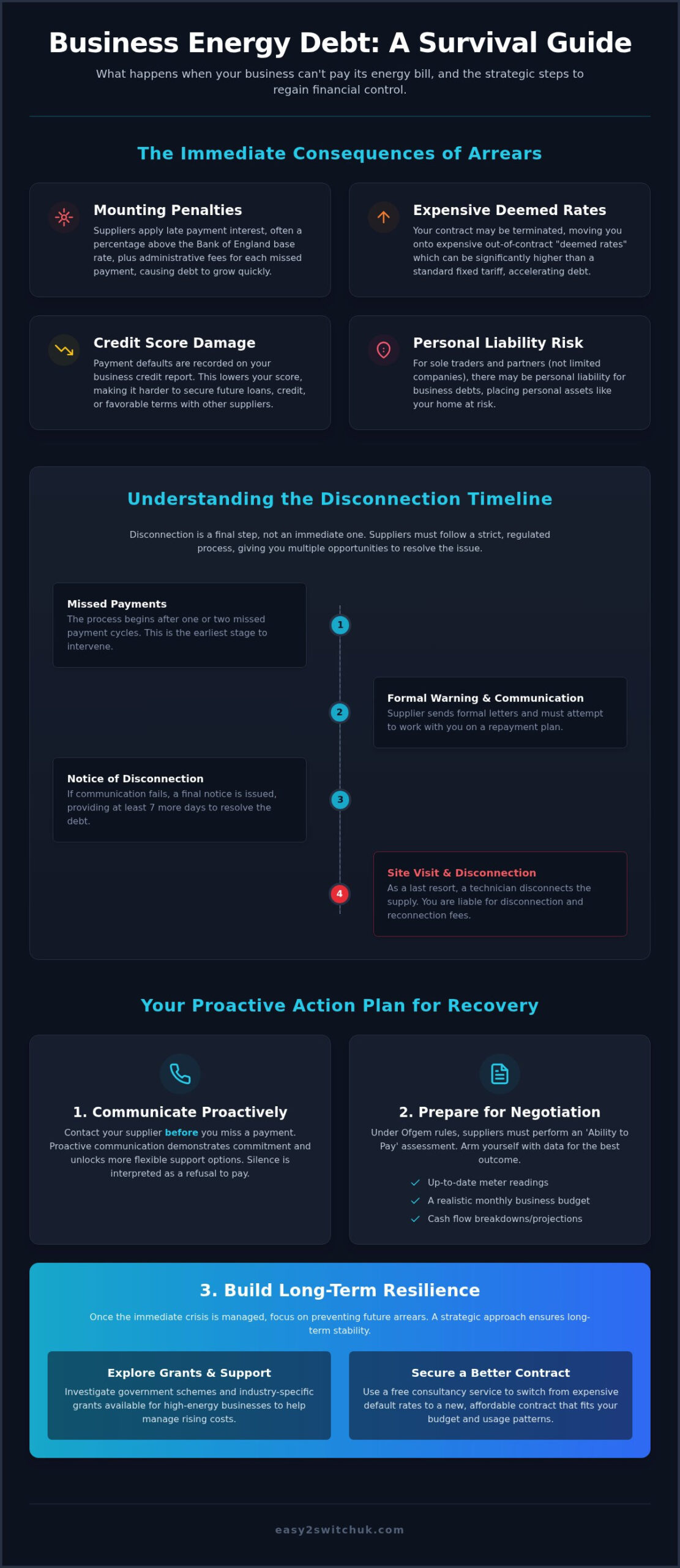
Falling behind on utility costs feels like a heavy weight on your shoulders, but understanding the mechanics of debt helps you regain control. When arrears begin to mount, the first thing you’ll notice isn’t a cut-off notice; it’s the sudden inflation of your balance. Suppliers typically apply late payment interest, often set at a specific percentage above the Bank of England base rate, alongside administrative fees for every missed billing cycle. These costs compound quickly, making the original debt much harder to clear without a strategic plan.
One of the most damaging side effects of falling into arrears is being moved onto ‘deemed rates’. These are expensive, out-of-contract tariffs that suppliers charge when no formal agreement is in place, often costing significantly more than a standard fixed-rate deal. If you’re wondering what happens if my business can’t pay its energy bill, the reality is that these high rates can accelerate your debt faster than the actual energy usage itself. It’s a cycle that turns a manageable shortfall into a long term financial crisis.
Understanding the Disconnection Timeline
Disconnection is rarely an overnight event; it’s a structured process governed by strict Ofgem regulations. Usually, a ‘Notice of Disconnection’ is only issued after several weeks of failed communication and at least one or two missed payment cycles. In 2026, UK suppliers are legally required to work with you to find a solution before they can even consider pulling the plug. This means they must offer a realistic repayment plan based on your current financial capability and business cash flow.
The process typically involves a formal warning letter, followed by a site visit or a final notice period of at least seven days. If a technician is sent to disconnect the supply, you’ll also be liable for the costs of that visit and the subsequent reconnection fee once the debt is settled. Acting before this notice arrives is the most effective way to protect your operations.
Credit Score Damage and Long-term Impacts
The damage from energy debt extends far beyond your utility meter. Commercial credit agencies monitor payment defaults closely. A single recorded default on your business credit report can lower your score instantly, making it difficult to secure loans, business credit cards, or even favorable terms with other trade suppliers. This loss of borrowing power often hits right when you need liquidity the most.
A poor credit rating creates a cycle that’s difficult to break. When you try to switch to a cheaper provider to lower your overheads, new suppliers may reject your application or demand a massive security deposit upfront. It’s also vital to check your business structure. While limited companies offer some protection, sole traders or partners in a business may find they have personal liability for these debts, putting personal assets at risk. Taking action early is the best way to keep these professional and personal boundaries secure.
How to Negotiate a Repayment Plan with Your Supplier
Negotiating with a utility provider often feels like an uphill battle, but proactive communication is your strongest defense against the threat of disconnection. Suppliers generally prefer a steady, agreed-upon repayment plan over the costly and legally complex process of cutting off a supply. If you reach out before a payment is missed, you demonstrate a commitment to resolving the debt, which often unlocks more flexible support options. Silence is interpreted as a refusal to pay, whereas transparency allows the supplier to treat you as a partner in solving the problem.
Under the 2026 Ofgem regulations, suppliers are required to conduct an ‘Ability to Pay’ assessment. This means they cannot simply demand a lump sum that would force your business into insolvency. Instead, they must consider your specific financial circumstances, including your current cash flow and essential operating costs. When discussing what happens if my business can’t pay its energy bill, remember that the goal of this assessment is to create a sustainable roadmap that clears the arrears without jeopardizing your company’s survival.
Essential Information to Have Ready Before the Call
To secure the best possible terms, you need to lead the conversation with hard data. Having these details ready ensures the supplier’s assessment is based on reality rather than estimates:
- Actual Meter Readings: Provide up-to-date readings to ensure the debt reflects your true usage. Estimated bills often inflate arrears unnecessarily.
- A Realistic Monthly Budget: Prepare a clear breakdown of your income and outgoings. Show exactly what surplus is available to put toward the debt after covering staff and essential stock.
- Evidence of Hardship: If your business is seasonal, such as a farm facing a lean winter or a charity awaiting grant funding, provide evidence of these fluctuations. This helps justify a request for lower payments during specific months.
Types of Support Suppliers Can Offer
Suppliers have several tools at their disposal to help you manage a shortfall. You might request a payment holiday, which pauses your debt repayments for a short period to allow your cash flow to recover. Alternatively, they can spread the arrears over a longer term, making the monthly installments more manageable. In some cases, installing a business prepayment meter can be a helpful way to stay on top of current usage while slowly chipping away at old debt, effectively preventing the balance from growing further.
Once you reach an agreement, it is vital to get every detail in writing. A verbal promise over the phone is difficult to enforce if a different department issues a disconnection notice later. Confirm the total debt, the exact monthly repayment amount, and the duration of the plan. If you find that your current supplier is unwilling to offer a fair deal, it may be time to consult a specialist to explore a business energy comparison for your future needs once the current arrears are settled.
Grants, Schemes, and Government Support for UK Businesses
Financial assistance isn’t always obvious, but it’s often the missing piece of the puzzle when cash flow is tight. In 2026, the primary safety net remains the Energy Bills Discount Scheme. This scheme provides a baseline level of support for most UK businesses, but it offers significantly higher discounts for Energy and Trade Intensive Industries (ETIIs), such as manufacturing and food processing. If you’re currently worrying about what happens if my business can’t pay its energy bill, checking your ETII eligibility should be your first priority, as it can drastically reduce the unit rates you’re being charged.
Beyond national schemes, local authorities often manage discretionary support funds designed for businesses facing temporary crises. These emergency relief grants are typically one-off payments intended to prevent insolvency or staff redundancies. Additionally, several charitable trusts specialize in assisting small business owners in financial distress. These organizations don’t just provide financial aid; they often offer expert debt counseling that can help you restructure your liabilities and find a sustainable way forward without the immediate threat of disconnection.
Support for the Agricultural Sector
UK farmers face unique energy challenges, particularly with high-drain equipment and seasonal production cycles. To help, 2026 modernization funds are specifically targeting energy efficiency in the agricultural sector. These grants can cover a portion of the costs for installing renewable energy systems or upgrading to more efficient grain dryers and cooling systems. Managing your tax burden is another way to free up capital; for instance, understanding how to apply for exemptions or reductions on the Climate Change Levy can lower your overall bill significantly. We recommend conducting a professional energy audit to identify where your farm is losing power and to satisfy the requirements for these specialized funding streams.
General Business Energy Grants
The 2026 ‘Smart Data Repository’ is a vital tool for SMEs looking to regain control. By accessing your business’s granular usage data, you can pinpoint exactly where waste occurs and use this evidence to apply for government-backed loans for hardware upgrades. These loans often feature low interest rates and are specifically for purchasing energy-efficient lighting, insulation, or HVAC systems. Your local business growth hub is an excellent resource for navigating these options. They provide free financial advice and can signpost you to regional grants that may not be advertised nationally, helping you build a more resilient energy strategy for the future.
Strategic Recovery: Lowering Future Bills to Prevent Arrears
Recovering from a period of arrears requires more than just a short term repayment plan; it demands a total overhaul of your procurement strategy. If you’re still concerned about what happens if my business can’t pay its energy bill in the future, the solution lies in proactive cost reduction. The first step is often a business energy comparison to transition away from expensive default rates. These out-of-contract tariffs are designed to be temporary, yet they often become a permanent drain on resources for busy directors who lack the time to manage a switch.
Beyond the unit rate, auditing your bill for errors can provide significant relief. Charities and low-usage businesses should ensure they’re being charged the reduced 5% VAT rate rather than the standard 20%. If you’ve been incorrectly billed, you can often claim back overpayments from previous years, which provides an immediate cash injection. We also recommend reviewing your standing charges to ensure you’re only paying for the capacity your site actually utilizes, which is particularly relevant for seasonal operations like farms that have fluctuating power needs.
Reducing Consumption Without Capital Expenditure
Lowering your overheads doesn’t always require significant investment in new hardware. Start by identifying ‘vampire’ loads, such as office equipment or heavy machinery left on standby, which can account for a surprising portion of your base load. Educating your team on simple energy-saving habits can lead to immediate, measurable reductions in your monthly outgoings. Smart meters prevent the accumulation of estimated debt by providing your supplier with real-time, accurate usage data every day.
Professional Contract Audits
A hidden cause of mounting debt is often an incorrectly applied Climate Change Levy (CCL) or simple billing discrepancies that go unnoticed. A professional audit helps identify these errors, ensuring you aren’t paying for more than you’ve consumed. Engaging a commercial energy broker simplifies this process, as they handle the technical analysis and negotiation on your behalf. This ‘done-for-you’ approach ensures your business is protected by a contract that actually supports your cash flow rather than hindering it. By taking control of these variables now, you build a resilient foundation that protects your business from future market volatility.
How Easy2switch UK Helps Businesses Take Control
Managing a business through a financial squeeze is difficult enough without the added weight of complex utility procurement. While the earlier sections of this guide explain what happens if my business can’t pay its energy bill, our role at Easy2switch UK Ltd is to ensure those scenarios never become your reality. We provide a professional, national energy consultancy service that removes the burden of supplier negotiation from your desk. By acting as a Reliable Specialist, we handle every detail of the process, from the initial comparison to the final contract signature, allowing you to focus on your core operations.
Our approach is built on the principle of calm efficiency. We understand that for a director watching their cash flow, the last thing they need is another invoice. That’s why our service is entirely free to the user. We work on a commission-based model where the suppliers pay us directly, ensuring our advice remains focused on finding the best individual fit for your specific needs rather than a one-size-fits-all corporate solution. If you’ve been searching for answers on what happens if my business can’t pay its energy bill, you’ve likely realized that the best solution is a preventative one that secures lower rates before debt can accumulate.
A Stress-Free Path to Lower Energy Bills
Our independence is our greatest asset. Because we aren’t tied to a single provider, we can access hundreds of offers across the UK market in 2026, many of which aren’t available on standard consumer comparison sites. This is particularly vital for businesses currently in arrears or those nearing the end of a fixed term, as it allows us to find competitive rates that prevent a transition onto expensive deemed tariffs. Whether you prefer to discuss your options over the telephone or through our online platform, you’ll receive personalized support that demystifies the procurement process and makes switching feel effortless.
Partnering for Long-term Energy Resilience
We take pride in our deep knowledge of niche sectors, particularly the UK farming industry and the charity sector. These organizations often have unique usage patterns that standard brokers fail to account for, often leading to unnecessary costs. We don’t just find you a deal and disappear; we provide ongoing monitoring to ensure your business remains on the most efficient tariff possible. This long term partnership builds resilience against market volatility and provides the peace of mind that your energy costs are in capable hands. Secure a better energy deal today with Easy2switch UK Ltd and take the first step toward permanent financial control.
Securing Your Business Energy Future
Managing utility debt is about more than just clearing a balance; it’s about building a more resilient operation. By understanding exactly what happens if my business can’t pay its energy bill, you can move from a position of fear to one of informed action. Proactive communication with your supplier, combined with accurate meter readings, remains your best defense against disconnection. Leveraging 2026 government grants and sector-specific support for farms and charities can provide the breathing room your cash flow needs to recover.
At Easy2switch UK, our expert energy consultants specialize in the UK farming industry and the SME sector. We offer free impartial advice with no hidden fees, providing a done-for-you switching service that saves you significant time and money. Don’t let complex contracts or mounting arrears dictate your company’s future. Take control of your energy costs with a free Easy2switch quote and let us handle the negotiations for you. With a professional strategy and a specialist partner by your side, your business can return to a path of stability and growth.
Frequently Asked Questions
Can my business energy be cut off without notice in 2026?
No, your energy cannot be disconnected without prior notice. Under 2026 Ofgem regulations, suppliers must send a formal Notice of Disconnection and provide at least seven days’ warning before taking action. They’re also legally required to attempt to set up a repayment plan with you first. Disconnection is viewed as a last resort, but if you ignore all communication, the process will proceed. Always respond to letters to prevent this from happening.
Am I personally liable for my limited company’s energy debt?
Generally, directors of a limited company are not personally liable for company debts. The business is a separate legal entity. However, if you signed a personal guarantee when setting up the contract or if you operate as a sole trader or partnership, your personal assets could be at risk. It’s vital to check the specific terms of your energy agreement to understand your level of personal exposure and liability for any outstanding balances in 2026.
What are deemed rates and why are they so expensive?
Deemed rates are the tariffs you pay when you use energy without a formal contract in place. This often happens if you move into new premises or if your fixed-term deal expires without a renewal. These rates are significantly higher than negotiated contracts because the supplier hasn’t hedged the energy for your specific usage. Being on these rates often explains what happens if my business can’t pay its energy bill, as they drain cash flow rapidly.
Are there specific energy grants for UK farmers facing debt?
Yes, several modernization grants are available for UK farmers in 2026 to help reduce energy overheads. These funds often support the installation of more efficient equipment or renewable energy systems like solar PV. While few grants clear existing debt directly, they reduce future bills to make arrears manageable. Farmers can also explore Climate Change Levy (CCL) exemptions or reductions to further lower their ongoing utility costs and improve their long term financial resilience.
How do I set up a repayment plan with my energy supplier?
Contact your supplier as soon as you realize a payment will be missed. You’ll need to provide recent meter readings and a clear breakdown of your business’s current cash flow. Under 2026 rules, suppliers must conduct an Ability to Pay assessment to ensure the plan is sustainable. Once you agree on a monthly amount that covers your current usage plus a portion of the debt, ensure you get the agreement confirmed in writing.
Can I switch energy suppliers if my business is currently in debt?
Usually, you cannot switch suppliers if you have outstanding debt that has been overdue for more than 28 days. The current supplier has the right to object to the switch until the arrears are settled or a repayment plan is agreed upon. However, if the debt is the result of a supplier error or if you have a specific agreement with a new provider to take over the balance, a transition might still be possible.
What is the 2026 Energy Bills Discount Scheme for businesses?
The 2026 Energy Bills Discount Scheme provides a baseline level of support for all eligible UK businesses, charities, and public sector organizations. It works by applying a discount to your unit rates when wholesale prices exceed a certain threshold. Businesses in energy-intensive sectors, such as manufacturing or food processing, often qualify for a higher level of support. This scheme is designed to protect firms from extreme market volatility and prevent them from falling into arrears.
How can a business energy broker help me if I’m struggling with bills?
A specialist broker like Easy2switch UK takes the stress out of procurement by handling negotiations on your behalf. We provide a done-for-you service that identifies the most appropriate contracts from hundreds of offers, ensuring you aren’t overcharged. Because our service is free to the user, it’s an ideal resource for businesses watching their cash flow. We help you move away from expensive deemed rates, which is a common factor in what happens if my business can’t pay its energy bill.
