
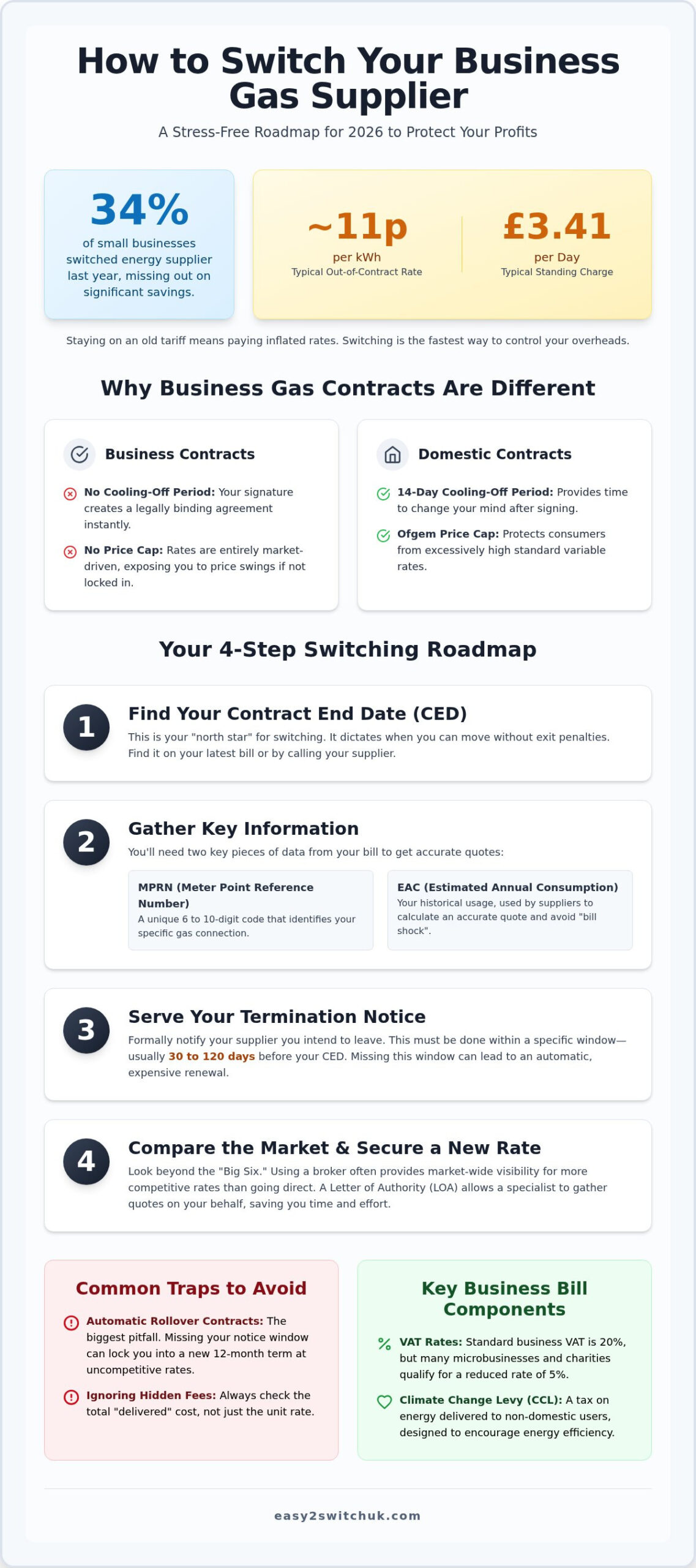
Did you know that only 34% of small businesses switched their energy supplier last year? It’s a surprising figure when you consider that out-of-contract gas rates in August 2026 have climbed to roughly 11p per kWh, with daily standing charges reaching £3.41. Most owners stay on expensive tariffs simply because they fear the administrative burden or a potential disruption to their supply. Learning how to switch business gas supplier is often the fastest way to protect your profit margins and reclaim control over your overheads.
We know that managing utility contracts feels like a chore, especially when you’re busy running a farm, charity, or SME. It’s frustrating to deal with confusing notice periods and the constant worry of hidden fees. You deserve a transition that’s efficient and transparent, allowing you to focus on your work while the complex market variables are handled by capable hands.
This expert-led roadmap provides everything you need for a stress-free transition to a cheaper tariff. You’ll discover how to navigate the 2026 regulations, what paperwork you actually need, and how to secure a “done-for-you” switch that avoids common contract traps. We’re here to ensure your procurement process is professional, logical, and entirely effortless.
Key Takeaways
- Understand why commercial gas contracts differ from domestic ones, particularly the absence of a cooling-off period.
- Master the essential steps of how to switch business gas supplier to ensure you never miss a critical notice period.
- Discover why market-wide visibility through a broker often results in more competitive rates than direct supplier quotes.
- Identify the common traps that cause switches to fail and learn how to avoid expensive out-of-contract rates.
- Learn how to secure a specialist service to manage your entire energy transition for free.
Understanding Business Gas Switching in 2026
Business gas switching is the process of moving your commercial energy supply to a new contract, either with your current provider or a new one. In 2026, this has become a core business strategy rather than a simple utility check. With market volatility continuing to impact bottom lines, knowing how to switch business gas supplier effectively allows you to lock in rates that protect your cash flow. Unlike domestic energy, where the UK energy regulator Ofgem implements a price cap, business energy is entirely market-driven. This means prices can swing significantly based on wholesale trends.
One of the most important things to understand is that business gas contracts do not offer a cooling-off period. In a domestic setting, you might have 14 days to change your mind. In the commercial world, your signature creates a binding legal agreement immediately. This is why we focus on a “done-for-you” approach that ensures every detail is correct before you commit. Taking control of these overheads isn’t just about saving a few pounds; it’s about removing the anxiety of unpredictable bills.
Fixed vs. Variable: Which Contract Fits Your Business?
Choosing the right structure is the first step in stabilizing your energy overheads. Fixed-rate contracts are the most popular choice for small businesses and farms because they provide absolute budget certainty. You pay a set price per kWh for the duration of the term, usually between one and three years. This shields you from any sudden price spikes in the wholesale market.
Variable or flexible procurement is typically reserved for larger energy users. These contracts track the wholesale market, allowing you to buy energy in stages. While this can lead to lower costs if market prices drop, it requires constant monitoring and carries a higher risk. For most SMEs, the stability of a fixed-rate deal is the more pragmatic choice.
Why Business Gas Differs from Domestic Switching
The lack of a price cap is just the beginning of the differences. Business energy bills also include specific taxes and levies that don’t apply to households. Here are the key factors to watch:
- VAT Rates: While standard business VAT is 20%, many microbusinesses and charities qualify for a reduced rate of 5%.
- Climate Change Levy (CCL): This is a tax on energy delivered to non-domestic users to encourage energy efficiency.
- Meter Types: Your meter type determines how your data is collected and how suppliers calculate your quotes.
Understanding these variables is essential when researching how to switch business gas supplier. It ensures that when you compare quotes, you’re looking at the total “delivered” cost rather than just the unit rate. Our goal is to make these technical details accessible so you can make an informed decision without the stress.
A Step-by-Step Guide to Switching Your Business Gas Supplier
Starting your journey toward better energy rates requires a clear view of your current obligations. The first thing you need is your Contract End Date (CED). This date is your “north star” because it dictates exactly when you can move without facing exit penalties. Learning how to switch business gas supplier effectively begins with this single piece of information, usually found on your most recent bill or by contacting your provider directly.
Once you know your window, it’s time to look beyond the “Big Six” suppliers. The UK market in 2026 is highly competitive, with independent providers often offering more tailored rates for niche sectors like farming and local charities. Comparing these options usually requires a Letter of Authority (LOA). This simple document allows a specialist to gather quotes on your behalf, ensuring you see the full market spectrum without spending hours on the phone with different sales departments.
Gathering Your Data: MPRN and EAC Explained
Your Meter Point Reference Number (MPRN) is a unique 6 to 10-digit code that identifies your specific gas connection. It’s not the same as your account number; you’ll typically find it in a separate box on your bill. You’ll also need your Estimated Annual Consumption (EAC), which represents the amount of gas your business is expected to use over a year. EAC is a calculation of your historical usage that suppliers use to provide an accurate quote, and getting this right prevents “bill shock” when your first statement arrives.
Navigating the 30-Day Notice Period
Most commercial contracts require a formal termination notice between 30 and 120 days before the CED. If you miss this window, your supplier might automatically renew your contract for another year at a much higher rate. Following Ofgem’s rules for switching supplier ensures you stay within your rights and avoid these common pitfalls. While some microbusinesses have more flexibility, it’s always safer to serve notice early to keep your options open.
After issuing your notice, the timeline to “go-live” with a new supplier typically takes around five working days under current regulations. This quick turnaround means you won’t experience any interruption to your gas supply or physical changes to your pipes. If managing these deadlines feels like a distraction from your daily operations, you can let an energy specialist handle the paperwork for you, ensuring every notice is served on time and every quote is validated against your specific needs.
Comparing Commercial Rates: Broker vs. Direct Suppliers
When you’re researching how to switch business gas supplier, you’ll eventually face a choice: do you call suppliers yourself or use a broker? The DIY approach involves contacting individual companies, waiting on hold, and repeating your data dozens of times. While this gives you direct control, it often limits your view to the “Big Six” or a handful of well-advertised names. In contrast, a broker has market-wide visibility, comparing hundreds of offers simultaneously to find the best fit for your specific sector.
Many business owners worry about the cost of using a specialist. At Easy2switch UK, our service is free for the customer. We receive a commission from the supplier, which is built into the unit rate of the tariff. This model ensures you get expert guidance without an upfront bill, making professional procurement accessible for every farm, charity, and small business. It’s a pragmatic way to ensure you aren’t leaving money on the table simply because you didn’t have time to call twenty different providers.
The Hidden Costs of Staying with Your Current Provider
Staying loyal to your current provider often leads to a “loyalty penalty”. When your fixed term ends, you’re moved to out-of-contract rates if you haven’t agreed on a new deal. In August 2026, these rates have reached roughly 11p per kWh, with daily standing charges around £3.41. These prices are significantly higher than negotiated contracts and can drain your bank account quickly. A fresh comparison every year is the only way to protect your profit margins from these automatic price hikes. Knowing how to switch business gas supplier before these rates kick in is essential for long-term financial health.
How Brokers Access Off-Market Rates
Specialist Business Energy Consultants maintain direct relationships with supplier pricing desks. These connections often provide access to “off-market” tariffs that aren’t available on public websites or through direct calls. Because we handle high volumes of switches, suppliers offer us exclusive rates to win your business. This impartial advice helps you choose between 20 or more providers, ensuring the final contract is a perfect fit for your specific usage patterns and budget requirements.
Avoiding Common Switching Pitfalls and Contract Traps
Even with a clear roadmap, the transition can hit unexpected hurdles. The most frequent reason a transfer fails is a supplier objection. This happens when your current provider blocks the move, often due to an outstanding balance or a contract that hasn’t officially reached its notice window. Understanding how to switch business gas supplier involves preempting these issues by clearing debts and verifying your contract status well before the “go-live” date.
Credit checks also play a significant role in the 2026 market. Suppliers are increasingly cautious, and a low credit score can lead to rejected applications or demands for a security deposit. If you’ve missed your termination window, you might find yourself in a “rollover contract.” These agreements lock you in for another year, usually at uncompetitive rates. While it’s harder to escape these once they begin, acting immediately to serve notice for the next expiry date prevents the cycle from repeating.
Escaping Deemed Rates and Out-of-Contract Pricing
Deemed rates apply when you move into a new premises without signing a formal agreement or when a contract expires without a new one in place. These are essentially “emergency” prices that suppliers charge for the flexibility of not being in a contract. Deemed rates can be 80% higher than fixed rates. To protect your budget, you should sign a new contract as soon as you take over a property or at least six months before your current deal ends. Moving off these rates immediately is a priority for any business looking to stabilize its overheads.
What to Do if Your Current Supplier Objects
If you receive an objection notice, don’t panic. You usually have a 30-day window to resolve the dispute without the new contract being cancelled. Common triggers include:
- Unpaid Invoices: Even a small disputed amount can trigger a block.
- Contract Overlap: Attempting to switch before your current commitment allows.
- Incorrect Site Data: Mismatched MPRN or address details on the application.
Resolving these requires direct communication with your old supplier’s objections team. A broker can mediate this process, identifying the exact cause of the block and ensuring the new supplier is ready to re-apply the moment the issue is cleared. If you’re facing a stubborn objection or a complex rollover, you can get expert help to resolve your contract disputes and get your switch back on track.
Making the Switch Simple with Easy2switch UK
Easy2switch UK acts as your independent energy consultancy, removing the administrative weight of procurement from your daily schedule. We specialize in sectors often overlooked by larger brokers, specifically focusing on the unique needs of UK farms, SMEs, and charities. Our “Done-for-You” philosophy means we handle the arduous paperwork and supplier negotiations while you focus on your core operations. By understanding how to switch business gas supplier through a specialist, you gain access to market-wide visibility without the stress of managing complex contracts yourself.
Our service is designed to be entirely transparent. Because we operate on a commission-based model where the supplier pays us, the service remains free for you. This removes any financial barrier to professional procurement, ensuring that even the smallest charity or family farm can access the same market expertise as a large corporation. We pride ourselves on being a reliable specialist, offering a personalized approach that finds the best individual fit rather than a one-size-fits-all solution.
Specialist Support for UK Farms and Charities
The agricultural sector faces unique challenges, such as seasonal gas usage for grain drying or livestock heating. We analyze these specific patterns to find tariffs that don’t penalize you for fluctuating demand throughout the year. For our charity clients, we ensure you aren’t overpaying by navigating the complexities of VAT exemptions and Climate Change Levy (CCL) discounts. Many non-profit organizations qualify for a reduced 5% VAT rate, yet they often remain on the standard 20% simply because their supplier hasn’t been updated. We also provide holistic energy management, helping you compare Farm Electricity Prices UK alongside your gas contracts to secure the best possible rates across your entire estate.
The Easy2switch Process: From Phone Call to Savings
Our approach is brisk and logical, designed to move you from curiosity to confidence quickly. It begins with an initial consultation where we identify your specific usage needs and current contract end dates. From there, we perform an impartial comparison, presenting the top options from hundreds of offers across the UK market. We don’t just hand you a list; we explain the benefits of each choice so you can make an informed decision with ease.
Once you’ve selected a tariff, we manage the transition from start to finish. This includes issuing termination notices and mediating any supplier objections that might arise. Our support doesn’t end when the switch is complete. We stay with you as a long-term partner, monitoring the market to ensure your next renewal is just as effortless. Take control of your energy costs today and let our specialists find the right fit for your business.
Secure Your Business Energy Future
Mastering how to switch business gas supplier is one of the most effective ways to stabilize your overheads in an unpredictable 2026 market. By preparing your data early and respecting notice periods, you can avoid the expensive trap of out-of-contract rates that drain your profit margins. Remember that market-wide visibility is your strongest tool; looking beyond the household names often reveals tailored tariffs that better suit your specific operational needs.
Whether you’re managing a busy farm, a local charity, or a growing SME, you don’t have to handle the administrative burden alone. Easy2switch UK is a specialist energy consultancy for the UK farming industry and small businesses, providing a free service that gives you access to hundreds of commercial energy tariffs. Our expert-led approach ensures your transition is handled with calm efficiency, letting you focus on your work while we secure your savings through a commission-based model that keeps our help free for you.
Ready to reclaim control over your utility bills? Get a Free, No-Obligation Business Gas Review from Easy2switch today. We’re here to make your procurement process simple, transparent, and entirely stress-free.
Frequently Asked Questions
How long does it take to switch business gas suppliers?
Under current regulations, most business gas switches take approximately five working days to complete. This faster switching guarantee ensures your transition happens quickly once the contract is signed. However, you should still begin researching how to switch business gas supplier at least six months before your current contract ends. This gives you ample time to compare hundreds of offers and issue your termination notice without rushing the process.
Will my gas supply be interrupted during the switch?
No, your gas supply won’t be interrupted at any point during the transition. The switch is purely administrative; the same pipes and meters deliver your gas regardless of which supplier you pay. You don’t need any site visits or physical changes to your infrastructure. We handle the coordination between your old and new providers to ensure a seamless “go-live” date that requires zero downtime for your business or farm.
Can I switch business gas if I am currently in debt to my supplier?
Suppliers have the right to object to a switch if you have an outstanding balance on your account. If you’re in debt, you’ll typically need to clear the arrears before the transfer can proceed. Some microbusinesses may have specific protections, but generally, resolving financial disputes is the first step in learning how to switch business gas supplier. We can help mediate these conversations to identify exactly what’s owed and clear the path for your move.
What is a Letter of Authority (LOA) and why do I need one?
A Letter of Authority is a legal document that gives an energy consultancy permission to act on your behalf. It allows us to contact suppliers, gather your historical usage data, and request bespoke quotes without you needing to be on every call. You remain in total control of the final decision; the LOA simply empowers us to do the heavy lifting and administrative research required to find your business the most competitive rates available.
Do I need a smart meter to switch to a better business gas rate?
You don’t strictly need a smart meter to switch, but having one can open access to more competitive, data-driven tariffs. Smart meters provide suppliers with accurate usage data, which removes the risk of estimated billing. If you have a traditional meter, you can still switch to a better rate by providing manual readings. Most suppliers will offer to install a smart meter for free after your new contract begins to improve billing accuracy.
What happens if my business moves to new premises?
When you move premises, you enter a “Change of Tenancy” process. You’re responsible for the gas at your old site until your lease ends or a new tenant takes over. At your new location, you’ll likely start on expensive deemed rates. It’s vital to sign a new contract immediately upon moving in to avoid these high costs. We can manage both the exit from your old site and the procurement for your new one simultaneously.
Is there a cooling-off period for business gas contracts?
Unlike domestic energy deals, business gas contracts don’t have a standard cooling-off period. Once you sign a commercial agreement, it’s a legally binding contract with no option to cancel without penalties. This is why we emphasize the importance of a professional review before you commit. We ensure every term is transparent and fits your budget requirements so you don’t find yourself locked into an unsuitable agreement with no way out.
How much can I typically save by switching business gas supplier?
Savings vary depending on your current tariff and usage patterns, but moving from out-of-contract rates to a negotiated fixed deal can reduce costs significantly. For many SMEs and farms, the difference between a “loyalty” rate and a market-competitive one is substantial. By accessing hundreds of supplier offers through an independent consultancy, you ensure your business isn’t paying more than necessary. We focus on finding the best individual fit to maximize your long-term stability.
