
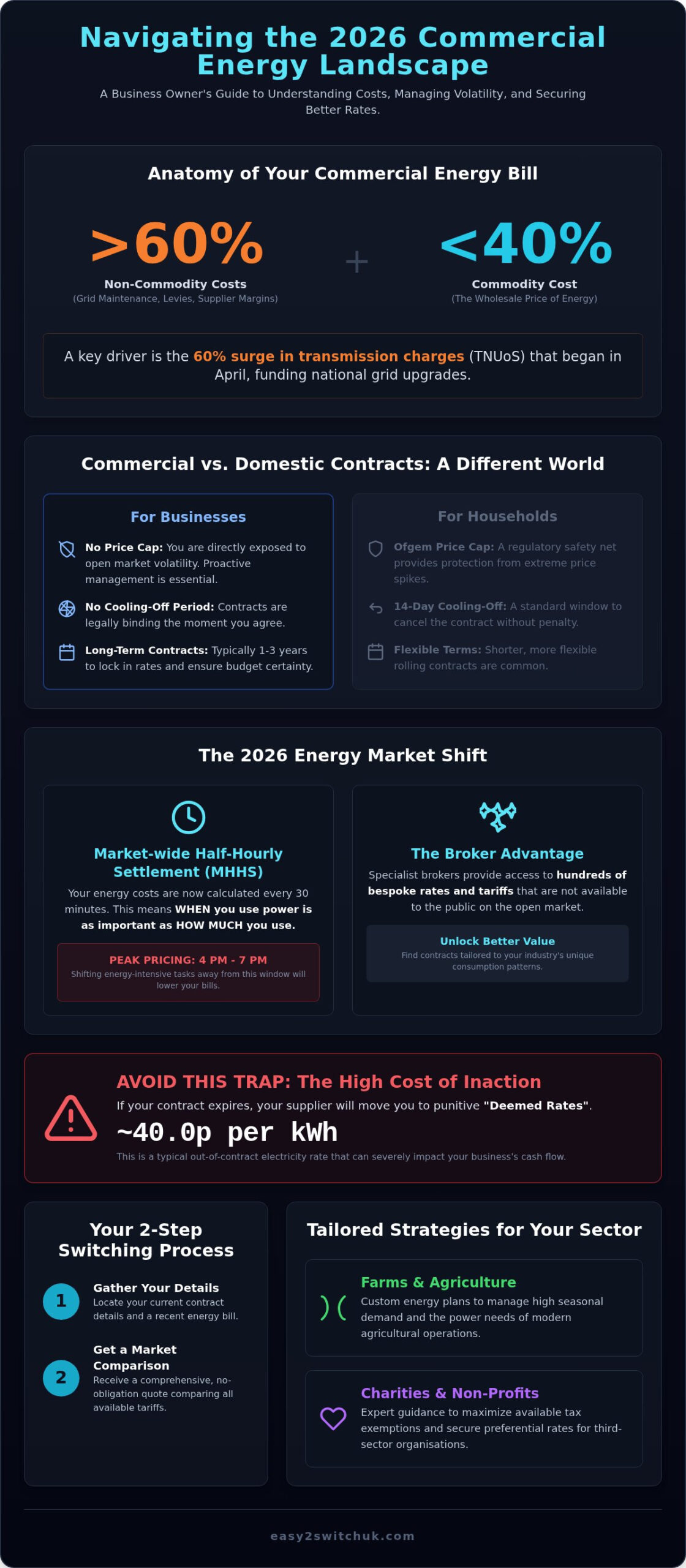
Did you know that non-commodity costs, including the 60% surge in transmission charges starting this April, now account for over 60% of your total commercial energy bill? For many UK business owners, looking at a utility statement feels more like solving a puzzle than managing a budget. Between the rollout of Market-wide Half-Hourly Settlement and the latest Climate Change Levy adjustments, the landscape is shifting rapidly. It’s understandable if you feel frustrated by the administrative burden of staying on top of these changes while trying to run your daily operations.
We agree that your time is better spent growing your business than decoding complex contracts or hunting for hidden fees. This guide is designed to help you take control of your overheads with a clear breakdown of the 2026 market and a roadmap to secure the best rates. You’ll learn how to achieve fixed price certainty and simplify the switching process through expert advice tailored to your specific sector, whether you’re managing a busy farm, a local charity, or an SME. We’ll walk you through the essential steps to turn market volatility into a strategic advantage for your bottom line.
Key Takeaways
- Learn how commercial energy contracts differ from domestic ones and why understanding 2026 market volatility is essential for budget stability.
- Discover how to decode your bill by identifying the specific components of unit rates and standing charges that influence your total monthly spend.
- Find out how a specialist broker accesses bespoke rates and hundreds of supplier offers that are typically unavailable on the open market.
- Follow a clear, two step process to switch suppliers effectively, starting with your current contract details and a comprehensive market comparison.
- Explore tailored energy strategies for farms and charities, including how to manage seasonal demand peaks and maximize available tax exemptions.
Understanding the Commercial Energy Landscape in 2026
Managing commercial energy requires a total shift in mindset compared to handling a household account. While domestic users rely on the Ofgem price cap for protection, businesses operate in an open market with no such safety net. In 2026, this means you’re responsible for your own risk management. If your contract expires and you don’t act, you’ll default to “deemed” rates. As of September 2026, these out-of-contract rates are roughly 40.0p per kWh for electricity, which can devastate a business’s monthly cash flow. Proactive procurement is the only way to avoid these punishing costs.
Commercial vs. Domestic Energy: Key Differences
The legal framework for business contracts is much stricter than what you might experience at home. It’s vital to understand these three areas before signing anything:
- No Cooling-Off Period: Unlike domestic agreements, commercial contracts are legally binding the moment you agree to the terms, whether that’s over the phone or via a digital signature. There’s no 14-day window to change your mind.
- Contract Lengths: Businesses typically fix their rates for one to three years. This provides budget certainty in a market where wholesale prices fluctuate daily.
- Taxes and Levies: Most firms pay 20% VAT and the Climate Change Levy (CCL). On April 1, 2026, the CCL rate was set at £0.00801 per kWh for both gas and electricity.
While you may be familiar with the UK’s ‘Big Six’ energy suppliers from your home bills, the business market includes hundreds of specialized providers. These smaller players often offer bespoke tariffs that better suit specific industries like farming or charities.
Why 2026 is a Pivotal Year for Energy Strategy
This year marks a massive shift in how UK businesses are billed. The rollout of Market-wide Half-Hourly Settlement (MHHS) is now live across the country. This system settles energy costs every 30 minutes, meaning the time you use power is now just as important as the amount you use. Businesses that can shift high-drain activities away from the expensive 4-7 PM peak will see significant benefits.
Additionally, non-commodity costs now make up over 60% of your total bill. A major driver is the 60% increase in Transmission Network Use of System (TNUoS) charges that took effect in April 2026. This increase funds the £7.65 billion national grid upgrade required for the UK’s transition to clean power. Taking control of your commercial energy strategy now isn’t just about finding a cheaper unit rate; it’s about protecting your business from these rising infrastructure costs through smart timing and expert brokerage.
Decoding Commercial Energy Costs: Unit Rates and Standing Charges
Understanding your commercial energy bill is the first step toward reducing it. Your total cost consists of two primary elements: the unit rate and the standing charge. The unit rate is the price you pay for every kilowatt-hour (kWh) of energy you consume. In contrast, the standing charge is a fixed daily fee that covers the cost of maintaining the national grid and supplying power to your premises. While the unit rate often gets the most attention, standing charges vary significantly between suppliers and can impact smaller businesses with lower usage more heavily.
Non-commodity costs now represent over 60% of your total invoice. These include transport and distribution fees that suppliers pass on to you. With the 60% increase in Transmission Network Use of System (TNUoS) charges starting in April 2026, the standing charge portion of your bill may look higher than in previous years. Balancing these fixed costs with a competitive unit rate is vital for maintaining a healthy bottom line.
Fixed vs. Flexible Contracts: Which is Right for You?
Most UK businesses choose fixed-rate contracts to lock in price certainty for one to three years. This protects you from wholesale market spikes, which is a significant advantage in the volatile 2026 landscape. However, larger users might consider flexible “pass-through” contracts. These allow you to buy energy in stages, potentially benefiting from price drops, though they carry the risk of higher costs if the market rises. If you find your current costs are unmanageable, you can find helpful guidance from Ofgem on managing business energy debt.
Falling into “deemed” or out-of-contract rates is an expensive trap you must avoid. As of September 2026, indicative deemed electricity rates sit around 40.0p per kWh with daily standing charges reaching 254.0p. These rates are significantly higher than negotiated contracts. If your current deal is ending, our experts at Easy2switch UK can help you compare the market to secure a new fixed rate before these high costs kick in.
The Impact of Industry-Specific Usage Profiles
Your industry dictates how and when you use power. High-intensity users, such as farms, can leverage off-peak rates by running heavy machinery or cooling systems during the night. For charities, the savings can be even more direct. Many charitable organizations are eligible for a reduced VAT rate of 5% rather than the standard 20%, alongside potential exemptions from certain environmental levies. The Climate Change Levy (CCL) for 2026 is an environmental tax charged at £0.00801 per kWh for both electricity and gas to encourage UK businesses to operate more efficiently. Identifying these industry-specific nuances is often the quickest way to lower your overheads without changing your daily operations.
Why Use a Commercial Energy Broker Instead of Going Direct?
Many business owners assume that cutting out the middleman leads to lower costs. In the commercial energy market, the opposite is often true. Suppliers frequently reserve their most competitive, bespoke rates for brokers who bring them high-volume business. When you go direct, you’re limited to the public tariffs of a single provider. An independent broker like Easy2switch UK Ltd provides a “whole of market” advantage, comparing hundreds of offers instantly to find the right fit for your specific usage profile.
Handling your own procurement carries a heavy administrative cost. You’d need to contact dozens of suppliers, wait for quotes, and try to compare apples with oranges in complex contract terms. We take that burden off your desk. Because our service is free for the end-user, with commissions paid directly by the suppliers, you get expert market analysis without any upfront fees or hidden costs. It’s a pragmatic way to take control of your overheads while staying focused on your daily operations.
Brokerage vs. Direct Negotiation
Negotiating with energy giants is a lopsided battle for a single business. Consultants leverage the collective volume of their entire client base to secure prices that an individual SME or farm simply couldn’t access. Having a specialist on your side provides several key benefits:
- Leveraged Pricing: Access to “bulk” rates usually reserved for large corporations.
- Contract Clarity: Expert eyes to spot hidden clauses or unfavorable terms.
- Dispute Resolution: A dedicated point of contact to handle supplier errors on your behalf.
Beyond the initial contract, a broker acts as your advocate. Whether it’s resolving a billing dispute or managing a complex meter installation, professional support ensures you aren’t ignored by supplier call centers. For more background on your rights, you can review Ofgem energy advice for businesses to see how the regulatory framework supports your choice of using a consultancy.
Transparency and Trust in Energy Consultancy
Trust is the foundation of any service partnership. A reputable broker should be transparent about their commission structure and provide impartial advice based on your needs, not supplier incentives. At Easy2switch UK Ltd, we pride ourselves on being reliable specialists who understand the unique challenges of the UK farming and charity sectors. We don’t believe in one-size-fits-all solutions. Instead, we offer personalized support to ensure you never pay more than necessary for your commercial energy. If you want to dive deeper into how to select the right partner, read our Commercial Energy Broker Guide 2026 for a full breakdown of the UK market.
The Step-by-Step Guide to Switching Commercial Energy Suppliers
Switching your commercial energy supplier doesn’t have to be a source of stress. It’s a logical process that, when handled correctly, ensures you never pay more than the market requires. The first step is locating your current contract and signing a Letter of Authority (LOA). This document is your tool for independence; it allows your consultant to act on your behalf, gathering data from suppliers without you needing to spend hours on hold. Once we have this, we conduct a full market comparison. We look beyond the headline unit rate to calculate the “Total Cost of Ownership.” This includes standing charges and non-commodity fees, ensuring the deal you sign actually lowers your total monthly expenditure.
Preparing for Your Energy Review
To get the most accurate quotes, you’ll need your Meter Point Administration Number (MPAN) for electricity or Meter Point Reference Number (MPRN) for gas. These are unique identifiers found on your latest bill. You should also have your annual consumption data ready, as suppliers offer better rates to businesses with predictable usage patterns. Understanding your “Renewal Window” is equally critical. Most business contracts allow you to secure a new rate up to six months before your current deal ends. For a deeper look at how this fits into your long-term plan, see our guide on Business Energy Comparison 2026.
Avoiding Common Switching Pitfalls
A “Contract Objection” is the most common hurdle in the commercial energy sector. This happens when your current supplier blocks the move, often due to an outstanding balance or a disagreement over your notice period. We handle these negotiations for you to ensure the transition remains on track. To avoid the risk of double-billing, we coordinate the start and end dates of your contracts precisely. On the day of the switch, always take a clear photo of your meter. Providing final readings to your old supplier and opening readings to the new one ensures a clean break and accurate final invoicing. If you’re ready to start your review, you can request a free energy comparison today and let our specialists handle the administrative burden for you.
Specialist Solutions for Farms, Charities, and UK SMEs
A one-size-fits-all approach to commercial energy often leaves businesses paying for capacity they don’t use or facing penalties for unexpected peaks. Every sector has a unique “energy fingerprint” that requires a tailored strategy to ensure efficiency. Whether you’re running a high-demand agricultural operation or a community-focused charity, your procurement needs to reflect your daily reality. At Easy2switch UK Ltd, we specialize in demystifying these complexities, providing a done-for-you service that aligns your energy contract with your specific operational goals.
Farming Energy: More Than Just Lighting
Agricultural businesses face some of the most volatile consumption patterns in the UK. Managing the heavy load of grain drying during harvest, the consistent demand of milking parlours, or the precise requirements of cold storage requires more than just a standard meter. These high-drain activities can push you into expensive peak-time brackets if not managed correctly. Farms require specialist energy consultants because their unique operational cycles involve high-drain machinery and seasonal peaks that generic business tariffs often overlook. For a deep dive into managing these specific costs, you can consult our Farm Electricity Prices UK 2026 Guide.
Charities and non-profit organizations often miss out on significant savings because they aren’t aware of their tax status. Many are eligible for a reduced VAT rate of 5% and exemptions from the Climate Change Levy (CCL). Similarly, growing SMEs need scalable energy solutions that can adapt as they move into larger premises or increase their production capacity. We ensure these exemptions are applied correctly from day one, protecting your budget so more of your funds can go toward your core mission or business expansion.
Taking Control of Your Energy Future
The transition from being an anxious payer to an informed strategist happens when you have a reliable specialist in your corner. While a one-off switch might provide a temporary fix, a long-term energy partnership ensures you’re always positioned to benefit from market dips and new efficiency technologies. We monitor the 2026 market for you, identifying the right moment to renew or adjust your strategy before your current deal expires. This proactive approach removes the administrative burden and provides the peace of mind that your commercial energy is being handled by capable hands. If you’re ready to simplify your procurement and secure a better deal, you can get a free commercial energy review from Easy2switch UK Ltd today.
Taking Control of Your Business Energy Strategy
Managing overheads in 2026 doesn’t have to be a source of constant stress. By understanding the shift in transmission charges and the new half-hourly settlement system, you’ve already taken the first step toward better financial health. We’ve explored how avoiding expensive out-of-contract rates and leveraging sector-specific expertise can protect your bottom line. Whether you’re managing a farm’s seasonal peaks or a charity’s VAT exemptions, the right strategy makes all the difference.
As an independent consultancy with access to over 100 supplier offers, we’re here to simplify the entire process for you. Our done-for-you switching service is fast, reliable, and completely free for the end-user. You can secure a better rate for your business with a free energy review from our specialist team today. Taking charge of your commercial energy costs is a powerful way to ensure your business remains resilient and competitive. We’re ready to help you turn these market complexities into a clear advantage for your future.
Frequently Asked Questions
What is commercial energy and how does it differ from domestic supply?
Commercial energy refers to the gas and electricity supplied specifically to business premises rather than households. Unlike domestic supply, these contracts lack a government price cap and usually don’t offer a cooling-off period once signed. You’ll typically pay 20% VAT and environmental levies, though some sectors qualify for reductions. Because business usage is often higher and more complex, suppliers offer bespoke pricing based on your specific consumption profile and credit history.
How much can a business save by using an energy broker in 2026?
Savings depend on your annual consumption and current tariff, but using a broker ensures you aren’t stuck on expensive default rates. We access hundreds of supplier offers, including bespoke rates that aren’t available on public comparison websites. By comparing the whole market, we help you find the most competitive deal for your specific industry. This process eliminates the risk of overpaying for standing charges or non-commodity costs that suppliers often hide in complex contracts.
What is a ‘deemed rate’ and why should my business avoid it?
A deemed rate is an expensive default tariff applied by a supplier when you move into new premises or your existing contract expires without a renewal. These rates are significantly higher than negotiated commercial energy deals. For example, out-of-contract electricity rates in September 2026 are approximately 40.0p per kWh. Avoiding these rates is vital for your cash flow, as they can double your monthly energy expenditure without warning or protection.
Can my charity get a discount on business energy rates or VAT?
Charitable organizations often qualify for a reduced VAT rate of 5% instead of the standard 20% on their energy bills. You might also be exempt from the Climate Change Levy (CCL), which is an environmental tax set at £0.00801 per kWh for 2026. We specialize in identifying these exemptions for our charity clients, ensuring you only pay what’s legally required so more of your funds can support your core charitable mission.
How long does the commercial energy switching process take?
The administrative transfer between suppliers can take as little as five days, but the strategic process is longer. We recommend starting your energy review at least six months before your current contract expires. This gives us enough time to manage the objection period and coordinate meter readings for a seamless transition. Starting early ensures you aren’t forced into expensive out-of-contract rates while your new agreement is being processed by the supplier.
Is there a fee for using the Easy2switch UK Ltd brokerage service?
There is no fee for using Easy2switch UK Ltd. Our independent consultancy provides a completely free service to businesses, farms, and charities because we earn a commission directly from the supplier you choose. This commission is built into the energy price, meaning you don’t face any upfront costs or hidden consultancy charges. It’s a pragmatic, no-risk way to access expert market analysis and secure a better deal for your organization.
Do I need a smart meter to get the best commercial energy rates?
While not always mandatory, having a smart meter is the best way to access competitive commercial energy tariffs in 2026. With the national rollout of half-hourly settlement, suppliers prefer businesses that can provide accurate, real-time usage data. This allows them to offer more precise pricing and helps you identify peak usage times where you can save money. If you don’t have one, we can advise you on the installation process during your review.
What happens if my energy supplier goes bust in 2026?
If your supplier fails, Ofgem will automatically move you to a Supplier of Last Resort to prevent any interruption to your power or gas. Your energy supply is safe, and any credit balance on your account is protected under regulatory rules. However, the new tariff you’re placed on will likely be more expensive than your original deal. In this scenario, it’s important to contact us immediately to negotiate a new, lower-cost contract.
