
You’ve just hung up the phone and realized the “exclusive” rates you agreed to are actually well above the market average. It’s an incredibly stressful moment to find yourself asking, “can I get out of a business energy contract I just signed?” while worrying about the long-term impact on your farm or firm’s cash flow. It’s a common fear. Many business owners feel immediate regret after a high-pressure sales call, fearing they’re now locked into a deal that will drain their profits for years to come.
This 2026 guide from Easy2switch UK Ltd explores the legal realities of the UK commercial market and details how you can address the pressing question, “can I get out of a business energy contract I just signed?” through specific, actionable steps. While the B2B sector doesn’t offer a standard cooling-off period, identifying technical errors or evidence of mis-selling can provide a legitimate path to cancellation. We’ll preview the unique rights of micro-businesses and explain how to audit your new agreement for compliance failures. Discover how to take control of your procurement and ensure you find a way to answer the question, “can I get out of a business energy contract I just signed?” effectively before the new rates take effect.
Key Takeaways
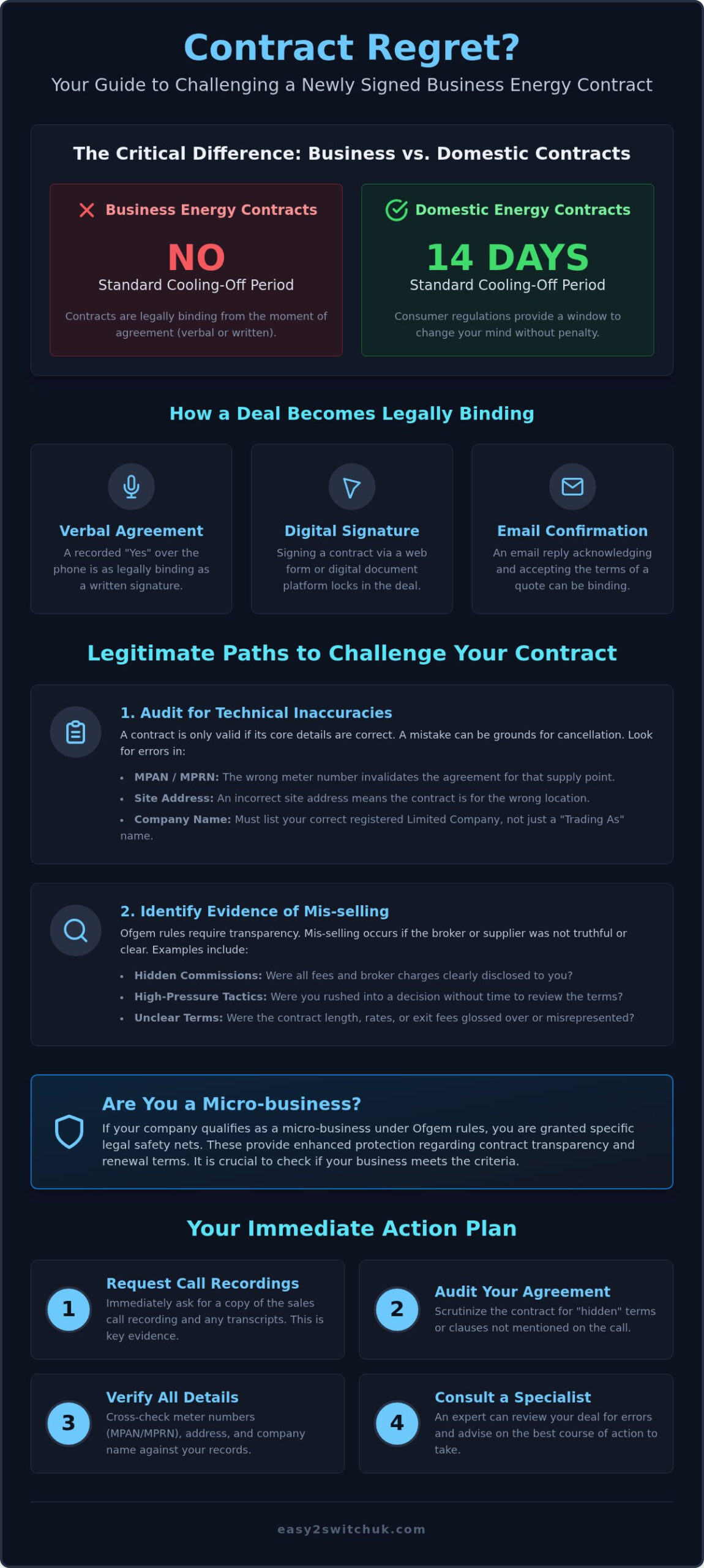
- Understand that unlike domestic energy, business contracts have no automatic cooling-off period, meaning they are legally binding from the point of agreement.
- Learn how to evaluate if you can get out of a business energy contract I just signed by checking for technical errors in meter details or evidence of mis-selling.
- Discover if your company qualifies as a micro-business under 2026 Ofgem rules, which provides specific legal safety nets regarding contract transparency.
- Act immediately by requesting sales call recordings or transcripts to verify that all terms were clearly explained before you committed.
- See how a specialist broker can review your recently signed deal for “hidden” terms or errors, offering a clear path to take control of your energy procurement.
The Hard Truth: Is There a Cooling-Off Period for Business Energy?
If you’ve just agreed to a deal and are now wondering, “can I get out of a business energy contract I just signed?” the immediate answer is usually no. In the UK, there is no statutory Cooling-Off Period for Business Energy. Once the agreement is made, whether it’s through a digital signature or a verbal confirmation over the phone, it becomes a legally binding document. This applies even if you haven’t received a physical copy of the contract yet.
The legal framework governing Business-to-Business (B2B) transactions differs significantly from consumer law. UK regulations assume that business owners possess the necessary expertise to vet contracts and understand commercial risks before committing. This assumption of professional competence means that the law offers fewer protections against “buyer’s remorse.” Unless there’s a specific clause in your supplier’s terms and conditions that allows for a grace period, you’re committed from the moment of acceptance. It’s a stark reality that catches many SMEs and farmers off guard, especially when energy costs account for a massive portion of their overheads.
Domestic vs. Business Energy Rights
Your experience as a domestic consumer doesn’t apply to your commercial energy procurement. At home, you’re protected by the Consumer Contracts Regulations, which typically provide a 14-day window to change your mind. In the commercial sector, this protection vanishes. The “point of no return” for a business energy deal is the instant the supplier accepts your offer. For a farm or a small firm, this means the due diligence must happen before the signature. There is no cooling-off period for micro-businesses either, despite ongoing advocacy from groups like the Federation of Small Businesses for greater protections.
Verbal Agreements and “Letter of Authority” Pitfalls
Many owners are surprised to learn that a recorded phone call is just as binding as a physical contract. If a broker or supplier reads the terms and you agree verbally, the deal is done. Similarly, a Letter of Authority (LOA) is a powerful tool. It allows a broker to act on your behalf to gather data or even sign contracts. If you’ve signed an LOA without clear boundaries, you might find yourself in a contract you didn’t personally sign. Common binding triggers include:
- A recorded verbal “Yes” to a contract summary over the phone.
- A digital signature on a web-based contract form.
- An email confirmation acknowledging the terms of a quote.
Understanding these triggers is the first step in assessing your situation. If you’re asking “can I get out of a business energy contract I just signed” because you feel the process was rushed or unclear, the next step is looking for technical errors or evidence of mis-selling that could invalidate the agreement.
Legitimate Ways to Challenge or Exit a Recently Signed Contract
While the lack of a cooling-off period is a hurdle, a signed document isn’t always an airtight one. If you’re asking, “can I get out of a business energy contract I just signed?” your first move should be a forensic review of the details. Contracts are only valid if the data they contain is accurate and the process used to secure them followed Ofgem’s rules on business energy contracts. If a broker or supplier took shortcuts, you might have a legal path to walk away without penalty.
Checking for Technical Inaccuracies
Technical errors are the most common “get out of jail free” cards in the commercial sector. For a contract to be enforceable, it must correctly identify the supply point. We often see errors in the MPAN (electricity) or MPRN (gas) numbers, especially in the farming industry where multiple meters across different outbuildings can lead to confusion. If the contract lists the wrong meter or an incorrect site address, the agreement is technically flawed. Similarly, if you signed under a “Trading As” name instead of your registered Limited Company entity, the contract may be legally void. Even a significant discrepancy in your Estimated Annual Consumption (EAC) can sometimes be used to challenge the validity of the deal if it was used to provide a misleading quote.
The “Mis-selling” Argument
In the 2026 UK energy market, transparency is a regulatory requirement, not a courtesy. Mis-selling occurs if a broker or supplier provided false information to secure your signature. This includes claiming a deal is “the cheapest on the market” without proof or failing to disclose the commission they earn from the supplier. If you weren’t told about a standing charge increase or were pressured into a five-year deal when you asked for two, you have grounds for a dispute. Using a specialist commercial energy broker to audit your recently signed contract can quickly highlight these compliance failures.
Brokers must follow a strict script during recorded calls. If they skipped sections regarding your right to complain or failed to clearly state the contract’s end date, the agreement’s legitimacy is compromised. In some cases, if the switch hasn’t actually started yet, a supplier might agree to a mutual termination simply to avoid a protracted legal dispute. If you’re feeling trapped by a rushed decision, having an expert review your contract for errors is a sensible, low-friction first step toward taking back control.
Micro-Business Protections: Your Legal Safety Nets
While the commercial energy market is generally less regulated than the domestic sector, Ofgem provides a specific safety net for the smallest entities. If you are currently asking, “can I get out of a business energy contract I just signed?” your first step is to determine if your firm qualifies as a micro-business. In 2026, these businesses enjoy enhanced transparency rules that can provide a legitimate exit route if a supplier or broker failed to meet their regulatory obligations during the sales process.
The primary protection for micro-businesses is the requirement for suppliers to provide “Principal Terms” clearly before any agreement is reached. These terms include the contract duration, any break clauses, and a full breakdown of charges. If these were hidden in the small print or not explained during a recorded call, the contract’s validity is on shaky ground. For a small SME or a family-run farm, this classification is often the most effective tool for challenging a deal that feels restrictive or unfair.
Do You Qualify as a Micro-Business?
To use these legal protections, your business must meet at least one of the following criteria defined by Ofgem for 2026:
- You employ fewer than 10 full-time equivalent employees.
- Your annual turnover or balance sheet total does not exceed €2 million.
- You use no more than 100,000 kWh of electricity per year.
- You use no more than 293,000 kWh of gas per year.
If you fall into this category, brokers must follow the “Transparency Rule.” This means they are legally required to disclose the commission they earn from the supplier as a cost per kWh. If this commission was not disclosed, or if you were misled about the “free” nature of a broker’s service, you have strong grounds for a dispute. It’s a common scenario for small farms where energy usage might be high, but employee counts remain low, making the consumption threshold the key to qualifying for these rights.
Ofgem’s Role in Dispute Resolution
When a direct challenge to a supplier fails, micro-businesses have the right to involve the Energy Ombudsman. By 2026 standards, all brokers must be members of a Qualifying Dispute Settlement Scheme (QDSS). This gives you an independent platform to contest a contract signed under high-pressure tactics or lack of transparency. If you feel you were rushed into a deal without seeing the full terms, you can lodge a formal complaint. The Ombudsman has the power to cancel contracts or award compensation if they find the broker failed to follow the mandatory conduct standards. This process ensures that even if you’ve already signed, you aren’t left without recourse against predatory sales practices.
Immediate Steps to Take If You Regret Your New Contract
If you are currently asking, “can I get out of a business energy contract I just signed?” you must move quickly. In the commercial energy market, time is your greatest enemy. Because there is no statutory cooling-off period, your ability to challenge a deal often depends on identifying procedural errors before the switch progresses too far. Following a structured action plan can help you build a case for termination or renegotiation before the new rates take effect.
- Step 1: Act immediately. Do not wait for the first bill to arrive. The sooner you flag a problem, the more leverage you have.
- Step 2: Request the call recording. If you signed over the phone, ask the broker or supplier for the full audio file or a written transcript. This is vital for checking if they followed mandatory disclosure rules.
- Step 3: Issue a formal “Notice of Dispute.” Send a written objection to both the broker and the supplier stating that you contest the contract’s validity.
- Step 4: Benchmark your rates. Consult an independent energy comparison expert to see how far your new deal sits above the current market average.
- Step 5: Document everything. Keep a log of every email, phone call, and letter sent after the signature date.
Gathering Your Evidence
The first 48 hours are critical for identifying broker non-compliance that could void the agreement. Check your welcome pack or digital confirmation for any discrepancies. Look closely at the “Small Print” for terms that were not mentioned during your initial conversation. If a broker promised you a specific rate but the contract shows a higher standing charge or hidden “service fees,” you have immediate grounds for a dispute. Record the exact timestamps of any high-pressure emails or calls you received, as these can support a claim of aggressive sales tactics under Ofgem’s 2026 conduct standards.
The Formal Dispute Letter
Your objection must be professional and pragmatic to get a result. Use clear phrasing like “I am formally disputing the validity of this contract based on a lack of transparency regarding commission disclosure.” Ensure you CC the supplier, the broker, and keep a copy for potential escalation to the Energy Ombudsman. A well-structured letter shows the supplier that you understand your rights and are prepared to follow the formal complaint process. If you feel overwhelmed by the technical jargon in your new agreement, you can contact Easy2switch for a free contract review to identify any compliance gaps that could help you walk away.
How Easy2switch Helps You Avoid Contract Traps
If you’re currently asking, “can I get out of a business energy contract I just signed?” you’re likely feeling the weight of a decision made under pressure. At Easy2switch UK Ltd, we act as the calm expert who steps in to prevent these high-stress scenarios from happening. By partnering with a specialist business energy broker before you commit, you gain an impartial view of the market rather than a one-sided sales pitch. We identify the hidden terms, such as restrictive exit fees or unannounced standing charge hikes, that frequently lead to buyer’s remorse.
Our specialized focus on the farming industry ensures we understand that a dairy farm or a grain store has vastly different requirements than a standard high-street office. We don’t just look at the unit rate. We analyze your specific usage patterns and verify every technical detail, such as MPAN and MPRN accuracy, before anything is finalized. This “done-for-you” approach eliminates the common errors that often leave business owners searching for legal loopholes in a rush to exit a bad deal.
Total Transparency in Energy Procurement
Transparency is the foundation of our service. While some brokers might hide their fees in complex jargon, we ensure our commissions are clearly understood as part of the supplier’s offer. Our business energy consultants navigate the volatile 2026 market by comparing hundreds of offers from a wide panel of suppliers. This breadth of choice ensures you receive genuine value rather than just the first deal that comes your way. We take the complexity out of procurement, allowing you to focus on running your business while we handle the market variables with professional efficiency.
Securing Your Next Move
If you’re holding a contract you haven’t signed yet, or if you’re worried about one you recently committed to, we offer a free, no-obligation review. We help you understand the legal realities of your situation and identify if there is a legitimate path to a better deal. For our agricultural clients, we specialize in demystifying farm electricity prices, ensuring that seasonal peaks and multi-site meters don’t result in significant overpayment. We make the transition process feel accessible and straightforward, moving you from curiosity to confidence.
Taking control of your energy costs doesn’t have to be a solo effort. Contact Easy2switch UK Ltd for a free contract review and impartial advice to ensure your next energy move is the right one for your firm’s future.
Take Control of Your Business Energy Future
Realizing you might be stuck in a high-rate deal is a significant stressor, but you aren’t without options. While the law doesn’t provide a standard cooling-off period for commercial agreements, technical inaccuracies or failures in broker compliance can provide the leverage you need to challenge a deal. If you’re currently asking, can I get out of a business energy contract I just signed, the answer often lies in the forensic details of the sales process and your specific micro-business classification under 2026 Ofgem rules.
At Easy2switch, we specialize in supporting UK farms and SMEs through these complex market transitions. Our team provides a completely free service with no hidden broker fees, giving you impartial access to over 100 supplier tariffs. We act as your calm specialist, reviewing the fine print to identify errors or mis-selling that others might miss. Get a Free, Impartial Review of Your Energy Contract today to see where you stand. You deserve an energy partner that prioritizes your firm’s independence and financial health. With the right expert support, you can move forward with confidence and clarity.
Frequently Asked Questions
Is there a 14-day cooling-off period for business energy?
No. Unlike domestic energy, there is no statutory cooling-off period for business energy contracts in the UK. Once you agree to the terms, the contract is legally binding immediately. This applies to all business sizes, including micro-businesses, as confirmed by Ofgem regulations in 2026. The only exception is if your specific supplier offers a voluntary grace period in their terms, which is extremely rare in the commercial sector.
Can I cancel a business energy contract if I haven’t signed the paperwork yet?
It depends on whether you have made a verbal agreement. In the UK energy market, a recorded phone call often constitutes a legally binding contract even without a physical signature. If you’ve given verbal consent to the terms during a compliance call, the supplier can legally process the switch. However, if no verbal or digital agreement exists, you can stop the process by notifying the supplier and broker immediately.
What happens if I was mis-sold my business energy contract?
If you believe you were mis-sold, you have the right to lodge a formal dispute. Mis-selling occurs if a broker provided false information, hid commissions, or used high-pressure tactics. You should first follow the supplier’s internal complaints procedure. If the issue remains unresolved after eight weeks, micro-businesses can escalate the case to the Energy Ombudsman. Documenting every interaction is vital when asking, “can I get out of a business energy contract I just signed?”
Can I cancel my energy contract if my business moves premises?
Yes, most business energy contracts include a “Change of Tenancy” clause. This allows you to terminate the contract at your current location without penalty when you legally vacate the site. You must provide proof of the move, such as a lease termination or a sale agreement. While the contract for that specific site ends, your supplier may offer to transfer the agreement to your new location, so check your specific terms.
How much does it cost to exit a business energy contract early?
Early exit fees are typically calculated based on the remaining value of the contract or a fixed penalty per meter. Suppliers often charge for the estimated profit lost on the energy you would have used over the remaining term. For large firms or farms, these costs can reach thousands of pounds. It’s often more cost-effective to identify technical errors or compliance failures in the original agreement rather than paying a standard termination fee.
Does a verbal agreement over the phone count as a legal contract?
Yes, a verbal agreement is a legally binding contract in the UK business energy sector. Suppliers use recorded calls to confirm your identity and acceptance of the rates. Once you say “yes” to the summary of the deal, you are committed. This is why it’s critical to review all figures during the call, as the law assumes businesses have vetted the deal before agreeing to the recorded terms.
What should I do if a broker pressured me into signing a deal?
You should immediately request a copy of the sales call recording and file a formal complaint with the brokerage firm. High-pressure sales tactics violate the 2026 standards of conduct set by Ofgem. If the broker is a member of an Alternative Dispute Resolution scheme, you can seek an independent review. Using a transparent specialist like Easy2switch helps you avoid these traps by providing impartial advice without a pushy sales environment.
How can I tell if I qualify for micro-business energy protections?
You qualify as a micro-business in 2026 if your firm meets one of three criteria: employing fewer than 10 full-time staff, having an annual turnover under €2 million, or using less than 100,000 kWh of electricity per year. If you meet these thresholds, you’re entitled to clearer contract terms and simpler dispute resolution. This classification is a powerful tool if you’re wondering, “can I get out of a business energy contract I just signed?”
