
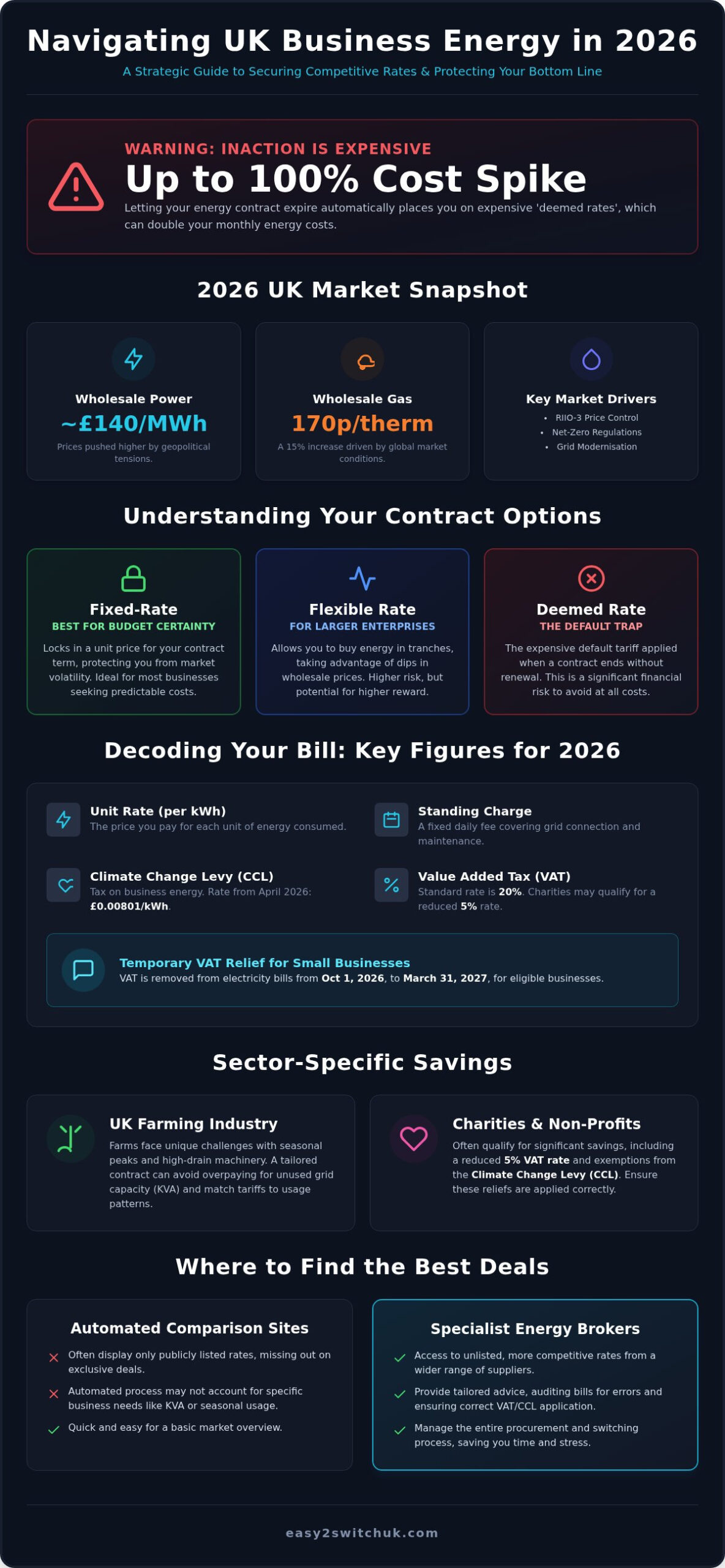
Did you know that letting your current energy contract expire without a plan could see your monthly costs spike by as much as 100%? In a market where wholesale power prices have climbed toward £140/MWh, finding the right business energy deals isn’t just about saving a few pennies; it’s about protecting your bottom line from expensive deemed rates. You’ve worked hard to build your company or farm, so it’s only natural to feel protective over your margins when faced with volatile global markets and complex industry jargon.
We understand that deciphering CCL rates or standing charges feels like a full-time job you didn’t apply for. This guide simplifies the process, showing you exactly how to handle the 2026 UK market to secure competitive gas and electricity rates. We’ll explore the impact of the RIIO-3 price control period, the temporary VAT removal on electricity starting October 2026, and how new Ofgem regulations for brokers are making the industry more transparent. By the end, you’ll have a clear, stress-free strategy to lower your bills and take control of your energy procurement.
Key Takeaways
- Learn how to navigate 2026 market volatility and avoid expensive out-of-contract rates that could significantly impact your business margins.
- Understand why specialist brokers often secure more competitive business energy deals than automated comparison sites by accessing unlisted rates from niche suppliers.
- Discover how to audit your historical usage data and identify peak-time consumption to uncover immediate opportunities for cost reduction.
- Gain clarity on complex bill components like standing charges and CCL rates to ensure your contract aligns with your industry’s specific usage patterns.
- Explore how a done-for-you switching service tailored to farms and charities can manage the entire procurement process from start to finish.
Understanding the 2026 Business Energy Market
Business energy deals are commercial contracts tailored to the specific volume and usage patterns of a company rather than a household. Unlike the domestic market, there’s no government-mandated price cap for businesses. This means your rates are dictated entirely by wholesale market conditions and your ability to negotiate. With wholesale gas prices rising 15% to 170p/therm in late 2026, staying on a default tariff is a significant financial risk that can drain your company’s resources.
The current landscape is defined by geopolitical tension and evolving UK energy policy. Renewed military action between the US and Iran has pushed wholesale power prices toward £140/MWh as of September 2026. Additionally, the transition into the RIIO-3 price control period on April 1, 2026, is driving up non-commodity costs as the grid modernises for net-zero targets. Securing competitive business energy deals requires a proactive approach to these shifting variables to ensure you aren’t overpaying for essential utilities.
Net-zero regulations are no longer just a distant goal; they’re actively shaping commercial energy procurement. Suppliers are increasingly prioritising low-carbon electricity options to meet the UK’s 2050 targets. For businesses, this means that the most competitive rates are often tied to green energy commitments or efficiency improvements. Understanding these policy shifts is essential for any company looking to future-proof their energy strategy while maintaining control over their operational costs.
Fixed vs. Flexible Business Energy Contracts
Fixed-rate deals offer a locked-in unit price for the duration of your contract, providing vital budget certainty when markets are volatile. Conversely, flexible or “pass-through” contracts allow larger enterprises to buy energy in tranches, potentially benefiting when wholesale prices dip. Deemed rates are the expensive default tariffs applied by suppliers when a contract expires without a renewal, often costing up to 100% more than a negotiated plan.
Sector-Specific Energy Needs: Farms and Charities
The UK farming industry faces unique challenges, such as seasonal peaks during harvest and high-drain machinery usage. Charities and non-profits often qualify for a reduced 5% VAT rate and exemptions from the Climate Change Levy (CCL), which is set at £0.00801 per kWh from April 2026. Working with Business Energy Consultants: Securing the Best Commercial Rates in 2026 ensures these specific reliefs are correctly applied to your account.
Key Components of a Competitive Business Energy Deal
Securing the best business energy deals requires more than just looking at the headline price. A commercial quote is built from several moving parts, and focusing on one while ignoring others often leads to unexpected costs. The primary figures you’ll encounter are the unit rate and the standing charge. While the unit rate represents the price you pay for every kWh of gas or electricity consumed, the standing charge is a fixed daily fee that covers the cost of maintaining the connection to the grid. In 2026, finding a balance between these two is vital, especially for businesses with low usage but high connection requirements.
Taxation also plays a major role in your total expenditure. The Climate Change Levy (CCL) is a tax on energy delivered to businesses to encourage efficiency. From April 1, 2026, the main CCL rate for both electricity and natural gas is £0.00801 per kWh. Most companies pay a standard VAT rate of 20%, but some charities and small businesses qualify for a reduced 5% rate. It’s also vital to note that the government has removed VAT from electricity bills from October 1, 2026, to March 31, 2027, for eligible small businesses, providing a temporary but welcome relief. When reviewing your options, Ofgem’s advice for businesses suggests checking for any hidden fees or environmental levies before signing.
Decoding Your Energy Bill
Many suppliers offer quotes that omit “pass-through” costs like transmission and distribution fees, which then appear as surprises on your first invoice. You should also check your KVA, or Available Capacity; this is the amount of power the grid reserves for your site. If your KVA is set too high, you’re paying for capacity you don’t use, which is a common issue for modernised farms. Your MPAN and MPRN numbers act as unique identifiers for your electricity and gas meters, and having them ready is the first step in securing accurate quotes. If you’re unsure about your current charges, a quick review with Easy2switch can help clarify your bill.
Smart Meters and Half-Hourly Settlement
The 2026 smart meter rollout is transforming how commercial rates are calculated. By using half-hourly data, suppliers can offer more accurate billing based on exactly when you use power. This shift allows for better usage monitoring and helps you identify energy-heavy equipment that could be shifted to off-peak times. Preparing your infrastructure for these modern management tools is no longer optional if you want to access the most competitive tariffs available today.
Energy Brokers vs. Comparison Sites: Which is Better for Your Business?
While automated comparison sites promise a switch in minutes, they often lack the depth required for complex commercial contracts. For most companies, the most competitive business energy deals aren’t found on a public dashboard. Automated tools generally only show standard tariffs from a limited pool of suppliers, ignoring the bespoke pricing available through direct negotiation. A specialist broker accesses unlisted rates from niche providers that don’t participate in mass-market comparison engines, ensuring you see the full range of market opportunities.
Transparency is a cornerstone of a reliable brokerage service. In 2026, Ofgem began regulating energy brokers more strictly, introducing a mandatory register and requiring clear disclosure of commission structures. This shift ensures that the advice you receive is impartial and focused on your specific financial goals. According to Ofgem’s advice for businesses, understanding how your intermediary is compensated is a vital step in securing a fair deal. This professional oversight helps demystify the procurement process, turning a complex market into a manageable business asset.
The Advantages of a Managed Switching Process
Administrative tasks are a significant drain on your time. A specialist handles the entire switching process, from gathering historical data to managing the final transition between suppliers. More importantly, they help you avoid the “renewal trap” by tracking your contract end dates months in advance. This prevents you from being rolled onto expensive deemed rates, which we previously noted can double your costs. For more detail on this process, explore our Commercial Energy Broker Guide 2026: Navigating the UK Business Gas and Electricity Market.
Choosing the Right Partner for Your Industry
Generalist brokers often miss the nuances that drive savings in specific sectors. A farm, for example, has vastly different usage patterns than a retail office, requiring a consultant who understands seasonal peaks and machinery demands. You should look for a partner that provides impartial advice across both the “Big Six” and independent suppliers. A reputable UK consultancy won’t just offer a one-size-fits-all solution; they’ll tailor their search to find the individual fit that respects your industry’s unique regulatory exemptions and operational needs.
How to Audit Your Business Energy Usage for Maximum Savings
A thorough energy audit is the first step toward securing more competitive business energy deals. You can’t manage what you don’t measure, so start by gathering 12 months of historical usage data. This annual view is vital for identifying seasonal spikes, such as the heavy demand of grain drying on a farm or increased heating needs in a charity community hall. Once you have this data, look for high-drain equipment that operates during peak tariff times. Shifting even a small percentage of your consumption to off-peak hours can lead to immediate reductions in your monthly expenditure.
The next phase of your audit focuses on the contractual fine print. Check your current contract end date and, crucially, your notice period; missing this window often leads to the renewal trap we discussed earlier. You should begin comparing market rates at least six months before your renewal date. This lead time allows you to lock in rates when wholesale prices dip, rather than being forced to accept whatever is available in a volatile week. If you’re ready to start this process, let our specialists handle the market comparison for you.
Practical Efficiency Wins for Commercial Properties
Implementing efficiency measures doesn’t always require a massive capital investment. Lighting and HVAC systems are the low-hanging fruit of energy reduction; switching to LED bulbs or installing smart thermostats can yield significant savings with a quick payback period. Beyond hardware, behavioral changes are equally important. Engaging your staff in simple habits, like powering down workstations or closing warehouse doors, creates a culture of conservation. For a broader look at how these savings translate across different settings, read our guide on Energy Comparison 2026: How to Secure the Best Rates for Home and Business.
The Role of Renewable Energy in Reducing Costs
For farms and warehouses with ample roof space, solar PV and battery storage are becoming essential tools for energy independence. These systems allow you to generate your own power and store it for use during expensive peak periods. If onsite generation isn’t feasible, green tariffs offer a way to align your environmental goals with financial reality. REGO (Renewable Energy Guarantees of Origin) certificates serve as official proof that the electricity you’ve purchased was generated from authentic renewable sources. This transparency ensures that your “green” deal isn’t just marketing, but a genuine contribution to net-zero targets.
Simplifying the Switch: How Easy2switch Secures Your Energy Future
The Easy2switch mission is built on a simple premise: removing the anxiety and complexity from energy procurement. We know that for a busy farm manager or a charity trustee, spending hours on hold with dozens of different suppliers isn’t a productive use of time. Our specialized focus on the UK farming industry and charities means we already understand the specific relief schemes and seasonal usage profiles that generalist brokers often overlook. By managing the entire “done-for-you” process, we ensure you can focus on your core operations while we secure the most competitive business energy deals available in the 2026 market.
Our process is designed to be efficient and professional. From the initial call where we gather your requirements to the final switch, we handle the administrative heavy lifting. This includes negotiating with a wide panel of providers to find unlisted rates that aren’t available on standard comparison tools. Crucially, our service remains free for our clients. We’re funded through supplier-paid commissions, which means you benefit from our specialist expertise and end-to-end management without any hidden fees or direct costs to your organization. This model ensures our goals are aligned with yours: finding the best possible fit for your specific needs.
What to Expect When You Contact Us
When you reach out to our team, you’ll receive a personalized energy review with no obligation to proceed. We don’t believe in one-size-fits-all solutions; instead, you’re paired with a dedicated consultant who understands the nuances of your sector. Whether you’re managing high-drain agricultural machinery or navigating VAT exemptions for a non-profit, your consultant provides tailored advice. We maintain transparent communication throughout the contract transition, providing regular updates so you’re always informed about the status of your new agreement and the expected start dates.
Taking Control of Your Overheads Today
Taking control of your overheads is about more than just a single transaction; it’s about adopting a proactive energy strategy. By looking ahead and locking in rates before your current deal expires, you avoid the expensive out-of-contract rates that can otherwise double your bills. This long-term approach transforms energy from an unpredictable expense into a controlled variable, providing the budget certainty your business needs to thrive. For a deeper look at planning your next strategic move, explore our Business Energy Comparison 2026: A Strategic Guide for UK SMEs & Farms.
Secure Your Commercial Energy Strategy for 2026
Securing competitive business energy deals requires a proactive approach to a volatile market. By auditing your usage six months ahead and understanding the nuances of standing charges and CCL exemptions, you protect your organization from expensive default rates. Whether you manage a farm with seasonal peaks or a charity eligible for VAT relief, having the right data makes all the difference to your bottom line.
You don’t have to manage this complexity alone. We compare hundreds of offers to find your best fit, providing specialist expertise in farm and charity energy deals with no hidden fees. Our service is 100% free for customers; it’s funded entirely by supplier commissions. Get a free, impartial business energy review from Easy2switch today to take control of your overheads. It’s time to move forward with confidence and clarity.
Frequently Asked Questions
How much can a business save by switching energy suppliers in 2026?
Savings vary based on your annual consumption and current tariff, but businesses often see significant reductions by moving away from expensive out-of-contract rates. In 2026, default tariffs can be as much as 100% higher than negotiated business energy deals. By comparing hundreds of supplier offers, you can identify lower unit rates that match your usage profile, especially if you haven’t switched in several years or are on a rolling monthly plan.
Is it really free to use a business energy broker like Easy2switch?
Yes, our brokerage service is 100% free for the customer to use. We earn a commission directly from the energy supplier you choose to switch to, which is built into the unit price of your energy tariff. This model ensures you receive expert, end-to-end management of your procurement process without any hidden fees or direct costs to your company, farm, or charity, making professional market expertise accessible to everyone.
What is a “Letter of Authority” and why does an energy broker need one?
A Letter of Authority (LOA) is a legal document that gives an energy broker permission to act on your behalf when communicating with suppliers. It doesn’t allow the broker to sign contracts without your consent; instead, it lets them request historical usage data, obtain quotes, and manage administrative queries. This document is essential for a done-for-you service, as it removes the burden of data gathering from your busy schedule.
Can I switch my business energy deal if I am in a fixed-term contract?
You generally cannot leave a fixed-term business contract before its end date without paying a significant termination fee. However, you can often secure your next deal up to 12 months before your current one expires. This proactive approach allows you to lock in competitive rates during market dips, ensuring a seamless transition to your new supplier the moment your existing fixed-term agreement concludes and avoiding expensive rolling rates.
What happens if my energy supplier goes bust after I switch?
If your supplier fails, Ofgem’s Supplier of Last Resort process ensures your energy supply is never interrupted. You will be automatically moved to a new supplier, and any credit balance you have is protected. While your new temporary tariff might be more expensive, you are free to shop around for better business energy deals once the transition is complete, ensuring your operations continue without any technical downtime or loss of power.
How long does the business energy switching process actually take?
While we can often provide competitive quotes within 24 hours, the actual transition between suppliers typically takes between four and six weeks. This timeline includes the necessary administrative checks and meter data transfers between the old and new providers. Starting the process at least six months before your current contract ends is the most reliable way to ensure a stress-free switch without the risk of falling onto expensive deemed rates.
What is the Climate Change Levy (CCL) and can my business be exempt?
The Climate Change Levy (CCL) is an environmental tax on commercial energy use, set at £0.00801 per kWh for electricity and gas from April 2026. Many charities and non-profits qualify for full exemption, while businesses using very small amounts of energy may also be exempt under de minimis rules. Additionally, organizations with a Climate Change Agreement (CCA) can receive significant discounts of up to 92% on their electricity levy.
Do business energy deals have a cooling-off period like residential ones?
No, business energy contracts do not typically include a cooling-off period. Unlike residential tariffs, once a commercial contract is agreed upon, it is legally binding immediately. This is why it is vital to review the terms and conditions carefully before committing. Working with a specialist ensures that you understand every aspect of the agreement, from the unit rates to the contract duration, before anything is finalized for your business.
