
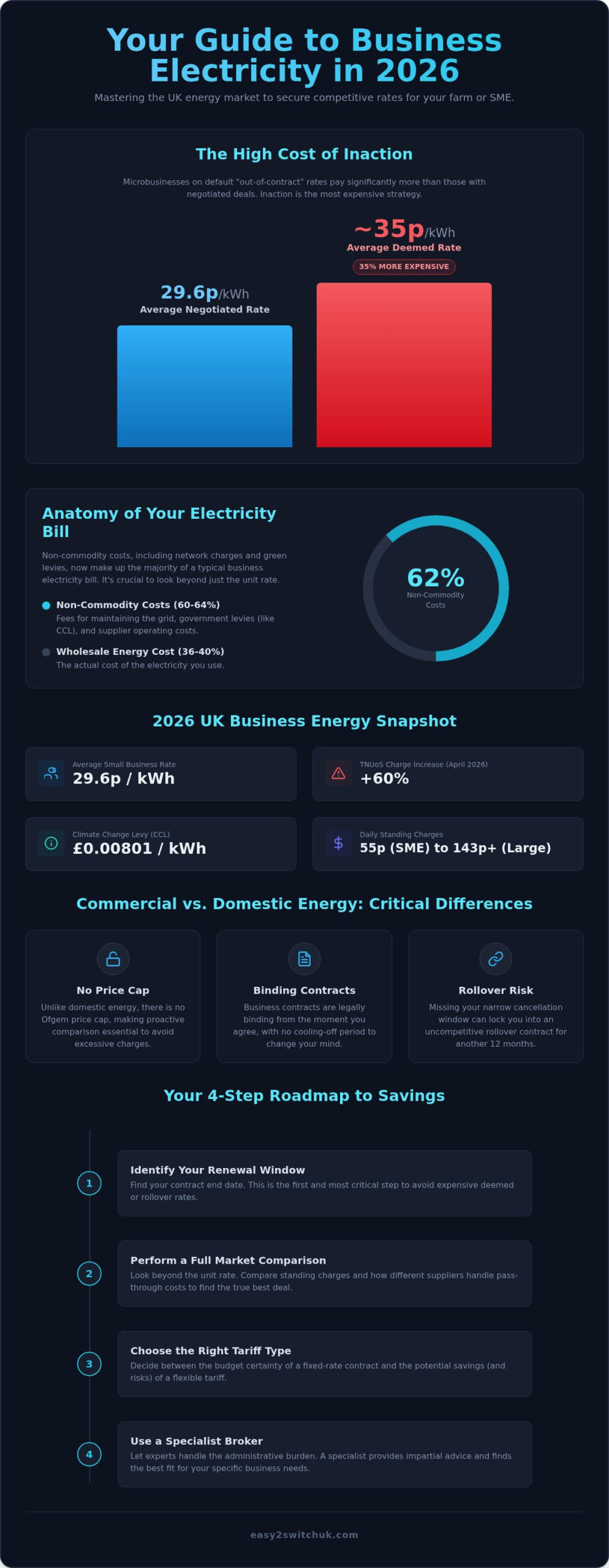
Did you know that microbusinesses on out-of-contract rates in 2026 often pay 35% more for their power than those on negotiated deals? With average small business rates currently sitting at 29.6p per kWh, the financial pressure to find a better deal is significant, yet the process often feels rigged against you. You’re likely exhausted by opaque pricing and the aggressive renewal tactics used by suppliers to keep you locked into expensive arrangements. Performing a thorough business electricity comparison shouldn’t feel like a second job, but between shifting tariff structures and rising non-commodity costs, it’s difficult to know if you’re truly comparing apples to apples.
We understand that you need clear answers and total budget certainty. This guide reveals how to master the complex UK energy market to secure the most competitive rates for your farm or SME in 2026. You’ll learn how to lock in fixed-rate contracts that provide peace of mind, even as network charges fluctuate. We’ll also explain how to lower your Climate Change Levy (CCL) impact and use a simplified switching process handled by experts. From understanding the temporary VAT removal to managing the rollout of half-hourly settlement, we’ll provide the pragmatic steps you need to take control of your commercial energy costs.
Key Takeaways
- Understand why inertia is costly in 2026 and how the lack of a business price cap makes proactive management essential for your bottom line.
- Learn to look beyond the unit rate to identify hidden costs in your standing charge and pass-through fees that can inflate your total bill.
- Discover how a professional business electricity comparison helps you choose between fixed-rate security and the potential rewards of flexible tariffs.
- Get a clear, step-by-step roadmap for switching suppliers that ensures you never miss a renewal window or get stuck on expensive deemed rates.
- See how specialist brokerage services handle the administrative burden for farms and SMEs, providing impartial advice to find the best fit for your specific needs.
Why Business Electricity Comparison is Vital in 2026
Waiting for your renewal letter is a risky strategy in the current climate. In 2026, the UK energy market remains volatile, and staying with your current supplier by default is often a costly mistake. For a small business, the average electricity rate currently sits at 29.6p per kWh, while medium-sized enterprises see averages around 26.3p. However, these figures only tell part of the story. With non-commodity charges now accounting for roughly 60-64% of a typical bill, the actual energy you use is just one piece of the financial puzzle. A proactive business electricity comparison is essential for farms and SMEs to ensure they aren’t overpaying for infrastructure costs and levies that have risen sharply over the last year.
Regular benchmarking protects your bottom line against these market fluctuations. Transmission Network Use of System (TNUoS) charges increased by over 60% in April 2026, hitting high-usage businesses particularly hard. By comparing the market, you can identify suppliers who offer better structures for these pass-through costs. It’s about taking control of your overheads rather than being at the mercy of a single provider’s pricing strategy.
Commercial vs. Domestic Electricity: Key Differences
The most critical distinction for any business owner to understand is the lack of a safety net. Unlike your home energy, there’s no Ofgem price cap to limit what suppliers can charge commercial clients. Business contracts are legally binding from the moment you agree to the terms; there’s no cooling-off period to change your mind later. You also have to manage the Climate Change Levy (CCL), which as of April 1, 2026, stands at £0.00801/kWh. While the government has temporarily removed the 20% VAT on bills from October 2026 to March 2027, charities and low-energy users should still verify if they qualify for the permanent 5% reduced rate. Working with a Specialist Energy Broker can help clarify these tax obligations and ensure your contract is tailored to your specific sector, whether you’re running a busy farm or a local charity.
The Cost of Inaction: Deemed and Rollover Rates
A deemed rate is a default tariff applied when no formal agreement is in place. These are almost always the most expensive way to buy power. In 2026, deemed electricity rates for small businesses average around 35p per kWh, which is roughly 35% higher than negotiated contract rates. If you fall onto these rates, the financial impact is immediate and severe. Rollover contracts are another trap to avoid; they can lock you into uncompetitive pricing for a full 12 months if you miss your narrow cancellation window. For businesses in the agricultural sector, where energy demand is high and margins are often tight, these unnecessary costs can significantly hinder profitability. Identifying your contract end date early is the first step in avoiding these expensive default positions.
Breaking Down Your Commercial Electricity Quote
Opening a commercial energy quote can be a confusing experience. Unlike a domestic bill, a thorough business electricity comparison involves several distinct cost layers that vary significantly between providers. You’ll see two primary figures: the unit rate, which is the price per kilowatt-hour (kWh) of power consumed, and the standing charge, a fixed daily fee for maintaining your connection to the grid. In 2026, finding a balance between these two is vital. A low unit rate might look attractive on paper, but if it’s coupled with a high standing charge, it could be a false economy for low-usage businesses.
Unit Rates vs. Standing Charges
Calculating your total annual cost requires looking at both variables together. For a small business, the average electricity rate is currently 29.6p per kWh with a daily standing charge of 55.3p. However, larger firms often see standing charges as high as 143.1p per day. If your farm or SME has high seasonal usage, you might benefit from a lower unit rate even if the standing charge is slightly higher. Conversely, if your operations are energy-efficient, a lower daily fee should be your priority. To get an accurate picture, multiply your annual consumption by the unit rate and add 365 days of standing charges. This simple sum reveals the true value of any offer.
Hidden Costs: CCL, VAT, and kVA
Your quote also includes non-commodity costs that can account for over 60% of your total bill. The Climate Change Levy (CCL) is a key factor; as of April 1, 2026, the rate is £0.00801/kWh. While many businesses must pay this, some charities or those using very little energy may qualify for exemptions or the 5% reduced VAT rate. You should also watch for capacity charges, often listed as kVA. This is the amount of space you’ve reserved on the local network. Many farms pay for more capacity than they actually use, which adds unnecessary pounds to every bill. If you’re unsure if your current capacity matches your needs, it’s often worth getting a free energy audit to identify potential savings.
Finally, keep an eye on the metering. The rollout of Market-wide Half-Hourly Settlement (MHHS) is well underway in 2026, with 80% of meters expected to be migrated by October. This system provides granular data on when you use power. For larger commercial users, this data is the secret to securing better rates, as it allows suppliers to offer tariffs that reflect your actual consumption profile rather than generic estimates. Ensuring your quote reflects your real-world data during your business electricity comparison is the only way to guarantee a fair deal.
Comparing Fixed, Variable, and Flexible Tariffs
Selecting the right tariff is just as important as finding a low rate. When you perform a business electricity comparison, you’ll generally choose between three main contract types, each with its own risk profile. Fixed-rate tariffs are the most popular choice for SMEs in 2026, as they lock in the unit price for 1 to 3 years. This provides a vital shield against wholesale market volatility and the rising non-commodity costs that now make up over 60% of most bills. While variable-rate tariffs allow you to benefit if market prices drop, the lack of a price cap means your costs could skyrocket without warning. For high-volume users like large dairy farms or manufacturing plants, flexible procurement allows you to buy energy in “tranches” throughout the year, spreading the risk and potentially securing lower average prices.
Green tariffs are also becoming more accessible in 2026. While these were once significantly more expensive, the gap has narrowed as renewable infrastructure expands. Many businesses now use green contracts to meet sustainability targets while managing commercial reality. However, it’s essential to check the “transparency” of these deals to ensure the power is truly from renewable sources rather than just offset by certificates. Balancing these options requires a clear understanding of your business’s risk appetite and long-term budget goals.
The Case for Fixed-Rate Contracts
For most small businesses, peace of mind is the priority. A fixed-rate contract ensures that your unit price remains the same regardless of what happens in the global energy market. In a year where Transmission Network Use of System (TNUoS) charges have increased by over 60%, having a predictable base rate is a significant advantage for financial planning. You won’t have to worry about sudden price hikes during the winter months, allowing you to focus on running your business. While you might miss out on occasional market dips, the protection against a 35% jump to deemed rates makes fixed deals the reliable choice for the majority of UK SMEs.
Specialist Tariffs for Agriculture and Industry
Farms and industrial sites have unique consumption patterns that generic tariffs often ignore. Seasonal peaks, such as harvest time or calving seasons, mean your energy demand can fluctuate wildly. Specialist agricultural tariffs are designed to accommodate these shifts, often offering better rates for businesses with high off-peak usage. If your business operates across multiple locations, multi-site contracts can simplify your administration by aligning all your meters under a single renewal date. For a deeper look at how to align these choices with your broader strategy, consult our Business Energy Comparison 2026 guide. This tailored approach ensures that your business electricity comparison accounts for the specific operational demands of your sector rather than just picking a one-size-fits-all solution.
The Step-by-Step Guide to Switching Suppliers
Switching your energy provider isn’t the administrative nightmare many business owners fear. It’s a structured process that, when handled correctly, protects you from expensive rollover rates. By following a clear roadmap, you can move from an uncompetitive tariff to a deal that better suits your current consumption needs. The process typically takes between two to six weeks, so starting early is the best way to ensure a seamless transition.
- Step 1: Locate your most recent bill to identify your contract end date. This date is the anchor for your entire switching strategy.
- Step 2: Use your usage data to perform a comprehensive business electricity comparison. You should look beyond the “Big Six” suppliers, as independent providers often offer better rates for specialist sectors like agriculture or charities.
- Step 3: Issue a formal termination notice to your current supplier. Doing this early prevents them from automatically rolling you onto a new 12-month contract at uncompetitive prices.
- Step 4: Review your new offer and sign the contract. Most providers now use electronic signatures to ensure the transition happens as quickly as possible.
- Step 5: Provide a final meter reading on the day of the switch. This ensures your closing bill from the old supplier and opening bill from the new one are perfectly aligned.
What Information Do You Need to Start?
To get an accurate quote, you’ll need your Meter Point Administration Number (MPAN). This is a unique 21-digit number found on your bill, usually in a box starting with a large ‘S’. You also need your annual consumption data in kWh. Looking at your last 12 months of usage provides the most reliable baseline, especially for farms with seasonal demand peaks. Knowing your current notice period is equally important; missing this window can delay your switch by several months and leave you stuck on expensive deemed rates.
Managing the Transition Without Disruption
A common concern for business owners is the fear of losing power during the switch. This is a myth. Your electricity travels through the same physical cables regardless of who bills you, so there’s zero risk of a cut-off. To make the process even smoother, you can sign a Letter of Authority (LOA). This document allows a specialist to communicate with suppliers on your behalf, handling the technical queries and paperwork that usually cause delays. This ‘done-for-you’ approach removes the administrative burden, allowing you to focus on your daily operations while experts manage the procurement. If you’re ready to take control of your overheads, you can use our free switching service to find the best market rates without the hassle.
The Advantage of Using a Specialist Energy Broker
While automated comparison sites are a popular starting point for domestic users, they often fail the “apples to apples” test required for commercial contracts. These platforms typically prioritise the lowest unit rate while ignoring the complexities of standing charges, capacity requirements, and non-commodity levies. A thorough business electricity comparison requires a human eye to spot terms that might look attractive in a table but prove expensive in practice. By working with a specialist, you gain access to impartial advice that focuses on the most appropriate deal for your specific operational needs rather than just the first result on a spreadsheet.
One of the primary benefits of this approach is the “free to user” model. Easy2switch UK Ltd operates as an independent consultancy where the service is funded through supplier commissions. This means you receive professional market analysis and a “done-for-you” switching process without any direct cost to your business. It removes the financial barrier to expert procurement, ensuring that even small SMEs and local charities can benefit from the same market intelligence as large corporations.
Bespoke Solutions for Farms and Charities
Agricultural energy needs are rarely standard. Whether you’re managing the high seasonal loads of grain drying or the constant demand of dairy refrigeration, your consumption profile is unique. A generic comparison site won’t account for these peaks, potentially placing you on a tariff that penalises high usage during harvest. Our Business Energy Consultants specialise in these high-usage sectors, ensuring your contract reflects your real-world activity. For charities, this expertise is equally vital. We help organisations navigate VAT exemptions and identify suppliers who offer lower standing charges for non-profit sites, protecting limited budgets from unnecessary drain.
Taking Control of Your Energy Future
Using a broker allows you to move from a reactive “crisis” mode of energy management to a proactive strategy. Instead of scrambling to find a deal when a renewal letter arrives, you have a partner who monitors the market year-round. This relationship provides a layer of reassurance that is missing from automated platforms. If a supplier dispute arises or a billing error occurs, you don’t have to spend hours on hold with a corporate call centre. Your broker handles the administrative heavy lifting, acting as a reliable specialist who knows your account history and your business goals. It’s about more than just a transaction; it’s about taking control of your overheads with a partner you can trust. Contact Easy2switch today for a free energy review and see how much your farm or SME could save in 2026.
Secure Your Commercial Energy Future in 2026
Managing commercial power costs in 2026 requires more than just checking a single unit rate. You’ve seen how shifting non-commodity charges and the total lack of an Ofgem price cap make a proactive approach essential for your stability. By performing a regular business electricity comparison, you protect your SME or farm from the immediate financial shock of deemed tariffs and the trap of automatic rollover contracts. Taking control of your procurement now ensures that your business remains resilient against future market volatility.
You don’t have to handle this complex transition alone. Easy2switch UK Ltd provides direct access to hundreds of commercial energy tariffs, backed by deep expertise in the UK farming industry and specialist sectors. Our independent consultants offer free, impartial advice to help you find the most appropriate deal for your specific operational needs. We handle the administrative heavy lifting so you can focus on running your business with total budget certainty. Take control of your energy costs with a free Easy2switch comparison. It’s time to move from market anxiety to long-term financial independence; we’re here to make that process effortless.
Frequently Asked Questions
Is business electricity cheaper than domestic electricity?
Commercial unit rates are often lower than domestic rates because businesses typically consume higher volumes of power. However, the lack of an Ofgem price cap means you’re more exposed to market volatility. You also need to account for higher standing charges and the Climate Change Levy. While domestic users pay 5% VAT, businesses usually pay 20%, though temporary government relief in 2026 has altered this landscape for many firms.
How long does it take to switch business electricity suppliers?
The process of switching business electricity suppliers typically takes between two to six weeks. This timeline depends on how quickly your current provider processes the termination notice and how soon the new supplier can take over the meter. It’s best to start your business electricity comparison at least three months before your current contract ends. This buffer ensures you avoid expensive out-of-contract rates if any administrative delays occur during the transition.
Do I need a smart meter to compare business electricity rates?
You don’t strictly need a smart meter to compare rates, but having one provides the granular data needed for the most accurate quotes. In 2026, the rollout of Market-wide Half-Hourly Settlement means 80% of meters are migrating to advanced systems. These meters allow suppliers to offer tariffs based on your actual consumption patterns rather than estimates. If you’re still using a traditional meter, you can use your last 12 months of bills to provide a consumption baseline.
What happens if my current energy supplier goes bust?
If your supplier fails, Ofgem will appoint a Supplier of Last Resort to take over your account. Your power supply won’t be interrupted, and any credit balance is usually protected. However, you’ll likely be placed on a deemed tariff, which is significantly more expensive than a negotiated contract. Once the new supplier is appointed, you should immediately conduct a business electricity comparison to move off the default rate and secure a competitive fixed-term deal.
Can I switch my business electricity if I am in a fixed-term contract?
Most business energy contracts are legally binding for their full term, so you cannot switch until you enter your renewal window. This window typically opens one to six months before your contract expires. If you try to leave early, you’ll likely face heavy exit fees or find the switch is blocked by your current supplier. It’s vital to track your end date so you can issue a termination notice and arrange a new contract to start seamlessly.
What is a Letter of Authority (LOA) and why is it needed?
A Letter of Authority is a simple legal document that gives a broker permission to act on your behalf with energy suppliers. It allows us to request your usage data, manage termination notices, and negotiate better rates without you needing to be on every phone call. You retain full control over the final decision; the LOA simply removes the administrative burden. It’s a standard tool that streamlines the procurement process for busy farm owners and SME directors.
How much commission do business energy brokers charge?
Easy2switch UK Ltd provides a service that is free for the end-user. We earn a commission directly from the energy supplier you choose to switch to, which is built into the unit rate of the tariff. This model ensures that you get professional consultancy and a done-for-you switching process without any upfront costs or hidden fees. We provide impartial advice from hundreds of supplier offers to ensure you find the most appropriate fit for your specific business needs.
Can I compare business electricity if I have multiple sites?
Yes, comparing rates for multiple sites is an excellent way to simplify your energy management. We can look for multi-site contracts that align all your properties under a single renewal date and one supplier. This approach is especially beneficial for agricultural businesses with several land parcels or SMEs with multiple branches. It reduces paperwork and often gives you more bargaining power with suppliers because of your combined total consumption across all your different locations.
