
Your business energy contract does not follow your company when you relocate; it legally binds to the physical meter on the wall. If you are wondering what happens if I move business premises mid-contract, the reality is far less punitive than you might expect. Relocating an operation is stressful enough without the dread of early exit penalties or breach charges hanging over your balance sheet.
Most suppliers recognise that vacating a property legally triggers a contract release, but you must satisfy strict evidentiary rules to avoid ongoing liability. In this guide, you will discover exactly what happens to your utility agreements during a move, how to complete Change of Tenancy paperwork accurately, and how to dodge punitive deemed electricity rates that average around 35p per kWh at new sites. We’ll walk through the exact handover timelines, meter reading protocols, and steps to secure competitive commercial power from day one.
Key Takeaways
- Understand what happens if I move business premises mid-contract, including why agreements attach to physical meters rather than your trading entity.
- Discover the legal differences between porting your existing commercial supply contract and executing a clean early exit.
- Master the critical 14 to 30 day Change of Tenancy timeline and gather the exact proof documents required by UK suppliers.
- Protect your company from paying inflated deemed electricity rates and surging standing charges the moment you collect your new keys.
- Learn how partnering with a commercial energy brokerage removes administrative burdens by handling supplier handovers and securing competitive incoming rates.
What Happens to Your Commercial Energy Contract When You Move?
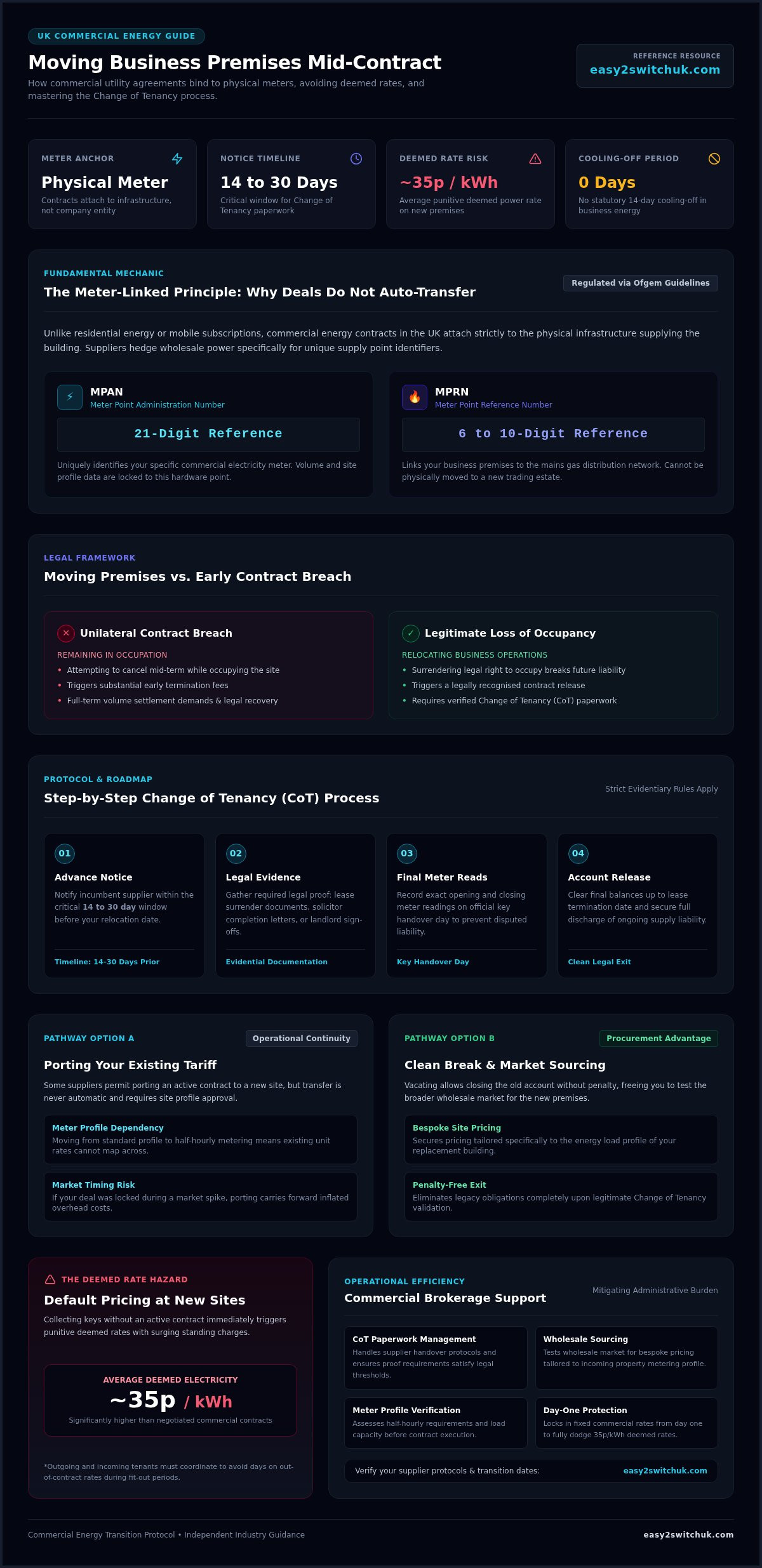
When business leaders ask what happens if I move business premises mid-contract, they often assume corporate utility deals work like mobile phone subscriptions. In the domestic energy sphere, you can frequently carry a tariff along with you to a new flat. Commercial supply agreements operate under entirely different legal mechanics governed by guidelines from the UK energy regulator Ofgem. In the business sector, your utility contract does not belong to your company name or legal entity. It attaches strictly to the physical infrastructure supplying the building.
Because the contract governs a precise piece of hardware, surrendering your legal right to occupy that building fundamentally changes your commitments. Once your lease terminates or the property sale completes, your operational connection to that meter ceases. Under standard commercial contract law, this genuine loss of occupancy breaks your ongoing liability for power delivered after the handover date.
The Meter-Linked Principle: MPAN and MPRN Explained
Every commercial property in the UK features unique identifier numbers that anchor its utility agreements to the grid:
- MPAN (Meter Point Administration Number): A 21-digit reference that identifies your specific commercial electricity meter.
- MPRN (Meter Point Reference Number): A 6 to 10-digit number that links your premises to the mains gas distribution network.
Suppliers hedge wholesale volume specifically for that individual MPAN or MPRN based on historical site profile data. You cannot physically drag that profile or meter connection to a new trading estate across town. Consequently, an agreement tied to an existing shop, farm, or workshop cannot automatically transfer to your replacement facility.
Moving Premises vs Early Contract Breach
Business contracts contain no statutory 14-day cooling-off windows, and suppliers aggressively pursue firms that walk away without cause. However, leaving because of relocation is fundamentally different from a contract breach:
- Unilateral breach: Attempting to cancel mid-term while remaining in occupation triggers early termination fees, legal recovery, or full-term volume settlement demands.
- Legitimate vacation: Ending occupancy via an official move legally releases you from future supply obligations at that MPAN or MPRN.
Understanding what happens if I move business premises mid-contract boils down to proof. Landlords typically stipulate that outgoing tenants must clear utility balances up to the lease end date. Energy providers will not simply accept a phone call stating you have vacated; you must satisfy their Change of Tenancy (CoT) evidential threshold with verifiable legal documentation to discharge your liability cleanly.
Options for Your Energy Supply When Relocating Business Premises
Once you understand that contracts attach to physical meters rather than your trading name, the question of what happens if I move business premises mid-contract shifts toward strategy. You essentially face two distinct commercial pathways: porting your current deal or executing a clean break to source a new tariff.
Neither path is universally superior. The right choice depends on the energy profile of your replacement building, prevailing wholesale rates, and your operational capacity during the move.
Porting Your Existing Commercial Energy Tariff
Some suppliers permit businesses to “port” an active contract to a new site, but this is never automatic. Suppliers review the incoming property’s load capacity and metering setup before agreeing. For instance, if you move from an office with a standard profile meter into a light manufacturing unit requiring half-hourly metering, the supplier cannot simply map your old unit rates across.
Porting works best when maintaining operational simplicity is your primary goal. Keeping your incumbent supplier lets you preserve existing billing arrangements and account management structures, which can reduce headaches during an otherwise chaotic transition. However, if your current rate was locked during a market spike, carrying it forward could lock in uncompetitive overheads.
Closing the Old Account and Sourcing a New Agreement
For most organisations, relocating presents a clean break and a lucrative procurement opportunity. Vacating the property allows you to close the old account without penalty, freeing you to test the broader wholesale market for your new site’s specific profile.
Rather than accepting whatever default arrangements exist at your new building, going out to market lets you secure bespoke pricing tailored to the premises. Fixed contracts for small businesses frequently offer substantial savings compared to inherited default tariffs, particularly when non-commodity charges account for over 60% of delivered electricity costs. Consulting a comprehensive commercial energy broker guide provides clarity on how wholesale timing influences these procurement decisions.
If you prefer an independent specialist to evaluate both options and negotiate with suppliers on your behalf, speaking with Easy2switch UK can streamline the entire process while keeping administrative friction to a minimum.
Step-by-Step Change of Tenancy (CoT) Process and Checklist
Timing dictates everything when releasing your business from an active utility deal. When considering what happens if I move business premises mid-contract, many directors assume informing the supplier a few days before departure is sufficient. In reality, most commercial suppliers demand between 14 and 30 days of written notice prior to your vacation date. Miss that window, and you risk remaining legally liable for standing charges and ongoing consumption long after you have handed back the keys.
Executing an orderly transition requires treating utility administration as a core legal workstream rather than an afterthought. Following a rigorous verification process prevents expensive billing overlaps between incoming and outgoing parties.
Mandatory Documentation Required by UK Energy Suppliers
Energy providers do not cancel agreements on good faith. To release your liability, their change-of-tenancy validation teams require concrete documentary proof showing you no longer possess operational control over the site:
- Proof of tenancy end: A formal deed of surrender, a certified copy of your lease assignment, or an official completion statement from your conveyancing solicitor.
- Landlord or agent verification: Full names, trading addresses, phone numbers, and email contacts for the landlord or managing agent reclaiming control.
- Entity validation: Your Companies House registration number, trading address, and new registered billing address for receiving the final reconciliation statement.
Handover Day Protocol: Final Meter Readings and Settlement
Disputes frequently arise when incoming occupants run high-draw machinery or heating systems before registering their own accounts. You can prevent this liability by establishing an indisputable audit trail on completion day.
Photograph every meter face on the exact day of legal handover, ensuring the serial number and numerical registers are razor sharp. Submit these figures directly to your provider alongside your signed inventory or CoT handover sheet. This guarantees your final invoice covers precisely what your business consumed, ending your financial exposure cleanly.
Managing Shared Meters, Sub-Meters, and Agricultural Sites
Complex real estate creates additional hurdles during handovers. Multi-let commercial properties, rural enterprises, and light industrial parks frequently rely on private sub-meters or unmetered landlord distribution networks. Navigating these setups requires matching master supply records with private check-meter splits to avoid subsidising neighbouring units. For rural enterprises handling diversified barns, workshops, and farmhouses, reviewing sector trends in farm electricity prices UK helps identify how sub-meter arrangements impact overall operational costs.
Mastering these logistical checkpoints ensures you navigate what happens if I move business premises mid-contract without absorbing avoidable residual overheads.
The Danger of Deemed Rates at Your New Commercial Property
Opening the front doors of your new site without an active commercial energy agreement triggers an immediate financial trap known as deemed rates. Under the Electricity Act 1989 and Gas Act 1986, suppliers automatically place any incoming occupant who consumes power without an explicit contract onto statutory default terms. When planning what happens if I move business premises mid-contract, sorting out your new premises before move-in day is just as critical as exiting your old building cleanly.
The positive news is that statutory regulations protect your agility here. Unlike fixed agreements, you aren’t tied into a lock-in period on deemed terms, meaning you have the legal right to switch suppliers immediately without paying exit fees.
Why Deemed and Out-of-Contract Tariffs Are So Costly
Commercial energy enjoys no protective consumer price cap. Suppliers charge premium deemed rates to cover the unpredictable risk of powering a business whose credit score, trading volume, and operational patterns they don’t yet understand.
The financial difference is significant:
- Deemed unit rates: Deemed electricity rates for small firms average around 35p per kWh, whereas fixed-rate commercial contracts often price under 25p per kWh.
- Out-of-contract extremes: Uncontracted electricity can climb to 40.0p per kWh with daily standing charges hitting 254.0p, while out-of-contract gas sits near 12.0p per kWh with standing charges reaching 338.0p per day.
- Cash flow shock: Small businesses pay roughly 36% more for electricity and 27% more for gas simply by letting accounts drift onto out-of-contract rates.
Coupled with April 2026 increases in Transmission Network Use of System (TNUoS) charges, paying default standing charges severely damages initial operating margins.
How to Identify the Existing Supplier at Your New Premises
Escaping deemed rates requires locating the incumbent supplier quickly. You can ring the regional Distribution Network Operator (DNO) covering the property to trace the MPAN and identify the registered electricity supplier. For mains gas, the national Find My Supplier portal retrieves your MPRN and current shipper within minutes.
Once you hold those meter details, running a thorough business energy comparison empowers you to look beyond the default supplier and assess competitive tariffs across the wider commercial market. To lock in fixed rates before your lease begins and avoid punitive holding charges entirely, request a free commercial energy review with Easy2switch to secure the best available market rates.
How Working with an Energy Broker Streamlines Your Business Move
Relocating an entire commercial enterprise tests internal operations to their limit. Juggling IT infrastructure, logistics, staff reassignments, and customer communications leaves precious little time to manage utility bureaucracy. When corporate teams try to resolve what happens if I move business premises mid-contract in-house, they routinely lose dozens of productive hours chasing call centre queues, deciphering contradictory supplier forms, and disputing overlapping invoices.
Working with an independent specialist transforms this chaotic experience into a controlled, hands-off workflow. Because UK commercial energy brokerages operate through supplier-funded commissions, businesses, farms, and non-profits access comprehensive procurement and migration management without paying direct service fees.
Outsourcing Change of Tenancy Administration and Supplier Disputes
The administrative burden of a commercial move goes far beyond sending a brief email. Energy retail providers frequently raise technical objections, question the validity of lease assignments, or misplace handover documentation, leaving businesses exposed to ongoing liability.
A dedicated broker steps in as your direct liaison, managing the entire documentation pipeline:
- Submitting complete Change of Tenancy evidence packs directly to senior supplier validation teams.
- Resolving erroneous supplier objections before they halt your account closure.
- Auditing final closing invoices against your photographic handover readings to prevent overcharging.
- Managing communication between landlords, legal teams, and incoming occupants to confirm exact cut-off points.
Securing Optimal Gas and Power Contracts Before Moving Day
The greatest commercial advantage of partnering with an independent broker lies in advance procurement. Instead of arriving at your new premises under the shadow of default rates, a broker accesses live wholesale tariffs across major UK suppliers months before your lease begins. With non-commodity charges now making up 60% to 64% of typical power bills, having an expert analyse time-of-use patterns and network costs is essential.
An expert broker maps your anticipated operating hours to appropriate tariff structures, ensuring supply begins cleanly on day one. When you compare gas suppliers and power deals across the whole market, you turn what could be a disruptive administrative headache into a proactive cost-reduction project for your incoming site.
Take Control of Your Commercial Energy Relocation
Navigating what happens if I move business premises mid-contract doesn’t need to disrupt your commercial momentum. Because business energy contracts bind to physical meters rather than your trading company, an official move grants you a legitimate exit. Serving proper written notice, compiling certified lease documentation, and recording timestamped meter readings ensures you leave past liabilities behind without penalty.
Relocation also presents an ideal opportunity to reset your utility overheads before default deemed tariffs take effect at your new site. Rather than losing days to bureaucratic paperwork and call centre queues, let an independent specialist oversee the transition. You can let Easy2switch handle your business move and secure better energy rates across leading UK energy suppliers. Our commercial energy brokerage delivers end-to-end Change of Tenancy management and competitive tariff procurement at no direct cost to your business through transparent supplier-funded commissions, giving you total peace of mind to focus on your new premises.
Frequently Asked Questions
Can my energy supplier charge me an exit fee if I move premises mid-contract?
No, energy suppliers cannot charge early termination fees if you genuinely relocate, provided you supply valid Change of Tenancy documentation. Because commercial energy contracts bind to the physical meter rather than your trading business, surrendering your legal occupancy extinguishes your supply liabilities at that address without trigger breach penalties.
How much notice must I give my commercial energy supplier before moving?
Most commercial suppliers in the UK require between 14 and 30 days of written notice before your official move date. Giving short notice or simply abandoning the meter risks leaving your business liable for ongoing daily standing charges and unauthorized consumption by future occupants until the supplier processes the vacation.
Can I transfer my existing business energy contract to my new building?
Sometimes, but porting an agreement isn’t guaranteed. When evaluating what happens if I move business premises mid-contract, suppliers will only permit a transfer if your new property matches the meter configuration, operational profile, and capacity of your previous site. If the incoming property features different metering or consumption requirements, you must arrange a new contract.
What documents do I need to submit for a Change of Tenancy?
Suppliers require formal legal evidence proving you no longer occupy the property. Acceptable documents include a signed deed of surrender, a certified lease assignment, an official completion statement from your conveyancing solicitor, or a signed letter from the commercial landlord confirming the date keys were surrendered alongside your final meter readings.
What happens if the previous tenant left an energy debt on the meter?
You aren’t responsible for utility debt incurred by prior occupants. In the commercial energy sector, debts belong strictly to the legal entity that consumed the power. Submitting your tenancy agreement and a photographic opening meter reading establishes a clean audit trail, forcing the supplier to pursue the historical account holder independently.
How do I avoid paying deemed energy rates when entering a new property?
The simplest way to avoid deemed rates is to negotiate a fresh commercial contract before your official handover day. Trace the property’s MPAN or MPRN in advance, compare wholesale tariffs across the market, and align your new contract start date with your lease commencement so you never draw uncontracted power.
Can a commercial energy broker manage the relocation process for me?
Yes, an independent broker can oversee the entire migration from start to finish. If you aren’t sure what happens if I move business premises mid-contract, brokers like Easy2switch manage Change of Tenancy paperwork, resolve supplier disputes, and procure competitive incoming contracts across major UK providers at no direct fee via supplier-paid commissions.
