
Most commercial tenants believe their energy bills are a fixed cost dictated by their landlord, but that assumption is often costing them thousands of pounds every year. If you’re looking to complete a commercial tenant switch energy supplier UK move, you might feel held back by confusing lease clauses or the fear of landlord friction. It’s frustrating to feel locked into a “default” rate while your overheads continue to climb, especially when you want to focus on growing your business rather than decoding utility contracts.
The reality is that your business has more power than you might think. This guide shows you exactly how to reclaim control over your utility costs under the latest 2026 Ofgem regulations. You’ll discover how to lower your monthly bills and secure better terms, even if you don’t own the bricks and mortar of your premises.
We’ll break down your legal rights regarding sub-metering and the Maximum Resale Price rules. We also explain how to manage landlord relationships professionally and show you how a specialist brokerage can handle the transition for you at no upfront cost. By the end, you’ll have a clear, stress-free path to a better deal and lower overheads.
Key Takeaways
- Confirm your legal right to choose your provider; if you pay the energy company directly, you can initiate a commercial tenant switch energy supplier UK process to lower your overheads.
- Understand the Maximum Resale Price (MRP) rule which legally prevents landlords from making a profit on the energy they sell to sub-metered tenants.
- Learn how to identify and escape “deemed rates,” the expensive default pricing that often applies when you first move into a new commercial premises.
- Follow a practical 5-step checklist to gather your meter data and review lease clauses, ensuring a smooth transition without landlord friction.
- Discover how to use a professional energy consultancy to manage the entire switching process for you with zero upfront fees or hidden charges.
Understanding Your Rights: Can a Commercial Tenant Switch Energy?
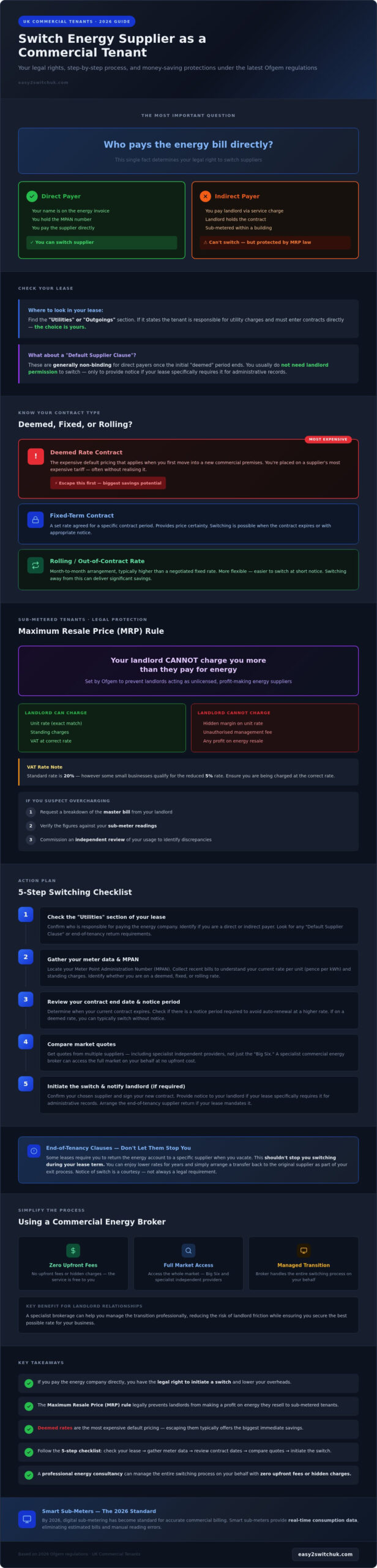
If you’re wondering whether you can legally initiate a commercial tenant switch energy supplier UK process, the answer depends on one simple factor: who pays the bill? The primary rule in the UK is that the party responsible for paying the energy company has the legal right to choose that supplier. If your business name is on the invoices sent by an energy company, you are the customer of record. This means you aren’t tied to the landlord’s choice, regardless of what a “preferred supplier” clause in your lease might suggest.
Identifying your “responsibility for supply” is the first step. You’ll find this in the “Utilities” or “Outgoings” section of your commercial lease. If the lease states that the tenant is responsible for all utility charges and must enter into contracts with providers directly, the choice is yours. Landlords sometimes include a “Default Supplier Clause” to ensure the lights are on when a new tenant moves in. However, these clauses are generally non-binding for direct payers once the initial “deemed” period ends. In most cases, you don’t need the landlord’s permission to switch if you are the account holder; you only need to provide notice if your lease specifically mandates it for administrative records.
Direct Payer vs. Indirect Payer
Distinguishing between these two statuses is vital because it dictates your path to savings. A direct payer has a contract with a member of the energy supply market, whether that’s a “Big Six” firm or a specialist independent provider. You receive the bill, you pay the supplier, and you hold the Meter Point Administration Number (MPAN). An indirect payer, conversely, pays the landlord for energy via service charges. In this scenario, the landlord holds the contract. While you can’t switch the supplier yourself, you still have legal protections regarding how much the landlord can charge you.
The “End of Tenancy” Requirement
Some leases include a clause requiring you to return the energy account to a specific supplier when you vacate. While this sounds restrictive, it shouldn’t stop you from switching during your lease term. You can enjoy lower rates for years and simply arrange a transfer back to the original supplier as part of your exit process. Notice of switch is a courtesy, not always a legal requirement.
Tenant Electricity Sub-Metering Regulations UK: What the Law Says
Sub-metering occurs when a landlord takes a single mains energy supply and distributes it across several commercial units within one building. This setup is common in shared office blocks, industrial estates, and retail parks. While you might not be able to perform a commercial tenant switch energy supplier UK move directly if you are sub-metered, you are protected by strict legal frameworks. Your landlord acts as a reseller, not a provider, which means they must follow specific rules regarding how they pass those costs on to you.
Transparency is the cornerstone of these regulations. You have a legal right to see the original bill the landlord received from their supplier. This ensures that the costs you are paying reflect the actual market rates. Landlords can legally recover the unit cost of the energy, the standing charges, and VAT at the appropriate rate (usually 20%, though some small businesses qualify for 5%). They cannot, however, use your energy consumption as a secret profit centre. If you feel your bills are higher than they should be, an independent review of your usage can often reveal where the discrepancies lie.
Maximum Resale Price (MRP) Protections
The Maximum Resale Price (MRP) is a regulation set by Ofgem to prevent landlords from acting as unlicensed, profit-making energy suppliers. Under these Ofgem energy supplier regulations, the person reselling the energy cannot charge more than they paid for it. In a commercial setting, this means the unit rate you pay must match the rate the landlord is charged by their chosen provider. If a landlord adds a “hidden margin” or an unauthorised management fee to your pence-per-kWh rate, they are likely in breach of these rules. If you suspect you are being overcharged, your first step is to request a breakdown of the master bill to verify the figures against your sub-meter readings.
Smart Sub-Meters and Data Access
By 2026, the shift toward digital sub-metering has become the standard for accurate commercial billing. Smart sub-meters provide real-time consumption data, which eliminates the friction of estimated bills and manual reading errors. This data is essential for your business to verify invoices and identify energy-saving opportunities. Access to this information is a key part of modern business energy comparison strategies. When you have clear data, you can approach your landlord with facts rather than guesses. If your current sub-metering feels outdated or opaque, you might want to consult a specialist at Easy2switch UK Ltd to understand your options for better transparency and fairer rates.
Identifying Your Contract Type: Deemed, Fixed, or Rolling?
Before you begin the commercial tenant switch energy supplier UK process, you need to understand the specific terms of your current agreement. Business energy contracts aren’t like domestic ones; they don’t have a standard price cap, and they often involve complex renewal windows. If you don’t know your contract type, you could be paying significantly more than the current market rate without even realising it.
Locating your “Contract End Date” and “Notice Period” is the first step toward taking control. This information is usually found on the second or third page of your bill, often near your Meter Point Administration Number (MPAN). Most commercial contracts require a notice period of 30 to 90 days. If you miss this window, your supplier might automatically move you onto a rolling rate, which is a costly position for any business to be in.
Out-of-contract or rolling rates are the most expensive tariffs available. These rates can cost up to 80% more than a negotiated fixed-term deal because they’re designed as a temporary bridge rather than a long-term solution. For a tenant, staying on these rates for even a few months can wipe out a significant portion of your annual profit margin. Identifying your status early allows you to plan your exit and secure a more competitive deal.
The Danger of Deemed Rates for New Tenants
A “Deemed Contract” is the default arrangement when no formal agreement is signed. This typically happens when you move into a new commercial unit and start using gas or electricity without first setting up a contract with the existing supplier. It’s a common trap that makes your first few months of tenancy unnecessarily expensive. Suppliers charge these premium rates because there’s no commitment from the tenant, and they have no guarantee of how long you’ll stay. You aren’t stuck here, though. You can move from a deemed rate to a competitive market tariff almost immediately, as these contracts usually don’t have a fixed end date or a lengthy notice period.
Negotiating Fixed Rates in 2026
In the 2026 energy market, fixed-term contracts remain the most popular choice for tenants seeking budget certainty. You can typically lock in your unit rates for 12, 24, or even 36 months. While a longer contract protects you from price spikes, it also means you won’t benefit if market prices drop. The key is timing your entry into the market. Many tenants miss their renewal window because they’re focused on daily operations, but commercial energy brokers can track these dates for you. By monitoring the market and your specific contract end date, they ensure you’re ready to switch the moment your current deal allows, preventing a lapse into expensive rolling rates.
How to Switch Your Business Energy: A 5-Step Checklist
Taking control of your utility costs is a straightforward process when you have the right information. If you’ve confirmed you’re a direct payer, you can begin a commercial tenant switch energy supplier UK move to secure better rates for 2026. This checklist streamlines the transition, helping you avoid common pitfalls like missing renewal windows or falling back onto expensive out-of-contract rates.
- Step 1: Gather your data. You’ll need your most recent bill to find your unique meter identifiers and your annual consumption in kWh.
- Step 2: Review your lease. Check for any specific clauses regarding utility providers or requirements to notify the landlord of a change.
- Step 3: Compare the market. Use a specialist commercial energy broker to access rates that aren’t always visible on public comparison sites.
- Step 4: Sign a Letter of Authority (LOA). This document allows your broker to gather data and negotiate with suppliers on your behalf.
- Step 5: Manage the transition. Once a new deal is signed, notify your landlord as a courtesy and keep a record of the switch date.
Finding Your MPAN and MPRN
Your MPAN (Meter Point Administration Number) for electricity and MPRN (Meter Point Reference Number) for gas are unique identifiers for your property’s supply points. You’ll usually find these in a small box on your bill, often titled “Details of charges.” They’re more important than the supplier’s name because they identify the physical connection to the grid. If you’ve just moved in and don’t have a bill yet, you can find these numbers by contacting your local network operator. Having these ready prevents delays when you start your switch today with a professional consultancy.
The Letter of Authority (LOA) Explained
Unlike residential switching, commercial energy procurement requires a signed Letter of Authority. This is a standard industry document that grants a broker permission to speak to suppliers about your account. It’s a vital tool that saves you from spending hours on hold with call centres. Crucially, a standard LOA doesn’t give a broker the power to sign a contract or commit your business to a deal without your final, explicit approval. It simply enables them to do the heavy lifting of data collection and price comparison, ensuring the final decision remains entirely in your hands.
Simplifying the Switch with a Commercial Energy Broker
Completing a commercial tenant switch energy supplier UK process doesn’t have to be a solo mission. While the legal right to switch is clear, the practical execution in a volatile 2026 market requires constant attention to price fluctuations and complex contract jargon. A specialist broker acts as your advocate, ensuring that your business isn’t just getting a different deal, but a better one tailored to your specific operational hours and peak usage times. This impartial advice is vital when you’re trying to separate marketing noise from genuine savings.
Brokers provide the professional weight needed to manage landlord expectations. If a landlord is hesitant about a change, having a detailed market report and a clear comparison of unit rates can turn a difficult conversation into a logical business decision. This evidence-based approach removes the emotional friction often associated with property management. We also offer support that extends beyond the initial signature; this includes ongoing bill validation to ensure the supplier is charging you correctly and handling dispute resolution if issues arise. This “done-for-you” service allows you to focus on your core business while we handle the complexities of the energy market.
Zero-Cost Professional Consultancy
One of the most common concerns for cost-conscious tenants is the price of professional advice. At Easy2switch, we use a commission-based model where the chosen supplier pays us a fee once the contract is live. This means there’s no separate invoice for the tenant and zero upfront cost for our expertise. Having a business energy consultant monitor the market for you is particularly beneficial for sectors like farming or small-scale manufacturing. These industries often operate on thin margins where even a small reduction in the pence-per-kWh rate can lead to significant annual savings. We keep track of the renewal windows so you don’t have to, preventing your business from ever lapsing back into expensive out-of-contract rates.
Taking Control of Your Overheads
The goal is to empower you to treat energy as a manageable overhead rather than an unavoidable, fixed lease expense. By choosing to switch, you’re taking a significant step toward consumer independence and long-term financial stability. The process is designed to be low-friction; it starts with a simple phone call or an online enquiry where we gather your basic usage data. From there, we handle the supplier negotiations and the administrative heavy lifting. If you’re ready to see how much your business could save, contact Easy2switch for a free commercial energy review and let our specialists find the best fit for your specific needs.
Take Control of Your Business Energy Costs Today
Reclaiming control over your utility overheads is about more than just finding a lower unit rate; it’s about exercising your legal rights as a business owner. Whether you are navigating sub-metering regulations or escaping the trap of expensive deemed rates, the path to a commercial tenant switch energy supplier UK move is now clear. You don’t have to accept high costs as an inevitable part of your lease. Understanding your status as a direct payer and staying ahead of your renewal window are the two most effective ways to protect your profit margins in 2026.
As an independent UK consultancy, Easy2switch specializes in securing the best rates for farms and SMEs with no hidden fees or upfront costs. We handle the complex negotiations and administrative heavy lifting so you can focus on running your business with total peace of mind. Our team ensures that your transition is handled with calm efficiency and professional authority. Get a Free Commercial Energy Quote from Easy2switch and start lowering your overheads today. Energy independence is within your reach, and the transition is simpler than you think.
Frequently Asked Questions
Can my landlord refuse to let me switch energy suppliers?
If your business is the direct account holder with an energy provider, your landlord typically has no legal standing to prevent you from switching. This right is tied to who is responsible for the bill. However, if the landlord pays the supplier and re-invoices you through a service charge, they retain control over the contract choice. In these cases, you should review your lease for any clauses that allow for tenant consultation on utility procurement.
How much can a landlord charge a commercial tenant for electricity in 2026?
Under 2026 Ofgem regulations, a landlord can only charge you the exact amount they paid for the energy you consumed. They are legally prohibited from adding a profit margin to the unit rate. You are responsible for your share of the standing charges and VAT at the correct rate. If you are a small business or charity, ensure you aren’t being charged the standard 20% VAT if you qualify for the 5% reduced rate.
What is the Maximum Resale Price (MRP) for business tenants?
The Maximum Resale Price is a regulatory cap that ensures landlords don’t act as unlicensed energy profit-makers. It dictates that the price a tenant pays for redistributed energy must not exceed the price the landlord paid to the original supplier. This includes the unit rate and a proportional share of the standing charge. While it protects you from price gouging, it doesn’t necessarily guarantee you the lowest market rate available to direct payers.
Do I need a separate meter to switch my own energy supplier?
You generally need a dedicated meter with its own unique MPAN or MPRN to initiate a commercial tenant switch energy supplier UK process independently. If your unit is part of a larger supply shared with other tenants through sub-meters, the landlord holds the master contract. In this situation, you cannot switch the supplier yourself, but you can request that the landlord compares market rates to ensure they are fulfilling their duty to provide value.
What happens to my energy contract if I move out of my commercial unit?
Most business energy contracts include a “Change of Tenancy” clause that allows you to terminate the agreement when you legally vacate the premises. You’ll need to provide your supplier with a final meter reading and proof of your move-out date, such as a lease termination letter. This prevents you from being held liable for energy used by the next occupant. Always check if your specific contract requires a minimum notice period for a move.
Is it free to use a business energy broker to switch as a tenant?
Using a specialist consultancy like Easy2switch is entirely free for the tenant. We operate on a commission-based model where the energy supplier pays a fee that is already built into the unit price of the tariff. There are no hidden charges or separate invoices for our brokerage services. This allows you to access professional market analysis and managed switching support without adding to your business’s upfront costs or monthly overheads.
How do I know if I am on a deemed rate contract?
You are likely on a deemed rate if you’ve moved into a new property without signing a formal agreement or if your previous contract expired without a renewal. These rates are significantly higher than negotiated deals and are often clearly labeled as “Deemed” or “Out of Contract” on your monthly invoice. If your unit rate seems unusually high compared to market averages, it’s a strong indicator that you need to secure a new fixed-term contract immediately.
Can a landlord charge an administration fee for reselling energy?
Landlords cannot add a profit-making administration fee to the cost of the energy itself under MRP rules. However, they may be able to recover legitimate management costs if your lease specifically allows for a service charge covering utility administration. These fees must be transparent and reflect actual administrative work rather than a hidden markup on your electricity usage. Always ask for a detailed breakdown if you see “management fees” appearing on your energy statement.
