
What if your smart meter was actually the most powerful tool for reducing your overheads instead of the technical hurdle stopping you from a better deal? Many UK business owners hesitate to change contracts because they fear losing automated billing accuracy or getting stuck with a “dumb” meter. However, switching business energy supplier with a smart meter is now more efficient than ever; faster switching regulations mean a transfer can often be completed in just five working days. You shouldn’t have to choose between a cheaper rate and the convenience of remote readings.
We understand the frustration of dealing with vague technical support when you’re just trying to keep your farm or SME running smoothly. It’s common to worry about the compatibility of older SMETS1 units versus newer SMETS2 technology during a transition. This guide promises to clear that confusion, showing you exactly how to maintain smart functionality and troubleshoot any connectivity gaps. We will walk you through the protocol for a seamless switch that ensures accurate monthly billing from day one, giving you total control over your energy procurement.
Key Takeaways
- Gain clarity on SMETS1 and SMETS2 compatibility to ensure your existing hardware continues to provide automated readings after your move.
- Use our step by step guide for switching business energy supplier with a smart meter to maintain seamless data flow and billing accuracy.
- Master quick troubleshooting techniques for WAN and HAN signal issues to resolve connectivity drops without needing long calls to technical support.
- Learn which supplier features, such as advanced data portals, are essential for businesses looking to take full control of their energy consumption.
- Find out how a specialist brokerage service can act as your technical advocate, managing the entire migration process at no extra cost to your business.
Switching Business Energy with a Smart Meter: What to Expect
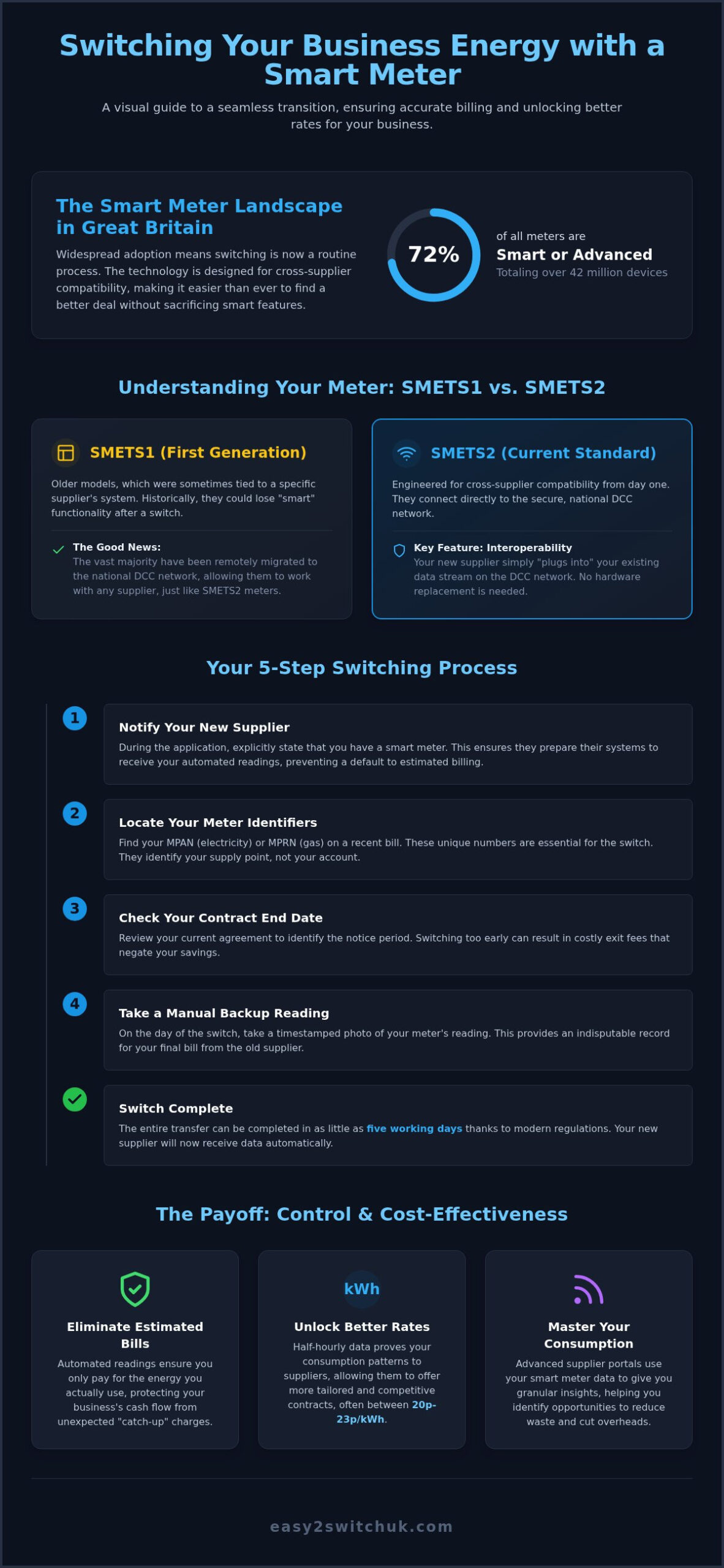
As of June 2026, 72% of all meters in Great Britain are now smart or advanced, totaling over 42 million devices. This widespread adoption means that switching business energy supplier with a smart meter is no longer a technical gamble but a routine administrative task. However, the experience of your switch often depends on whether your hardware belongs to the first or second generation of smart technology.
A smart meter is essentially a secure gateway between your premises and the energy grid. If you need a refresher on what is a smart meter, it’s a device that utilizes a dedicated wireless network to send actual usage data to your provider. This process removes the guesswork from your overheads, ensuring your farm or SME isn’t held back by the cash flow strain of inaccurate, estimated billing.
SMETS1 vs SMETS2: Why the Generation Matters
SMETS2 meters are the current industry standard, engineered specifically to ensure cross-supplier compatibility from the moment they’re installed. If your business uses an older SMETS1 meter, you might have heard stories about these devices losing their “smart” features after a switch. This happened because the early models were often hard-wired to the original installer’s proprietary system.
The landscape has changed significantly by late 2026. A massive migration project has moved the vast majority of SMETS1 meters onto the national Data Communications Company (DCC) network. This migration allows older meters to function just like their newer counterparts. You can typically spot a SMETS2 meter by looking for a serial number that starts with ’19’ or ’20’, or by identifying a small, separate communication hub sitting on top of the main meter unit.
The DCC Network and Your Switching Rights
The DCC serves as the central platform for the UK’s smart energy infrastructure, acting as a neutral hub that handles data for all suppliers. Because of this centralized system, you have the right to switch suppliers without needing to replace a working SMETS2 meter. The technology is designed to be “interoperable,” meaning the new supplier simply “plugs in” to your existing data stream.
Switching business energy supplier with a smart meter is vital for maintaining an accurate budget. When you’re looking at competitive electricity unit rates, which in September 2026 range between 20p and 23p per kWh, every penny counts. Smart meters provide the half-hourly data required for Market-wide Half-Hourly Settlement (MHHS). This data is the key to unlocking the best possible quotes, as it proves to potential suppliers exactly when and how your business consumes power, allowing for more tailored and cost-effective contract offers.
The Step-by-Step Process: Switching with a Smart Meter
The process of switching business energy supplier with a smart meter is designed to be automated, but a few manual checks ensure nothing falls through the cracks. While the technology handles the heavy lifting, your preparation determines how smoothly the transition occurs. Following Ofgem’s guide to switching is a great starting point for understanding your rights, but business accounts require a more granular approach to data management. You must notify your new supplier that you have a smart meter during the application process. This ensures they prepare their systems to receive your half-hourly data rather than defaulting to estimated billing.
Preparing Your Data for a Seamless Move
Before you sign a new contract, locate your Meter Point Administration Number (MPAN) for electricity or Meter Point Reference Number (MPRN) for gas. These are unique identifiers for your supply point, not your account number. You’ll find these 13 or 21-digit numbers on a recent bill. It’s also vital to check your current contract end dates; switching too early can trigger expensive exit fees that outweigh any savings from a lower unit rate. Most business contracts have a specific notice period you must honor to avoid rolling onto more expensive out-of-contract rates.
On the actual day of the switch, take a manual backup reading. Even though your meter is smart, having a timestamped photo of the register provides an indisputable record if there’s a dispute over the final bill from your old supplier. This simple step protects your cash flow from unexpected catch-up bills later. If managing these technicalities feels like a distraction from your core operations, business energy consultants can handle this data collection and supplier liaison on your behalf, ensuring every detail is documented correctly.
What Happens on Switch Day?
Under current regulations, the time it takes to switch business electricity suppliers is typically five working days once the contract is finalized. During this period, a technical handshake occurs behind the scenes. Your new supplier sends a secure request to the DCC to take over the communication link to your meter. Your power supply will not be interrupted at any point during this digital handover, as the switch happens on the billing and data level rather than the physical wires.
Your In-Home Display (IHD) might behave strangely for the first 24 to 48 hours. It may temporarily stop showing cost data or revert to a “waiting for data” screen while it syncs with the new supplier’s pricing schedule. This is normal behavior during a transition. Once the signal is established, verify your first bill against your backup reading to confirm the new supplier is receiving smart data correctly. If you’re looking for a hassle-free transition, a done-for-you brokerage service can monitor these technical milestones to ensure your billing stays accurate from day one.
Troubleshooting Business Smart Meter Connectivity Issues
If your data stops flowing after switching business energy supplier with a smart meter, don’t panic. Technical drops are often just a “handshake” delay between the old and new provider’s systems. As of June 2026, over 90% of smart meters in Great Britain are operating in full smart mode, but a small percentage still face minor connectivity hurdles during a transition. Identifying whether the fault lies with the external network or your internal display is the first step toward a fix.
Most connectivity issues are software-based and don’t require a physical engineer visit. Before you spend time on hold with technical support, there are several pragmatic checks you can perform to restore your automated billing. Quick action ensures you don’t end up with a gap in your usage data, which is essential for accurate budgeting and future contract negotiations.
Checking Signal Strength: WAN vs HAN
Your meter uses two distinct networks to communicate. The Wide Area Network (WAN) is the most critical; it’s the signal that sends your usage data to the DCC and then to your supplier. Look for the WAN light on your communications hub, usually located on top of your electricity meter. If it’s flashing once every five seconds, you have a healthy connection. A rapid flash or no light at all suggests the meter isn’t talking to the national network.
The Home Area Network (HAN) is what connects your meter to your In-Home Display (IHD). On farms or large industrial sites, physical barriers can often block this signal. Thick stone walls, steel-framed barns, or even large machinery parked between the meter and the office can cause the HAN light to fail. If your meter is working but your IHD is blank, the distance between the two is likely the culprit. Move the display closer to the meter to see if the data returns.
Step-by-Step Fixes for Common Errors
Start with a simple power cycle of your IHD. Unplug the device, let the internal battery drain or turn it off, wait for a minute, and restart it. This often forces the display to re-sync with the new supplier’s tariff information. If this doesn’t work, give the system time. We recommend a 14-day “wait and see” period after switching business energy supplier with a smart meter. This allows the DCC to complete all back-end security updates and credentials transfers.
- Re-pair the device: Follow the on-screen instructions on your IHD to “search for network” if it shows a connection error.
- Check the distance: Ensure your IHD is within 10 metres of the meter for the best HAN signal.
- Request a remote reboot: If the WAN light remains off after two weeks, ask your new supplier to send a “re-comms” command to your meter.
If these steps fail, the issue might be a “dead spot” in the national mesh network. In these rare cases, your supplier may need to install a T3 aerial to boost the WAN signal. Most connectivity issues are resolved remotely, keeping your business operations uninterrupted and your billing accurate.
Choosing the Best Supplier for Smart Meter Support
While every provider in the UK is now obligated to support smart technology, the quality of their digital infrastructure varies significantly. A low unit rate might look attractive on paper, but it quickly loses its value if the supplier’s back-office systems can’t process your data correctly. When you are switching business energy supplier with a smart meter, you aren’t just buying energy; you are choosing a technical partner. Poor tech support can lead to months of estimated billing and time-consuming disputes that pull you away from your core business operations.
The introduction of Market-wide Half-Hourly Settlement (MHHS) in 2026 has made this choice even more critical. Suppliers who have invested in robust systems can use your granular usage data to offer more competitive, tailored rates. In contrast, suppliers with aging systems may struggle to integrate SMETS1 migrations, leading to the “dumb” meter issues discussed earlier. Prioritising a supplier with a proven track record in smart data management ensures your farm or SME remains in control of its overheads.
What to Look for in a Tech-Forward Supplier
A truly tech-forward supplier provides a user-friendly online portal that goes beyond showing your balance. You should look for platforms that allow for real-time data downloads in CSV or Excel formats. This is essential for energy auditing and identifying waste in your daily operations. Additionally, check if the supplier offers a dedicated smart meter troubleshooting team rather than a general customer service line. Integration with third-party energy management software is another major advantage for larger industrial sites or multi-site businesses, as it allows you to centralise your consumption data for better strategic planning.
The Broker Advantage in Tech Selection
Selecting the right provider requires more than just looking at a price list. Expert commercial energy brokers maintain internal performance logs on how different suppliers handle technical migrations. We track which companies are currently experiencing delays with the DCC network and which ones are most reliable at maintaining SMETS1 connections during a switch. This insider knowledge prevents you from moving to a supplier that might save you a few pounds on the standing charge but cost you dozens of hours in administrative frustration.
By using a specialist service, you ensure that your new contract supports the specific smart features your business relies on, such as export tracking for solar panels or complex multi-rate tariffs. If you want to avoid the technical pitfalls of a bad migration and secure a supplier that actually understands your hardware, contact our team for a free, expert-led comparison.
Simplifying the Switch: Let Easy2switch Handle the Tech
Managing the technicalities of a transition shouldn’t be your responsibility. While the benefits of automated data are clear, the administrative burden of switching business energy supplier with a smart meter can feel overwhelming for busy business owners. Easy2switch UK Ltd acts as your professional advocate, stepping into the gap between you and the energy companies. We manage the “back-and-forth” communication, ensuring that your meter’s unique technical profile is correctly recognized by your new provider from day one.
Our service is designed to alleviate the anxiety of technical migration. Instead of spending hours on hold with a supplier’s support desk trying to explain a signal drop, you can rely on our specialists to handle the troubleshooting. We understand the UK energy market’s complex variables and ensure that your move is a tool for empowerment rather than a source of frustration. By acting as a technical intermediary, we ensure your smart meter migrates correctly without leaving you to navigate the DCC network alone.
Expert Help for UK Farms and SMEs
Farms and rural businesses often face the most significant connectivity challenges due to their geographic location and complex site layouts. Because farm electricity prices are increasingly tied to half-hourly usage data, maintaining smart functionality is a financial necessity, not just a convenience. We specialise in the UK farming industry, meaning we know how to navigate the specific hurdles that come with multi-meter setups and stone-built outbuildings.
If a dispute arises between your old and new supplier regarding your meter’s status or the accuracy of a final bill, we intervene on your behalf. We provide impartial advice on contract terms and ensure that no data gaps occur during the migration. This specialist support ensures your business continues to benefit from accurate, automated billing without you needing to become a technical expert. We focus on the human element of the service, finding the best individual fit for your specific meter setup.
Start Your Stress-Free Switch Today
Taking control of your energy costs is straightforward when you have a reliable specialist handling the procurement. Our process is brisk and logical, moving you from initial curiosity to a finalized contract with minimal friction. You can start the process through a simple telephone consultation or by using our online portal to provide your current meter details.
There are no hidden fees for our expertise; our service is entirely free for you to use, as we are paid via a commission from the energy suppliers. This allows us to focus entirely on finding the best individual fit for your business rather than pushing a one-size-fits-all solution. Let us handle the technical migration and supplier communication while you focus on running your business. Get a free business energy review from Easy2switch UK Ltd and see how much you could save with a seamless, smart-enabled switch.
Take Control of Your Energy Data
Moving your business to a more competitive tariff shouldn’t mean sacrificing the data accuracy you’ve come to rely on. By understanding the transition from SMETS1 to SMETS2 and knowing how to troubleshoot simple connectivity drops, you can ensure your overheads remain transparent and manageable. Remember that switching business energy supplier with a smart meter is a strategic move to leverage half-hourly data for better rates, provided you select a supplier with the right technical infrastructure.
You don’t have to navigate the complexities of the DCC network or supplier technical desks alone. At Easy2switch, we combine deep expertise in UK farming energy with a commitment to providing free impartial advice for all SMEs. Our done-for-you switching process handles every technical detail, ensuring your smart meter migrates correctly while you focus on your daily operations. Taking control of your utility costs is a simple, low-friction path when you have a reliable specialist in your corner.
Secure a better business energy deal today with Easy2switch and experience a seamless transition tailored to your specific needs. It’s time to turn your smart meter into a tool for financial independence.
Frequently Asked Questions
Will I lose my smart meter functionality if I switch business suppliers?
You shouldn’t lose smart functionality during a switch because the national DCC network now supports the vast majority of UK meters. While older first-generation units sometimes reverted to manual mode in the past, the ongoing migration project has resolved this for most SMEs. Switching business energy supplier with a smart meter is now a standard digital process that maintains your automated billing as long as the new supplier is compatible with the DCC hub.
How do I know if my business has a SMETS1 or SMETS2 meter?
Identifying your meter generation is straightforward if you check the serial number on the front of the device. SMETS2 meters usually have a serial number starting with 19 or 20 and feature a separate communications hub on top. If your meter was installed before 2018 and has a different serial pattern, it’s likely a SMETS1 unit. Most of these have now been remotely upgraded to work with all UK suppliers.
What should I do if my smart meter stops sending readings after a switch?
If your readings stop after a switch, wait for the 14-day stabilization period to conclude before taking action. This delay allows the new supplier to securely update the security credentials on your device. If the issue persists, check the WAN light on your meter hub for signal strength. You can then request a remote reboot from your provider, which often fixes software handshaking errors without needing a physical engineer visit.
Can I switch energy suppliers if I have a faulty smart meter?
You can still switch suppliers even if your smart meter is currently faulty or not sending data. The physical energy supply remains unaffected by the data communication layer. However, you must inform your new broker or supplier about the fault during the application. They will likely start your new contract on estimated or manual readings until a replacement meter is installed or the existing unit is repaired by the provider.
Does a smart meter make it easier or harder to switch business energy?
A smart meter makes switching significantly easier because it provides the precise half-hourly usage data that suppliers now require for their most competitive rates. Under the 2026 Market-wide Half-Hourly Settlement (MHHS) rules, having this granular data allows brokers to secure more accurate quotes tailored to your specific consumption patterns. This removes the risk premium that suppliers often add to contracts based on estimated or manual meter readings.
How long does it take for a smart meter to connect to a new supplier?
While the actual switch of your electricity supply takes just five working days, the smart data connection can take up to two weeks to fully sync. During this time, your new supplier is establishing a secure link with the DCC network. Switching business energy supplier with a smart meter is a multi-stage digital process, so your In-Home Display might show temporary errors until the new tariff information is successfully downloaded to your hardware.
Are there specific suppliers that are better for business smart meters?
Some suppliers are better suited for businesses because they offer advanced online portals and dedicated technical support for smart hardware. When comparing offers, look for providers that integrate half-hourly data into their billing systems and provide CSV downloads for energy auditing. Large legacy suppliers sometimes have slower technical response times, whereas tech-forward challengers often provide more seamless data integration for complex farm or industrial site setups.
What is the DCC migration and how does it affect my business?
The DCC migration is a national project that moves older SMETS1 meters onto a single, secure communication network. This affects your business by ensuring that your older hardware doesn’t become “dumb” when you change providers. Once migrated, your SMETS1 meter gains the same interoperability as a newer SMETS2 device. This project is essential for maintaining your switching rights and ensuring you can always access the best market rates regardless of your meter’s age.
