
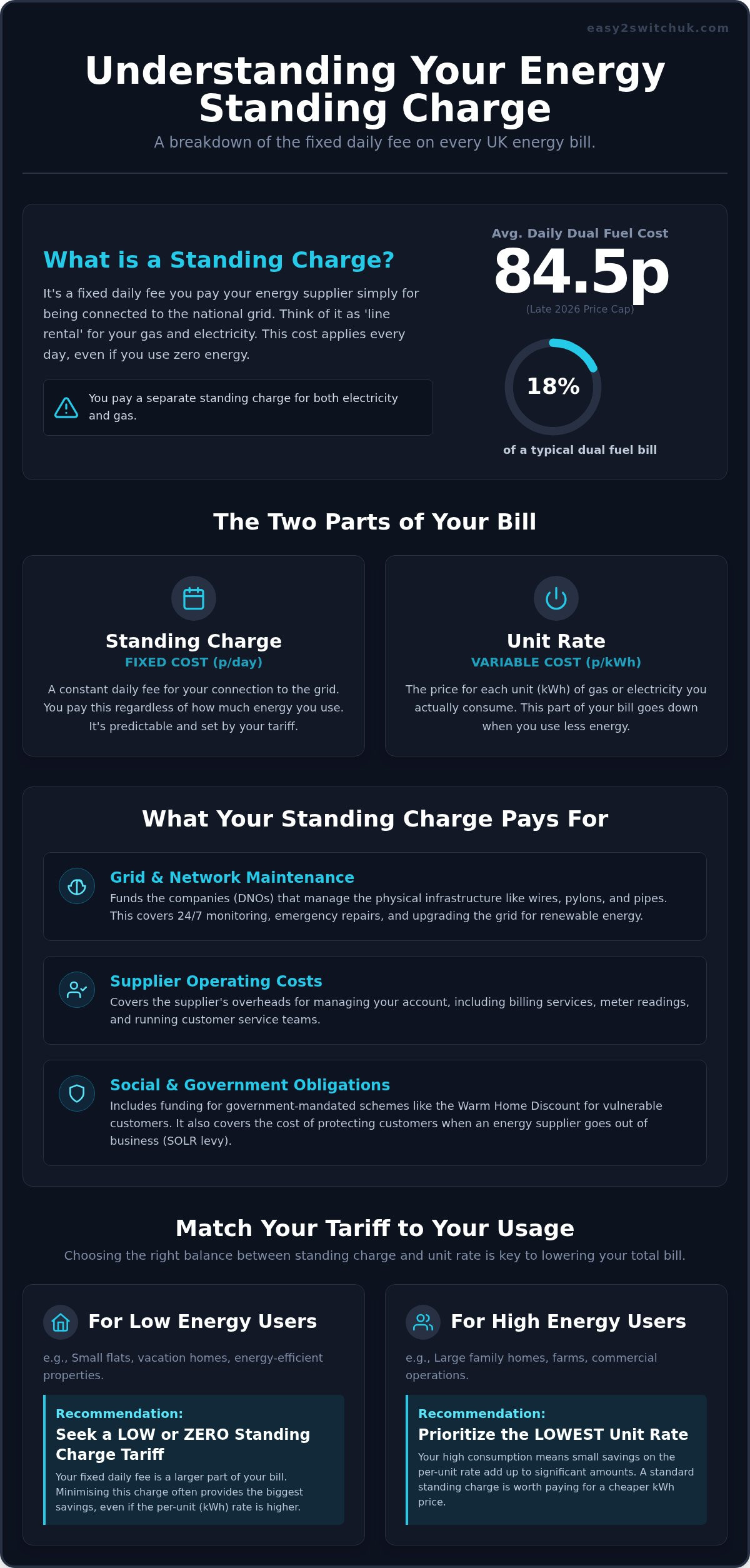
Why does your energy bill still demand payment even when your home, farm, or office has been empty for a week? It’s a frustrating reality for many who feel penalised for saving energy. This fixed daily fee often feels like an unavoidable tax on your connectivity. Understanding exactly what is a standing charge is the first step toward taking control of your overheads. In late 2026, these costs account for about 18% of a typical dual fuel bill. This means you’re paying roughly 84.5p every single day just to stay connected to the grid, regardless of how many units you actually use.
You might feel confused by why regional prices vary so much or why business rates differ so sharply from domestic ones. We’re here to simplify the math. This guide explains how the October 2026 VAT removal on electricity impacts your daily costs and why gas charges have shifted. You’ll learn how to navigate regional price differences and how to identify a tariff that aligns with your specific usage patterns. Whether you’re managing a household or a commercial operation, we provide the clarity you need to switch with confidence and stop overpaying for your connection.
Key Takeaways
- Learn exactly what is a standing charge and why this fixed daily fee applies even if your property is empty or you use no energy.
- Discover how these costs fund essential UK energy infrastructure, social obligations, and the maintenance of the national grid.
- Understand why your geographic location and chosen payment method can lead to significant variations in your daily rates.
- Compare the unique scale of business and farm standing charges to ensure your commercial operations are correctly classified and billed.
- Identify how to choose between high and low standing charge tariffs based on your specific usage profile to lower your total energy spend.
What is a Standing Charge? The Daily Cost of Connectivity
A standing charge is a fixed daily fee you pay to your energy supplier for the maintenance of the connection to your property. Think of it as the ‘rent’ you pay for access to the national energy grid. Whether you’re running a busy dairy farm or keeping a small flat, this cost remains constant regardless of how much gas or electricity you actually use. Even if your property sits empty for a month, the charge continues to accrue every single day.
These fees are overseen by Ofgem, the energy regulator, to ensure that the costs of maintaining the national infrastructure are shared across all users. You’ll see separate standing charges for your electricity and gas supplies, as each requires its own network of pipes or cables to reach your meter. Understanding what is a standing charge helps you see past your usage and into the structural costs of your energy supply.
How Standing Charges Appear on Your Bill
When you check your latest statement, look for a section labelled ‘Daily Charge’ or ‘Standing Charge’ in the cost breakdown. Unlike your energy usage, which is measured in kilowatt-hours (kWh), this fee is strictly calculated in pence per day (p/day). For example, under the late 2026 price cap, the average electricity standing charge is approximately 54.83p per day.
Your supplier calculates the total by multiplying this daily rate by the number of days in your billing period. If your bill covers a 90-day quarter, you’ll see the daily rate multiplied by 90. This makes it one of the few predictable parts of your energy costs, allowing you to budget for your connection with precision before you even flick a switch.
Unit Rate vs. Standing Charge: What’s the Difference?
It helps to view your bill as having two distinct components. The unit rate is the variable cost. You only pay this for the actual energy you consume; if you turn off the heating or switch to LED bulbs, this number goes down. The standing charge is the fixed cost. It covers the supplier’s overheads, such as billing services, emergency repairs, and government social schemes, which exist whether you use energy or not.
In the current 2026 market, you’ll rarely find a tariff that eliminates the standing charge entirely. While some ‘zero standing charge’ options exist, they usually compensate by charging a significantly higher unit rate. Finding the right balance between these two figures is the most effective way to take control of your bills and choose a tariff that fits your specific home or business profile.
Why Do We Pay It? Breaking Down the 2026 Costs
Many people feel frustrated by daily fees, but these costs serve a vital purpose. When you ask what is a standing charge, you’re really looking at the price of reliability. These funds allow suppliers to manage your account, provide customer service, and facilitate accurate billing. Beyond the office work, your daily payment maintains the massive physical network of pipes and cables that deliver gas and electricity to your door. It’s the financial backbone that ensures power is available the moment you need it.
The total amount you pay is a collection of different levies. As Ofgem explains standing charges, these fees ensure that every household and business contributes to the national infrastructure. In late 2026, these charges represent about 18% of a typical dual fuel bill, reflecting a complex balance between network maintenance and social responsibility.
Maintaining the National Grid and Local Networks
A significant portion of your daily fee goes to Distribution Network Operators (DNOs). These are the companies responsible for the actual wires, pylons, and transformers in your area. In 2026, much of this investment is directed toward upgrading the grid for a greener future, including the integration of more renewable energy sources. Your payment covers 24/7 grid monitoring and the emergency repair teams who work through storms to keep your lights on. Without this shared funding, the cost of individual repairs would be devastating for most property owners.
The Cost of Failed Suppliers and Social Schemes
Your bill also includes “social and environmental obligations.” This covers government-mandated schemes like the Warm Home Discount, which supports vulnerable households. From April 2026, 80% of these specific costs shifted to unit rates, which helped moderate standing charge increases. However, the fee still includes the “Supplier of Last Resort” (SOLR) levy. This acts as a safety net, covering the costs incurred when an energy company goes bust and its customers must be moved to a new provider.
Recent changes in October 2026 have shifted these numbers again. The removal of VAT from electricity bills caused the electricity standing charge to fall by 2.4 pence per day, while gas charges saw a minor increase of 0.7 pence per day to cover supplier operating costs. You can take control of your energy costs by identifying which tariffs offer the best balance of these fixed fees. These levies also fund the UK’s progress toward Net Zero targets by 2050, ensuring our energy system remains resilient for the next generation.
Why Standing Charges Vary Across the UK
While we have established what is a standing charge and its purpose, the actual amount you see on your bill depends heavily on your postcode. You might notice that a contact in a different part of the country pays significantly less than you do for the exact same energy connection. These variations occur because energy suppliers must operate within regional limits set by the regulator, reflecting the differing costs of maintaining the network in various UK territories. It’s a pragmatic, if sometimes frustrating, way of balancing the books across the national grid.
According to House of Commons Library research, these regional disparities are a long-standing feature of the UK market. They ensure that the specific costs of maintaining local networks are recovered from the people using them. This system means that your geographic location is often the single biggest factor in determining your daily fixed costs, even before you consider which supplier to use.
Regional Logistics and Infrastructure Challenges
The complexity of the local grid is the primary driver of regional price differences. In sparsely populated rural areas, there are fewer households to share the cost of maintaining thousands of miles of cables and pipes. This leads to higher maintenance costs per household compared to densely packed urban centres where the network is more compact. Distance from power stations and gas terminals also plays a role; the further energy must travel, the more infrastructure is required to move it. Consequently, rural regions often face higher infrastructure levies than cities where the network serves more customers per mile.
The Impact of Your Meter Type and Payment Method
How you choose to pay also dictates your daily rate. Direct Debit users typically receive the lowest standing charge rates because they’re the most cost-effective for suppliers to manage. In contrast, standard credit, where you pay upon receiving a bill, is often the most expensive due to higher administrative overheads. This creates a clear path for consumers to take control of their costs by simply adjusting their billing preferences.
A significant shift in 2026 is the implementation of the levelisation charge. This mechanism adds a small amount to the standing charges of Direct Debit customers to fund lower daily costs for those on prepayment meters. This ensures that vulnerable households aren’t unfairly penalised by the fixed nature of these fees. Smart meters have also changed the landscape by allowing you to track these daily charges in real-time. This visibility helps you understand what is a standing charge in the context of your daily budget, making it easier to see how your payment method influences your total spend.
Business and Farm Standing Charges: A Different Scale
Commercial standing charges operate on a significantly larger scale than domestic bills. When you ask what is a standing charge in a business context, you’re looking at a fee that accounts for the heavy industrial infrastructure required to support your operations. Unlike a standard home, businesses often require a much larger “pipe” of energy to power machinery, large-scale lighting, or refrigeration. This increased demand means your daily fee isn’t just an administrative cost; it’s a capacity reservation that ensures the grid can handle your peak loads at any moment.
For many SMEs and larger enterprises, KVA (Available Capacity) charges are often bundled into the standing charge. This represents the maximum amount of electricity your site is permitted to draw from the network. If your business uses half-hourly (HH) metering, your billing structure becomes even more granular. These meters send data every 30 minutes, allowing for precise tracking but often resulting in complex standing charges that include various network and distribution levies domestic users never encounter.
Standing Charges for the UK Farming Industry
Farmers face a unique set of challenges because they often manage multiple meters across outbuildings, barns, and the main farmhouse. Each of these connections carries its own daily fee, which can lead to high fixed costs even during quiet periods. If you have a grain dryer or seasonal machinery that only runs for a few weeks a year, you’re still paying the standing charge for that connection every other day of the year. It’s vital to review your farm electricity prices UK to ensure your meter classifications and capacity levels match your actual requirements.
Commercial Energy Contracts and Negotiated Rates
The most critical difference for businesses is the lack of a universal price cap. While households have a safety net, commercial rates are dictated by the open market and the strength of your negotiation. This makes fixed-term contracts essential for locking in your daily standing charges and protecting your bottom line from sudden spikes. Working with a commercial energy broker allows you to access hundreds of supplier offers that aren’t always available to the general public. They handle the “standing charge” math for you, identifying tariffs with lower fixed fees that suit your specific industry profile.
Taking control of these fixed overheads is one of the fastest ways to improve your business’s cash flow. Request a free energy audit today to see if your current standing charges align with the best available rates for 2026.
How to Minimise Your Daily Energy Costs
Reducing your energy bill requires more than just turning off the lights. It starts with a clear-eyed look at your usage profile. By now, you understand what is a standing charge and how it impacts your daily costs. To truly minimise your overheads, you must determine whether you are a high or low consumer. This distinction dictates which part of the tariff you should target for the biggest savings. It’s about finding the right balance between the fixed daily fee and the price you pay for each unit of energy.
You should always evaluate the total cost of a contract rather than focusing on a single headline figure. A tariff with a suspiciously low unit rate might hide an inflated standing charge that erodes your savings. Conversely, a ‘zero standing charge’ tariff often carries a much higher unit rate, which can lead to massive bills if your usage increases unexpectedly. Taking control of these variables is the most effective way to protect your budget in the current market.
The Mathematical Trade-Off: High vs. Low Usage
If you manage a low-usage property, such as a holiday cottage or a small apartment, your priority should be finding a low standing charge. In these scenarios, the fixed daily fee often makes up the majority of your total spend. For high-usage properties like a busy dairy farm or a large office block, the logic flips entirely. High consumers should focus on securing the lowest possible unit rate, even if it means accepting a slightly higher daily fee. A 5p difference in unit rate usually outweighs a 10p difference in standing charge for high users. Calculating this trade-off correctly can save your business hundreds of pounds over a standard fixed-term contract.
Taking Control with Expert Guidance
The 2026 energy market remains volatile, making manual comparisons a time-consuming and often confusing task. Prices shift quickly; the “best” deal available this morning might be gone by the afternoon. Using specialized business energy comparison tools simplifies this complex math. These digital tools allow you to input your specific annual usage data to see exactly how different standing charges and unit rates interact over a full twelve-month period.
Working with an impartial consultant provides an extra layer of security and ease. They handle the switching paperwork and negotiate directly with hundreds of supplier offers, ensuring you don’t get trapped in a contract that doesn’t fit your specific needs. This professional oversight helps you find the right individual fit for your home, farm, or business. By understanding what is a standing charge in the context of your total contract value, you can finally move from financial anxiety to absolute confidence.
Take Control of Your Energy Costs in 2026
Understanding your energy bill doesn’t have to be a source of stress. You’ve seen that your daily fee isn’t just an arbitrary number; it’s a structural cost that funds the UK’s infrastructure and vital social safety nets. Understanding what is a standing charge allows you to move beyond frustration and start making strategic choices for your property. Whether you are managing a busy commercial farm or a small household, the key lies in balancing those fixed daily rates with your actual consumption levels.
Finding the right tariff requires looking at the total contract value rather than just the headline unit rate. At Easy2switch UK Ltd, we provide a free, impartial service that simplifies this comparison process for you. Our specialists offer expert advice tailored specifically for farms and businesses, ensuring there are no hidden fees or administrative hurdles. We handle the math so you can focus on running your operations with absolute confidence. Take control of your energy bills today with a free comparison from Easy2switch UK Ltd and secure a deal that fits your needs perfectly.
Frequently Asked Questions
Can I have an energy tariff with no standing charge in 2026?
Yes, some tariffs offer a £0 standing charge, but these usually come with significantly higher unit rates for every kilowatt-hour you use. This is a common trade-off in the current market. These plans often suit low-usage properties like holiday homes or storage units. You should calculate your total annual spend before switching, as high-usage homes or farms will almost always pay more on a zero-standing-charge plan.
Why has my standing charge gone up while my usage went down?
Your standing charge is a fixed daily fee that covers the cost of maintaining the national grid and funding social obligations. It’s not linked to how much energy you consume. In late 2026, these costs have shifted due to increased supplier operating allowances and levies for failed companies. Even if you use zero units, you still pay this fee to keep your property connected to the energy network.
Do I pay a standing charge if my property is empty?
Yes, you must pay the daily fee as long as the property has an active energy connection. This cost ensures that the infrastructure remains safe and ready for use whenever you return. If you manage a farm with multiple outbuildings that are only used seasonally, these daily costs can add up quickly. It’s often helpful to review what is a standing charge across all your meters to identify potential savings.
Is the standing charge the same for every supplier?
No, each energy supplier sets its own daily rates based on their specific operating costs and regional logistics. While Ofgem limits the maximum charge for those on standard variable tariffs, suppliers can offer lower rates on fixed-term contracts to attract new customers. This is why comparing the market is essential. Small differences in daily pence can result in significant annual variations for businesses and households alike.
How much is the average standing charge for a UK business in 2026?
There is no single average for businesses because commercial charges depend on your meter type and available capacity (KVA). Unlike domestic bills, business rates aren’t protected by the Ofgem price cap, meaning daily fees can be significantly higher for large-scale operations. A farm with heavy machinery will pay more for its connection than a small office. Professional brokerage services can help you negotiate these fixed fees directly with suppliers.
Does a smart meter help reduce my standing charge?
A smart meter doesn’t directly lower the daily rate your supplier charges, but it provides real-time visibility of your costs. By seeing exactly what is a standing charge on your in-home display every day, you can budget more effectively. It also ensures your billing is accurate, preventing the stress of estimated bills. While the meter itself doesn’t change the tariff, the data it provides helps you choose a more suitable plan.
Are standing charges covered by the Ofgem price cap?
Yes, for domestic customers on standard variable tariffs, Ofgem sets a maximum daily limit for both electricity and gas standing charges. As of October 2026, the average dual fuel standing charge is roughly 84.5p per day. This cap doesn’t apply to fixed-rate deals or business contracts. For commercial users, the market is unregulated in this regard, making it vital to lock in a competitive rate through a fixed-term agreement.
Why do I pay a standing charge for gas if I only use it for heating in winter?
You pay the gas standing charge 365 days a year to cover the ongoing maintenance of the gas network. This includes emergency repair services and the cost of keeping the pipes pressurized and safe. Even during the summer, the supplier must ensure gas is available at your property the moment you turn on a boiler or stove. It’s a service availability fee rather than a usage-based cost.
