
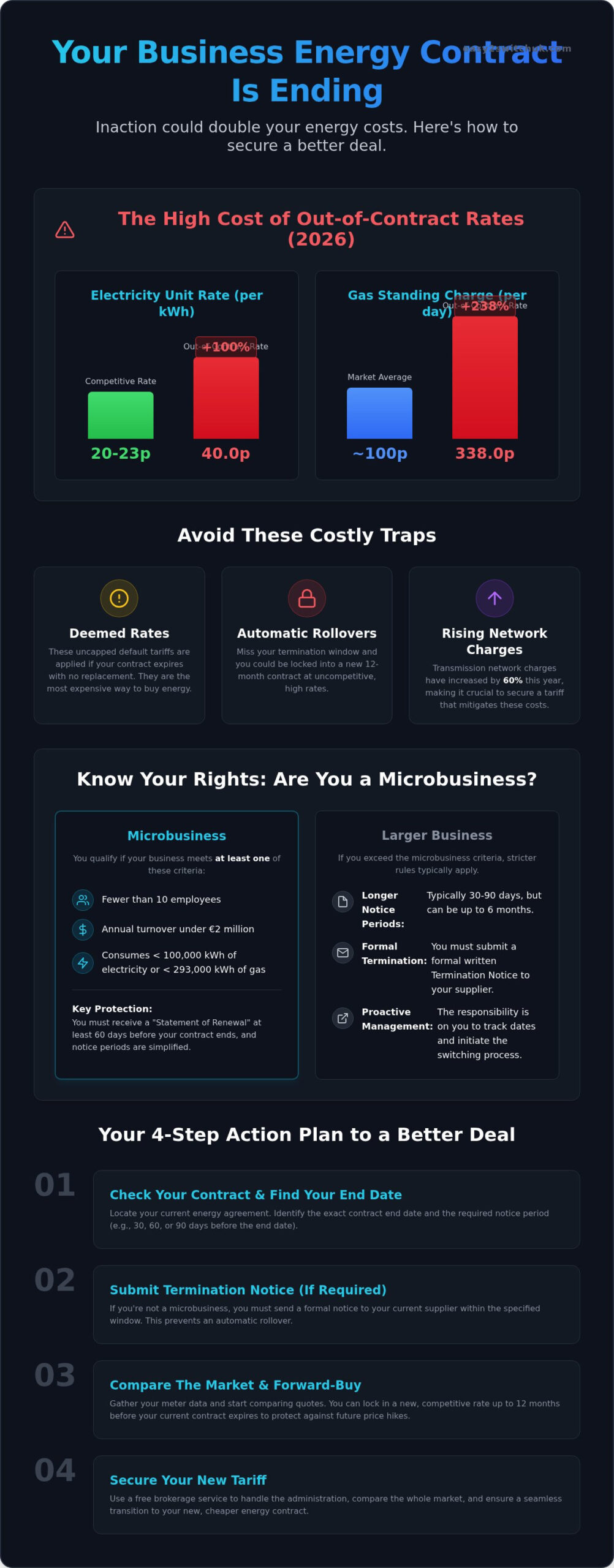
Did you know that failing to agree to a new energy contract before your current deal expires could see your rates skyrocket by up to 100%? In 2026, businesses moving to out-of-contract electricity rates are facing costs as high as 40.0p per kWh, which is nearly double the current competitive market rate. It’s completely understandable if you’re unsure about what to do when your business energy contract is ending, especially when notice periods feel like an administrative burden you don’t have time for. Most business owners feel a sense of anxiety about being trapped in high-cost rollover contracts or getting lost in the technical jargon of supplier tariffs.
This guide explains exactly how to secure a competitive tariff and protect your bottom line before your deadline hits. We’ll provide expert advice on market timing, including how to navigate the 60% increase in transmission network charges seen this year. You’ll learn the exact steps to transition seamlessly to a better deal, from understanding your specific notice period to using a free brokerage service that handles the heavy lifting. By the end of this article, you’ll have a clear, low-friction path to taking control of your energy overheads for the year ahead.
Key Takeaways
- Understand the financial impact of deemed rates and why inaction can lead to your energy costs doubling in the current 2026 market.
- Learn exactly what to do when your business energy contract is ending to navigate termination windows and avoid expensive out-of-contract rates.
- Discover how forward-buying allows you to lock in competitive rates up to 12 months before your current agreement expires, protecting you from market volatility.
- Simplify the transition process by identifying the specific meter data you need to compare the whole market rather than just the biggest suppliers.
- Find out how to use a free, specialist brokerage service to manage the entire switching process, reducing your administrative burden at no extra cost.
The Silent Cost of Inaction: What Happens When Your Business Energy Contract Ends?
When your fixed-term energy deal expires, your supplier doesn’t simply keep charging you the same rate. Instead, they shift your account onto default pricing, which is almost always the most expensive way to buy energy. Many business owners believe they have a grace period to decide what to do when your business energy contract is ending, but in reality, the financial penalty for inaction begins the very first day your contract lapses. Unlike domestic energy, there is no 14-day cooling-off period in the business sector. Once you are on these rates or sign a new agreement, you are legally bound to those terms immediately.
The financial impact of falling into this “rollover trap” is stark. As of late 2026, out-of-contract electricity rates have reached 40.0p per kWh, compared to competitive market rates which sit closer to 20p or 23p per kWh. Daily standing charges also see a significant hike, with electricity charges reaching 254.0p and gas climbing to 338.0p. This isn’t just a minor increase; it’s a price shock that can cause your monthly overheads to double overnight. A foundational step in understanding your electricity bill is recognizing that these inflated rates are designed to protect the supplier against market volatility, not to provide value to your business.
Understanding Deemed and Out-of-Contract Rates
Deemed rates are the default tariffs applied when you move into new premises without a contract or when your current agreement expires without a replacement in place. These rates are significantly higher than negotiated deals because there are no regulatory price caps in the business energy sector. While domestic customers have a price cap to fall back on, businesses must rely on their own procurement strategy to avoid these uncapped costs. Suppliers use these high rates to encourage businesses to sign new fixed-term contracts, effectively penalizing those who stay on the “deemed” list.
The Risk of Automatic Rollovers
While industry regulations have tightened, some older contracts still contain “evergreen” clauses or automatic one-year extensions. If you don’t provide a formal notice of termination within the specific window required by your supplier, you could be rolled over into a new 12-month contract at much higher rates than you currently pay. Given the 2026 market volatility and the 60% increase in transmission network charges, being locked into a sub-optimal deal for another year is a risk most SMEs cannot afford. It’s vital to check your original contract terms now to ensure you aren’t silenced by an automatic renewal that prevents you from seeking a more competitive tariff.
Your Legal Rights and Protections: Termination Windows Explained
Knowing what to do when your business energy contract is ending starts with understanding your legal classification. Under Ofgem regulations, your rights differ significantly depending on whether you’re classified as a microbusiness or a larger commercial entity. In 2026, many suppliers have streamlined their processes, but the responsibility to act within specific timeframes remains firmly with the business owner. Missing a window can lead to the expensive rollover rates we discussed earlier.
Microbusiness Protections in 2026
To qualify as a microbusiness in 2026, your company must meet at least one of three criteria: employ fewer than 10 people, have an annual turnover under €2 million, or consume less than 100,000 kWh of electricity (or 293,000 kWh of gas) per year. If you fit this profile, you’re entitled to a “Statement of Renewal” at least 60 days before your contract ends. This document must clearly show your current rates compared to the new proposed rates. Crucially, microbusinesses no longer need to provide long notice periods for many standard contracts, which simplifies the process of moving to a more competitive supplier.
Navigating Termination Windows for Larger Businesses
For businesses that exceed the microbusiness thresholds, the rules are often stricter. Standard notice periods typically range from 30 to 90 days, though some complex contracts may require up to six months’ warning. To leave your current supplier, you must submit a formal Termination Notice within the allowed window. This letter should include your account number, meter details, and a clear statement of your intent to leave. Always request a “Termination Acknowledgment” in writing. Without this proof, a supplier might claim they never received your notice and block your switch to a cheaper tariff.
Suppliers can legally block a switch for two main reasons: outstanding debt on the account or failing to provide notice within the correct window. If you’ve lost your original paperwork, you can find your contract end date on your latest bill or by requesting it directly from your supplier. If you find yourself overwhelmed by these administrative details, our team at Easy2switch UK can assist in identifying these deadlines and ensuring your notice is filed correctly.
Taking control of your energy transition is about more than just finding a low price. It’s about ensuring your business is legally positioned to move when the market is right. By confirming your status and notice period today, you remove the primary obstacles that suppliers use to keep businesses on high-cost default rates.
Market Timing vs. Contract Expiry: A Strategic Procurement Framework
Many business owners believe they must wait until their current deal expires before looking for a new one. This is a high-risk strategy. In the 2026 energy market, waiting until the final month leaves you vulnerable to sudden price spikes and limits your ability to negotiate. The most effective approach for what to do when your business energy contract is ending is to treat the expiry date as the finish line, not the starting point. By planning ahead, you move from a position of reaction to one of control.
Forward-buying is a powerful tool that allows you to lock in 2026 rates up to 12 months before your current agreement ends. This doesn’t mean you pay for two contracts at once; it simply means you’ve secured your future price today for a start date in the future. For charities and farms with seasonal usage peaks, such as harvest or winter heating periods, this foresight is critical. It ensures that when your demand is highest, your rates are already protected against the market’s unpredictable swings.
The 6-Month Countdown Strategy
A structured timeline removes the stress of last-minute procurement. We recommend following this logical flow to ensure you don’t miss the best market opportunities:
- Month 6: Conduct an initial market scan. Gather your annual consumption data and meter numbers (MPAN/MPRN) to see how current forward-prices compare to your existing tariff.
- Month 4: Analyze market trends. In 2026, non-commodity charges like network and policy costs make up 60-64% of your total bill. Securing a deal now can hedge against further increases in these regulated elements.
- Month 2: This is your action window. Issue your formal termination notice to your current supplier and sign your new contract. This guarantees a seamless transition on the day your old deal expires.
Choosing the Right Contract Structure
Your choice of contract should reflect your business’s risk tolerance. Most SMEs and farms prefer fixed-rate contracts. These provide absolute budget certainty by locking in the unit price for the duration of the term. It’s a pragmatic choice for those who need to know exactly what their overheads will be each month, regardless of geopolitical events or wholesale market shifts.
Larger energy users might consider pass-through contracts. These can offer potential savings by separating wholesale energy costs from non-commodity charges, though they carry more risk if regulated costs rise unexpectedly. Additionally, green tariffs have become more accessible in 2026. While they sometimes carry a small premium, they allow businesses to meet sustainability targets while maintaining commercial reality. Balancing these options requires a specialist eye to ensure the fine print doesn’t contain hidden fees that could erode your expected savings.
The Step-by-Step Transition: From Notice to Live Switch
Once you’ve decided on a procurement strategy, the actual process of moving suppliers requires attention to detail. Understanding what to do when your business energy contract is ending involves a shift from strategic planning to administrative execution. This phase is where many business owners feel the most pressure, but following a logical sequence ensures that your transition remains seamless and free from expensive errors. The goal is a “done-for-you” experience that moves your account from one provider to another without any interruption to your daily operations.
The complexity of the UK market means that looking beyond the “Big Six” suppliers is essential for finding the best value. In 2026, many smaller, specialist suppliers offer highly competitive tariffs that are often missed by those who only check the major names. Managing this comparison and the subsequent paperwork is a primary function of a commercial energy broker. They act as your representative, verifying the fine print and ensuring that the registration of your meters with the new supplier is handled correctly behind the scenes.
Essential Information for a Smooth Switch
To get an accurate quote, you need three specific pieces of data. First, locate your Meter Point Administration Number (MPAN) for electricity and your Meter Point Reference Number (MPRN) for gas. These are usually found on the second page of your bill. Second, gather at least 12 months of consumption data. This allows suppliers to price your contract based on your actual usage patterns rather than a generic estimate. For our clients in the agricultural sector, it’s vital to ensure all meters across the property are included in the review. Farms often have multiple supply points for various outbuildings or specialized equipment, and missing just one can lead to that specific meter falling onto a high-cost deemed rate.
The Final Handover Process
There is a common misconception that switching suppliers involves a physical change to your pipes or wires. On “Switch Day,” there is absolutely no interruption to your power or gas supply. The transition is purely administrative. You’ll need to provide a final meter reading to your old supplier to ensure your closing bill is accurate. This prevents “estimated” final charges that are often skewed in the supplier’s favor. Once the old account is settled, you can set up your new Direct Debit and online management portal with the incoming provider. To start this process without the stress of managing the admin yourself, you can request a free market review from Easy2switch UK today.
The “Transfer Period” typically takes between 15 and 30 days once the contract is signed. During this time, your new supplier will coordinate with the national database to register your meters. Keep a close eye on your final bill from your previous supplier to check for any overcharges or hidden exit fees. By handling these final steps with precision, you ensure that the savings you’ve negotiated are fully realized from day one of your new agreement.
Navigating the 2026 Energy Market with Easy2switch UK
Deciding what to do when your business energy contract is ending doesn’t have to be a solitary task. Easy2switch UK acts as your specialist partner, removing the complexity from a market that often feels designed to confuse. We provide a bridge between your business and hundreds of supplier tariffs, ensuring that you aren’t just another number in a database. Our approach is built on calm efficiency and local accountability, giving you the tools to take control of your overheads without sacrificing your valuable time. We handle the market variables so you can focus on running your business.
A common question is how a professional consultancy can offer its services at no cost to the business owner. Our brokerage is entirely free to the end-user because we are funded through supplier commissions. This model is a strategic advantage for you. Since we aren’t tied to any single provider, we remain impartial, searching the entire market to find the specific fit for your consumption profile. It aligns our interests with yours; we succeed when we find you a deal that makes genuine commercial sense for your specific situation.
Expertise for Farms and Charities
Agricultural businesses and charities face unique challenges that a generic comparison site simply won’t catch. For farmers, managing multiple meters across various outbuildings requires a specialist eye to avoid high-cost deemed rates on secondary supply points. You can find more detail on this in our guide to farm electricity prices UK. Charities, meanwhile, often qualify for a reduced VAT rate of 5% and exemptions from the Climate Change Levy (CCL). We ensure these reliefs are applied correctly from day one, preventing overpayment that can be difficult to claw back from suppliers later.
A Stress-Free Path to Savings
Our business energy consultants manage the entire narrative of your switch. From drafting the initial termination notice to verifying the final meter registration, we handle the administrative heavy lifting. This “done-for-you” service is designed to alleviate the anxiety of missing a deadline or falling into a rollover trap. We monitor the 2026 market trends, including the recent 60% hike in transmission network charges, to ensure your new tariff is truly competitive. If your contract is ending soon, don’t leave your procurement to chance. Contact us today for a free, no-obligation energy review and let our specialists secure your business’s financial future.
Take Control of Your 2026 Energy Overheads
The end of an energy contract shouldn’t be a source of stress; it’s a strategic opportunity to improve your bottom line. By engaging with the market up to 12 months in advance, you move away from the risk of expensive rollover rates and into a position of financial control. Whether you are managing a busy commercial office, a regional charity, or a multi-meter agricultural site, the key is to act before the supplier’s default tariffs take effect.
Knowing exactly what to do when your business energy contract is ending allows you to bypass the administrative burden of comparing hundreds of tariffs. We simplify the process. At Easy2switch UK, we provide impartial advice across the entire UK market with no hidden fees. Our service is funded by supplier commissions, so you don’t have to pay us. We bring specialist knowledge of the unique needs of farms and charities, ensuring you access every available relief and competitive rate.
Get a free, no-obligation business energy review from Easy2switch UK and let our team handle the transition for you. Taking this simple step today ensures your business remains protected throughout 2026 and beyond.
Frequently Asked Questions
Can I switch my business energy contract early?
Yes, you can secure a new rate up to 12 months before your current deal expires through forward-buying. While the new rates won’t start until your current contract ends, locking them in early protects your business from sudden market spikes. This strategy is a vital part of what to do when your business energy contract is ending; it ensures you aren’t forced into a high-cost deal at the last minute.
How long does it take to switch business energy suppliers in 2026?
The administrative transfer usually takes 15 to 30 days once you sign a new agreement. However, the strategic process should start much earlier. We suggest beginning your market review at least six months before your expiry date. This timeline provides enough space to issue formal termination notices and compare hundreds of different supplier offers, ensuring a smooth transition that avoids the expensive out-of-contract rates applied to those who wait too long.
What is a Letter of Authority (LOA) and why do I need one for a broker?
A Letter of Authority is a standard document that allows a broker to communicate with energy suppliers on your behalf. It grants us permission to collect your historical usage data, meter details, and current contract end dates. You retain the final decision on which contract to sign. The LOA simply enables us to handle the time-consuming paperwork and negotiations, providing a “done-for-you” experience that takes the administrative weight off your shoulders.
Will my electricity or gas be cut off during the switch?
Your electricity and gas supply will remain completely unaffected during the switching process. The change is purely administrative, as your new supplier registers your meter on the national database. Since the physical infrastructure, the pipes and wires, remains the same, there is no risk of a disconnection. You’ll continue to receive power and gas exactly as before, with the only difference being the lower rates on your new provider’s bill.
What happens if I forget to cancel my business energy contract?
Forgetting to act usually results in your supplier moving you onto “deemed” or “out-of-contract” rates. These default tariffs are significantly higher than negotiated deals and don’t have the protection of a price cap. In the 2026 market, these rates can easily double your monthly energy spend. Some older contracts may also include automatic rollover clauses that lock you into another year of expensive energy if you miss your specific termination notice window.
Are there any fees for using an energy broker like Easy2switch?
There are no upfront or hidden fees for using Easy2switch UK. Our consultancy service is free for the end-user because we are funded by commissions paid directly by the energy suppliers. This commission is incorporated into the unit price of the tariff you select. This model ensures that our specialist advice for farms, charities, and businesses remains accessible while allowing us to search hundreds of different offers to find your best fit.
How do I know if my business is classified as a microbusiness?
Your business is a microbusiness if it consumes less than 100,000 kWh of electricity or 293,000 kWh of gas annually. Alternatively, you qualify if you have fewer than 10 employees and an annual turnover or balance sheet under €2 million. This classification is important because it grants you specific legal protections, including the right to receive transparent information about your contract renewal options at least 60 days before your current deal expires.
Can I switch energy suppliers if I am in debt to my current one?
Suppliers have the legal right to block a switch if you have an outstanding debt on your account. To move to a new provider, you must settle any overdue balances first. If you are currently in a billing dispute, it’s essential to address this early in your notice window. Once your account is clear of debt, the objection will be lifted, allowing you to transition seamlessly to a more competitive energy tariff.
