
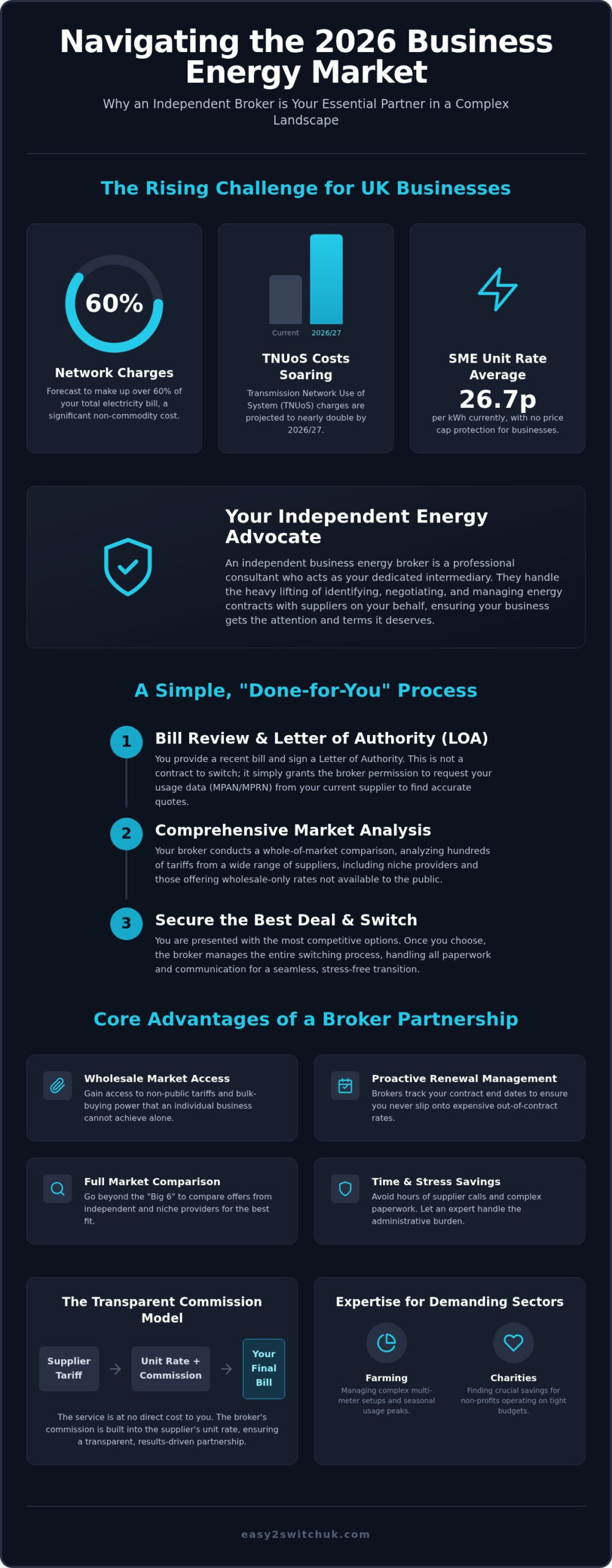
Did you know that network charges are forecast to make up over 60% of your business electricity bill this year? With TNUoS costs nearly doubling in the 2026/27 period, the days of “set and forget” energy contracts are officially over. You’re likely tired of the endless supplier calls and the anxiety that comes with missing a renewal window. It feels like the market gets more complex every time you look at a bill, especially with unit rates for small businesses currently averaging around 26.7p per kWh.
This 2026 guide shows you how an independent business energy broker can take that weight off your shoulders. You’ll learn how they secure competitive tariffs, manage procurement complexity, and streamline your switching process at no direct cost to your business. We’ll explore the latest market trends, including the shift toward mandatory Ofgem registration for intermediaries and the impact of recent geopolitical volatility. By the end, you’ll have a clear path to lower unit rates and a stress-free transition that lets you focus on running your business with confidence.
Key Takeaways
- Understand how an independent business energy broker acts as a dedicated consultant to negotiate contracts and manage the entire procurement process on your behalf.
- Discover how the “done-for-you” switching model operates without direct fees by building commissions into supplier tariffs for a transparent, no-upfront-cost service.
- Learn the streamlined two-step process for switching, from the initial bill review and Letter of Authority to a comprehensive market analysis of hundreds of tariffs.
- Identify why industry-specific expertise is vital for sectors like farming and charities to manage complex multi-meter setups and seasonal usage peaks.
- Gain the tools to take control of your overheads and navigate 2026 market volatility with expert advice tailored to your specific business needs.
What is an Independent Business Energy Broker and Why Use One in 2026?
If you’re asking what is an energy broker?, they are a professional consultant who identifies, negotiates, and manages energy contracts on your behalf. In the UK, an independent business energy broker acts as a dedicated intermediary, handling the heavy lifting of procurement between your company and various suppliers. They manage the entire process from start to finish, ensuring your business isn’t just another number to a large supplier. By acting as a specialist advocate, they secure terms that align with your specific operational needs and financial goals.
The 2026 market requires a sharper eye than previous years. While the extreme price swings of 2022 have faded, businesses now face rising non-commodity costs, including a forecast 60% increase in network charges. Expert negotiation is vital for protecting your margins against these shifting variables. An independent business energy broker helps you take control by accessing non-public tariffs and managing the administrative burden, saving you from hours of frustrating supplier calls and complex paperwork.
The Difference Between Domestic and Business Energy
Business energy contracts are bespoke agreements. They’re built around your specific consumption patterns and meter setups, making them far more complex than a standard home deal. Commercial rates are rarely available as instant online prices because suppliers need to assess the unique risk and usage profile of each individual business. Crucially, businesses don’t have a domestic-style “price cap” to protect them. Without that safety net, you’re exposed to the full weight of market shifts, making professional guidance a necessity for any savvy business owner.
Key Benefits of Professional Energy Consultancy
A reliable specialist provides calm efficiency by monitoring wholesale trends every day. They know exactly when the market dips and when it’s time to lock in a new rate for the future. They also look beyond the “Big 6” suppliers, comparing offers from independent niche providers that might offer better service or lower standing charges for your industry. Proactive renewal management is another major win. Your broker tracks your contract end dates to ensure you never slip onto expensive “deemed rates” or out-of-contract tariffs by accident, which can happen in an instant if you miss a renewal window.
How Business Energy Brokers Work: Transparency and Commissions
One of the most common questions from business owners is how a “free” service actually sustains itself. An independent business energy broker operates without charging you any direct upfront fees. Instead, they use a supplier-paid commission model where the fee is integrated into the unit rate of the energy you consume. It’s a transparent arrangement that keeps the broker focused on your results. If they don’t find you a competitive deal, they don’t get paid. This setup creates a natural incentive for the broker to secure the best long-term fit for your business rather than chasing a quick win. Unlike some platforms that rely on “preferred partner” lists, an independent specialist provides a whole-of-market comparison to ensure you see the full range of available options.
The Role of the Letter of Authority (LOA)
To start the process, you’ll need to sign a Letter of Authority. This document is often a source of confusion, but its purpose is straightforward. It gives the broker the legal right to request your historical usage data and technical details from your current supplier. This includes your MPAN and MPRN numbers, which are unique identifiers for your electricity and gas meters. It’s important to remember that signing an LOA isn’t a commitment to switch. It’s simply the authority to quote. You retain the power to reject any offer that doesn’t meet your requirements.
Wholesale Market Access vs. Direct Quotes
Many of the most competitive rates in 2026 aren’t visible to the general public. Suppliers often reserve “wholesale-only” tariffs for brokers who manage large portfolios of clients. This bulk-buying power allows an independent business energy broker to negotiate terms that an individual small business or charity couldn’t access alone. By comparing gas and electricity accounts at the same time, the broker ensures your entire energy portfolio is synchronised. This reduces administrative friction and ensures you aren’t managing multiple renewal dates across different providers. If you are ready to simplify your procurement, you can learn more about our switching process today.
Choosing the Right Independent Business Energy Broker for Your Company
Not all intermediaries are created equal. While many platforms offer a quick price comparison, finding the right independent business energy broker requires looking beyond the headline unit rate. A true partnership is built on industry specialism. For instance, a working farm with seasonal grain drying peaks and multi-meter agricultural setups needs a very different tariff structure than a high-street charity shop with consistent 9-5 lighting requirements. A specialist understands these operational nuances and ensures your contract doesn’t penalise you for seasonal usage spikes.
Transparency is the cornerstone of a reliable relationship. You should feel comfortable asking how a broker is compensated and which suppliers they’re actually comparing. A reputable specialist will explain their commission structure clearly, as we discussed in the previous section, ensuring there are no surprises later. Unlike automated comparison tools that leave the administrative burden on your desk, a “done-for-you” service provides a dedicated point of contact. This means you have a human expert to handle billing queries and supplier disputes, offering a level of support that a generic call centre simply cannot match.
What to Look for in a Reputable Broker
When evaluating potential partners, look for a proven track record within the UK market. A broker who understands the specific challenges of your sector will be better equipped to handle complex procurement needs. They should offer a clear process for resolving billing errors, which are surprisingly common in the commercial sector. Proactive renewal management is also vital. Your broker should alert you several months before your current contract expires, giving you ample time to survey the 2026 market rather than rushing into a deal at the last minute.
Red Flags to Avoid During Procurement
Be wary of brokers who use high-pressure tactics. If someone claims a deal is “limited time only” or “expires in an hour” without providing a full market comparison, it’s a sign to step back. You deserve the time to review the options and understand the terms. Another red flag is a lack of clarity regarding the supplier panel. If a broker only compares three or four “preferred partners,” you aren’t getting a true whole-of-market view. Finally, always check for hidden administration fees. An independent business energy broker should be upfront about any costs from the start, ensuring the service remains a tool for independence rather than an additional financial burden.
The Step-by-Step Process of Switching Energy Suppliers
Switching your energy provider shouldn’t be a source of stress or a drain on your schedule. A structured approach ensures you remain in control without the administrative headache of dealing with suppliers directly. An independent business energy broker streamlines the transition through five logical stages designed to protect your bottom line. There’s no need to spend hours on hold or decode complex terms; the process is built around efficiency and clarity.
- Step 1: The Initial Review. You provide a recent bill and sign the Letter of Authority (LOA). This allows your broker to verify your current rates and usage patterns.
- Step 2: Market Analysis. The broker compares hundreds of tariffs from across the UK market, looking for the best fit for your specific consumption profile.
- Step 3: The Proposal. You receive a clear, side-by-side comparison of the best available deals, highlighting unit rates and standing charges.
- Step 4: Acceptance and Management. Once you select a tariff, the broker handles the paperwork, including terminating your old contract and managing the new setup.
- Step 5: Ongoing Support. The relationship continues as the broker monitors the market, alerting you months before your next renewal window to avoid expensive “deemed rates.”
What Information You Need to Provide
Accurate data is the foundation of a competitive quote. You’ll need to provide your annual consumption figure in kWh, which helps the broker find a tariff that matches your usage volume. It’s also vital to locate your MPAN (electricity) or MPRN (gas) numbers on your current bill. These unique identifiers ensure the broker quotes for the correct meters on your site. Finally, check your current contract end date and notice period requirements. Missing these windows can result in penalties or being rolled onto out-of-contract rates, which currently average around 40.0p per kWh for electricity.
Handling the Transition Period
Many business owners worry about potential power cuts, but there is zero risk of physical energy disconnection during a switch. The transition is purely administrative; the wires and pipes stay exactly the same. Smart meters play a key role here by providing automated, accurate readings for your final and first bills, which eliminates the frustration of estimated charges. For a deeper look at managing specific fuel types, see our expert guide to compare gas suppliers. If you’re ready to start your review, you can request a free energy audit today.
Specialist Energy Brokerage: Tailored Support for Farms and Charities
Generic energy advice often fails to account for the unique operational demands of specialized sectors. While a standard office might have predictable usage, agricultural and non-profit sites face distinct financial and technical challenges. An independent business energy broker provides the sector-specific expertise needed to navigate these complexities. Whether you’re managing a multi-meter dairy farm or a regional charity, a tailored approach ensures you aren’t paying for a one-size-fits-all contract that doesn’t fit your actual consumption patterns.
Energy Solutions for the UK Farming Industry
The farming industry requires a specialist approach because energy usage is rarely consistent. High-usage seasonal peaks, often driven by heavy machinery or intensive grain drying, can create massive spikes in demand that standard tariffs aren’t designed to handle. Agricultural sites also frequently feature complex multi-meter setups across various outbuildings. These can lead to billing errors or inefficient standing charges if they aren’t managed by a professional. We help farmers take control of these overheads to protect essential margins as network charges rise in 2026. For a deeper dive into current rates, see our complete 2026 guide for farm electricity prices. By aligning your contract with your peak usage periods, an independent business energy broker helps you avoid the high costs associated with poorly structured agricultural tariffs.
Supporting Charities and Non-Profit Organisations
Charities often miss out on significant savings simply because they aren’t aware of specific tax benefits available to them. Many non-profit organisations are eligible for a reduced VAT rate of 5% rather than the standard 20%, provided they meet certain criteria for non-business use. Additionally, charities can often claim exemptions from the Climate Change Levy (CCL), which is a tax on energy delivered to non-domestic users. Identifying these opportunities is a core part of our service, ensuring that more of your funding goes toward your cause rather than your utility provider. You can explore these strategic options further in our business energy comparison guide. Our commitment is to make the switching process fast and stress-free, providing reliable specialist support that empowers you to focus on your mission while we handle the procurement details with calm efficiency.
Take Control of Your Energy Overheads Today
Managing commercial utilities shouldn’t feel like a full-time job. As network charges and market variables continue to shift throughout 2026, having a reliable specialist in your corner is the most effective way to protect your margins. By partnering with an independent business energy broker, you gain access to wholesale-only tariffs and impartial advice that larger suppliers often keep behind closed doors. You’ve seen how a tailored approach can benefit specialized sectors, from the high seasonal demands of the UK farming industry to the specific VAT exemptions available for charities.
We pride ourselves on providing a transparent, done-for-you service with no direct fees for our brokerage. Our team handles the complex paperwork and supplier negotiations, allowing you to focus on your core operations with absolute confidence. It’s time to stop overpaying for “deemed rates” and start benefiting from a strategy designed for your specific needs. Get a Free Business Energy Review from Easy2switch UK Ltd to see how much you could save. We’re ready to help you simplify your procurement and secure a more stable financial future.
Frequently Asked Questions
Is an independent business energy broker really free to use?
Yes, the service is free for the end-user because the broker earns a commission from the supplier you choose to switch to. This fee is built into the unit rate of your energy tariff, so there are no direct invoices or upfront costs to pay. This model ensures an independent business energy broker remains focused on finding you a competitive deal; if they don’t secure a contract you’re happy with, they don’t receive a commission.
How much could a business energy broker save my company in 2026?
Savings vary based on your consumption and current contract status, but the primary value lies in avoiding expensive out-of-contract rates. With network charges forecast to make up over 60% of bills in 2026, a broker helps you identify tariffs with lower standing charges or better unit rates. By comparing hundreds of offers, they ensure you don’t pay more than necessary for your specific industry profile, whether you’re a small office or a large farm.
Will my energy supply be interrupted if I switch via a broker?
No, your energy supply will never be interrupted during the switching process. The transition is entirely administrative, meaning the physical wires, pipes, and meters remain exactly where they are. Your new supplier simply takes over the billing on an agreed date. An independent business energy broker manages the timeline and coordinates with both providers to ensure the handover is seamless and stress-free, with no impact on your daily operations.
What is a Letter of Authority (LOA) and do I have to sign one?
A Letter of Authority (LOA) is a standard document that gives a broker permission to speak to suppliers on your behalf. It allows them to gather your historical usage data and technical meter details, which are essential for generating accurate quotes. Signing an LOA isn’t a binding contract to switch suppliers; it’s simply a tool that empowers your broker to conduct a thorough market analysis and present you with the best available options.
Can a broker help if I am already in a contract?
Yes, a broker can provide significant help even if you’re currently mid-contract. They can review your existing terms to identify your exact renewal window and notice period, ensuring you don’t miss the chance to switch later. In many cases, you can even lock in a future rate months in advance. This proactive approach protects your business from sudden price hikes and ensures you’re ready to transition the moment your current deal ends.
Do business energy brokers work with all UK suppliers?
Independent brokers typically work with a wide panel of providers, ranging from the “Big 6” to smaller, niche specialists. This whole-of-market access is a key advantage over direct supplier quotes. By comparing hundreds of offers simultaneously, they can find competitive rates that aren’t advertised to the general public. This is particularly useful for sectors like farming or charities, where specific independent suppliers might offer more flexible terms or tailored billing structures.
What happens if I forget to renew my business energy contract?
If you forget to renew, your supplier will move you onto “deemed” or “out-of-contract” rates, which are significantly higher than fixed-term deals. For electricity, these rates can reach 40.0p per kWh in the current market. A broker prevents this by tracking your contract end dates and alerting you well in advance. They handle the termination of your old contract and the setup of your new one, ensuring you never pay these penalty prices.
Are commercial energy brokers regulated in the UK?
The UK energy brokerage market is currently transitioning into a formal regulatory framework overseen by Ofgem. Throughout 2026, new standards for commission transparency and mandatory registration are being introduced to protect businesses from hidden fees. This shift from a voluntary code to a regulated system ensures that intermediaries operate with greater accountability. Working with a professional specialist means you’re supported by a consultant who follows these evolving industry standards to ensure a fair procurement process.
