
Centralise the records, but don’t assume every site needs the same utility decisions. Managing utilities for a multi-site charity means keeping track of different meters, usage patterns, contract dates and operational needs, even when information is spread across bills, inboxes and site teams. Without a shared view, finance teams and trustees can struggle to see what the charity is spending, which accounts need attention and why a contract was chosen.
A clear process brings those details together while preserving the differences between sites. This guide explains how to build a reliable record of sites, meters, suppliers and renewal dates, then use it to check bills, plan renewals and set approval steps. It also covers how to compare electricity and gas contracts, including their terms and how any broker is paid. Easy2switch provides charity energy brokerage, comparing supplier offers and supporting charities through switching. The service is free to the customer: the chosen supplier pays a commission incorporated into the tariff.
Key Takeaways
- Managing utilities for a multi-site charity starts with one dependable record of sites, meters, suppliers and contract dates.
- Give organisation-wide oversight to a named owner, while involving local site contacts in checking operational details.
- Compare energy offers against each site’s usage, contract dates and needs, not just the headline rate.
- Use a repeatable routine to check bills against the right site, meter, fuel and billing period, and keep renewal actions visible.
- Charity energy brokerage can support supplier comparisons and switching. Understand how the broker is remunerated when assessing an offer.
Managing utilities for a multi-site charity starts with one reliable picture
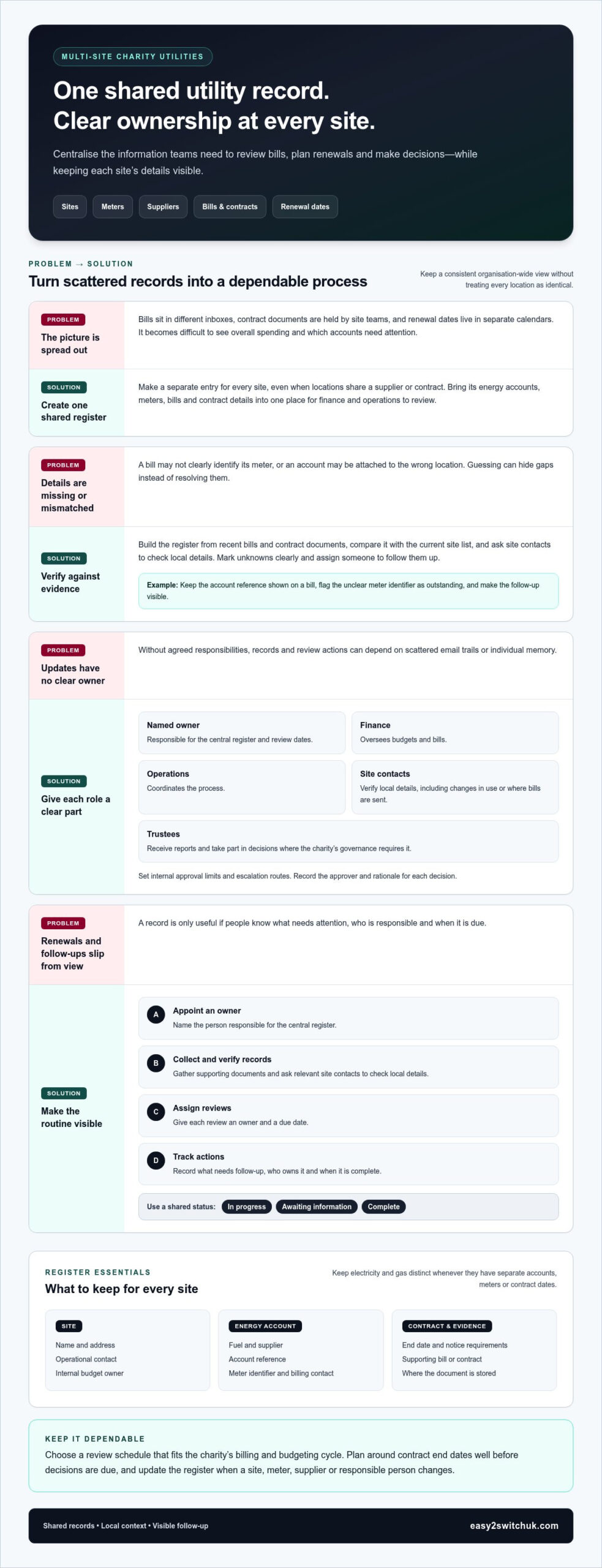
When bills arrive in different inboxes, site teams hold separate contract documents and renewal dates sit in individual calendars, it is hard to understand the charity’s overall position. Bring gas and electricity information into one shared register. This gives finance and operations a consistent view while allowing each site’s usage, contract and operational needs to be considered separately.
A multi-site utility register is a central record of each charity location and its related energy accounts, meters, suppliers, bills and contract details. In practice, centralised utility records create an organisation-wide view of site-level information, so teams can coordinate decisions without treating every site as identical. Charities serve a wide range of purposes and operate in varied settings, as outlined in Charity (disambiguation). Retaining relevant local detail helps make the register useful across that variety.
What information should a charity record for every site?
Create a separate entry for each site, even when several locations share a supplier or contract. Record:
- Site details: name, address, operational contact and internal budget owner.
- Energy account details: electricity and gas supplier, account reference, meter identifier and billing contact.
- Contract information: end date, any notice requirements and the source document supporting each detail, such as a bill or contract.
Keep electricity and gas records distinct whenever they have separate accounts, meters or contract dates. Note where each supporting document is stored. That makes it easier for a colleague to verify an entry and investigate a discrepancy without searching through multiple inboxes.
It is also helpful to log property compliance documents, such as energy performance certificates (EPCs), within the register. If your charity needs to update or verify ratings across its premises, assessors like Energy Smart can inspect buildings and issue certified commercial EPCs.
How can you find missing or inconsistent utility records?
Build the register from documents rather than memory. Compare recent bills and contract documents with the charity’s current site list. Check that each account is attached to the right location and meter, and ask site contacts to flag premises that have opened, become vacant or changed use. Those changes can affect which records and contracts need attention.
Do not fill gaps with guesses. Mark unknown details clearly and assign someone to follow them up. For example, if a bill shows an account reference but does not identify the meter clearly, keep the reference and flag the meter identifier as outstanding. The gap is then visible, with a clear next step.
Use the first version of the register as the shared starting point for future reviews. The aim is not to make every site fit one template for energy use. It is to show what the organisation knows, where the evidence is stored and which details still need follow-up.
Build a central utility-management process without losing site-level detail
A register remains useful only if people know who updates it and what happens when it needs attention. When managing utilities for a multi-site charity, give one person organisation-wide responsibility for energy records and review dates. Ask local contacts to verify what is happening at their sites. This combines consistent oversight with the local knowledge needed to make sound decisions.
Use a shared register with controlled access and a named owner. Include fields for site, fuel, usage period, contract date and follow-up status. A simple status such as “in progress”, “awaiting information” or “complete” shows colleagues where action is needed without relying on scattered email trails.
Consistent records make portfolio-wide reviews easier because teams can compare sites using the same information while retaining each location’s context. The NCVO’s Managing your energy costs for charities is a useful companion to an internal process for overseeing energy spending.
Who should own utility information and decisions?
Agree responsibilities before the next review. Finance can oversee budgets and bills; operations can coordinate the process; and site contacts can verify local details, such as changes in use or where bills are sent. Trustees can receive reports and take part in decisions where the charity’s governance requires it. Set approval limits and escalation routes internally. For each decision, record the approver and rationale so there is a clear history for the next review.
Turn those responsibilities into a straightforward workflow:
- Appoint an owner: name the person responsible for the central register.
- Collect and verify records: gather documents and ask relevant site contacts to check local details.
- Assign reviews: give each review an owner and a due date.
- Track actions: record what needs follow-up, who owns it and when it was completed.
How often should multi-site utility records be reviewed?
Choose a regular review schedule that fits the charity’s billing and budgeting cycle. Use contract end dates to plan reviews well before decisions are due, leaving time to gather information and follow the charity’s approval process. Update the register whenever a site, meter, supplier or responsible person changes, and record the update so the information stays dependable.
When a contract review involves comparing supplier offers, Easy2switch’s charity energy brokerage can help compare electricity and gas contracts and support switching. Explore charity energy contract support as part of your review planning.
Compare energy contracts across charity sites on more than headline rates
Once the records are organised, compare electricity and gas offers against the needs of each site. A headline rate alone does not show whether an offer suits a location or supports the charity’s budget and administrative needs. For a broader procurement perspective, see this business energy comparison guide.
Set out the details in a comparison table before discussing options with budget holders or trustees. Keep offers separate by site and fuel, even when the charity is considering a more coordinated approach.
| Site | Fuel | Usage and period | Contract dates | Offer terms | Decision owner |
|---|---|---|---|---|---|
| Site name | Electricity or gas | Recorded usage and dates covered | Current end date and proposed duration | Applicable charges, payment terms and renewal conditions | Named approver or budget holder |
What should a charity compare in an electricity or gas offer?
Review the contract duration, applicable charges, payment terms and renewal conditions alongside the quoted rate. Match each offer to the usage and account information for that site and fuel. If usage records are incomplete or cover different periods, note the limitation rather than treating the figures as directly comparable. An illustrative rate or potential saving is not a guaranteed result.
Consider practical fit as well as cost: would the terms help the organisation forecast energy spending, and would they add administrative work across multiple accounts? ACEVO’s Managing rising utility costs and sustainability for charities also explores the relationship between cost management and sustainability.
How can a charity balance consistency with site-specific needs?
Aligning renewal dates may make future reviews easier to coordinate, but it is not automatically the right approach for every location. A site with different operating hours, usage patterns or contract timing may need a separate decision. Weigh the administrative benefit of alignment against the suitability of each offer, and record any trade-offs for budget holders and trustees.
For managing utilities for a multi-site charity, consistency should help teams make informed comparisons, not force identical choices. A clear rationale for each site makes the overall decision easier to explain and revisit, even when the contracts differ.
Create a practical routine for bills, renewals and utility oversight
A repeatable review helps teams catch missing information, follow up on questions and prepare for contract decisions before they become urgent. Set the schedule around the charity’s billing and budgeting cycle. Some teams may review bills monthly, while a quarterly check may suit another organisation. The important things are to review regularly, assign responsibility and record the next action.
How can teams spot bill issues and usage changes?
For each bill, check that the site, meter, fuel and billing period match the account record. Compare the charges and usage with previous periods for the same site, and use available meter information to understand notable changes. A different reading can have several explanations, so treat it as a prompt to investigate, not proof of a billing fault.
Track follow-up in the shared register rather than an individual inbox. Record the question, the person responsible and a target resolution date. A practical review sequence is:
- Match the bill to the correct site, meter, fuel and period.
- Compare usage with that site’s previous bills and available meter details.
- Flag unusual changes or missing information for investigation.
- Assign an owner and record the outcome once resolved.
This gives finance and site teams a clear record of what has been checked and helps keep recurring queries visible until they are closed.
How should charities prepare for contract renewals?
Use a renewal calendar to turn contract dates into planned decisions. For each account, record the contract end date, review owner, date for considering offers and internal approval checkpoint. Allow enough time to gather information, compare terms and secure the necessary approval before a decision is due.
As a renewal approaches, bring together relevant bills and usage details. Agree who will review offers and who can approve the chosen option. Record the decision and the reasons behind it, including priorities such as budget predictability, contract fit or administration. This gives trustees and finance colleagues a useful reference for future reviews.
Easy2switch provides charity energy brokerage and switching support for charities comparing supplier electricity and gas offers. The service is free to the customer: the chosen supplier pays a commission incorporated into the tariff. The commercial energy broker guide explains brokerage in the UK business energy market. For support with a charity energy contract review, compare electricity and gas offers with Easy2switch.
Get support managing multi-site charity energy contracts with confidence
A clear internal process may be enough to oversee routine bills and keep contract dates on track. Specialist support can help when several sites have different renewal dates, the team needs to compare supplier offers or coordinating a review is taking time away from other work. The right approach depends on the charity’s records, decision process and electricity and gas contracts.
What does an energy broker do for a multi-site charity?
Easy2switch provides charity energy brokerage, helping charities compare supplier electricity and gas contract offers and navigate switching online or by telephone. This can bring supplier options into a clearer comparison, while your charity remains responsible for assessing suitability and following its own approval process. For more on advisory support, read the business energy consultants guide.
Understand how the brokerage is paid. Easy2switch’s service is free to the customer; the chosen energy supplier pays a commission incorporated into the tariff. This is part of the commercial arrangement to consider alongside an offer, not a reason to assume a particular price or saving. Assess each option against the charity’s information and site needs, as well as the supplier’s terms.
How can a charity take the next step?
Prepare the information needed for a relevant comparison. Gather current bills, contract details, a site list and available meter information for each location. Note missing details and identify who will review and approve a decision. This gives the comparison a practical starting point and keeps site-level requirements in view.
Before committing to a contract, follow the organisation’s agreed approval process and record the decision. Compare the terms against the charity’s priorities rather than treating one headline rate as the whole picture. That keeps responsibility and reasoning clear for budget holders and trustees.
If you’re ready to explore supplier options, discuss charity energy options with Easy2switch online or by telephone. This provides a practical next step for managing utilities for a multi-site charity while keeping the final decision grounded in your organisation’s needs.
Make your charity’s energy decisions easier to manage
Managing utilities for a multi-site charity becomes more straightforward when records, responsibilities and renewal dates are brought into one dependable process. Keep a central view of each site, but assess offers against local usage and operational needs rather than assuming one contract suits every location.
Regular bill checks and a renewal calendar help teams flag questions early, prepare comparisons and follow the charity’s approval process. When supplier offers are difficult to compare or coordination takes time, charity energy brokerage can provide practical support with electricity and gas contracts and switching.
Easy2switch’s service is free to the customer. The chosen supplier pays a commission incorporated into the tariff, so the remuneration model is clear as you consider offers. Discuss your charity’s energy options with Easy2switch and take a practical next step towards clearer decisions across your sites.
Frequently Asked Questions
How do charities manage utilities across multiple sites?
Charities can manage utilities across multiple sites by keeping one central register and assigning clear responsibilities for updates, bill checks and contract decisions. Record each site’s energy accounts separately, then use shared reporting to see upcoming renewals and outstanding questions. Local contacts can verify site details, while finance or operations oversees the overall process. This gives the charity a consistent view without assuming every location has the same usage or requirements.
What information should a charity collect for each utility account?
For each electricity or gas account, record the site name and address, operational contact, internal budget owner, supplier, account reference and meter identifier. Include the billing contact, contract end date, any notice requirements and where the supporting bill or contract is stored. Keep usage linked to its billing period, and flag unknown details for follow-up rather than filling gaps with assumptions. These records make managing utilities for a multi-site charity more consistent.
Can a charity compare energy contracts for several sites together?
Yes. A charity can review supplier offers across several sites in one comparison, using a separate row for each site and fuel. Include usage and the period it covers, contract dates, applicable offer terms and the person responsible for the decision. A combined review can help teams see the portfolio clearly, but it does not mean every site should choose the same contract. Assess each offer against local usage, operational needs and timing.
How often should a charity review its utility bills?
Set a regular review schedule that fits your charity’s billing and budgeting cycle, rather than assuming one frequency suits every organisation. Reviews might be monthly or quarterly, provided bills are checked consistently and questions are followed through. Match each bill to the correct site, meter, fuel and billing period, then compare usage with that site’s previous records. Treat an unusual change as a reason to investigate, not automatic proof of an error.
How can a charity track utility contract renewal dates across sites?
Use a shared renewal calendar or register that lists each site, fuel, contract end date, review owner and internal approval checkpoint. Set a decision date early enough for the team to gather bills and usage details, compare offers and follow the charity’s approval process. Keep electricity and gas dates separate when their contracts differ. Update the record when a supplier, site, meter or responsible person changes, and note completed decisions for future reference.
Is an energy broker’s service free for charities?
Easy2switch’s charity energy brokerage is free to the customer. The chosen energy supplier pays Easy2switch a commission incorporated into the tariff. The charity does not pay Easy2switch directly for the brokerage, but the service has a commercial remuneration arrangement. Consider the commission model alongside the contract terms and supplier offer rather than assuming that “free” means no payment is involved.
What should a charity prepare before comparing energy contracts?
Gather current electricity and gas bills, contract details, a complete site list and available meter information. For each account, note the usage and billing period, supplier and contract end date, and identify any gaps that need follow-up. Agree who will review offers and who can approve a decision under the charity’s internal process. Accurate, site-specific information supports a more useful comparison, with suitable terms depending on each site’s needs and supplier offers.
