
Did you know that small businesses often pay 36% more for electricity the moment their fixed-term deal ends? If you’ve just looked at your latest bill and realised, “I forgot to renew my business energy, what happens now”, the sudden price hike can feel like a genuine emergency. It’s a common oversight for busy owners who are prioritising daily operations over the fine print of utility contracts. You’re likely facing out-of-contract rates, which as of August 2026, have climbed to an average of 40.0p per kWh for electricity. These prices are designed as a safety net for suppliers, not a fair deal for your bottom line.
We understand that the confusion between “deemed” and “out-of-contract” rates only adds to the stress when you’re already worried about rising non-commodity charges. This guide is designed to give you back control. You’ll discover exactly how these emergency rates are calculated and follow our step-by-step guide to escaping expensive deemed rates immediately. We will show you how to stop the financial leak, secure a long-term fixed deal, and hand off the complex paperwork to a specialist so you can focus on running your business again with total peace of mind.
Key Takeaways
- If you’re asking “I forgot to renew my business energy, what happens now”, understand that your supply remains safe, but you’re likely paying premium rates that lack a regulatory price cap.
- Learn how to locate your contract end date and essential MPAN or MPRN numbers on your invoice to begin the process of lowering your bills.
- Discover the flexibility of “deemed” rates, which allow you to switch to a competitive fixed deal at any time without facing exit fees.
- See how an impartial specialist compares hundreds of UK supplier offers to find a tailored fit for your farm, charity, or small business.
- Find out how to use a professional brokerage service at no cost to your business, with all administrative paperwork handled on your behalf.
The Immediate Reality: What Happens When Your Business Energy Contract Expires?
The moment your fixed-term contract ends, your energy supplier moves you to a default tariff. It’s a stressful realisation to have, especially when you think, “I forgot to renew my business energy, what happens now?” The good news is that your supply won’t be cut off. In the UK energy market, suppliers are required to maintain your gas and electricity supply as a safety net, ensuring your business operations continue without interruption. However, this safety net comes with a high price tag.
Deemed Rates vs. Out-of-Contract Rates
While people often use these terms interchangeably, they refer to slightly different situations. Deemed rates typically apply when you move into a new premises and start using energy without signing a formal agreement with the existing supplier. Out-of-contract rates occur when your existing fixed deal reaches its end date and you haven’t arranged a new one. Both statuses share one common goal for the supplier: they are intentionally expensive. These rates are designed to be high to encourage businesses to move onto a negotiated contract quickly. Deemed rates are the default, non-negotiated tariff applied when a contract expires.
The Financial Impact on Your Bottom Line
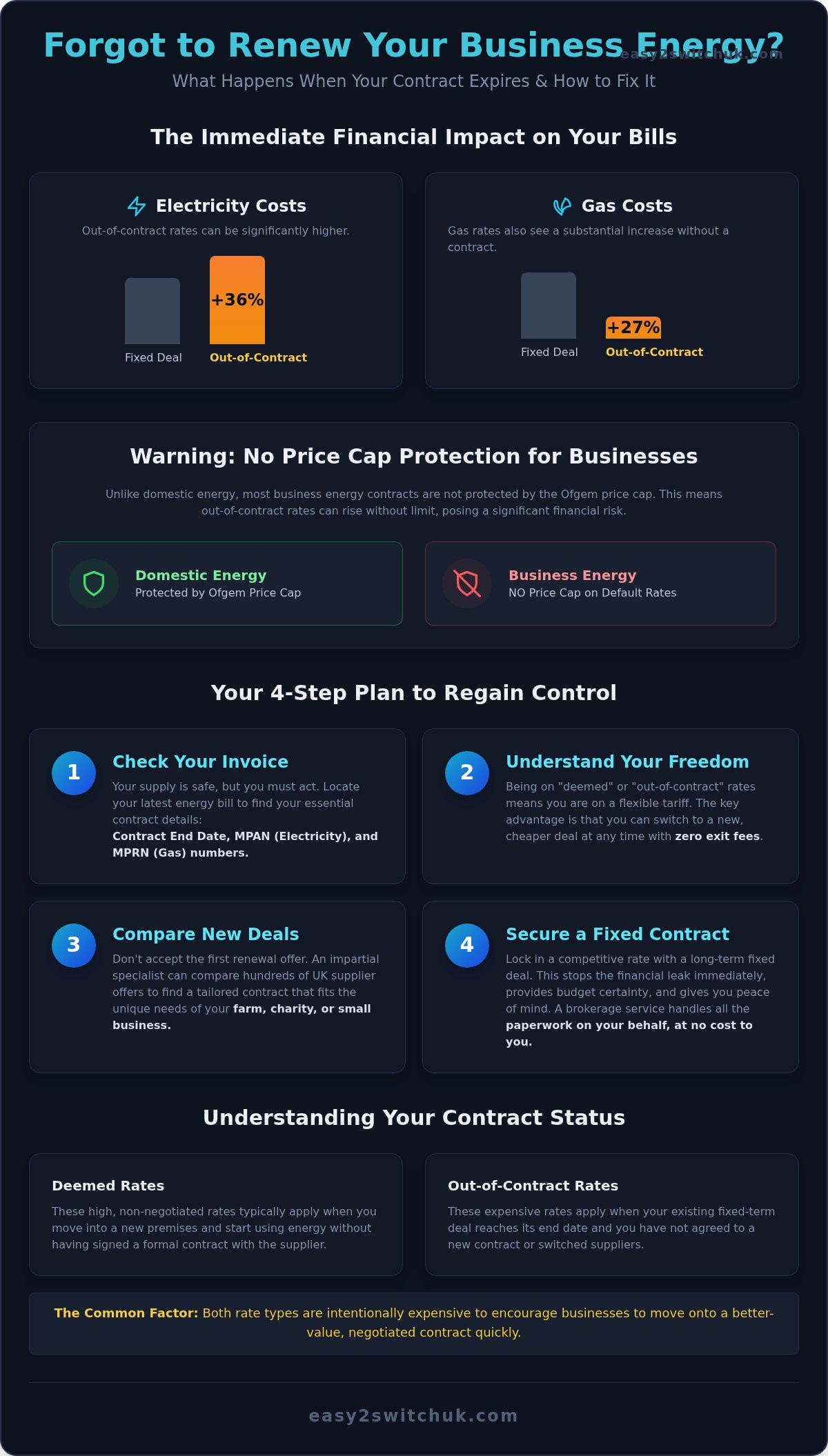
The price jump is often a shock to the system. According to data from August 2026, small businesses falling onto out-of-contract electricity rates can expect to pay around 36% more than those on negotiated deals. Gas rates for small businesses often see a 27% increase. It isn’t just the unit price that rises; daily standing charges can balloon significantly. For instance, average out-of-contract electricity standing charges have reached 254.0p per day. For a small farm or an SME, this sudden spike in overheads can severely disrupt monthly cash flow. If you’ve found yourself saying “I forgot to renew my business energy, what happens now”, the priority is stopping this financial leak.
Rollover Contracts in 2026
In previous years, many suppliers would automatically “roll” you into another year-long contract. In 2026, regulations have become much stricter, particularly for micro-businesses. Most suppliers can no longer lock you into a new long-term deal without your express consent. Instead, they must move you to the flexible but expensive out-of-contract rates mentioned above. This shift gives you more freedom to switch, but it places the responsibility on you to act before the high costs drain your budget. Since there is no regulatory price cap on these rates for most businesses, costs can escalate rapidly without warning.
Why Out-of-Contract Rates Are the Most Expensive Way to Power Your Business
Falling onto out-of-contract rates isn’t just a minor administrative slip; it’s a significant financial risk. When you realise, “I forgot to renew my business energy, what happens now”, you’re stepping into a market where the rules are very different from the ones protecting your home. Suppliers use these rates to shield themselves from wholesale market volatility. Since they don’t know how long you’ll stay on these flexible terms, they charge a massive premium to ensure they don’t lose money if energy prices suddenly spike. This “risk premium” is passed directly to you, making it the most expensive way to power your operations.
No Protection from the Ofgem Price Cap
One of the biggest shocks for business owners is the absolute absence of a safety net. While domestic users enjoy the protection of a price cap, Ofgem explains that no such limit exists for most commercial energy contracts. This exposure is particularly dangerous for high-usage sectors like dairy farming or manufacturing, where machinery runs around the clock. In these industries, even a minor hike in unit rates can wipe out a month’s profit in days. Taking control through a proactive business energy comparison is the only way to shield your bottom line from these uncapped swings.
The “Rollover” Trap for Unwary Businesses
Even in 2026, some businesses face the risk of being “stuck” in a contract they didn’t actively choose. While micro-businesses have seen increased protections, larger commercial entities or those on older contract types may still be subject to rollover clauses. If you haven’t submitted a formal termination notice within the required window, some suppliers may legally roll you into a new 12-month deal. These deals are rarely competitive and often far higher than the market average. A Reliable Specialist can help you identify these traps early, ensuring you aren’t locked into a sub-optimal rate because of a missed deadline.
Suppliers justify these high costs as a necessity for their own stability. Because out-of-contract rates allow you to leave at any time, the supplier cannot purchase energy in advance for you at a fixed price. They are essentially buying your energy on the “spot market,” which is incredibly volatile in the current climate. To protect their margins, they set their default rates at a level that covers the worst-case scenario. This is why acting quickly is essential. If you’re currently paying these emergency rates, you can partner with an independent consultant to find a fixed-term solution that offers the budget certainty your business needs to thrive.
How to Check Your Current Energy Contract Status and End Date
If you’ve just discovered that you’re out of contract, your first priority is finding the exact date your previous agreement lapsed. It’s easy to feel overwhelmed when you realise, “I forgot to renew my business energy, what happens now”, but the information you need is usually right in front of you. Grab your most recent invoice. You are looking for the “Contract End Date”, which suppliers are now required to display clearly for micro-businesses. If it isn’t on the front page, check the back under the “About your tariff” section.
On that same bill, you’ll find two critical identifiers. For electricity, look for the Meter Point Administration Number (MPAN), usually found in a grid-like box starting with an “S”. For gas, look for the Meter Point Reference Number (MPRN). These unique codes are essential for getting accurate new quotes. If you manage multiple sites, such as a farm with several outbuildings or a charity with various offices, keep a simple spreadsheet. It’s common for different meters to have staggered end dates. Tracking them individually prevents the “I forgot to renew my business energy, what happens now” scenario from repeating across your entire portfolio.
Reading Between the Lines of Your Energy Bill
Your bill contains more than just the end date. Look closely at the tariff name. If you see terms like “Standard Variable”, “Out of Contract”, or a deemed contract, you’re already paying those emergency rates. You should also check the “Notice Period” section. Most business contracts require 30, 60, or even 90 days’ notice to leave a fixed deal. Finally, locate your Estimated Annual Consumption (EAC). This figure tells potential new suppliers exactly how much energy you use, ensuring your new quotes are based on reality rather than guesswork.
What if You Can’t Find Your Paperwork?
If your filing system has let you down, don’t worry. You can contact your supplier’s retentions department directly. Be firm; tell them you’re auditing your costs and need your contract end date and EAC. If they try to pressure you into a “quick fix” deal over the phone, politely decline until you’ve seen the wider market. Alternatively, using a commercial energy broker is a far more efficient route. By signing a simple Letter of Authority (LOA), you give a specialist the legal right to speak to suppliers on your behalf. This allows them to track down missing data and audit your supply history with calm efficiency.
4 Steps to Take Right Now if Your Energy Contract Has Expired
Finding out you’re overpaying is frustrating. However, the situation is entirely fixable. If you’ve realised, “I forgot to renew my business energy, what happens now”, your next moves will determine how quickly you can stop the financial drain.
Step 1: Don’t panic. While the rates are high, your flexibility is at its peak. If you’re stressed because you think, “I forgot to renew my business energy, what happens now”, remember that being on deemed rates actually means you are free to leave with zero exit fees. You aren’t tied down. You can start a switch today.
Step 2: Gather your data. You need your latest bill. Specifically, look for your MPAN or MPRN numbers and your meter serial numbers. Having these ready ensures your new quotes are accurate and prevents delays during the registration process.
Step 3: Compare the market immediately. Don’t just look at one supplier. You need a baseline rate to understand what a “good” deal looks like in 2026. This allows you to see exactly how much you’re currently overpaying on your out-of-contract tariff.
Step 4: Serve notice to your current supplier. Even if you haven’t picked a new deal yet, tell your current provider you intend to leave. This formal step prevents any further administrative rollovers and signals that you’re taking control of your procurement.
Immediate Mitigation Strategies
Your current supplier will likely send an “urgent” renewal offer once they notice you’re out of contract. Avoid signing this immediately. These first offers are rarely the most competitive. They’re often designed to capture “lazy” renewals from busy owners. Instead, use this time to explore the wider market. If you accidentally agreed to something over the phone, check if a cooling-off period applies, though these are rarer in commercial contracts than domestic ones.
Securing Your Next Fixed Deal
In the 2026 market, you’ll need to choose between 12-month and 36-month contracts. Currently, 24 to 36-month deals often offer similar value to shorter ones, providing much-needed budget certainty. For those in the agricultural sector, seasonal flexibility is key. Farmers should look for contracts that accommodate the high-usage peaks of harvest or calving seasons without punitive over-usage charges.
The most efficient path is the done-for-you route. You can partner with a Reliable Specialist to let an expert handle the supplier negotiations on your behalf. Since suppliers pay the commission, this service remains free for your business while ensuring you get a deal tailored to your specific industry needs.
Securing a New Deal: How Easy2switch UK Ltd Simplifies the Renewal Process
Realising that “I forgot to renew my business energy, what happens now” is a stressful moment, but it is also an opportunity to reset your procurement strategy. At Easy2switch UK Ltd, we specialise in moving businesses from expensive out-of-contract rates to competitive fixed-term deals with minimal effort on your part. Our impartial approach means we scan hundreds of offers from across the UK market to find the best fit for your specific needs, rather than pushing a one-size-fits-all solution.
We operate on a “Free to You” model. Our consultancy service is paid via supplier commissions, which means you receive professional brokerage and administrative support without an upfront fee. This accessibility is vital for SMEs and charities where every penny of the budget counts. We take pride in our “Done-for-You” promise; once you’ve selected a deal, Easy2switch UK Ltd handles the entire switching process, including the technical paperwork and supplier correspondence, so you can focus on your daily operations.
Why a Specialist Broker is Better Than a Comparison Site
While automated comparison sites are fine for simple domestic bills, they often struggle with the complexities of commercial energy. A website algorithm might miss the nuances of half-hourly meters or the specific requirements of multi-site portfolios. Our team provides a human element that technology cannot replicate. We offer personalised advice based on your usage patterns and industry sector, acting as a Reliable Specialist who speaks your language rather than hiding behind jargon. For example, if you are managing a dairy farm or a rural manufacturing hub, we understand how your peak usage times impact your tariff options.
Taking Control of Your Energy Future
The panic of thinking “I forgot to renew my business energy, what happens now” should not be a recurring event. Part of our service involves setting up proactive alerts for your future renewal windows. We track the market for you, ensuring that you are informed months before your next contract ends. This creates a sense of calm efficiency in your procurement, moving you from reactive crisis management to proactive cost control. You don’t have to spend hours comparing suppliers; we bring the market to you. Take control of your energy costs today with a free review and secure the long-term stability your business deserves.
Stop Overpaying and Take Control of Your Energy Procurement
Missing a renewal deadline doesn’t have to be a financial disaster. While out-of-contract rates are designed to be expensive, they also offer the ultimate flexibility to switch without exit fees. By gathering your latest bill and serving notice, you can stop the immediate drain on your cash flow. If you are currently worried because I forgot to renew my business energy, what happens now, the solution is just a few clicks away.
Our team specialises in supporting the UK farming community and SMEs through these exact transitions. We provide impartial advice from over 100 suppliers and handle every piece of paperwork on your behalf. Because our service is completely free for businesses, you gain the expertise of a specialist without adding to your overheads. It’s time to move from emergency rates to a stable, long-term deal that protects your bottom line.
Get a Free, No-Obligation Business Energy Review and let us handle the hard work for you. You’ve got this; we are here to help you get back on track.
Frequently Asked Questions
What is the difference between deemed rates and out-of-contract rates?
Deemed rates apply when you take over a property and use energy without signing a contract with the existing supplier. Out-of-contract rates apply when your fixed-term deal reaches its end date and you haven’t arranged a new one. Both are default tariffs designed to be expensive to encourage you to switch. They are often used interchangeably, but they represent different starting points for your energy supply.
Can my energy supplier cut off my business if I forget to renew?
No, your supplier will not cut off your power or gas just because a contract has ended. There is a safety net in place to ensure your business operations can continue. However, the supplier will move you to their standard variable or out-of-contract rates. These are significantly higher than negotiated deals, so while your lights stay on, your costs will rise immediately.
How much more expensive are out-of-contract rates for UK businesses?
Out-of-contract rates are significantly more expensive than negotiated deals. As of August 2026, small businesses pay roughly 36% more for electricity and 27% more for gas on these default tariffs. With average electricity rates at 40.0p per kWh, the financial impact is substantial. If you’re wondering, “I forgot to renew my business energy, what happens now”, the reality is a sharp increase in your monthly overheads.
Do I have to pay an exit fee if my business energy contract has already expired?
No, you do not have to pay an exit fee once your fixed-term contract has expired. Being on a deemed or out-of-contract tariff means you are on a flexible arrangement. You have the freedom to leave and switch to a new supplier at any time. This flexibility is the only advantage of these high rates, allowing you to move to a more competitive fixed deal without financial penalties.
How long does it take to switch business energy suppliers in 2026?
In 2026, switching business energy suppliers typically takes between 5 and 15 working days. The industry has streamlined the registration process to make it faster for SMEs and farms to move away from expensive default rates. While the technical switch is quick, you should ensure your final meter readings are submitted promptly to avoid any billing disputes with your previous supplier during the transition period.
Can a business energy broker help me if I’ve already rolled over into a new contract?
Yes, a specialist broker can still assist you. If you’ve been rolled into a new contract, we can audit the agreement to ensure the supplier followed Ofgem’s renewal rules. For micro-businesses, these rules are very strict. If the rollover is valid, we can still help you serve the necessary termination notice immediately. This ensures you are ready to switch the moment that new term ends.
Is the Ofgem energy price cap applicable to small businesses or farms?
No, the Ofgem energy price cap is strictly for domestic households and does not apply to small businesses, charities, or farms. Commercial energy prices are dictated by the wholesale market and the specific terms of your contract. Without a cap, businesses on default rates are fully exposed to market volatility. This makes it essential to negotiate a fixed-rate deal to provide budget certainty.
What information do I need to provide for a new business energy quote?
To get an accurate quote, you need your Meter Point Administration Number (MPAN) for electricity or Meter Point Reference Number (MPRN) for gas. These are found on your latest bill. You also need your Estimated Annual Consumption (EAC) and your current contract end date. Providing this specific data allows a broker to find the most appropriate deals from hundreds of supplier offers tailored to your actual usage.
