
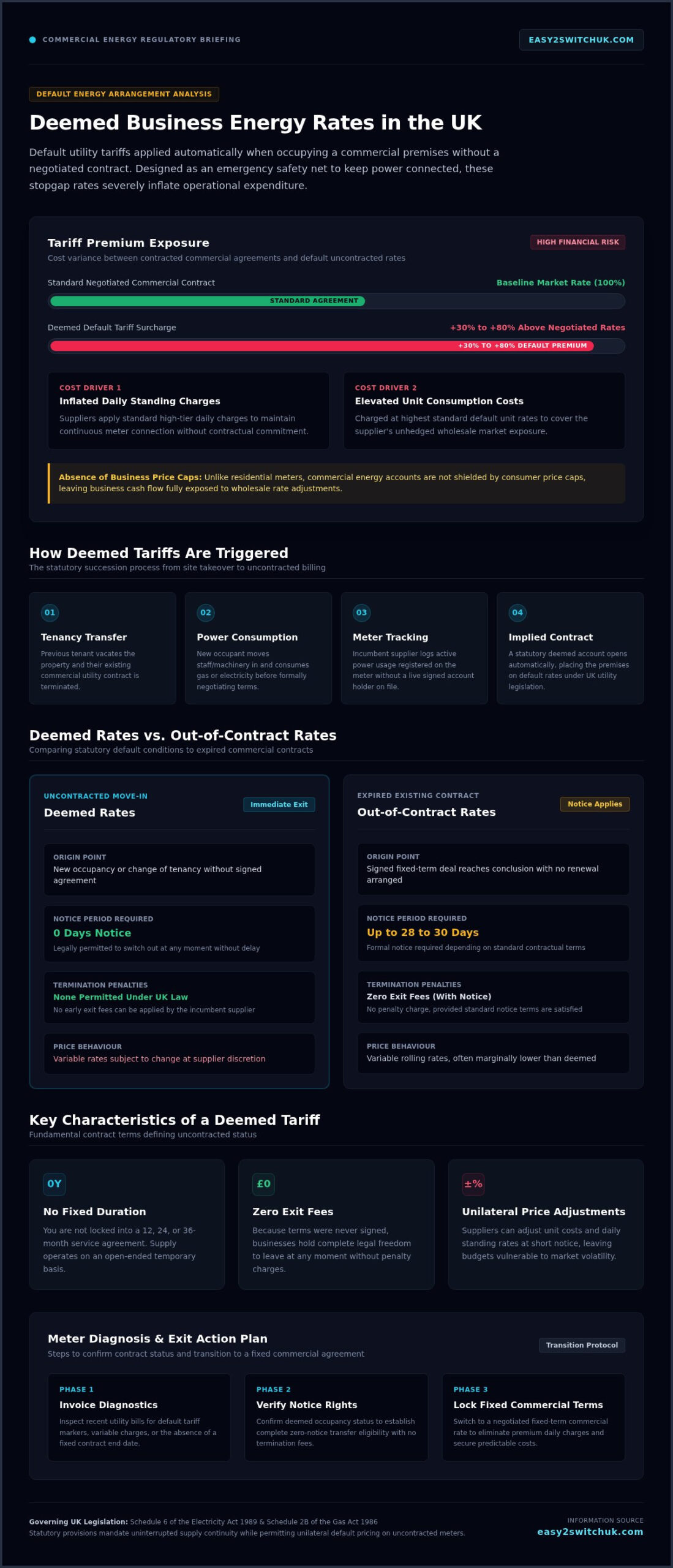
Your energy supplier’s default tariff was designed as an emergency safety net to keep the power running, not an acceptable commercial rate for operating a business. If you recently moved into new commercial premises or never formally signed an agreement with the incumbent provider, you’re likely paying the deemed business energy rates UK suppliers charge on uncontracted meters. These default tariffs often run between 30% and 80% higher than negotiated agreements, quietly draining your operational cash flow through inflated daily charges and unit costs.
Sorting through confusing supplier correspondence while wondering whether you’re legally permitted to switch is a frustrating distraction you don’t need. The good news is that being on a deemed tariff gives you complete freedom to leave at any point without paying exit penalties. We’ll show you how to confirm your contract status, eliminate excessive default charges, and transition smoothly to a competitive fixed-term commercial rate that protects your budget.
Below, explore our clear breakdown of how default tariffs function and the practical steps you can take to secure predictable energy costs in 2026.
Key Takeaways
- Understand how deemed business energy rates UK suppliers assign to uncontracted premises act as an expensive stopgap rather than a standard commercial tariff.
- Distinguish between move-in deemed agreements and expired out-of-contract rates to assess your exact contractual liabilities.
- Discover why the absence of business price caps leaves your operational cash flow exposed to premium daily standing charges and inflated unit costs.
- Use practical invoice diagnostic checks to identify default tariff markers and confirm your current meter status.
- Learn how to exit uncontracted arrangements immediately without notice periods or exit penalties to secure negotiated fixed-term stability.
What Are Deemed Business Energy Rates in the UK?
Deemed business energy rates UK companies encounter are default utility charges applied automatically when a commercial occupant consumes gas or electricity at a premises without a formally negotiated supply contract. Rather than cutting off the power, the incumbent supplier provides continuity under default terms until you agree to a standard agreement or switch to another provider.
This mechanism is backed by UK legislation under Schedule 6 of the Electricity Act 1989 and Schedule 2B of the Gas Act 1986. These statutory regulations ensure that energy suppliers maintain an uninterrupted flow of power to commercial properties, even in the absence of a signed agreement. While this legal framework protects your day-to-day operations from sudden disconnection, it comes at a steep financial price. Suppliers charge their highest standard tariffs to cover the unhedged wholesale risk of uncontracted power usage.
How Commercial Properties Fall Onto Deemed Tariffs
The most common path to a deemed tariff occurs during a change of tenancy or property acquisition. When a previous tenant vacates a commercial building, their negotiated utility agreement ends. If you take over the lease, move staff or equipment inside, and begin drawing power before signing your own contract, an implied contract is formed immediately.
Energy suppliers track meter usage continuously. As soon as meter readings show power consumption without an active account holder on file, the existing supplier opens a deemed account. Operating without a written agreement means you automatically accept these uncompetitive default rates simply by flipping the light switches or running your machinery.
Key Characteristics of a Deemed Energy Arrangement
Deemed arrangements behave very differently from standard commercial contracts:
- No fixed duration: You aren’t committed to a 12, 24, or 36-month service term.
- No termination fees: Because you never signed terms, you are legally free to switch at any moment without paying early exit penalties.
- Unilateral price adjustments: Incumbent suppliers can increase standing charges and unit prices at short notice, leaving your utility budget completely vulnerable to market volatility.
While deemed status acts as an effective emergency safety net during a chaotic relocation, letting it run indefinitely causes unnecessary damage to your bottom line.
Deemed Rates vs Out-of-Contract Rates: Key Differences Explained
Commercial utility bills frequently lump default charges under ambiguous terminology, but deemed rates and out-of-contract rates arise from two separate contractual situations. Deemed business energy rates UK organisations pay occur through tenancy succession when you occupy a premises without signing an agreement. Out-of-contract rates apply when an existing, signed commercial contract reaches its conclusion without an agreed renewal or transfer. Both scenarios result in unnecessary overheads, but knowing which one applies dictates how fast you can leave.
| Factor | Deemed Rates | Out-of-Contract Rates |
|---|---|---|
| Contract Origin | New tenancy or move-in without an agreed contract | Expired fixed-term deal with no renewal arranged |
| Notice Period | Zero notice required | May require up to 28 to 30 days notice depending on terms |
| Termination Fees | None permitted under UK law | Zero exit fees, but notice terms must be satisfied |
| Pricing Volatility | Variable pricing subject to change at supplier discretion | Variable rolling rates, often marginally lower than deemed |
Defining Out-of-Contract Energy Rates
Out-of-contract terms activate when an agreed fixed contract concludes and you haven’t locked in fresh terms or transferred your meter. Commercial supply agreements contain standard clauses permitting the supplier to move unrenewed meters onto rolling variable pricing. While these rates are usually slightly lower than deemed tariffs, they still sit well above competitive market rates. Some suppliers also require formal written notice before permitting an external switch.
Why Confusing the Two Tariffs Proves Costly
Assuming deemed terms carry the same notice requirements as out-of-contract arrangements creates expensive delays. According to Ofgem’s official guidance, customers on deemed terms have the statutory right to switch at any point without giving prior notice or paying penalty fees. Waiting weeks to review paperwork only prolongs your exposure to inflated daily standing charges.
You can benchmark available contract structures by consulting our business energy comparison 2026 guide. If you want to cut through administrative hurdles and secure competitive terms quickly, partnering with easy2switchuk.com allows you to benchmark suppliers and execute a clean exit from default pricing without hassle.
The Financial Impact of Deemed Energy Tariffs on Commercial Budgets
One widespread misconception among commercial tenants is that the Ofgem domestic price cap protects business utility bills. It doesn’t. Business consumers operate in a completely unregulated pricing environment where suppliers set default rates entirely at their own discretion. Without price cap limitations, paying deemed business energy rates UK suppliers issue can inflate your electricity and gas expenses by 30% to 80% compared to a negotiated commercial contract. For operations running refrigeration, heavy machinery, or multi-meter facilities, this disparity erodes cash flow rapidly.
Official guidance on how to Set up a business energy contract reminds organisations that unmanaged utility accounts carry significant financial exposure. Left unaddressed, default pricing creates substantial, unbudgeted expenditure month after month.
Why Suppliers Charge Premium Deemed Rates
Suppliers justify their premium deemed prices by citing wholesale purchasing friction. When you agree to a long-term commercial deal, the energy supplier purchases your projected volume in advance on the forward wholesale market. Uncontracted meters leave them unable to forecast consumption. They must buy power on volatile day-ahead spot markets, passing that financial risk and administrative overhead directly to your invoice through high safety margins.
Understanding these procurement mechanics is essential for long-term budget stability. Our commercial energy broker guide provides deeper insight into how energy providers build margins and how proactive negotiations remove those layers of risk.
Compounding Daily Standing Charges
The cost of deemed energy isn’t just tied to unit rates. Fixed daily standing charges on default tariffs are heavily inflated, meaning your business incurs steep overheads before a single kilowatt-hour is consumed:
- Unavoidable fixed baseline: High daily rates accrue every day of the month, whether your premises are fully operational or closed over weekends.
- Loaded non-commodity costs: Third-party charges, such as grid transmission upgrades and statutory levies, make up roughly 60% to 65% of commercial electricity bills. Suppliers bundle these heavily into default standing charges to hedge their liabilities.
- Cash flow leakage: High fixed standing fees combined with premium unit rates compound quickly, turning routine utility expenses into one of your largest operational overheads.
How to Check If Your Business Is on Deemed Energy Rates
Confirming whether you are currently paying deemed business energy rates UK suppliers assign to unmanaged meters requires a quick audit of your utility paperwork. If you never formally signed an agreement with the incumbent provider after moving in, you are almost certainly on default pricing. Run through this initial checklist to evaluate your premises:
- Generic invoice addressee: Correspondence addressed to “The Legal Occupier” rather than your specific business name indicates the supplier has no contracted account holder on record.
- Unspecified end dates: The contract duration or expiry date field is blank, showing rolling or ongoing terms.
- Missing documentation: Your internal files contain no signed fixed-term commercial contract or broker agreement for the current site.
Auditing Your Commercial Utility Invoices
Inspect the line-item breakdown on your latest electricity or gas bill. Energy suppliers are legally required to state the active tariff type on commercial statements. Look for labels such as “Deemed Rate”, “Default Variable”, or “Standard Commercial Terms”. If these designations appear alongside elevated standing charges and unit prices that fluctuate without an agreed schedule, your business is operating on default terms.
Locating Meter Identifiers (MPAN and MPRN)
Pinpointing your meters requires finding their national registry numbers. For electricity, locate the Meter Point Administration Number (MPAN), a 21-digit reference starting with an ‘S’ printed in a small grid on your bill. For gas, identify the Meter Point Reference Number (MPRN), typically a 6 to 10-digit number. If you have just taken over a site and hold no previous statements, your regional electricity distributor or gas transporter can identify your meter numbers from your trading address.
Establishing Tenancy Records and Meter Readings
Record meter readings on the exact day your commercial lease begins, accompanied by time-stamped photographs. Pair these numbers with your signed lease agreement or legal completion statement. Submitting these verified records to the supplier establishes your precise start date, preventing your business from inheriting historical arrears or inflated default bills run up by the previous occupant.
Uncovering meter details and navigating supplier queues takes time away from running your company. You can bypass the administration by letting our specialists handle the legwork. Review your options and secure competitive terms through our dedicated business energy brokerage.
How to Exit Deemed Rates and Secure a Competitive Business Energy Contract
Escaping default pricing is far simpler than most facility managers realise. Because UK businesses face no supplier lock-in or mandatory notice periods under deemed arrangements, you can initiate a transfer immediately. Leaving deemed business energy rates UK providers charge puts you back in charge of your operational overheads, transforming an open-ended financial drain into fixed budgetary predictability.
Step-by-Step Guide to Changing Business Tariffs
- Collate site documentation: Gather recent meter readings along with your commercial lease or transfer agreement to confirm your official occupation date.
- Run a tender comparison: Compare current commercial offers across fixed-term, flexible, or green tariffs, assessing total costs rather than just headline unit rates.
- Lock in a contract: Sign your chosen agreement. Your incoming supplier coordinates directly with the incumbent provider to initiate the transfer.
- Pay the closing balance: Submit a final meter reading on the switchover day and settle the closing default statement up to the exact transfer point.
You don’t have to face this procurement process alone. Exploring professional business energy comparison services streamlines each phase, taking the administrative burden off your desk.
Benefits of Working With an Independent Energy Broker
Approaching individual suppliers directly can turn into a time-consuming chore, particularly if your business operates complex multi-meter commercial sites or specialised operations. Independent energy brokers act as your dedicated procurement partner, delivering clear operational advantages:
- Whole-of-market tender access: Gain pricing from dozens of UK licensed suppliers, including commercial tariffs not published on public-facing price engines.
- Zero brokerage fees charged directly to your business: The service is entirely free to commercial clients, funded through standard supplier commissions.
- Complete administrative management: From submitting tender documents to resolving transfer hold-ups or incorrect objection notices, specialists oversee the process to completion.
- Sector expertise: Broker support ensures bespoke handling for multi-site companies, commercial enterprises, farms, and charities.
Switching from default arrangements restores budget stability. A tailored commercial contract eliminates arbitrary price spikes, locks in transparent standing charges, and keeps your operational funds focused where they belong.
Take Control of Your Commercial Utility Costs
Default tariffs ensure your power stays connected during a property move, but paying deemed business energy rates UK suppliers assign doesn’t have to drain your ongoing cash flow. Without statutory price caps to protect commercial operations, unhedged unit costs and heavy standing charges quietly erode margins month after month. Because deemed terms carry zero termination fees and no contractual lock-in, you hold complete freedom to walk away at any moment.
Transitioning to a competitive fixed-term agreement replaces unpredictable monthly invoices with dependable financial certainty. Easy2switch provides independent whole-of-market comparisons across leading UK energy suppliers, handling all administrative legwork from initial bill audits through to completed supplier transfers. Our specialist brokerage service is 100% free to commercial clients, funded via transparent supplier commissions. Stop overpaying on deemed rates with a free commercial energy review and secure the cost stability your enterprise deserves.
Frequently Asked Questions
Can a business energy supplier disconnect my power if I am on deemed rates?
No, an energy supplier cannot disconnect your commercial electricity or gas supply simply because you are on a deemed contract. The statutory regulations that establish deemed contracts exist specifically to prevent immediate disconnection when properties change hands. A supplier can only take steps toward physical disconnection if you build substantial unpaid arrears, fail to settle invoices, or refuse reasonable payment terms over an extended period.
Do I need to give 30 days notice to leave a deemed energy rate in the UK?
No, you do not need to provide 30 days notice or any advance warning to exit a deemed tariff. Under Ofgem regulations, deemed business energy rates UK customers pay carry zero notice requirements and no contract lock-in. You can agree to a new supply contract with an alternative provider immediately. Your incoming supplier will manage the switchover, and your deemed arrangement terminates automatically on the live transfer date.
Why are deemed business energy rates so much higher than contracted tariffs?
Deemed business energy rates UK suppliers charge run higher because providers purchase short-term wholesale power at volatile spot prices rather than hedging bulk volumes in advance. Supplying an uncontracted commercial site introduces significant forecasting uncertainty and credit risk. Suppliers cover these variables by adding substantial risk margins to both unit prices and daily standing charges, alongside elevated billing management overheads.
Can my business claim back money if we were placed on deemed rates by mistake?
Yes, your business can claim back overpayments if an administrative error or supplier delay wrongly placed you on default pricing. If you submitted a signed contract or formal transfer request that the supplier mismanaged, they must re-bill your account using the negotiated tariff terms. You will need to provide documented correspondence, contract confirmation slips, and dated meter readings to secure a credit adjustment or refund.
Does the UK domestic energy price cap apply to business deemed tariffs?
No, the Ofgem domestic energy price cap does not apply to non-domestic commercial supplies, regardless of whether you are on deemed or fixed terms. Commercial energy contracts operate in a deregulated market where suppliers set default rates without statutory maximum caps. This regulatory difference leaves business utility budgets fully exposed to unhedged wholesale spikes and elevated standing charges unless you secure a negotiated commercial agreement.
What documents do I need to prove I moved into a commercial building on deemed rates?
You need your signed commercial lease agreement, a solicitor’s completion statement, or a landlord transfer letter detailing the exact legal start date of your occupancy. In addition, submit clear, time-stamped photographs of your gas and electricity meters taken on move-in day. Providing these documents prevents the incumbent supplier from billing your organisation for energy consumed or arrears left behind by previous tenants.
How long does it take to switch away from a deemed business energy tariff?
Switching away from a deemed tariff typically takes between five working days and a few weeks, depending on meter setup and supplier processing. Microbusinesses benefit from faster industry switching standards, while complex commercial setups or multi-meter sites may take slightly longer for credit checks and network registration. Your power supply continues uninterrupted throughout the transition until your new fixed contract officially goes live.
