
What if the lowest unit rate isn’t the best deal for your cold store? Cold storage energy contracts UK businesses compare should reflect continuous refrigeration, site demand and the cost of running the operation, not just a headline price per kWh.
Energy costs can make budgeting difficult. Contract lengths, standing charges and changing non-commodity costs complicate comparisons, while the supply agreement needs to suit your facility’s operating pattern. An attractive rate on paper may not be the right fit once you review the full terms and your site’s needs.
This guide explains how to assess business energy offers for cold storage, compare them on consistent terms and prepare useful information before requesting quotes. It also covers fixed and variable tariffs, renewals and how the cold storage Climate Change Agreement may relate to wider energy costs without being confused with a supply contract. Use these checks to weigh your options and decide whether help comparing suppliers would be useful.
Key Takeaways
- Compare cold storage energy contracts UK suppliers offer against your facility’s actual electricity use, not a generic tariff.
- Assess unit rates, standing charges, contract length and key terms using the same site details and consumption period for every offer.
- Gather meter details, recent bills, consumption data, contract dates and business contact information before requesting quotes.
- Check how the supply agreement, site operations and any energy-efficiency commitments fit together. Confirm switching arrangements and terms with the supplier.
- A broker may make supplier comparisons easier. Easy2switch compares business energy offers at no customer fee; the chosen supplier pays commission incorporated into the tariff.
What makes cold storage energy contracts different from standard business tariffs?
A cold storage energy contract is an agreement to supply a facility with electricity, not a tender to buy refrigeration equipment or build a cold store. One sets out the terms for purchasing energy from a supplier; the other covers goods or construction work. For chilled and frozen operations, assess the supply agreement alongside the site’s refrigeration requirements and daily processes.
Reliable refrigeration is central to protecting stored goods and maintaining operations. An energy contract cannot guarantee uninterrupted supply. Buyers should understand the supplier’s terms and switching arrangements, then consider how the proposed contract fits the site’s needs. Suitability depends on the facility, its consumption data and the specific offer, not simply on whether it stores chilled or frozen products.
Why refrigeration loads shape the contract decision
Refrigeration is an operational electricity load, but cold stores don’t all use energy in the same way. Storage temperatures, refrigeration systems, opening hours and other site processes can affect when and how much energy a facility uses. Those details help suppliers assess a site and help buyers judge whether an offer is appropriate.
Use your own meter readings and consumption records rather than generic assumptions about cold stores. If some processes can be adjusted at certain times, ask whether the supplier offers relevant flexibility arrangements and what conditions apply. Demand response programs describe ways electricity use may respond to grid needs. Whether a particular site can participate depends on its operational requirements and the terms on offer.
Energy supply contracts, tenders and efficiency schemes are different
Search results for cold-storage tenders may show public procurement notices for equipment, construction or other services. These are not the same as an electricity supply agreement for an existing site. Check what a notice is asking organisations to provide before treating it as relevant to energy procurement.
A Climate Change Agreement (CCA) is also separate from the supply tariff. It concerns energy-efficiency commitments and may affect a business’s wider energy-cost considerations, but it doesn’t replace the supplier contract or set its unit rate. Before making decisions, check current cold-storage CCA participation criteria, targets, deadlines and tax treatment with authoritative sources. Confirm any obligations that apply to your business rather than assuming that scheme participation changes the terms of an energy offer.
The best starting point for comparing cold storage energy contracts UK suppliers offer is a clear picture of your facility: how it operates, what its meters record and what each supplier’s agreement says.
Which cold storage energy contract terms should UK buyers compare?
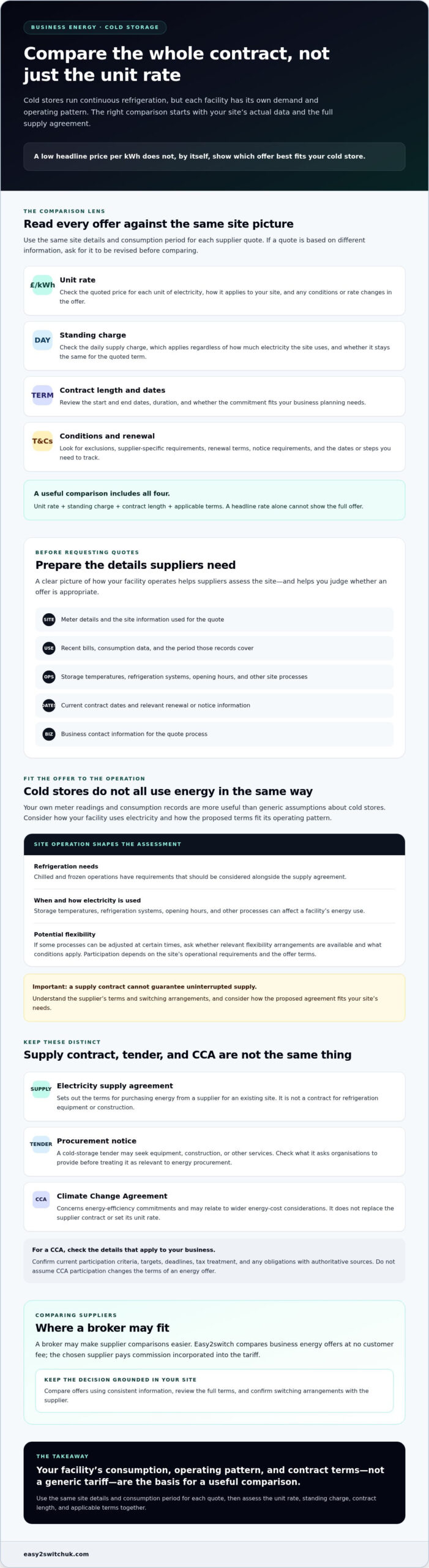
A useful comparison starts with consistent information. Ask suppliers to quote against the same site details and consumption period, then check what each offer includes. Rates and availability depend on the supplier and your business circumstances, so another site’s quoted price may not be a reliable guide.
A headline rate alone cannot show which energy contract is best for your cold store. The unit rate is the price charged for each unit of electricity used. The standing charge is a daily charge for supplying the site, regardless of how much electricity it uses. Both affect the overall cost, alongside the contract length and specific terms.
Comparison point | What to check
Unit rate | The quoted price per kWh, how it applies to your site and any conditions or rate changes described in the offer.
Standing charge | The daily amount charged for the supply and whether it stays the same for the quoted term.
Contract length | The start and end dates, duration and whether the commitment fits your planning needs.
Applicable terms | Conditions, exclusions or supplier-specific requirements that affect the quote or how it applies to your site.
Renewal and notice | What the offer says about renewal, notice requirements and the dates or steps you need to track.
Compare rates and contract structure on the same basis
Build a side-by-side comparison using the same meter and consumption period for every quote. If a supplier has used different site details or a different usage profile, ask for a revised offer before comparing prices. Then consider the combined effect of the unit rate and standing charge, rather than either figure alone.
Check the contract duration and renewal wording in the actual offer. Similar-looking quotes may have different conditions. If your business has Climate Change Agreement participation, review the scheme’s current information from the Cold Chain Federation’s Climate Change Agreement (CCA) guidance separately from the supplier’s tariff terms.
Check dates, changes and unanswered questions
Before accepting an offer, confirm its start and end dates, notice requirements and renewal process in writing. Ask the supplier how a change to your site details or consumption could affect the quoted terms. If anything is unclear, write down the question and request clarification before agreeing.
Comparing offers can take time. If you’d like help reviewing business energy supplier options, Easy2switch’s business energy brokerage is one option. The service is free to customers; the chosen supplier pays commission that is incorporated into the tariff.
How can a cold store prepare to compare electricity contracts?
Good quotes start with accurate site information. Before requesting options for cold storage energy contracts UK suppliers offer, gather records showing how your facility uses electricity and when the current agreement ends. Consistent inputs make it easier to compare offers fairly and identify questions for suppliers.
Gather the site information suppliers need
Start with recent bills and supplier records, not estimates. Collect at least 12 months of consumption data if available, along with the site’s MPAN, current supplier details and contract end date. Note operational factors that may shape demand, such as storage temperatures, refrigeration schedules and other major site processes. If a figure is missing or unclear, check the bill or ask the supplier rather than guessing.
For wider context on planning efficiency measures alongside procurement, see the Cold Chain Federation’s Energy Efficiency in Cold Stores: A Practical Guide. It can help you consider operational priorities, but efficiency planning is not a substitute for comparing supply terms.
Set decision criteria before reviewing offers
Decide what matters most before quotes arrive. Rank priorities such as price structure, contract certainty, length of term and the administrative support you need. Agree who will review the offers, approve a choice and sign. A shared comparison table helps decision-makers judge each proposal against the same criteria.
Use this sequence to move from records to a considered decision:
- Gather bills and meter details. Record the MPAN, current supplier and consumption history for the site.
- Confirm contract dates. Check the current agreement’s end date and any relevant renewal or notice wording.
- Describe the operation. Note processes that affect electricity use, including refrigeration schedules and storage requirements.
- Request comparable offers. Give each supplier the same site information and consumption period, and keep a record of what you supplied.
- Review and confirm. Compare offers against your agreed priorities, resolve uncertainties and confirm the final terms in writing before accepting.
Once you have the core records, the business energy comparison guide offers broader context for assessing supplier options. Preparation won’t determine which offer is right, but it gives suppliers and any broker a clearer basis for finding options that fit your facility.
How should operators assess risk, efficiency schemes and switching concerns?
For a cold store, the supply decision sits alongside operational and efficiency planning, but these are separate considerations. The energy contract sets out the supplier’s terms; site procedures manage refrigeration and daily continuity; an efficiency scheme may bring separate commitments. Assess each on its own terms, then check how they interact before agreeing to a change.
Questions to ask about switching and continuity
A supplier change alone doesn’t tell you what will happen at your site. Don’t assume every transfer is interruption-free or follows the same timetable. Ask the proposed supplier to explain the process, dates and responsibilities in writing, including whether any action is needed at the meter or site.
Check how and when your existing agreement ends, and confirm the planned start date for the new contract. Ask who will manage each step and what to do if dates or site details change. Keep the written answers with the offer so your operations and procurement teams can work from the same plan.
Where the Climate Change Agreement fits
The Climate Change Agreement (CCA) is an energy-efficiency scheme, not an electricity tariff. The Cold Chain Federation reports that the cold storage scheme began in January 2026 and is set to run until at least March 2033. Its published targets are measured against a 2022 baseline: 4.75% by the end of 2026, 7.75% by the end of 2028 and 11% by 2030. These commitments may be relevant to wider site energy planning, but they don’t establish which supplier contract is suitable.
Before relying on potential CCA benefits, confirm your business’s eligibility, applicable target requirements, deadlines and tax treatment against current authoritative guidance. The Cold Chain Federation’s CCA information is a useful starting point. Check the latest scheme details and obligations directly before making a decision. Treat any potential levy relief separately from the unit rate and other terms in a supplier offer.
A straightforward risk check is to document the proposed transfer, verify dates and responsibilities, and review any efficiency commitments separately from the supply contract. This gives your team a clearer basis for assessing cold storage energy contracts UK suppliers offer without assuming a tariff change resolves operational or scheme-related questions.
If help comparing business supplier offers would be useful, you can discuss business energy options with Easy2switch. The service is free to customers; the chosen supplier pays commission incorporated into the tariff.
When should a cold storage business use an energy broker?
Comparing supplier offers directly may suit a business with time to gather quotes, check contract wording and manage the process internally. Broker support may be useful if your team wants help comparing options and handling the switching process, especially when procurement competes with other operational priorities. It supports business energy comparisons, but it is not a dedicated cold-storage contract or a promise of a particular result.
For a broader overview of what to expect, read this commercial energy broker guide. Whether you compare independently or use a broker, keep your facility’s consumption information and contract requirements central to the decision. Assess offers available for your business circumstances rather than assuming one option will suit every cold store.
What to ask an energy broker before using the service
Ask which suppliers and offers have been considered for your site, and whether each quote uses the same meter details and consumption information. Check what the broker can explain about contract terms, including rates, standing charges, dates and renewal conditions. Get the supplier’s offer in writing and review it before deciding.
Ask how the broker is paid. Easy2switch’s service is free to customers, while the chosen supplier pays commission incorporated into the customer’s tariff. Ask how this applies to the offers being discussed so you understand the basis of the comparison. A broker’s involvement doesn’t remove your responsibility to check the terms and choose what fits your business.
A practical route to comparing business contracts
Easy2switch supports businesses online or by telephone, compares offers from hundreds of energy suppliers and provides a switching service. Available options depend on the business and supplier terms. Before agreeing to a transfer, confirm the process and dates with the supplier, and check how the new agreement fits your site’s operating needs.
For cold storage energy contracts UK businesses are assessing, broker support can help organise comparisons without taking the decision out of your hands. Compare the written terms, ask about anything unclear and proceed only when you’re comfortable with the agreement.
Compare business energy options with Easy2switch if you’d like support reviewing supplier offers and the switching process.
Make your next energy decision with confidence
The right cold storage energy contracts UK businesses choose should reflect the facility’s actual consumption and operating needs. Compare supplier offers using consistent site information, look beyond the headline rate to the full contract terms, and confirm dates and switching responsibilities directly with the supplier.
Keep supply arrangements, site operations and efficiency commitments distinct in your decision-making. If a Climate Change Agreement may apply, check current eligibility and obligations with authoritative sources rather than assuming it forms part of the energy tariff.
If you’d like support comparing business energy offers, Easy2switch can help online or by telephone. The service is free to customers, and the chosen supplier pays commission incorporated into the customer’s tariff. Review the offer and commission details before deciding whether it suits your business.
Compare business energy options with Easy2switch and take a clear, informed next step for your facility.
Frequently Asked Questions
Are cold storage energy contracts different from standard business energy contracts?
Usually, they’re business electricity supply agreements rather than a separate type of refrigeration contract. What makes the decision different is the site’s operating profile: refrigeration schedules, storage requirements and other processes can affect electricity use. Suppliers assess offers using the details provided, so a contract suitable for one cold store may not suit another. Check the quoted terms against your consumption records and operational needs.
How can a cold storage business compare electricity contracts?
Compare offers using the same site details and consumption period, then assess the unit rate, standing charge, contract length, renewal wording and other applicable terms. The headline rate alone won’t show which offer best fits your operation. Check that each quote uses the correct meter and usage information, and ask suppliers to clarify differences or conditions in writing before deciding. This makes comparisons fairer.
Can a business switch energy supplier without interrupting a cold store?
A supplier change doesn’t necessarily mean a physical interruption at the site, but don’t assume every transfer follows the same process or timing. Ask the proposed supplier to explain the steps, dates and responsibilities in writing. Confirm how your current agreement ends and when the new one is due to begin. If any site action is required, clarify who is responsible and how it should be coordinated with operations.
What information should I prepare before requesting a cold storage energy quote?
Gather recent electricity bills, the site’s MPAN, current supplier details, consumption history and the current contract’s end date. Include relevant operating information, such as refrigeration schedules or processes that affect electricity use. Check details against bills and supplier records rather than estimating missing figures. Consistent, accurate information helps suppliers or a broker assess available offers against your business circumstances and makes quotes easier to compare on the same basis.
Does a Climate Change Agreement reduce the price of a cold storage energy contract?
A Climate Change Agreement (CCA) isn’t part of the electricity supply tariff itself. Eligible participants may qualify for a reduction in the Climate Change Levy, subject to the scheme’s current rules and their obligations. That’s separate from the unit rate and standing charge in a supplier’s offer. Check current eligibility, targets, deadlines and tax treatment with authoritative sources before factoring any potential CCA benefit into your business’s cost planning.
Does Easy2switch charge cold storage businesses to compare energy contracts?
No. Easy2switch’s brokerage service is free to customers. If a customer chooses an offer, the supplier pays Easy2switch a commission incorporated into the customer’s tariff. Ask how commission relates to the offers being compared, and review the supplier’s written contract terms before accepting. Easy2switch supports businesses online or by telephone with comparing supplier offers and the switching process, but available options depend on the business’s circumstances.
When should a cold storage business review its energy contract?
Review your agreement ahead of its end date so you have time to check renewal wording, notice requirements and alternative offers. Revisit the contract if site details or operating patterns change, since these may affect the accuracy or relevance of a quote. Use current consumption records and confirm supplier-specific terms directly. Don’t assume a renewal or new offer will suit your facility without checking the full agreement.
