
What if the lowest unit rate doesn’t deliver the best overall value? Calculating the ROI of using an energy consultant means comparing the full contract, not just one figure. Unit rates, standing charges, exit fees and the time you’d spend sourcing and reviewing offers all matter.
It’s reasonable to ask whether potential savings justify the effort, especially when contract terms make offers difficult to compare. This guide gives you a repeatable way to assess a consultant-supported offer against your current contract, using your own consumption and clear assumptions. You’ll also learn how to account for contract timing and any early-termination costs before deciding.
Easy2switch UK Ltd’s comparison and advice are free to use. If you choose an offer, the selected supplier pays commission, which is built into the tariff. Include the full tariff in your comparison rather than treating the commission as proof of savings. We’ll also explain the practical value of a dedicated Account Manager and switching support, alongside Easy2switch UK Ltd’s commitments under the Data Protection Act, FCA, TPI Code of Practice and Business Protection from Misleading Marketing Regulations 2008.
Key Takeaways
- When calculating the ROI of using an energy consultant, compare offers over the same period and against the same usage, so the figures are fair.
- Use a clear method: calculate the estimated difference in contract costs, then assess time and administration separately. Keep assumptions visible and don’t present an estimate as a guaranteed saving.
- Assess tariff differences separately from time saved, administration and contract guidance. Record the evidence and assumptions behind each benefit.
- Test conservative, expected and higher-usage scenarios using your own consumption records. Check for fixed-term exit fees before deciding whether to switch early.
- Include commission transparently in your comparison: it’s paid by the chosen supplier and built into the tariff, not charged separately for a quote.
What Does the ROI of Using an Energy Consultant Actually Measure?
Consultant ROI is the measurable value of making a supported energy-contract decision compared with a fair alternative, such as renewing your current deal or arranging a contract yourself. It isn’t simply the difference between two unit rates. A sound assessment separates possible changes in energy charges from practical benefits, then records the evidence and assumptions behind each.
Energy consulting can cover a broad range of work, from improving energy use to managing costs and considering environmental goals, as outlined in this Energy consulting overview. For a supplier-contract comparison, keep your calculation focused on the contract decision. Don’t count equipment upgrades or reduced energy use unless they’re part of a separate, evidenced project.
Which benefits belong in an energy consultant ROI calculation?
Start with potential tariff savings. Compare expected charges over equivalent periods using the same consumption profile. Then assess practical value separately. Keeping these benefits distinct helps you avoid presenting an estimate as a guaranteed saving or assigning a cash value to time without a clear basis.
- Energy charges: Compare the expected cost of each contract using the same usage, period and relevant charges.
- Time: Note the staff or owner hours spent reviewing offers, checking terms or managing a renewal. Treat these as time saved unless you have a defensible way to value them in pounds.
- Administration: Record specific tasks handled, such as gathering offer details or supporting the switching process. Count only work you can describe, not a broad assumption that administration has disappeared.
- Contract guidance: Note practical help understanding terms and timing, while keeping this decision-support value separate from any tariff difference.
For example, if a comparison reduces the time you spend collecting and reviewing offers, that’s a practical benefit. It doesn’t automatically mean you’ve saved the same amount in cash. Your own records help make the distinction clear.
Why energy-contract ROI differs from equipment investment ROI
Energy-contract consultancy is different from buying equipment. A comparison or advice service can be free to use, with no separate customer charge for a quote. But “free to use” doesn’t mean you should ignore how the selected tariff is funded: Easy2Switch UK Ltd’s commission is paid by the chosen supplier and built into the tariff. Assess the actual offer rather than assuming the commission guarantees savings or makes the tariff unsuitable.
An equipment project usually involves capital expenditure, such as buying and installing technology, followed by estimated savings over time. Similarly, if your organisation is exploring broader sustainability initiatives or green building certifications through specialists such as ekocentric.com, those should be assessed as separate projects. A supplier contract instead sets the rates and terms for energy supplied during the contract period. Don’t apply equipment payback periods or product case studies to a contract decision. Compare the contract costs and conditions on their own terms, then describe any time or administrative benefit separately. Estimates depend on your contract details and usage, so they aren’t guaranteed savings.
For a transparent assessment, keep the offer, current contract and assumptions together. Easy2Switch abides by the Data Protection Act, FCA, TPI Code of Practice and Business Protection from Misleading Marketing Regulations 2008. These commitments are relevant to how advice is presented, but they don’t replace checking the figures and terms that determine your individual result.
How to Calculate Energy Consultant ROI From Comparable Contract Figures
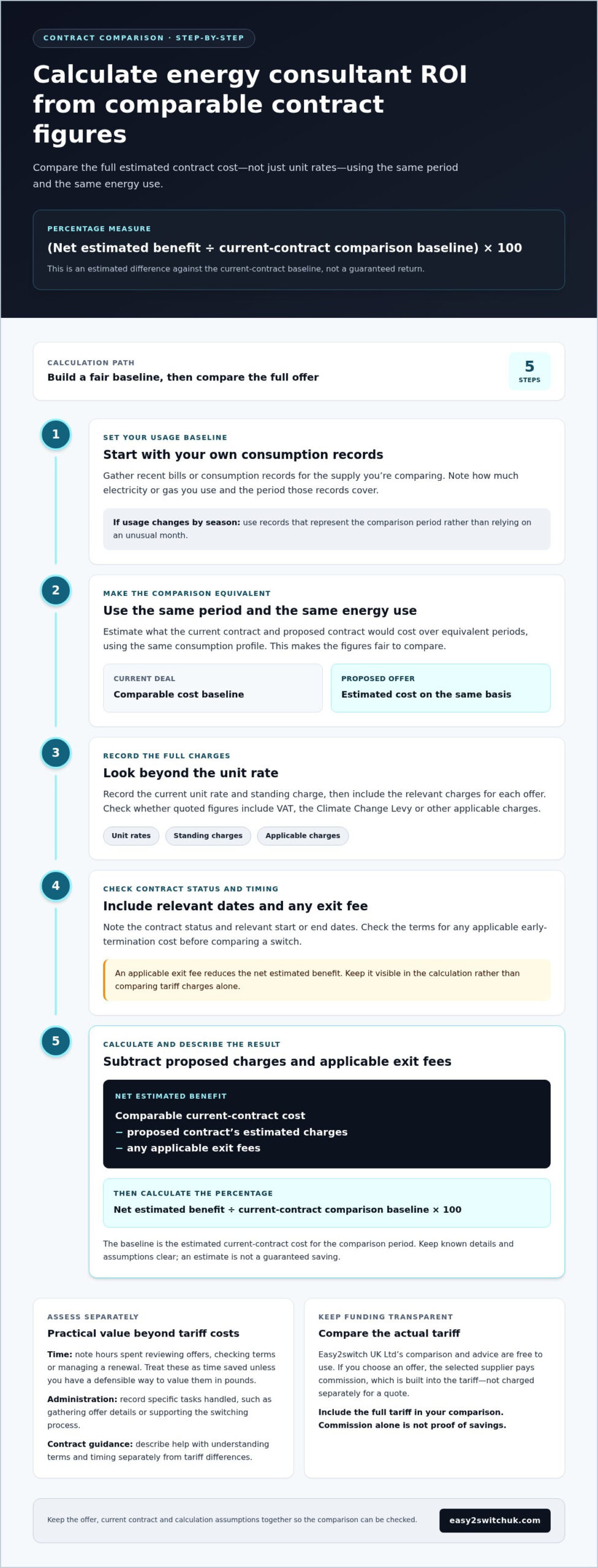
A useful comparison starts with a fair baseline: what your current contract would cost over the same period and for the same energy use as the new offer. The aim isn’t to predict a perfect future bill. It’s to estimate the difference using consistent figures, then make clear which details are known and which are assumptions.
For a percentage measure, use: estimated difference as a percentage of the current-contract baseline = (net estimated benefit ÷ current-contract comparison baseline) × 100. Calculate the net estimated benefit by subtracting the proposed contract’s estimated charges and any applicable exit fees from the comparable current-contract cost. The baseline is the estimated current-contract cost for that period. This percentage describes the estimated difference against that baseline, not a guaranteed return. Because Easy2Switch’s comparison and advice are free to use, there’s no separate quote fee to deduct from the estimate.
Build a fair baseline from your current energy contract
Gather recent bills or consumption records for the supply you’re comparing. Use them to establish how much electricity or gas you use, then note the current unit rate, standing charge, contract status and relevant start or end dates. If usage varies by season, use records that represent the comparison period rather than relying on an unusual month.
- Usage: Note the consumption period and amount used.
- Charges: Record unit rates and standing charges. Check whether quoted figures include VAT, the Climate Change Levy or other applicable charges.
- Terms: Note contract conditions, offer validity and any exit fee that could apply to your current fixed contract.
Apply consistent tax and levy treatment to both options. If a bill or offer presents these differently, clarify the basis before comparing totals. Label anything you can’t verify as an assumption or unknown.
Calculate the difference without overstating the result
Apply each contract’s unit rates and standing charges to the same consumption assumptions and comparison period. Include relevant conditions that affect the charges. A lower unit rate alone doesn’t establish a lower overall cost if standing charges or other terms differ.
For a simple model, let C be the estimated cost under your current contract and N the estimated cost under the new offer, using identical usage and dates. Net estimated benefit is C − N − applicable exit fees. If no exit fee applies, don’t deduct one. Check your current contract before switching: potential savings may outweigh an early-termination cost, but include that cost in the comparison.
For example, if your usage evidence covers a full year, use that same annual consumption profile for both contracts. Don’t compare a full-year current cost with a shorter new-offer period. Keep the result conditional on actual usage, contract terms and the supplier offer remaining valid. For broader business-finance context, Forbes business coverage may be useful, but your contract documents should determine the figures in this calculation.
Calculating the ROI of using an energy consultant is most useful when someone else can follow your workings. Easy2Switch UK Ltd offers free-to-use energy comparison and advice, with commission paid by the chosen supplier and built into the tariff. You can use a free energy comparison and advice service to review an offer, then assess its actual charges and terms against your baseline.
Which Energy Consultant Benefits Count Beyond the Tariff Difference?
A tariff comparison captures only one part of the value. A consultant may also reduce the time and administration involved in comparing offers and managing a switch, or help you understand contract terms. Keep these benefits in separate categories. That makes the assessment clearer and avoids blending a possible difference in charges with less easily measured practical support.
Separate direct contract value from time and administration
The estimated difference in contract charges is the direct financial measure. Record practical benefits separately, such as the time you would otherwise spend gathering offers, reviewing paperwork or coordinating a switch. Time saved can matter to an owner or staff member, but don’t convert it into a cash saving unless you have evidence to support that valuation.
Use a simple evidence check for each benefit:
| Benefit | Evidence available | Assumptions required | Limits |
|---|---|---|---|
| Estimated contract-charge difference | Current bills, usage records and the written offer’s rates and charges. | Comparable usage, period, tax treatment and contract conditions. | An estimate depends on actual consumption and offer terms. It isn’t a promised saving. |
| Time saved | Your own record of time spent on previous comparisons or renewals. | How much of that work the support replaces. | Report hours saved separately unless you can justify a financial value for them. |
| Administration and switching support | Tasks handled, such as reviewing paperwork or coordinating switching. | Which tasks you would otherwise have completed yourself. | Describe the work clearly. Don’t assign an arbitrary cash value. |
| Decision support | Contract details and explanations relevant to your decision. | How that guidance affects your understanding or confidence. | It supports a decision, but doesn’t establish that a tariff is right for every customer. |
Only include service benefits you can describe in concrete terms. For instance, note which comparison or switching tasks were handled rather than adding a general “convenience” figure to your estimated financial return. This keeps the calculation useful to someone reviewing it later.
Interpret commission transparently when judging value
Easy2Switch’s commission is paid by the chosen supplier and built into the tariff. It isn’t charged separately for a quote. Include the full quoted terms in your assessment and compare them with your current contract, including applicable charges and conditions. Commission disclosure is important context, but by itself it doesn’t prove a tariff is suitable or unsuitable.
When calculating the ROI of using an energy consultant, don’t use results from unrelated products, equipment projects or competitor case studies as evidence of what your own contract decision will deliver. Your evidence should come from your consumption, contract documents, actual offer and clearly described support. Keep financial estimates distinct from practical benefits, and you’ll have a balanced basis for deciding whether the overall value works for you.
How to Test Your ROI Estimate Before Making an Energy Contract Decision
A single estimate can hide how much the result depends on usage, timing or contract terms. Before deciding, test your comparison under different consumption assumptions and make sure the new offer covers a period that matches your decision. The aim isn’t to predict an exact future bill. It’s to see whether the estimated value holds up when reasonable assumptions change.
Stress-test usage, dates and contract assumptions
Use your own bills or consumption records to create conservative, expected and higher-usage scenarios. Base each on evidence that reflects your organisation, such as differences across billing periods, rather than an arbitrary percentage. Apply each consumption profile to both contracts using the same period and charges. This shows how higher or lower usage affects the estimated difference without presenting it as a promised saving.
Timing matters too. Check your current contract’s end date and whether the proposed offer starts at a comparable point. A comparison that assumes an immediate switch may not reflect the cost of staying until a fixed term ends. If you’re considering leaving a fixed contract early, check the applicable exit fee and subtract it from the estimated difference. Potential savings may outweigh the fee, but assess that using your actual terms.
Keep a short record alongside your calculation: the bills or usage records used, comparison dates, charges included, assumptions made and any details still unknown. This makes the estimate easier for a colleague or trustee to reproduce and review. For a broader framework for assessing contract terms, the business energy comparison guide can help you structure the wider comparison.
Choose a decision rule that fits your organisation
Decide in advance what information you need before weighing an offer. For example, require a complete breakdown of rates, standing charges, contract dates and relevant conditions, plus a clear explanation of any exit fee. For organisations managing energy agreements alongside wider estate requirements—often handled in statutory areas by specialists such as Oxford Environmental Consultants (OEC)—farms, businesses and charities should also clearly identify who has authority to review and approve contracts. That helps prevent an indicative estimate being mistaken for a final decision or responsibility being left unclear.
Set a practical threshold for proceeding, such as being able to compare the full offer against your current contract and explain how the estimate was calculated. If important terms are missing, mark them as unknown rather than filling gaps with assumptions. Keep the financial result separate from time saved or administrative support, so every part of the decision remains visible.
For context on the role of brokers in business energy decisions, see the commercial energy broker guide. If you’d like support comparing contract figures and terms, explore an energy comparison and advice for your organisation.
How Easy2Switch Helps You Assess Energy Consultant ROI
A useful comparison should leave you with more than a headline rate. Easy2Switch provides free-to-use energy comparisons and advice, helping you review an offer against your own usage, current contract and decision priorities. There’s no separate customer charge for a quote or advice, but it’s still important to assess the tariff and its terms on their merits.
What the Easy2Switch service contributes to the value assessment
Easy2Switch compares offers from hundreds of suppliers each week. A dedicated Account Manager can support you through the comparison and contract arrangements, while the done-for-you switching process can reduce the administration involved. These are practical benefits to consider separately from any estimated change in energy charges. They don’t guarantee that a new offer will save money.
Commission is paid by the chosen supplier and built into the tariff, not charged separately for a quote. Keep that model in mind as you review the offer. Compare its full rates, standing charges, contract conditions and dates with your current deal. If you’re on a fixed contract, check any exit fee before treating a possible difference as net value. Potential savings may outweigh the cost, but the decision depends on your actual figures and terms.
Over 90% of proposed contracts are accepted. That figure describes contract acceptance, not customer savings or a guaranteed outcome. Switching usually takes 2-3 weeks, depending on the supplier, and the switch doesn’t interrupt your energy supply. Keep estimated charges, practical support received and any assumptions in separate lines when calculating the ROI of using an energy consultant.
Easy2Switch abides by the Data Protection Act, FCA, TPI Code of Practice and Business Protection from Misleading Marketing Regulations 2008. This wording isn’t a claim of FCA authorisation. Easy2Switch’s brand commitments are to treat customers with respect, be honest, open and fair, remain impartial, deliver what it promises and act in customers’ best interests. Transparent terms and clear comparisons give you a practical basis for assessing the service.
Take a low-friction next step with your own contract details
Use your current energy information to request a free, no-obligation comparison. A dedicated Account Manager provides personal support through the comparison and contract arrangements, helping you understand the offer before you decide. You can then assess the quoted terms against your own contract rather than relying on a general example.
Make Your Next Energy Decision With Confidence
Your ROI estimate is most useful when it helps you choose a clear next step. Keep your calculation with your contract records, note when the offer was made, and revisit it when your renewal approaches or your usage changes. That gives you a practical reference for future decisions rather than relying on memory or a headline rate.
Calculating the ROI of using an energy consultant isn’t about proving that every comparison will save money. It’s about having enough relevant information to decide whether the contract, support and effort involved make sense for your organisation. You can take that step at your own pace, with your priorities and figures in view.
Easy2Switch has a Trustpilot rating of 4.6 from 49 reviewers. If you’re ready to compare options using your own energy information, get a free, no-obligation energy comparison. A clear next step can make your next contract decision more manageable.
Frequently Asked Questions
Is using an energy consultant free for the customer?
Yes. Easy2Switch’s energy comparison and advice are free to use, with no cost or obligation to request a quote. If you choose an offer, commission is paid by the selected supplier and built into the tariff, rather than charged separately for the comparison. When calculating the ROI of using an energy consultant, assess the tariff’s full terms and your own usage. A free comparison can inform your decision, but it doesn’t guarantee savings.
Can an energy consultant help if I am still on a fixed contract?
Yes, you can seek advice and compare options while you’re in a fixed term. Before deciding to switch early, check your contract for exit fees and compare any charge with the potential difference in energy costs. An offer may look attractive but be less valuable once an applicable fee is included. A comparison can also help you plan around your contract end date instead of making a premature commitment.
Will switching energy consultants or suppliers interrupt my gas or electricity supply?
No. Changing energy consultant doesn’t itself alter your supply, and a supplier switch is arranged without downtime. Your gas or electricity continues to reach your property during the change. The switch changes the supplier responsible for your account, not the physical supply. Keep paying bills as normal and follow the instructions provided for your account during the transition, so your records remain up to date.
Do I need to contact my current energy supplier to switch?
No. When you switch supplier through Easy2Switch, the new supplier handles the switching process, so you don’t need to arrange the transfer directly with your current supplier. Keep your latest bill and contract details available, as they help establish your current rates, usage and contract dates. If you’re in a fixed term, review any exit fees before proceeding, as these can affect the value of switching early.
Will my meter or equipment need to be changed when I switch?
In most cases, no. Switching supplier doesn’t require a meter or equipment change. A meter change is relevant only if you choose to upgrade to a smart meter. When comparing offers, use the meter details and consumption information already shown on your bills so the quote reflects your current setup. This keeps the comparison focused on the contract rather than assuming equipment work is part of the switch.
How long does an energy supplier switch usually take?
An energy supplier switch usually takes 2-3 weeks, depending on the supplier. The timing can vary, so allow for the process when planning around a contract renewal or end date. If you’re working towards a particular date, include that timing in the comparison discussion. Your dedicated Account Manager can provide personal support with the contract arrangements while the switch progresses.
Can an energy consultant help farms, businesses and charities?
Yes. Easy2Switch provides energy comparisons and advice for farms, businesses and charities, as well as homes. Easy2Switch abides by the Data Protection Act, FCA, TPI Code of Practice and Business Protection from Misleading Marketing Regulations 2008; this wording isn’t a claim of FCA authorisation. Easy2Switch is committed to treating customers with respect, being honest, open and fair, remaining impartial, acting in customers’ best interests and delivering what it promises.
