
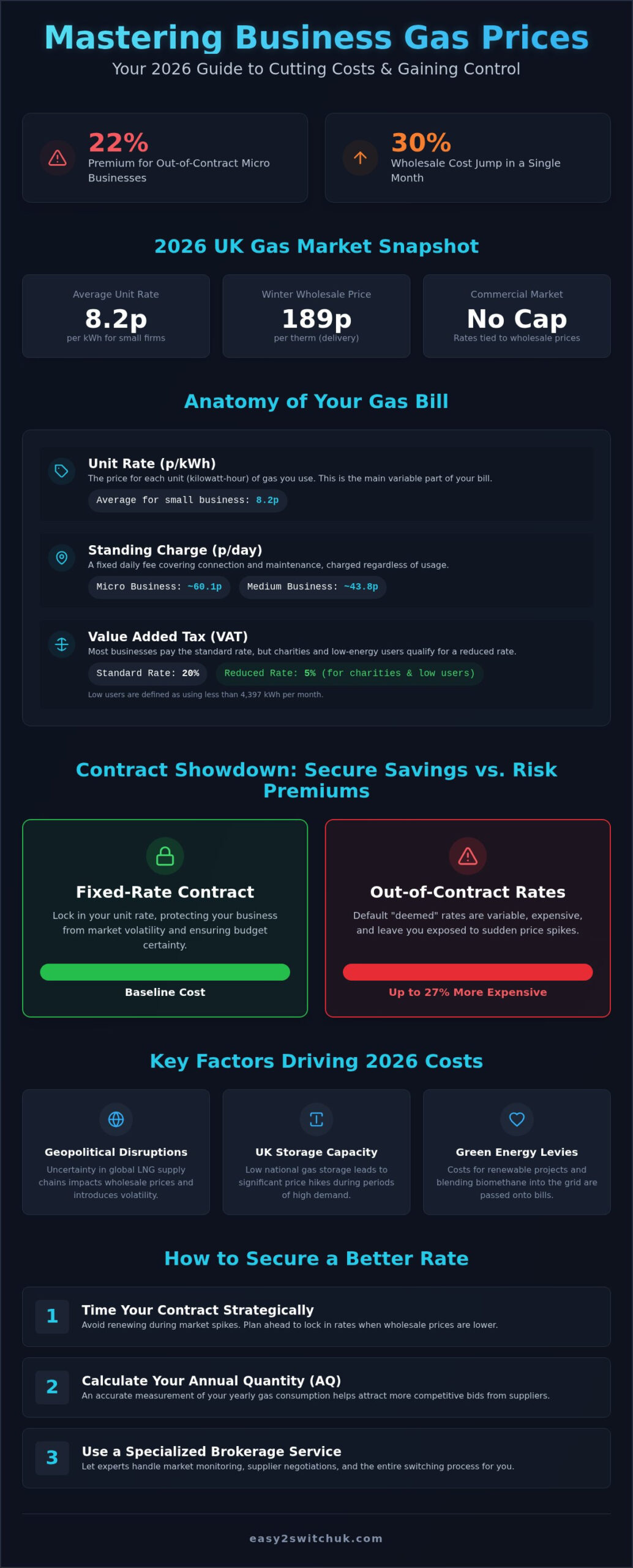
Did you know that micro businesses currently paying out-of-contract business gas prices are handed a 22% premium just for staying put? It’s a frustrating reality in a 2026 market where wholesale costs jumped 30% in a single month due to global volatility. You’ve likely felt the sting of opaque pricing structures and the constant worry that you’re being rolled onto expensive “deemed” rates. It feels like you need a degree in energy trading just to keep your overheads predictable while you’re busy running your daily operations.
We’re here to change that. This guide helps you master the complexities of the 2026 gas market so you can secure the most competitive rates for your business without the usual stress. We’ll demystify the current unit rates, which are averaging around 8.2p per kWh for small firms, and explain how geopolitical shifts are driving your bill. You’ll discover how a fixed-rate contract provides the budget certainty you need. Best of all, we’ll show you how a “done-for-you” switching experience can save you hours of negotiation, putting control back in your hands and ensuring you never pay more than necessary.
Key Takeaways
- Understand how 2026 wholesale volatility impacts your costs and why strategic contract timing is essential to avoid sudden market spikes.
- Learn the difference between fixed-rate security and the high costs of out-of-contract rates, which can cost small firms up to 27% more.
- Identify the core components of your commercial bill, including the 2026 Climate Change Levy (CCL) rates and potential exemptions for smaller operations.
- Discover how to lower your business gas prices by accurately calculating your Annual Quantity to attract more competitive bids from suppliers.
- Streamline your energy procurement with a specialized brokerage service that handles the entire switching process for UK farms, charities, and businesses.
Understanding Business Gas Prices in 2026: Market Trends and Outlook
The 2026 energy market is shaped by a paradox of high supply potential and sudden price volatility. In early September 2026, wholesale gas prices surged by 30% compared to the previous month, reaching approximately 189 pence per therm for Winter 2026 delivery. For UK companies, business gas prices are a strategic variable that requires proactive management. Unlike the domestic sector, the commercial market reacts instantly to shifts in the global natural gas market. This makes it vital to understand the underlying drivers before you commit to a long-term agreement.
The transition toward “Green Gas” is also playing a larger role in your bill. Suppliers are increasingly blending biomethane into the grid to meet sustainability targets. While this supports the UK’s net-zero goals, the infrastructure costs are often passed down through standard tariffs. Ofgem has stepped in to regulate business energy transparency more strictly in 2026, ensuring that brokers and suppliers are clearer about their fees, yet the responsibility to find the best deal still rests with the business owner.
Why Business Gas Rates Are Not Capped
While domestic customers rely on the Ofgem price cap for protection, no such safety net exists for commercial users. Business contracts are treated as private agreements between two professional entities. This lack of a cap means your rates are tied directly to the wholesale market at the moment you sign. If the market spikes during your renewal window, your costs rise accordingly.
It’s a system that rewards those who plan ahead. Individual negotiation is the only way to secure a fair rate in a non-capped market. Because business gas prices can fluctuate daily, the timing of your contract signature is often more important than the supplier you choose. Without a cap, the difference between a well-timed fixed contract and a default variable rate can represent a 27% increase in annual costs for small enterprises.
The 2026 Energy Landscape: What is Driving Costs?
Several factors are pushing 2026 rates higher. Geopolitical disruptions around the Strait of Hormuz have created uncertainty in the LNG (Liquefied Natural Gas) supply chain, while UK storage capacity remains a sensitive point for winter pricing peaks. When storage is low, suppliers hike prices to manage demand, which trickles down to your commercial bill.
We’re also seeing a shift toward sustainable energy levies. These non-commodity costs, which fund renewable energy projects, are forming a larger percentage of your total bill than in previous years. Managing these variables isn’t about guesswork; it’s about using market data to take control of your overheads. By understanding these trends, you move from being a passive consumer to an informed decision-maker.
The Core Components of Your Commercial Gas Bill
Understanding your bill is the first step toward lowering your business gas prices. While the total amount is what hits your bank account, that figure is actually a combination of several distinct charges. Some are dictated by the market, while others are fixed by infrastructure providers or the government. With the 2026 natural gas price forecast showing continued volatility, knowing exactly what you’re paying for helps you spot where savings are possible.
The unit rate is the price you pay for every kilowatt-hour (kWh) of gas you use. In late 2026, we see this hovering around 8.2p for small businesses. The standing charge is different; it’s a daily fee that covers the cost of maintaining the pipes and the connection to your premises. Even if you don’t use a single unit of gas, you’ll still pay this. For a micro business, this charge currently sits at approximately 60.1p per day, while medium-sized firms often see rates around 43.8p.
VAT is another area where businesses often overpay. Most companies pay the standard 20%, but charities and low-energy users (using less than 4,397 kWh per month) qualify for the reduced 5% rate. Non-commodity costs, such as transportation and distribution charges, are also baked into your bill. These cover the logistics of moving gas from international terminals to your meter. If you’re unsure if you qualify for lower rates, reviewing your business energy options with a specialist can clarify your position.
Standing Charges: The Fixed Cost of Connection
Standing charges aren’t uniform across the UK. They vary based on your geographic location and the type of meter you have installed. If you’re managing multi-site operations, these daily fees can stack up quickly. It’s often possible to negotiate a lower standing charge in exchange for a slightly higher unit rate, or vice versa, depending on your usage patterns. We often help clients analyze these ratios to find the most cost-effective balance for their specific industry needs.
Levies and Taxes: The Climate Change Levy (CCL)
The Climate Change Levy is a tax designed to encourage energy efficiency. As of April 1, 2026, the main rate for natural gas is £0.00801 per kWh. However, many of our agricultural clients and registered charities are eligible for significant exemptions. Specific horticultural processes or residential charity settings often don’t have to pay the full levy. Ensuring you’re correctly classified can save your business hundreds of pounds annually without changing your energy habits at all.
Fixed vs. Variable: Choosing the Right Gas Contract for Your Business
Deciding on a contract structure is the most critical choice you’ll make when managing business gas prices in 2026. While we’ve already broken down the physical components of your gas bill, the way you package those costs determines your long-term financial stability. In a market where wholesale prices for Winter 2026 delivery are hovering around 189 pence per therm, the difference between a secured rate and a variable one can be the difference between a profitable quarter and a budget crisis.
Larger commercial users often consider pass-through contracts to gain more transparency. These agreements separate the wholesale cost from the non-commodity charges, allowing you to see exactly what you’re paying for infrastructure and levies. For the biggest energy consumers, flexible procurement offers the ability to buy gas in “tranches” throughout the year. This strategy allows you to play the wholesale market, locking in portions of your supply when prices dip, rather than committing your entire load on a single day.
The Security of Fixed-Rate Gas Contracts
For most UK SMEs and farms, budget certainty is far more valuable than the gamble of a falling market. A fixed-rate contract locks in your unit price and standing charge for a set duration, typically between one and three years. While you won’t benefit if market prices drop significantly, you’re completely shielded from the 30% spikes we’ve seen recently. Choosing a longer three-year term can offer peace of mind, though it may carry a slight premium compared to a one-year deal. Using a professional business energy comparison helps identify these fixed terms by showing you the total cost over the full life of the contract, rather than just the initial monthly payment.
Avoiding the “Deemed Rate” Trap
The most expensive mistake a business can make is doing nothing. When your current contract expires without a new agreement in place, your supplier will move you onto “deemed” or out-of-contract rates. These are variable, high-margin tariffs that reflect the supplier’s risk in buying gas for you at short notice. In late 2026, these rates are sitting at approximately 12.0p per kWh, which is a massive jump from the 8.2p you might pay on a negotiated small business deal. This represents a 27% premium that serves no purpose other than to drain your cash flow. We recommend setting up a renewal window alert six months before your contract ends to ensure you have ample time to switch or renegotiate.
How to Compare Business Gas Rates for Maximum Savings
Comparing business gas prices effectively isn’t about looking at a single number. It’s a structured process that starts with your own data. To get accurate bids, you first need to gather your current bill and sign a Letter of Authority (LOA). This simple document allows a consultant to act on your behalf, cutting out the hours you’d otherwise spend on hold with various call centers. It’s a pragmatic first step that moves the administrative burden off your desk.
Next, calculate your Annual Quantity (AQ). This is the total amount of gas your business uses in a year. Suppliers use this figure to decide which pricing tier you fall into. A higher AQ might actually unlock lower unit rates because you’re seen as a high-volume customer. However, don’t just chase the lowest unit price. Look at the contract length, the reputation of the supplier for billing accuracy, and any potential penalties for over or under-usage. Some contracts include volume tolerance clauses that can lead to unexpected costs if your production levels change. Evaluation should always include a review of the supplier’s financial stability, especially given the market volatility seen in late 2026.
Finally, leverage a specialist broker who can access off-market rates that aren’t visible on public comparison websites. This done-for-you approach ensures that while you focus on your business, the heavy lifting of market analysis is handled by experts who know the industry landscape inside out.
Data is Power: Preparing for Your Comparison
Having your MPAN or MPRN number ready is the fastest way to speed up the process. This unique number identifies your specific gas connection regardless of who currently bills you. Understanding your consumption profile is equally vital. If your business has high peak usage, some suppliers may offer different structures than if your demand is steady. You can compare gas suppliers in more detail to see how different providers handle these specific load profiles and seasonal shifts.
The Broker Advantage: Accessing Wholesale Bids
A professional broker acts as your bridge to the wider market. While public web rates are generic and often higher to cover marketing costs, bespoke broker rates are negotiated based on your specific business profile. We leverage relationships with hundreds of suppliers to find the best fit for your farm, charity, or company. This ensures you receive impartial advice across the whole market rather than being steered toward a single preferred provider. Our specialist focus on the UK farming and agricultural sectors means we understand the unique seasonal demand shifts that standard comparison sites often miss. We handle the complex paperwork and supplier liaison, turning a time-consuming negotiation into a simple, logical choice for your business. If you’re ready to see what’s available for your site, request a bespoke energy quote today to begin your stress-free transition.
Simplifying the Switch: How Easy2switch Secures Your Ideal Gas Deal
Securing competitive business gas prices shouldn’t feel like a second job. We’ve built a model that takes the weight of market analysis off your shoulders, allowing you to focus on your core operations. Our “done-for-you” service is designed for efficiency; we handle everything from the initial market comparison to the final switch. It’s a free service for you because we work on a commission-based model with suppliers. This means there are no hidden end-user fees, and our success is tied directly to finding you the best possible fit for your specific site.
We believe in empowering business owners to take control of their overheads. By acting as your reliable specialist, we translate complex market data into clear, actionable choices. You aren’t just getting a list of rates; you’re getting a strategic partner who understands that every pound saved on energy is a pound that can be reinvested in your growth. This personalized approach ensures that your transition is smooth, logical, and entirely stress-free.
A Tailored Approach for Farms and Charities
Standard comparison sites often fail niche sectors like agriculture because they don’t account for seasonal surges or high-intensity usage patterns. Our commercial energy broker services are tailored to these specific needs. We understand that a farm’s energy profile is vastly different from a high-street shop or a corporate office. Having a dedicated consultant who knows your industry ensures you aren’t just another account number. We look at the human element of the service, ensuring that charities and agricultural businesses get the specialized attention they deserve in a crowded 2026 market.
Your Stress-Free Path to Savings
We’ve simplified the path to savings into three logical steps. First, we gather your data and Letter of Authority to understand your current position. Second, we leverage our access to hundreds of supplier offers to find the most competitive bids. Third, we manage the entire transition for you. Our support doesn’t end once the contract is signed. We proactively manage your renewals, acting as your local accountability partner to ensure you never fall back into the expensive out-of-contract rates discussed earlier. It’s a commitment to long-term value that keeps your business gas prices predictable and your budget secure. Request your free business gas review from Easy2switch UK Ltd today and start your journey toward effortless energy management.
Take Control of Your 2026 Energy Strategy
The 2026 energy market doesn’t have to be a source of constant anxiety for your operation. By understanding the recent shifts in business gas prices and identifying the specific components of your commercial bill, you’ve already taken the first step toward long-term savings. Whether you’re locking in a fixed-rate contract to avoid the 27% premium of deemed rates or seeking niche CCL exemptions for agricultural processes, the power lies in proactive preparation.
We’re here to handle the heavy lifting. As specialists in UK farming energy, we provide a completely free service, earning our commission from suppliers so you never face hidden end-user fees. With access to offers from over 100 UK suppliers, we ensure your transition is both seamless and logical. Our team acts as your reliable specialist, managing the complexities of the wholesale market so you don’t have to.
Get a Free, Impartial Business Gas Quote Today and secure the budget certainty your company deserves. You’ve worked hard to build your business; let us handle the market volatility while you focus on growth and independence.
Frequently Asked Questions
How are business gas prices calculated compared to domestic prices?
Business rates are based on wholesale market movements at the time of contract, whereas domestic rates are governed by the Ofgem price cap. Your specific business gas prices depend on your annual usage, meter type, and geographic location. Commercial contracts are private agreements, meaning they don’t benefit from a standard cap. This makes individual negotiation essential for securing the best rates and avoiding expensive default tariffs.
Can I switch my business gas supplier if I am currently in a contract?
You can arrange a switch at any time, but the new contract will only start once your current agreement reaches its end date. Most suppliers allow you to lock in a new rate up to six or even twelve months before your current deal expires. This proactive approach protects you from price spikes during your renewal window. It ensures a seamless transition without any service interruption or administrative stress.
Is it better to choose a fixed or variable gas rate in 2026?
A fixed-rate contract is generally better for managing business gas prices in 2026 due to high market volatility. Fixed deals provide budget certainty by locking in a unit rate for one to three years, shielding you from sudden wholesale price jumps. Variable rates might offer savings if the market drops, but they expose you to significant financial risk. If geopolitical tensions cause prices to surge, your costs could spiral without warning.
How long does it typically take to switch business gas suppliers?
The actual transfer process usually takes between 15 and 30 days once your current contract has ended. However, the preparation phase should start much earlier. We recommend beginning the comparison process six months before your renewal date. This gives us enough time to analyze hundreds of offers and handle the complex administrative paperwork required for a stress-free transition between your current and future gas suppliers.
What information do I need to get an accurate business gas quote?
You need your most recent energy bill, your MPRN (Meter Point Reference Number), and your Annual Quantity (AQ) of gas used. Having these details ready allows us to provide a precise quote based on your actual consumption profile rather than an estimate. A signed Letter of Authority is also necessary so we can communicate with suppliers and gather technical data on your behalf.
Do charities get a discount on business gas prices?
Yes, many charities qualify for a reduced VAT rate of 5% instead of the standard 20%. Charities and non-profit organizations may also be exempt from the Climate Change Levy (CCL) if they meet specific criteria. We specialize in identifying these exemptions to ensure your organization isn’t overpaying on its energy bills. This ensures more of your funds go toward supporting your core charitable mission.
Are there any hidden fees when using a business energy broker?
No, there are no hidden end-user fees when you use Easy2switch UK Ltd. Our service is free to you because we earn a commission directly from the energy supplier you choose to switch to. This fee is built into the unit rate of your chosen tariff. This transparent model ensures you receive impartial advice and access to hundreds of offers without any upfront costs or unexpected bills.
What is a “Letter of Authority” and why does my broker need one?
A Letter of Authority (LOA) is a legal document that gives us permission to act on your behalf with energy suppliers. It doesn’t allow us to sign contracts without your consent, but it does let us gather your usage data and request bespoke quotes. This document is essential for a “done-for-you” service. It removes the administrative burden of negotiating with multiple providers yourself.
