
A fixed price can feel safer, but it isn’t automatically the best fit for every organisation. If you’re weighing flexible business energy contracts UK suppliers offer against a fixed deal or corporate PPA, consider how much price risk your business can manage and how much control it needs over when and how it buys energy.
Flexible contracts can expose your business to wholesale market movements, but their pricing structures vary. The label alone won’t tell you what you’ll pay or when costs may change. Contract terms, energy use and your ability to adapt operations all matter.
This guide explains how flexible pricing works and compares it with fixed contracts and corporate PPAs. You’ll learn which commercial and operational factors affect suitability, and what to compare, including pricing components, purchasing arrangements, contract terms and exposure to market movements. Easy2switch compares supplier offers and supports businesses through switching, helping make different business energy deals easier to assess.
Key Takeaways
- Flexible business energy contracts UK businesses consider can vary in how prices are set, so compare the structure rather than relying on the contract label.
- Assess whether your organisation can manage market-linked price changes alongside its need for budget certainty.
- Compare flexible supply, fixed-term deals and corporate PPAs by price exposure, commitment and planning requirements.
- Before choosing, review consumption data, purchasing controls, contract duration and who will oversee energy decisions internally.
- Compare the full pricing structure, fees, billing terms and exit provisions. Supplier comparisons can help make offers easier to assess.
Flexible business energy contracts in the UK: what they are and why structure matters
Businesses need enough cost visibility to plan budgets, but a fully fixed price may leave less room to respond to changing market conditions. A flexible contract offers a different purchasing structure, but it doesn’t guarantee a lower bill. The outcome depends on the agreed pricing method, when energy is bought and how market prices move.
Flexible procurement is an agreed approach to buying business energy in which some or all of the price may be linked to market conditions, rather than fixed in full at the outset. This describes a pricing structure, not a promise of savings or price stability. The contract sets out how purchasing decisions work, what charges apply and which costs can change.
What does flexible pricing mean for a UK business?
Under a flexible arrangement, the commodity element of the energy price may track wholesale market movements according to the contract. Some agreements allow a business or its appointed purchasing manager to buy energy in stages, sometimes called tranches or purchasing windows. Other arrangements use different mechanisms. Check the agreement for how prices are set, who makes purchasing decisions and when they take effect.
The commodity charge is only one part of an energy bill. Bills can also include network charges, policy-related costs, taxes and supplier charges. How these are calculated, included or passed through depends on the contract and applicable rules. Compare each component separately rather than assuming that the whole bill moves in line with the market-linked energy price.
Business energy contracts are distinct from domestic tariffs. Ofgem’s domestic price cap applies to certain household default tariffs; it isn’t a cap on business energy prices and doesn’t set a business’s flexible contract rate. An Energy Savings Performance Contract is another energy-related concept, but it concerns energy-efficiency measures and performance rather than the purchasing structure of an electricity or gas supply agreement.
Which businesses might consider a flexible contract?
Flexible business energy contracts UK organisations consider may suit businesses with significant or variable energy use, but consumption alone doesn’t determine suitability. A farm with seasonal operations, a charity managing several sites or an SME with changing production schedules could assess how different structures match its needs. None is an automatic fit.
Start by asking whether the organisation can forecast consumption, monitor purchasing decisions and manage bills that may change as market prices move. Set budget limits, name decision-makers and establish an approval process. If the business needs predictable costs and has limited capacity to track the market, weigh that carefully. The right structure is one its finances and internal processes can support.
How flexible business energy contracts work alongside corporate PPAs
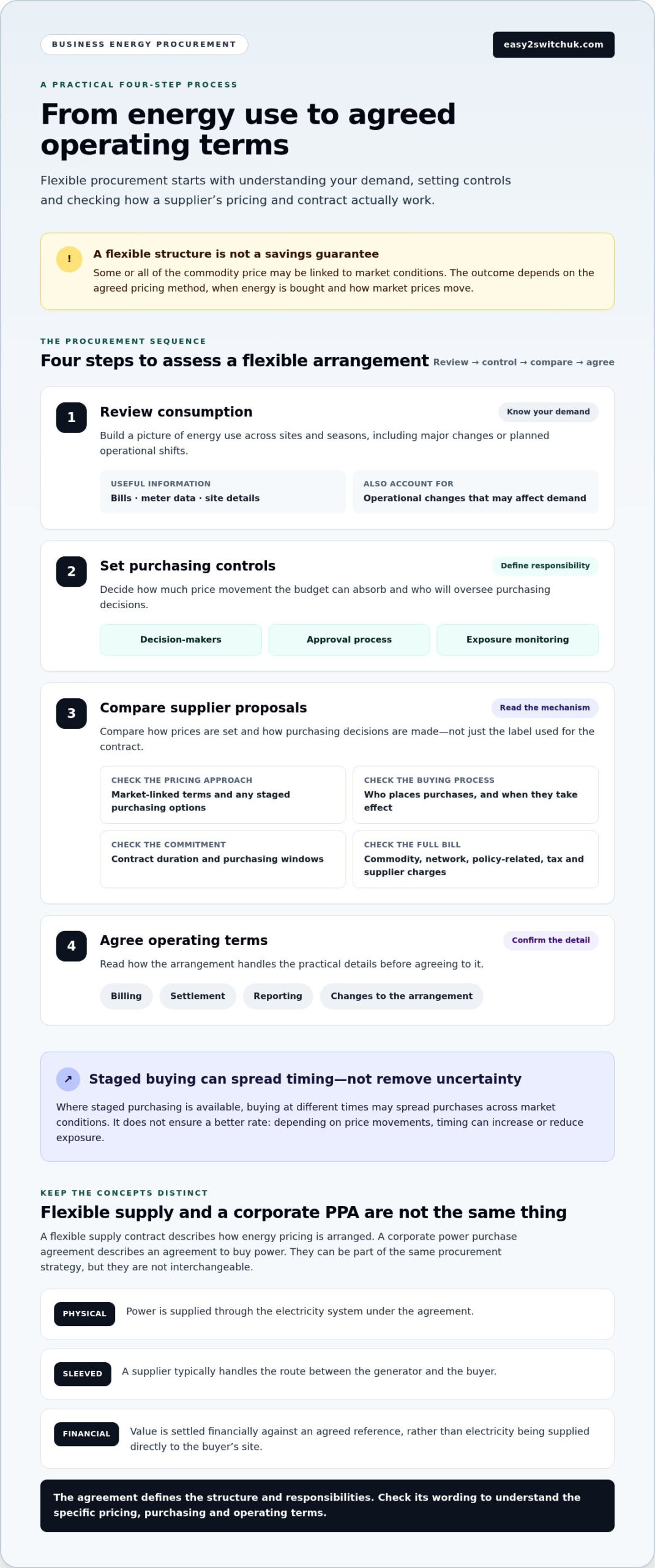
Flexible procurement is a process, not a single tariff design. Start by reviewing how much energy the business uses, when demand changes and how much price movement its budget can absorb. These details help shape a purchasing approach and show which supplier terms need close attention.
A flexible supply contract describes how energy pricing is arranged; a corporate power purchase agreement describes an agreement to buy power. The two can be part of the same procurement strategy, but they aren’t interchangeable. Understanding the distinction helps businesses compare flexible business energy contracts UK suppliers offer without mistaking a pricing mechanism for a power-buying agreement.
What happens when a business procures energy flexibly?
The process usually begins with consumption information, such as bills, meter data, site details and an outline of operational changes that could affect demand. The business then considers its priorities: how much certainty it needs, what level of market exposure it can tolerate and who will oversee purchasing decisions.
- Review consumption. Build a picture of energy use across sites and seasons. Note major changes or planned operational shifts.
- Set purchasing controls. Agree who can make decisions, what approvals are needed and how the organisation will monitor its exposure.
- Compare supplier proposals. Review the pricing approach, any staged purchasing options, contract duration and process for placing purchases.
- Agree operating terms. Read how billing, settlement, reporting and changes to the arrangement are handled in the contract.
Where staged purchasing is available, buying at different times may spread purchases across market conditions. It doesn’t ensure a better rate: depending on price movements, timing can increase or reduce exposure. Terms such as “tranche”, “flex” or “market-linked” can mean different things between agreements, so use the contract wording to understand the mechanism.
How is a corporate PPA different from a flexible supply contract?
A corporate PPA is an agreement between a power generator and a business buyer to purchase electricity under agreed terms. In a physical arrangement, power is supplied through the electricity system. A sleeved structure typically involves a supplier handling the route between generator and buyer. A financial PPA settles value financially against an agreed reference, rather than supplying electricity directly to the buyer’s site. The agreement defines the structure and responsibilities.
A PPA may sit alongside a separate supply contract that covers how electricity reaches a site and how remaining requirements are managed. It may also interact with a flexible purchasing strategy, depending on the arrangements and their terms. Treat the PPA, supply contract and related costs as connected parts of procurement, not as one contract by default.
Easy2switch compares electricity and gas offers from hundreds of suppliers and supports businesses through switching. Reviewing business energy offers can help clarify supplier contract options. A PPA is a separate agreement to assess on its own terms.
Flexible, fixed or PPA: compare the business energy contract trade-offs
Choosing a contract means balancing budget certainty, exposure to market movements and the time your organisation can give to procurement. Flexible business energy contracts UK businesses assess aren’t automatically better or worse than fixed supply or a corporate PPA. Compare each structure against your risk tolerance, decision-making capacity and longer-term objectives.
| Structure | Price exposure | Commitment | Planning considerations |
|---|---|---|---|
| Flexible supply | Prices may reflect wholesale market movements, depending on the agreed purchasing approach. | Set by the supplier contract, including its purchasing rules and term. | Needs oversight, clear approval processes and capacity to manage price changes. |
| Fixed-term supply | The agreed unit price may provide greater visibility for the covered energy charges, subject to contract terms. | Usually tied to an agreed supply term and conditions. | Can support budgeting, though actual bills still depend on usage and how other charges are treated. |
| Corporate PPA | Price and market exposure depend on the agreement’s pricing and delivery structure. | Defined by terms such as duration, volume and responsibilities. | Requires review of commercial, operational and delivery arrangements, as well as how it works alongside supply. |
When could a flexible contract fit better than a fixed deal?
A flexible arrangement may be worth considering if your organisation can tolerate budget variation, has people who can oversee purchasing decisions and can respond to changes in consumption. Any advantage depends on the market and agreed strategy, not simply on choosing a flexible contract. If prices move unfavourably, costs can rise. Consider whether your budget has room for that outcome and how purchase approvals will work in practice.
When should a business assess a corporate PPA?
A PPA may suit organisations with longer-term procurement objectives, renewable electricity priorities and the capacity to review a more involved agreement. It has different commercial and operational considerations from a standard supplier tariff, including the agreed volume, duration and how power is delivered or settled. It won’t suit every organisation or necessarily be cheaper. Assess its terms in context, including any separate supply arrangements.
Use your organisation’s priorities to guide the comparison: how much cost visibility matters, who can manage purchasing decisions and whether longer-term commitments align with your plans. No structure is universally best. For more context on comparing supplier offers and contract details, see this business energy comparison guide.
How to assess flexible business energy contracts before committing
A flexible contract is easier to manage when you know what information informs the price, which costs can change and who is responsible for decisions. Before comparing offers, bring consumption records and operational plans together. This gives your business a stronger basis for judging whether the pricing method and management workload fit its needs.
What information should a business prepare?
Gather recent electricity or gas bills, meter details, contract end dates and available consumption records for each site. Note upcoming changes that could affect demand, such as altered opening hours, new equipment, seasonal activity or planned expansion. A forecast based on outdated operations can lead to purchasing decisions that don’t reflect how the business will use energy.
Assign responsibilities early. Identify who owns the energy budget, monitors usage, approves purchasing decisions and handles supplier communications. In a small business, one person may cover several roles. What matters is having clear responsibilities and approval limits.
How can a business manage flexible-contract risk?
Set budget limits and approval thresholds before purchases begin. Decide how often the business will review market exposure, consumption and contract performance, and how that information will reach budget holders. Scenario planning can help test the effect of different price movements or demand levels, but scenarios are planning tools, not promises about future bills.
Read the full pricing and billing terms. Compare the charges and fees in each offer, how bills are calculated, when they’re issued and what happens if the contract ends early. Look for pass-through components and terms such as balancing or settlement. Their meaning and treatment depend on the specific agreement and relevant UK arrangements, so don’t assume suppliers handle them identically. Check how each term affects the bill and which party carries the relevant responsibility.
A practical checklist has three parts: commercial suitability, contract terms and operational readiness. First, decide whether your budget can absorb price variation and whether the purchasing approach fits your consumption. Next, compare duration, pricing components, fees, billing arrangements and exit provisions. Finally, confirm that your team can forecast demand, follow approval controls and monitor decisions consistently.
- Commercial suitability: Review consumption patterns, budget tolerance and the organisation’s appetite for market exposure.
- Contract terms: Check pricing, charges, billing, settlement language, duration and exit provisions in the written offer.
- Operational readiness: Confirm who forecasts, approves, tracks and reports on purchasing decisions.
This preparation makes flexible business energy contracts UK businesses are offered easier to compare on their actual terms rather than their labels. Easy2switch compares supplier electricity and gas offers and supports customers through switching. Compare business energy offers with Easy2switch.
Compare UK business energy contracts with support from Easy2switch
Once you understand the trade-offs between contract structures, compare supplier offers against your business’s requirements. Easy2switch helps businesses compare electricity and gas offers from hundreds of suppliers, with online and telephone support through the switching process. This makes it easier to review options without managing every part of the comparison alone.
What does an energy broker do during a business switch?
An energy broker gathers information about your business and its energy requirements, then uses those details to identify relevant supplier offers for comparison. The aim is to show how options differ, including their pricing approach and contract terms. When comparing flexible business energy contracts UK suppliers offer, focus on the structure described in each offer rather than assuming all flexible arrangements work alike.
Easy2switch supports customers through switching, from reviewing offers to taking the next steps with a selected supplier. The supplier provides the energy and sets the contract terms. The brokerage service is free to the customer: Easy2switch receives commission from the selected supplier, and that commission is incorporated into the tariff. This payment model explains how the comparison service is funded.
For more context on the intermediary role and how business energy brokerage works, the commercial energy broker guide explains the process in more detail.
What are the next steps for comparing offers?
Gather your latest bills, business details, meter information and current contract end dates before starting a comparison. If you manage several sites, keep the details for each one together so the comparison reflects the correct supply points and usage.
Review each offer as a complete package, not just by its headline unit rate. Check contract duration, pricing structure, standing charges, applicable fees, billing terms and any exit provisions. If you’re considering a flexible structure, pay particular attention to how purchasing decisions work and which parts of the bill may change. A clear comparison helps you decide which terms match your budget priorities and your team’s capacity to manage the contract.
Easy2switch offers supplier comparisons online or by telephone, with switching support to help you move forward after reviewing the options. The right choice depends on your business needs and the terms available, not on a promise of savings or a particular contract type. Compare business energy options with Easy2switch to review supplier offers for your organisation.
Make your next energy decision with confidence
Choosing a contract can be the start of a more deliberate procurement routine. Review your energy needs when operations change and ahead of future contract decisions. Bringing finance and operational teams into the conversation helps keep purchasing choices connected to business priorities instead of leaving them to a last-minute renewal.
For organisations weighing flexible business energy contracts UK suppliers offer, the next step isn’t to choose flexibility by default. Assess options against cash-flow needs, decision-making capacity and operational plans. Consider whether the arrangement would remain manageable if consumption changes or market conditions become less favourable. A sound decision should work beyond a single forecast or best-case scenario.
Use a supplier comparison to turn that assessment into a practical choice. Compare business energy options with Easy2switch and give your team a clear starting point for its next decision. With the right information in hand, you can choose an arrangement that fits how your organisation operates.
Frequently Asked Questions
What is a flexible business energy contract?
It’s a business supply agreement where the price can be linked, in whole or in part, to wholesale market movements under the contract’s rules. The agreement may set how and when energy is purchased, who can approve decisions and how prices are reflected in bills. Before signing, check which parts of your requirement are priced flexibly and what controls your business has over purchasing.
Is a flexible business energy contract cheaper than a fixed contract?
Not necessarily. A flexible contract may cost less or more than a fixed deal, depending on market movements, purchasing decisions and the supplier’s terms. A fixed price can make some costs easier to budget for, while flexible pricing can leave a business more exposed to price changes. Compare offers against your organisation’s priorities and risk capacity, not an assumption that either structure will be cheaper.
Can a small business get a flexible energy contract?
A small business may be able to get a flexible contract, but its size alone doesn’t determine whether one is available or suitable. Offers depend on supplier terms and the business’s circumstances. A small firm with changing operating hours, for example, should consider whether it can monitor consumption and manage decisions that affect its exposure. If it has limited time for energy procurement, the oversight involved may be an important factor in choosing a contract.
How does a corporate PPA differ from a flexible energy contract?
A corporate power purchase agreement, or PPA, is an agreement between a business buyer and a power generator to purchase electricity on agreed terms. A flexible energy contract describes how the price of a business’s supply is arranged. A PPA may operate alongside a separate supplier agreement, depending on its structure. The documents can cover different parts of procurement and should be assessed together where they interact.
What happens if wholesale energy prices rise during a flexible contract?
Your costs may rise if the contract exposes your business to higher wholesale prices, but the effect depends on its pricing rules and purchasing decisions. Some energy may already have been bought under earlier arrangements, while other volumes may remain exposed. Review how the agreement treats price changes, what purchasing controls apply and how you’ll monitor the effect on your budget. Don’t assume every unit is priced in the same way.
Are business energy contracts covered by the domestic energy price cap?
No. Ofgem’s domestic price cap applies to certain household default tariffs, not business energy contracts. Business supply agreements are commercial contracts with prices and terms set out by the supplier offer and agreement. A household price-cap figure shouldn’t be used to estimate a business’s energy costs. Compare the actual business contract terms, including the pricing structure and charges, when assessing an offer.
How much information does a business need to compare energy contracts?
Start with recent bills, business and site details, meter information, contract end dates and available consumption records. Electricity bills may show an MPAN, while gas bills may include an MPRN; these identifiers help distinguish supply points. Add planned changes, such as altered opening hours or expansion, that could affect usage. Complete records make it easier to compare offers against the business’s actual requirements.
