
The energy supply may stay connected when a business changes hands, but the previous owner’s contract doesn’t automatically become the new owner’s. That’s why transferring business energy supply to a new owner needs to be treated as a separate handover task, not assumed to happen as part of the sale. If the supplier isn’t told and a replacement arrangement isn’t made, the new business may be placed on deemed rates.
It’s understandable to be unsure who should contact the supplier, which bills belong to each owner, and whether the existing deal can continue. Getting the handover details right helps prevent gaps in account records and disputes about energy used before or after the changeover.
This guide explains what happens to the supply when ownership changes, how the outgoing and incoming owners can notify the supplier, and what information to prepare, including meter readings and responsibility dates. You’ll also learn how to check the existing contract and decide whether to continue an available arrangement, set up a new one or compare suppliers once the handover details are clear.
Key Takeaways
- When transferring business energy supply to a new owner, confirm the supplier’s process and the contract position rather than assuming the agreement transfers with the business.
- Ask the supplier which account and supply arrangement applies, and confirm who is responsible for charges from the handover date.
- Compare continuing an available arrangement, setting up a new agreement or exploring other suppliers against the contract end date and exit terms.
- Use a handover checklist to organise documents, submit meter readings for the agreed date and keep dated records until the supplier confirms the account details.
- Once the handover details are clear, Easy2switch can compare supplier offers and support switching. Customers pay no separate service fee; the chosen supplier pays commission incorporated into the tariff.
Transferring a business energy supply to a new owner: what actually changes?
A change of owner doesn’t, by itself, settle what happens to the business energy account or contract. Electricity or gas may continue flowing to the premises while account responsibility, contract status and billing details still need to be confirmed. Treat the supplier handover as separate from the sale, and check the contract terms and supplier process.
Suppliers may call a handover a Change of Occupier or Change of Tenancy. This means notifying the supplier that the business responsible for using energy at the premises has changed. The supplier can explain what information it needs and which arrangement applies. Don’t assume that an uninterrupted supply means the account has transferred correctly.
Short answer: Notify the supplier, establish the handover date and meter readings, then ask the supplier to confirm who is responsible for the account and what happens next.
Does the existing business energy contract automatically transfer?
Don’t assume the previous agreement carries over unchanged. The position may depend on the transaction, the named account holder, the contract terms and the supplier’s process. Ask the supplier to confirm the account responsibility, contract status, end date and any applicable terms in writing. Keep that response with the sale or handover records.
A sale of business assets may mean a different account holder becomes responsible for the supply at the premises. In a company-share sale, the same company may continue operating the account, but the transaction documents and supplier records still matter. These are practical distinctions, not a substitute for legal advice. Check the sale documents and seek professional advice if it’s unclear which entity remains responsible.
Which handover situations should owners distinguish?
Start by identifying what changed: the business assets or premises, the company’s ownership, or both. A new occupier should contact the supplier even if energy is still being supplied. The supplier can confirm how to record the change and which arrangement applies. Confirm the account handover rather than inferring it from the sale.
- Business or premises sale: Check who becomes responsible for the supply at the site and from what date.
- Company-share sale: Confirm whether the account holder remains the same company and whether the supplier needs updated information.
Once the handover details are clear, the new owner can consider next steps, including comparing suppliers. The UK’s energy comparison services offer context on the role of comparison in the market. Any decision should follow confirmation of the account and contract position, not replace it.
What happens to the energy account, contract, and supply during a handover?
During a handover, the energy supply to the premises and the account used to bill for it are separate matters. Electricity or gas can continue flowing while the supplier updates its records, but that doesn’t confirm who is responsible for charges or which contract applies. Ask the supplier to confirm the account position for the agreed handover date.
For transferring business energy supply to a new owner, the incoming occupier should contact the supplier and establish whether the site is recorded under a new account, an existing agreement or another supply arrangement. Give the supplier the handover date and any requested meter readings, then keep its written confirmation with the business records.
What are deemed rates or a deemed contract?
A deemed arrangement is a possible supplier arrangement when a business occupies premises and uses energy without agreeing a contract with the supplier for that supply. The exact terms and how they apply depend on the circumstances and supplier. Ask whether a deemed contract or another arrangement is in place, and request confirmation of its rate, terms and start date. Don’t assume the same arrangement applies to every new occupier.
The supplier should clarify what applies while the new account or contract is being set up. If it confirms a deemed arrangement, use that information to decide what to do next rather than relying on assumptions about the previous owner’s deal.
When might the buyer and seller need different actions?
The outgoing owner should ask the supplier to confirm the account end date and how it will issue the final bill. The incoming owner should establish the account start date, the correct contact details and the arrangement that applies from the handover. Clear dates help both parties check that billing responsibility matches the period each occupied or operated from the premises.
For a company-share sale, the company may remain the named account holder, but don’t presume the supplier’s records need no attention. Ask whether account details or contracting parties should be updated. In every transaction, check the sale documents and supplier response, and get professional advice if it’s unclear which party is responsible.
- Outgoing owner: Confirm the end date, final-reading process and final-bill arrangements.
- Incoming owner: Confirm the account start date, applicable supply arrangement and contact details.
- Share sale: Check with the supplier whether its account or contract records need updating.
Once the supplier has confirmed the account position, comparing alternatives may help you assess the next step. Easy2switch can compare supplier offers and support switching. There’s no separate Easy2switch service fee; the chosen supplier pays a commission incorporated into the tariff. Explore business energy comparison support if you’re ready to consider your options.
Should the new owner keep, replace, or compare the business energy contract?
Once the supplier has confirmed the account and who is responsible for it, the new owner can weigh up the available options. Don’t decide based on a headline unit rate alone. The right choice depends on the confirmed contract status, the business’s energy use and the terms the supplier is prepared to offer. Confirming these details makes the decision clearer and easier to document.
| Option | Contract status and supplier confirmation | Checks before deciding |
|---|---|---|
| Continue the current arrangement | Ask whether the supplier will allow the arrangement to continue for the new owner, and get the answer and applicable terms in writing. | Confirm the end date, renewal provisions, any exit terms or charges, and who will be responsible for the account. |
| Set up a new agreement | Ask the supplier to confirm the new agreement’s start date and how it relates to the account handover. | Review the offered terms, contract length, end date and any applicable charges before accepting. |
| Compare alternative suppliers | First confirm the account holder, responsibility date and current contract position with the existing supplier. | Compare the full terms and likely fit for the business, including its energy consumption patterns and operating needs. |
When could continuing the current arrangement be worth exploring?
Continuation may be worth asking about if the supplier confirms it’s available and the terms suit the business. Don’t assume the buyer can inherit or retain the seller’s contract. Check the end date, renewal provisions and any exit charges before agreeing to continue. Keep the supplier’s confirmation so there’s a clear record of what was accepted.
When should the new owner compare supplier options?
Compare after confirming who is responsible for the account and from which date. Look beyond the quoted rate and consider the full contract terms alongside the business’s actual usage, including whether demand changes with opening hours or seasonal activity. The business energy comparison guide explains factors to weigh when assessing offers. If the premises uses gas, see the business gas supplier comparison guide.
Before choosing an offer, make sure the supplier has confirmed the contract position and that any proposed start date fits the handover record. A comparison is most useful when it reflects the business’s needs and the complete terms, not just the first figure presented.
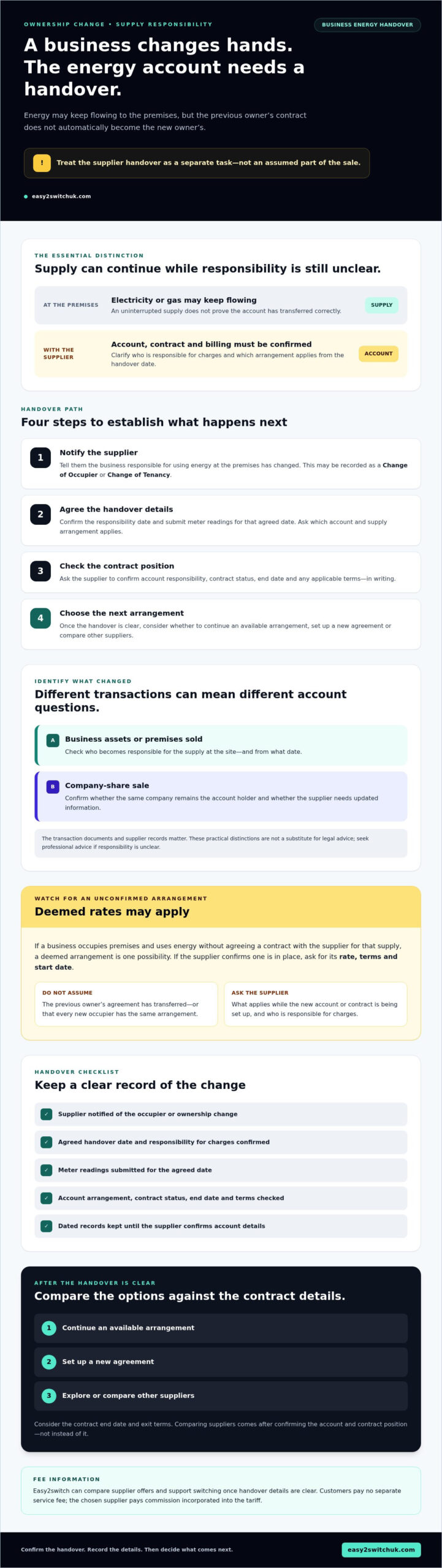
How to transfer business energy responsibility: a practical handover checklist
A clear record makes it easier for the supplier to assign account responsibility and bill the right party. When transferring business energy supply to a new owner, the buyer and seller should coordinate around the agreed handover date and follow the supplier’s notification process.
What information should the buyer and seller prepare?
Before contacting the supplier, gather the details that identify the site, account and change of responsibility. Check which documents the supplier requires, as its process may vary.
- Supplier name and account or reference number, if available.
- Full supply address and meter identifiers shown on a bill or meter.
- Agreed handover date and meter reading taken on that date.
- Outgoing and incoming parties’ names and contact details.
- Relevant sale, occupancy or company-change documents, if requested by the supplier.
How should owners confirm the account handover?
Use the supplier’s stated change-of-ownership process. The seller and buyer should check that the information they provide matches, particularly the premises and responsibility date. If the supplier asks for further evidence, send it through the specified channel and keep a copy.
- 1. Check the transaction date. Agree the date responsibility changes and make sure both parties use it in their records.
- 2. Take and record the reading. Capture the meter reading on the agreed handover date. Keep dated evidence, such as a photograph, and note which meter it relates to.
- 3. Notify the supplier. Provide the account, premises, contact and transaction details requested. Ask whether supporting documents are needed.
- 4. Request written confirmation. Ask the supplier to confirm the account holder, responsibility date, contract position and next steps for billing.
- 5. Keep the paperwork together. Retain correspondence, meter evidence, transaction documents and the outgoing final bill or incoming opening bill. Check that the dates and readings align.
If the supplier’s confirmation doesn’t match the agreed handover details, contact it promptly and keep a record of your correction request. Once the account position is clear, you can consider whether comparing supply options is appropriate. The commercial energy broker guide explains how brokerage can support that comparison.
Easy2switch can compare supplier offers and support switching. There’s no separate Easy2switch service fee; the chosen supplier pays a commission incorporated into the tariff. Explore business energy comparison support once the handover details are confirmed.
How Easy2switch can help the new owner compare the next energy deal
Once the supplier has confirmed the ownership dates, account responsibility and contract status, the new owner can decide whether to review energy options. This order matters: a comparison can help assess possible next arrangements, but it doesn’t confirm whether the seller’s contract can continue. The supplier must confirm that based on the account and agreement.
What can a business energy broker do after the handover?
Easy2switch provides business energy comparisons and can support the switching process. A broker can compare supplier offers against the business’s requirements, helping the new owner review available options rather than relying on a headline rate alone. The supplier must still confirm whether an existing agreement can continue or a new one is needed. For more on the role of brokerage, read this commercial energy broker guide.
To make a comparison relevant, be ready to discuss the premises’ energy needs and provide the information requested. Consider the business’s consumption, how it operates and the contract terms on offer. A suitable option depends on the business and available supplier offers; no particular supplier, rate or saving can be assumed in advance.
Easy2switch’s brokerage service has no separate customer service fee. The chosen supplier pays Easy2switch a commission, which is incorporated into the customer’s tariff. Consider this arrangement alongside the terms of any offer.
What should the new owner do next?
First, confirm the account and contract position directly with the current supplier. If the business needs a new agreement or wants to review its choices, compare supplier options once the handover details are settled. This keeps the comparison focused on the new owner’s requirements and avoids treating an unconfirmed contract status as fact.
If you’re transferring business energy supply to a new owner and are ready to explore the next deal, contact Easy2switch by phone or online for business energy comparison support. Review supplier options with the handover details in hand, then decide which route best fits the business.
Make the next energy decision with confidence
Transferring business energy supply to a new owner is easier to manage when the sale and supplier handover are treated as separate tasks. Confirm the responsibility date, account details and contract position with the supplier, and keep clear handover records. Once those facts are settled, decide whether to continue an arrangement, set up a new agreement or compare other options.
If you’re ready to review supplier offers, Easy2switch provides UK-wide business energy comparison and switching support by phone and online. There’s no separate Easy2switch customer fee; the chosen supplier pays a commission incorporated into the tariff. Compare options against your business’s requirements rather than assuming a particular supplier or saving is right for you.
Compare business energy options with Easy2switch and take the next step with a clearer view of your choices.
Frequently Asked Questions
Does a business energy contract automatically transfer to a new owner?
No. The new owner shouldn’t assume the existing business energy contract automatically transfers. The outcome can depend on the transaction structure, the supplier’s process and the contract terms. Contact the supplier promptly, explain what has changed, and ask for written confirmation of the account holder, responsibility date and available options. Check the transaction documents too, especially if it’s unclear whether the business or the company itself has changed hands.
Who is responsible for the business energy bill during a sale?
Responsibility can depend on the agreed handover date, supplier account records, transaction documents and applicable terms. The buyer and seller should record the handover date and meter reading, then ask the supplier how it will handle billing for each period. Don’t rely on the sale date alone as proof that the supplier has updated its records. Keep the supplier’s response and relevant bills with the handover paperwork.
How do I tell an energy supplier that a business has changed owner?
Contact the supplier using its stated change-of-ownership or change-of-occupier process. Prepare the supply address, account reference if available, agreed handover date, meter reading and contact details for both parties. Ask whether it needs sale, occupancy or company-change documents. Request written confirmation of the account status, contract position and next billing steps, then keep that confirmation with your transaction and meter records.
What happens if a business moves in before agreeing an energy contract?
The supplier may apply an arrangement such as a deemed contract, depending on the circumstances and its terms. Contact the supplier promptly to ask which arrangement applies, its rate and terms, and the start date. Don’t assume the previous owner’s agreement covers the new occupier. Once the supplier confirms the account responsibility and supply position, consider whether to arrange a new agreement or compare other options.
Can a new owner switch business energy supplier straight away?
That depends on the confirmed account and contract position, including any applicable terms or restrictions. Ask the current supplier whether the existing agreement continues, ends or requires action, and request confirmation before committing to a switch. Review the agreement for its end date and relevant exit terms. A change of business ownership alone doesn’t establish that contractual obligations have ended or that a different supplier can take over immediately.
What meter reading should be used when ownership changes?
Where possible, record the meter reading on the agreed handover date and keep dated evidence, such as a photograph or written record. Share it with the supplier through its required process, and make sure both parties retain a copy. If you can’t take a reading or aren’t sure which meter serves the premises, ask the supplier how it will establish the opening or closing reading for the account.
Can a business energy broker help with a change of owner?
Yes. A broker can help compare supplier offers and support a switching process, but the supplier confirms the account and contract position. When transferring business energy supply to a new owner, first confirm the handover details directly with the current supplier. If the business needs a new agreement or wants to review alternatives, Easy2switch’s comparison service has no separate customer fee; the chosen supplier pays commission incorporated into the tariff.
