
Did you know that wholesale gas prices in September 2026 have reached levels not seen in nearly four years? With the NBP day-ahead price sitting at 179.00p per therm and winter contracts climbing even higher, managing your farm gas prices UK overheads has never felt more urgent. It’s a heavy burden to carry when you’re already balancing the daily demands of a working farm.
It’s a reality that most farmers find themselves squeezed between volatile global markets and complex energy bills that seem designed to confuse. You likely feel that your time is better spent in the field than decoding hidden levies or comparing dozens of supplier quotes. We understand that frustration and agree that energy procurement should be a simple, transparent process rather than a source of constant anxiety.
This guide is here to help you master the 2026 market and secure the most competitive rates for your agricultural business. We’ll explore the current wholesale landscape, explain the impact of the £0.00801 per kWh Climate Change Levy, and provide a simple strategy for a stress-free switch. You’ll learn how to move from market uncertainty to predictable budgeting with total confidence.
Key Takeaways
- Understand the current drivers behind farm gas prices UK and learn how to navigate 2026 market volatility with confidence.
- Learn to look beyond the unit rate to identify standing charges and levies that often inflate your monthly overheads.
- Compare the security of fixed-term contracts against the flexibility of buying gas in tranches to better manage your budget.
- Adopt the “6-month rule” for contract renewals to ensure you aren’t caught by expensive out-of-contract rates during peak seasons.
- Discover how specialist brokers access exclusive supplier offers and handle the entire switching process so you can focus on your farm.
The 2026 UK Farm Gas Market: Trends and Volatility
The UK energy landscape in September 2026 is defined by a level of volatility that demands a strategic response. Wholesale gas costs have recently approached 200p per therm, driven by a combination of low European storage levels and significant geopolitical instability. Since the start of the US-Iran conflict on February 28, 2026, the market has struggled with supply uncertainty, further complicated by the suspension of LNG shipments from Qatar. For those monitoring farm gas prices UK, these factors have added billions in collective costs across the agricultural sector.
Wholesale vs. Retail: Why Your Bill Doesn’t Match the News
You might see headlines about falling gas prices while your renewal quote remains stubbornly high. This happens because suppliers include “risk premiums” to buffer against sudden market swings. In 2026, these premiums are higher than usual as providers protect themselves from the unpredictability of global natural gas prices. The wholesale-retail gap is the financial margin between the raw market price of gas and the final unit rate charged to a farm, covering supplier overheads, environmental levies, and risk mitigation. This gap ensures that even if wholesale rates dip, the retail price reflects the long-term risk the supplier is assuming on your behalf.
Seasonal Demand Shifts in Agriculture
Agricultural demand profiles are unique and often move in direct opposition to standard commercial energy patterns. Grain drying requires intense bursts of energy during late summer, while livestock operations face consistent heating requirements throughout the winter. These spikes often coincide with periods of high market demand, which can drive up costs if your procurement isn’t timed correctly. We find that planning your contract renewal at least six months in advance is the most effective way to avoid these price traps. By analyzing your historical usage data, we can identify your peak periods and negotiate a contract that accounts for your specific consumption cycle rather than a generic business model.
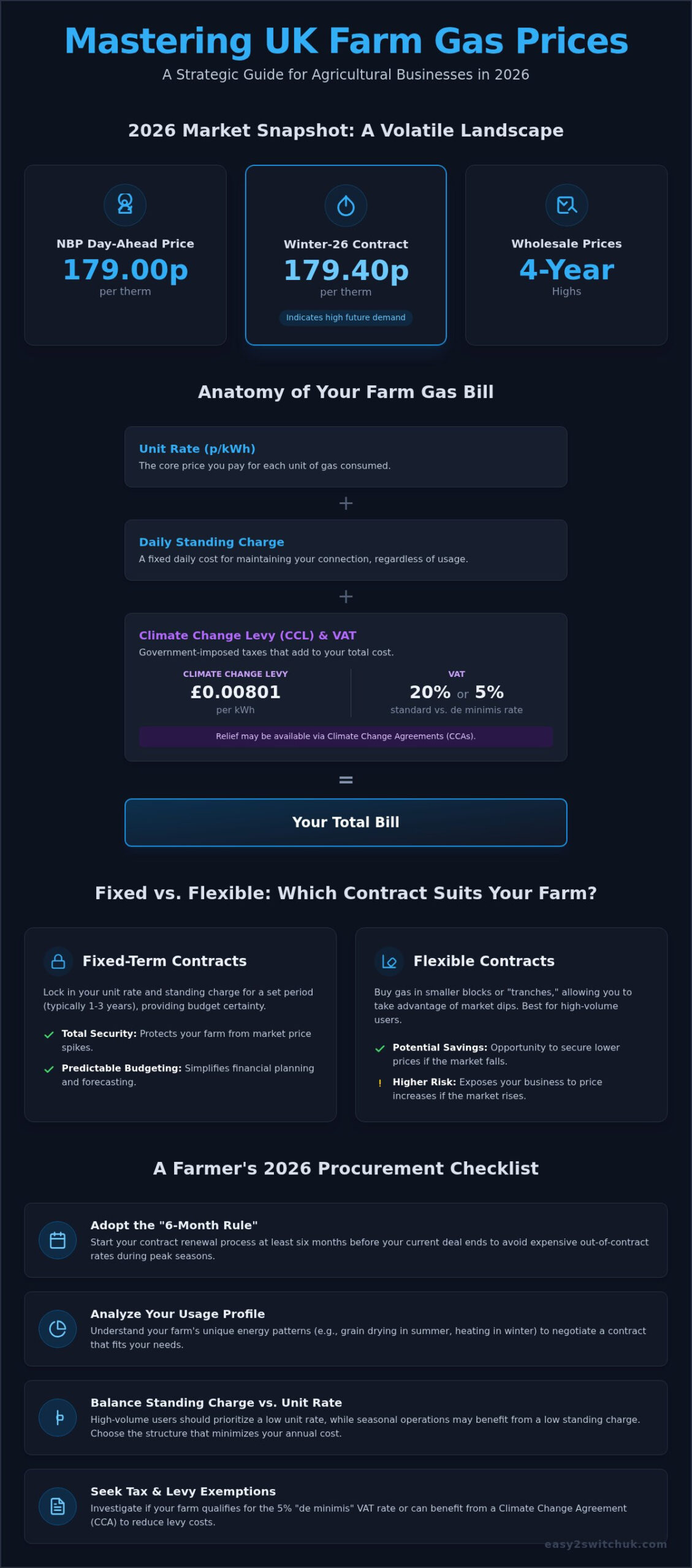
Looking ahead to the remainder of the 2026/27 farming cycle, forecasts suggest the market will remain tight. The Winter-26 contract currently sits around 179.40p per therm, indicating that suppliers expect high demand and limited supply to persist. While these numbers are challenging, they highlight why a “set and forget” approach to energy no longer works. Proactive management is now a necessity for protecting your farm’s bottom line.
Breaking Down Your Farm Gas Bill: Beyond the Unit Rate
Your gas bill is more than just a single number. While most farmers focus on the pence-per-kWh figure, the total cost of farm gas prices UK is often inflated by smaller, less visible charges. Understanding the anatomy of your commercial statement is the first step toward reclaiming control over your overheads. A typical bill includes your unit rate, a daily standing charge, the Climate Change Levy (CCL), and VAT. If you aren’t looking at all four, you’re only seeing half the picture.
VAT and Climate Change Levy (CCL) for Farms
Many agricultural businesses pay more tax than they should. While the standard commercial VAT rate is 20%, you might qualify for the 5% “de minimis” rate if your daily usage is below 145kWh. Additionally, the Climate Change Levy for natural gas in 2026 is £0.00801 per kWh. For intensive livestock operations, such as pig or poultry units, Climate Change Agreements (CCAs) can offer significant relief from these costs. Applying for these exemptions requires specific paperwork, but it’s a direct way to lower your gas expenditure without changing your supplier. Analyzing UK energy price trends shows that tax and levies remain a substantial portion of the total cost, making these exemptions vital for your bottom line.
Standing Charges vs. Unit Rates
The balance between your standing charge and unit rate can make or break your energy budget. High-volume users, like large poultry farms, usually benefit from a lower unit rate even if it means a higher daily standing charge. Conversely, if your gas use is seasonal, such as for grain drying, a high standing charge will eat into your profits during the idle months. It’s essential to compare gas suppliers to see which pricing structure aligns with your farm’s specific usage patterns. Choosing the wrong balance can lead to hundreds of pounds in wasted spend every year.
Billing errors are surprisingly common in the agricultural sector, often due to estimated meter readings or incorrect profile classes. We recommend checking your meter readings monthly to ensure your supplier isn’t overcharging you based on outdated projections. If you find the process of auditing these bills overwhelming, our team at Easy2switch can review your statements for you. We often find hidden costs like capacity charges or reactive power penalties that can be negotiated or removed entirely. Taking a few minutes to scrutinize your bill today can lead to predictable energy budgeting for the rest of 2026.
Fixed vs. Flexible Gas Contracts: Which Suits Your Operation?
Choosing the right contract structure is the most effective way to shield your business from the volatility of farm gas prices UK. In 2026, the market offers two primary paths: the security of a fixed rate or the agility of flexible procurement. While one offers peace of mind, the other provides an opportunity to capitalize on market dips. The right choice depends entirely on your farm’s scale and your appetite for risk. We help you weigh these options so you can make a decision that fits your specific financial goals.
The Case for Fixed-Price Stability
For many family-run farms, budget certainty is the priority. A fixed gas contract is a commercial energy agreement where the unit rate and standing charge remain constant for the duration of the term, typically one to three years. This means that if wholesale prices surge due to further geopolitical tension, your costs stay exactly where they were when you signed. It allows for multi-year planning without the constant worry of a market spike ruining your margins. We often recommend this for farms with steady, predictable usage who want to lock in a rate and focus on their day-to-day operations.
Flexible Procurement for Large Producers
If your operation consumes a high volume of gas, such as a large-scale poultry unit or a greenhouse complex, a flexible contract might be more advantageous. Instead of locking in a price on a single day, flexible procurement allows you to buy gas in “tranches” or blocks throughout the year. This approach requires more attention but offers several benefits:
- Market Agility: You can purchase portions of your gas when wholesale prices dip, rather than being stuck with a high rate.
- Risk Management: You aren’t tied to the price of a single day, which might be a market peak.
- Expert Support: Managing this requires constant market monitoring. We act as your eyes on the market, identifying the best moments to secure your next block of energy.
This strategy isn’t for everyone. It requires a high annual consumption threshold and a willingness to follow market trends closely. For those who qualify, it’s a powerful tool for lowering long-term overheads.
The most dangerous position for any farmer in 2026 is falling into “out-of-contract” or deemed rates. If your current deal expires and you haven’t signed a new one, your supplier will move you to their default pricing. These rates are often 40% to 100% higher than negotiated fixed-term prices. In August 2026, out-of-contract rates averaged 12.0p per kWh, a massive jump from competitive market offers. Staying ahead of your renewal date is the simplest way to protect your farm from these unnecessary costs. We handle the timelines for you, ensuring you never pay more than you should.
Strategic Gas Procurement: A 2026 Checklist for Farmers
Securing competitive farm gas prices UK isn’t just about picking a supplier on the day your current contract expires. It’s a strategic process that starts long before your deadline. Many farmers lose thousands by rushing into a deal because they’ve left it too late. By following a structured checklist, you take control of the procurement process and ensure your 2026 energy budget remains predictable and manageable.
The 6-Month Renewal Window
Waiting until the final month to look at your options is a financial mistake. We recommend starting the renewal process at least 180 days before your current deal ends. This 6-month window allows you to monitor market fluctuations and strike when rates are most favorable. It also gives you ample time to coordinate your gas and power requirements. If you’re looking at your total energy spend, it’s worth checking our guide on Farm Electricity Prices UK to align your dual-fuel planning effectively.
To get the best quotes, you’ll need to gather specific data. Suppliers require a Letter of Authority (LOA) to speak with us on your behalf, along with recent bills and your annual consumption figures. Accuracy here is vital. If a supplier underestimates your usage, you might face penalties; if they overstate it, your unit rate could be unnecessarily high. Having this data ready ensures that the quotes you receive are realistic and tailored to your actual needs.
Comparing Supplier Service Levels
Price is crucial, but it isn’t the only factor. In the farming community, a supplier’s reputation for customer service can be just as important as the rate they offer. Billing disputes or meter issues can cause significant stress during busy seasons like harvest. We compare more than just the Big Six suppliers, often finding that smaller, specialist providers offer better service and more relevant contract terms for agricultural clients.
A dedicated account manager can be a lifesaver when things go wrong. They understand that a farm isn’t a standard office and that gas usage for grain drying or livestock heating requires a flexible approach. Before signing, we check the fine print for volume tolerance clauses. These clauses can penalize you if your usage varies significantly from your original projection. We ensure the contract you sign has the flexibility your operation needs. If you’re ready to start your 2026 procurement, we can handle the entire search for you. You can start your free farm gas comparison today and let us find the best fit for your business.
How a Specialist Farm Energy Broker Secures Better Rates
Managing a farm in 2026 is a complex operation, and energy procurement shouldn’t be another source of stress. While previous sections outlined the market volatility and contract types, the actual process of securing competitive farm gas prices UK often requires specialist access. An independent energy consultancy like Easy2switch bridges the gap between you and the energy giants, acting as a reliable specialist who understands the unique demands of the agricultural landscape.
One of the primary advantages of using a specialist broker is access to exclusive “broker-only” rates. These deals are often negotiated in bulk and aren’t available on public websites or via direct supplier calls. Because we work with a vast network of suppliers, we can quickly identify which providers are currently offering the best value for specific agricultural profiles, whether you’re running a high-intensity poultry unit or a seasonal grain operation. This specialized access ensures you aren’t limited to the standard rates offered to the general business public.
Removing the Administrative Burden
The switching process is notorious for its paperwork and potential pitfalls. We handle the entire transition for you, from sending termination notices to your current supplier to managing the final data transfer to the new one. It’s common for suppliers to raise “objections” during a switch, often citing minor technicalities or billing discrepancies. We resolve these hurdles directly, ensuring your transition to a better rate is seamless and uninterrupted. If you want to understand more about how this system works, our Commercial Energy Broker Guide provides a deeper look into the UK market’s inner workings and the value of professional procurement.
Impartial Advice for Long-Term Savings
We pride ourselves on being an independent consultancy. Our advice is based solely on what fits your farm’s individual needs rather than a one-size-fits-all corporate solution. This specialism means we understand that your gas usage isn’t linear. We know that a late harvest or a cold spring can drastically change your requirements. Our service doesn’t end once the contract is signed; we provide ongoing market monitoring to ensure you’re always positioned for the best possible rates in future cycles. We keep a watchful eye on the 2026 trends so you can stay focused on your land.
Transparency is the cornerstone of our approach. Our service is free for the end-user because we receive a commission directly from the supplier you choose. This model allows us to offer professional expertise without adding to your monthly overheads. It’s a simple, results-oriented partnership designed to give you back your time and your peace of mind. You can take control of your farm gas prices today with Easy2switch and let us handle the complexities of the 2026 market for you.
Take Control of Your Farm’s Energy Future
Managing farm gas prices UK in 2026 doesn’t have to be a source of constant stress. By understanding wholesale trends and respecting the six-month renewal window, you’ve already taken the first step toward better energy budgeting. Remember that looking beyond the unit rate to identify levy exemptions and choosing the right contract structure can save your business thousands of pounds over the coming year. These strategic shifts move your operation from market uncertainty to total financial control.
You don’t have to handle these market complexities alone. Our specialist team at Easy2switch provides the deep industry knowledge needed to navigate the market with confidence and ease. Because we operate on supplier-paid commissions, our service is completely free to you with no stress and no hidden fees. We handle the entire switching process from start to finish so you can stay focused on your land. Get a free farm gas quote from Easy2switch today. We’re here to help you secure a predictable, efficient energy strategy that protects your bottom line for the long term.
Frequently Asked Questions
How are farm gas prices calculated in the UK for 2026?
Farm gas prices UK are calculated by combining the wholesale cost of gas with supplier margins, transmission fees, and daily standing charges. In 2026, your final unit rate also includes the Climate Change Levy and VAT. Since agricultural operations are classed as business consumers, there is no price cap. This means your rates are directly influenced by global supply trends and geopolitical events that impact the National Balancing Point market.
Do farms pay 5% or 20% VAT on gas bills?
Most agricultural businesses pay the standard 20% VAT rate on their gas bills. However, you might qualify for the reduced 5% rate if your farm’s consumption falls below the “de minimis” threshold of 145kWh per day. Additionally, if your gas is used for domestic purposes on the farm, such as heating a farmhouse, that portion of the bill should also be charged at the lower 5% rate to help manage your costs.
Can I switch my farm gas supplier if I am currently in a contract?
You cannot usually switch to a new supplier until your current fixed-term contract ends without paying significant exit fees. However, you can secure a new rate for the future up to twelve months before your current deal expires. We recommend starting this process early to lock in competitive rates before market volatility drives prices higher. Once your current term finishes, the transition to your new supplier happens automatically and without stress.
What is the Climate Change Levy (CCL) and can farmers get an exemption?
The Climate Change Levy is a government tax on commercial energy use, currently set at £0.00801 per kWh for natural gas in 2026. Many farmers can reduce this cost through Climate Change Agreements (CCAs). If your operation is considered energy-intensive, such as certain livestock or horticultural units, you could be eligible for a significant discount on the CCL. We help you identify if your farm qualifies for these specific tax reliefs to lower overheads.
Is it better to have a fixed or flexible gas contract for a farm?
The best choice depends on your farm’s annual consumption and risk appetite. Fixed-price contracts are the most popular choice for family farms because they offer budget certainty and protection against price spikes for up to three years. Flexible contracts are typically reserved for very large producers who consume enough gas to buy in tranches. For most agricultural businesses, the stability of a fixed rate is the most pragmatic way to manage monthly spending.
How much can a business energy broker really save a UK farm?
A specialist broker can often secure rates that are 40% to 100% lower than “out-of-contract” or deemed rates. By accessing exclusive supplier offers not available on public websites, we find the most competitive fit for your specific usage profile. Because our service is free to you, the savings go directly back into your farm’s bottom line. We handle the entire comparison and switching process, saving you hours of administrative work and phone calls.
What information do I need to provide for a farm gas quote?
To provide an accurate quote, we need a signed Letter of Authority (LOA) which allows us to speak to suppliers on your behalf. You should also have a recent gas bill handy to confirm your current contract end date and your annual consumption in kWh. Providing your Meter Point Reference Number (MPRN) is also helpful. This data ensures that the quotes we secure are tailored to your actual usage rather than a generic estimate.
What happens if I don’t renew my farm gas contract on time?
If you don’t renew on time, your current supplier will move you onto “deemed” or “out-of-contract” rates. These are significantly more expensive than negotiated deals, with August 2026 averages reaching 12.0p per kWh. These rates are variable, meaning they can rise with very little notice. To avoid this financial trap, we recommend starting your procurement at least six months before your contract expires to ensure a seamless transition to a predictable new rate.
