
Ever looked at your energy bill and felt a sense of frustration? You’ve been careful with your usage, switching off lights and turning down the thermostat, yet there’s a daily fee that never seems to change, even when you’re away. This is a common source of confusion for UK households, and it often leads to one simple question: what is a standing charge? It can feel like a hidden fee, leaving you wondering if your tariff is truly fair and why you’re paying for energy you haven’t even used.
At Easy2Switch, we believe in total transparency. This straightforward guide is here to demystify that fixed daily amount on your gas and electricity bills. We will break down exactly what this charge covers—from network maintenance to meter readings—and explain how it impacts your total energy costs. Our goal is to give you the confidence to read your bill with clarity, understand every part of your tariff, and feel empowered to take control of your household expenses for good.
Key Takeaways
- Understand that the standing charge is a fixed daily fee that covers the cost of supplying energy to your property, even if you use none.
- Discover the key factors that cause this charge to vary, as the rate you pay is not a universal figure across the UK.
- Learn the truth about “zero standing charge” tariffs and why they often mean paying a higher price for the energy you actually use.
- Knowing what is a standing charge is the first step to finding a tariff that balances this fixed cost with your unit rate for optimal savings.
Deconstructing the Standing Charge: What Are You Actually Paying For?
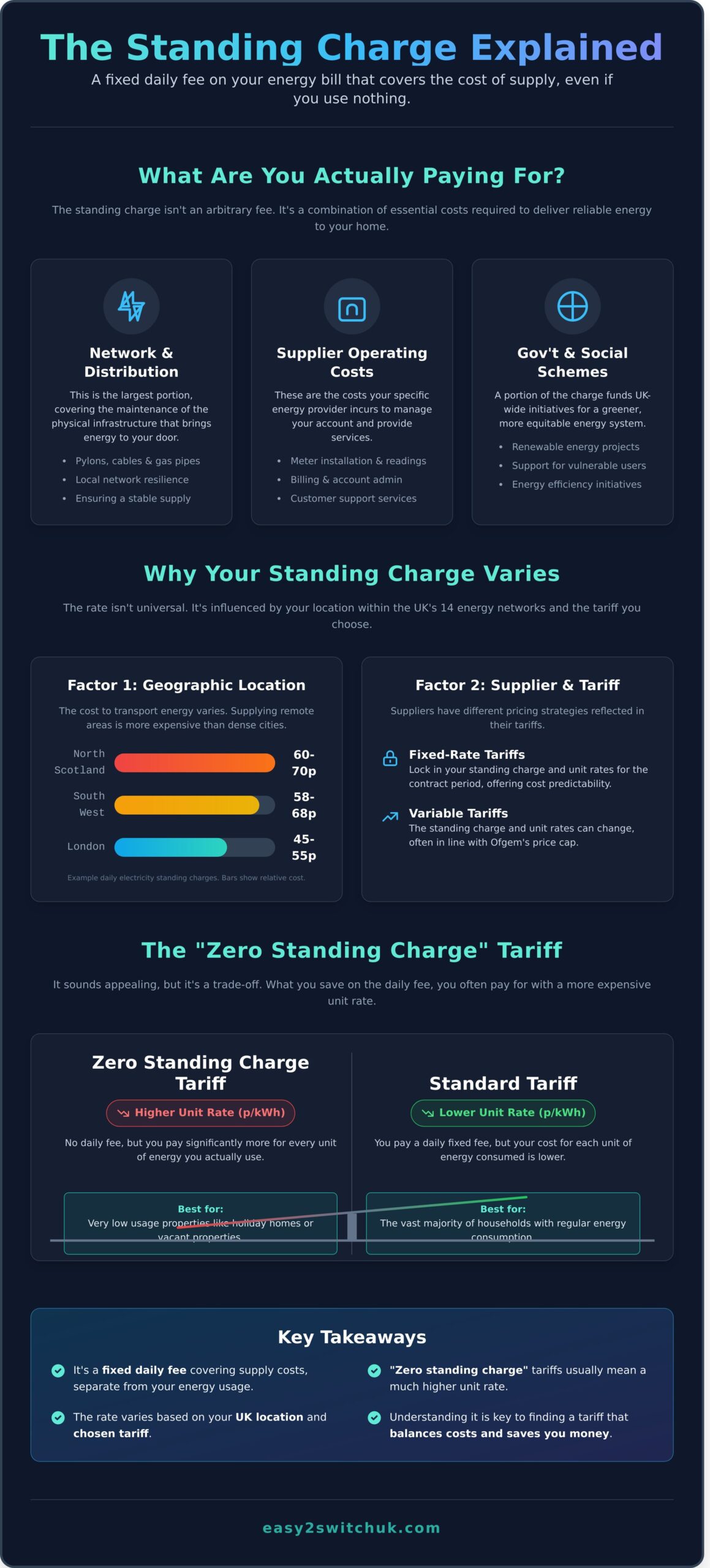
Think of the standing charge as the line rental for your energy supply. It’s a fixed daily fee, charged in pence per day, that you pay to your supplier regardless of how much gas or electricity you use. So, what is a standing charge actually for? It covers the fixed costs of getting energy to your property, ensuring the national grid is maintained and ready to deliver power the moment you need it. This isn’t an arbitrary fee; it’s a standard, Ofgem-approved practice across the UK energy industry, and it applies even if you’re away and use no energy at all.
To give you complete transparency, the charge is typically made up of three core components:
Network and Distribution Costs
A significant portion of your standing charge goes towards maintaining the vast, complex network of pylons, transformers, cables, and gas pipes that transport energy across the country and to your front door. This includes payments to your local Distribution Network Operator (DNO)—the company responsible for the ‘last mile’ of your supply. These funds ensure the physical infrastructure is kept safe, reliable, and resilient, preventing outages and guaranteeing a stable flow of energy to your home.
Supplier Operating Costs
Your energy supplier also has its own fixed operational expenses to cover. This part of the charge pays for essential services like installing and maintaining your meter, processing readings, and the administrative costs of billing and managing your account. It also funds the UK-based customer service teams you rely on for support and contributes to investment in technology to improve your experience. These fixed costs are a fundamental component of electricity pricing and are recovered from every connected customer.
Government Environmental and Social Schemes
Finally, the standing charge is used to collect funds for government-mandated environmental and social initiatives. This isn’t a direct tax, but a mechanism for suppliers to contribute to important national programmes. These can include:
- Renewable Energy Projects: Funding schemes like Contracts for Difference to help the UK develop wind and solar power.
- Vulnerable Customer Support: Paying for schemes like the Warm Home Discount, which provides financial aid to eligible households.
- Energy Efficiency: Contributing to initiatives that help homes become more energy-efficient, reducing overall demand.
This part of the charge helps fund the UK’s transition to a greener, more equitable energy system.
How Standing Charges Vary: Key Factors That Influence the Cost
When asking what is a standing charge, it’s crucial to understand that there is no single, universal figure. The daily rate you pay is a bespoke cost determined by a combination of your choices, your location, and your supplier’s business model. Understanding these key factors is the first step toward taking control of your energy bills and ensuring you’re on the right tariff.
Several elements work together to calculate your final charge. Let’s break them down.
Your Supplier and Tariff Choice
Each energy supplier has its own operational costs and pricing strategy. A large, established provider may have different overheads than a smaller, digital-first company. This is reflected in their tariffs. A fixed-rate deal might lock in a specific standing charge for the duration of your contract, offering predictability, while a variable tariff could see this daily rate change. Some suppliers may even offer tariffs with no standing charge at all, but this is often balanced by a higher price per unit of energy used.
Geographic Location in the UK
The UK is divided into 14 regional energy networks, and where you live has a direct impact on your standing charge. The cost of transporting power and gas across the country and maintaining the local pipes and wires varies significantly. For example, supplying energy to a remote, rural community is typically more expensive than to a densely populated city. As a detailed House of Commons Library report on standing charges explains, these regional network costs are a fundamental component of the final price you pay. This is why your postcode is a key piece of information when getting a quote.
To illustrate, here are some example variations for a typical electricity standing charge:
| Distribution Region | Example Average Daily Standing Charge (Electricity) |
|---|---|
| London | 45p – 55p |
| North Scotland | 60p – 70p |
| South West England | 58p – 68p |
Note: These figures are for illustrative purposes only and are subject to change based on the market and supplier.
Payment Method and Meter Type
How you pay your bill can also influence the rate. Suppliers often provide a small discount for customers paying by Direct Debit, as it guarantees payment and reduces their administrative costs. Paying upon receipt of a bill may result in a slightly higher standing charge. Furthermore, prepayment meters can have different standing charges compared to standard credit meters, although regulations aim to minimise this gap. Having a smart meter can also open up access to new tariffs, which in turn could offer different standing charge rates.
This complexity is precisely why comparing quotes is so important. The combination of these factors means your neighbour could be paying a different daily rate, reinforcing the need to find a tariff that provides the best value for your specific circumstances.
The ‘Zero Standing Charge’ Tariff: Too Good to Be True?
In the search for lower energy bills, a ‘zero standing charge’ tariff can seem like the perfect solution. The appeal is obvious: if you don’t use any energy, you don’t pay a penny. However, these tariffs are not a straightforward saving and often come with a significant trade-off. While it might seem like the ideal answer to the question of what is a standing charge and how to avoid it, the reality is more complex.
Energy suppliers still need to cover the fixed costs of maintaining the network and providing your supply. On a zero standing charge tariff, they recover these costs by charging a much higher price for every unit (kWh) of gas and electricity you use. This fundamentally shifts the cost from a fixed daily fee to one based entirely on your consumption.
Who Might Benefit from a Zero Standing Charge Tariff?
For a small number of users, this trade-off can make financial sense. This type of tariff is typically best suited for properties with extremely low or intermittent energy consumption. Consider if your property fits one of these profiles:
- Properties that are often empty: Holiday homes, second homes, or rental properties during vacant periods are prime candidates. You avoid paying a daily fee when the property is unoccupied.
- Very low energy users: If your energy usage is consistently minimal, you may save money by not having the fixed daily charge add up over the year.
- Seasonal businesses: A business that operates for only a few months a year, like a seasonal pop-up shop or a campsite, could benefit by eliminating costs during its long shutdown periods.
When to Avoid a Zero Standing Charge Tariff
For the vast majority of UK households and businesses, a zero standing charge tariff will result in a significantly higher overall bill. The fixed costs associated with your energy supply, which Ofgem explains standing charges cover, are simply rolled into a higher unit rate. This makes it a poor choice for:
- Most typical households: If you have consistent, daily energy needs for heating, cooking, and appliances, the higher unit cost will quickly outweigh any savings from the lack of a standing charge.
- High-usage properties: Businesses, farms, charities, and large family homes will almost certainly pay more due to the inflated price of every kWh consumed.
Calculating Your Break-Even Point
To determine if a zero standing charge tariff is right for you, you need to calculate your ‘break-even point’. This is the daily energy usage at which the cost of both tariff types becomes equal. The formula is simple:
(Standard Tariff Daily Standing Charge in pence) / (Price Difference in Unit Rates in pence) = Daily kWh Break-Even Point
For example:
- A standard tariff has a 50p daily standing charge and a unit rate of 25p per kWh.
- A zero standing charge tariff has a £0 daily standing charge but a unit rate of 30p per kWh.
- The calculation is: 50p / (30p – 25p) = 10 kWh.
In this scenario, if you use more than 10 kWh of electricity per day, the standard tariff is cheaper. If you use less, the zero standing charge tariff would save you money. Finding the right balance can be tricky. Let us compare the market for you.
Standing Charges for Businesses and Farms: What’s Different?
While the core purpose of a standing charge is the same for everyone, the commercial energy market operates under a different set of rules. For businesses, farms, and other non-domestic sites, energy contracts are far more complex, and the standing charge can vary dramatically based on a wider range of factors. Understanding what is a standing charge in a commercial context is the first step towards optimising your business’s energy spend.
Unlike the regulated domestic market, business energy tariffs are bespoke. This means suppliers have more freedom to structure their pricing, leading to significant differences in both unit rates and daily standing charges.
Domestic vs. Business Standing Charges
The differences between domestic and commercial standing charges go beyond just the price. They reflect the distinct demands and regulatory frameworks of the business sector. Key distinctions include:
- Infrastructure and Supply: Businesses often require a more robust connection to the grid, especially those using heavy machinery. This increased infrastructure cost is passed on through a higher standing charge.
- Taxes and Levies: Business energy bills are subject to different environmental taxes. While most businesses pay VAT at 20% (compared to 5% for domestic users), they are also liable for the Climate Change Levy (CCL), which is a tax on energy delivered to non-domestic users.
- Contract Terms: Commercial energy contracts are typically fixed for longer periods (2-5 years) and offer less flexibility than domestic tariffs. The standing charge is locked in for the duration of this term.
Special Considerations for Farms and High-Usage Sites
For high-consumption businesses like farms, manufacturing plants, or large retail outlets, the cost structure becomes even more specialised. Many of these sites have half-hourly meters that record energy usage every 30 minutes, providing highly detailed data that influences billing.
In addition to the standard daily fee, these sites often pay a capacity charge (measured in kVA) as part of their fixed costs. This charge is for the amount of power reserved from the network to ensure the site can draw its maximum required load at any time. A farm, for instance, has a unique energy profile with intense peaks during milking or when running grain dryers. Managing this capacity effectively is crucial to controlling costs. Because these factors make it difficult to know what is a standing charge component versus a capacity charge, getting an expert analysis is key to securing the right deal.
Navigating these complexities is where expert guidance becomes invaluable. At Easy2Switch UK, we specialise in finding bespoke, transparent energy solutions that match the unique demands of your business or farm.
How to Manage Your Energy Costs Effectively
While the standing charge is a fixed daily cost, you are still firmly in control of your overall energy bill. The key isn’t to eliminate this charge entirely, but to find the optimal balance between the standing charge and the unit rate that suits your specific energy consumption. Shifting your focus from a single fee to the total cost is the most effective strategy for securing genuine savings.
Look Beyond a Single Number
It can be tempting to choose a tariff with a very low or even a £0 standing charge, but this can be a false economy. Suppliers often compensate for a low standing charge by setting a much higher price per unit (kWh) of energy you use. For a household or business with high consumption, this will almost always result in a more expensive bill. The most reliable way to compare is by looking at the total estimated annual cost, which combines:
- The daily standing charge (multiplied by 365 days)
- Your estimated annual usage (multiplied by the unit rate)
Always consider other factors like contract length, potential exit fees, and the supplier’s customer service reputation before making a decision.
The Power of Regular Market Comparison
The UK energy market is dynamic, with prices and tariffs changing constantly. The best deal available today might be uncompetitive in six months. Regularly comparing suppliers is the single most effective way to ensure you are paying a fair price for your energy. Understanding what is a standing charge is crucial, but comparing how different suppliers structure it alongside their unit rates is how you find long-term value.
How an Energy Consultancy Can Help
Navigating the market to find the perfect tariff can be time-consuming and complex. That’s where an independent energy consultancy like Easy2Switch UK provides a clear advantage. We handle the hard work for you, offering a hassle-free service designed to put you back in control.
- Bespoke Analysis: We analyse your specific energy usage to identify the ideal tariff structure for your needs—whether that’s a low standing charge or a competitive unit rate.
- Exclusive Access: We have access to a wide range of tariffs, including deals that aren’t always available to the public, ensuring you get the best possible price.
- Time and Savings: Our UK-based team does the comparison for you, saving you valuable time and providing complete peace of mind. Our service is free and impartial.
Take control of your energy costs. Get a free, no-obligation quote today.
Take Control of Your Standing Charge and Business Energy Costs
Ultimately, the standing charge is a fixed daily cost that covers keeping your property connected to the grid. While you can’t avoid it, understanding how it varies and being wary of ‘zero standing charge’ deals gives you the power to make smarter choices. Now that you have a clear answer to what is a standing charge, the next step is ensuring your overall tariff is optimised for your needs.
For businesses and farms especially, finding the right balance between standing charges and unit rates is crucial for managing overheads. At Easy2Switch UK, our UK-based team provides impartial, expert advice to demystify your bills. As specialists in farm and business energy, we make the process of finding a better deal simple and hassle-free. Let us handle the comparison so you can focus on what you do best.
Get your free business energy comparison and find a better deal today. Taking control of your energy spend is easier than you think.
Frequently Asked Questions About Standing Charges
Do I have to pay a standing charge if my property is empty?
Yes, in most cases, you still have to pay the standing charge even if your property is empty and you aren’t using any energy. This is because the charge covers the cost of keeping your property connected to the gas and electricity networks, not the energy you consume. It’s a fixed daily fee for maintaining the supply infrastructure, so it applies regardless of your usage. If the property will be vacant for an extended period, it’s worth contacting your supplier to discuss your options.
Why has my standing charge increased recently?
Standing charges have risen across the UK for several reasons. These include the increased costs of maintaining the energy grids and the expense of moving customers from failed suppliers, which is spread across all consumer bills. Additionally, investments in green energy infrastructure and network upgrades are also factored into this fixed cost. Suppliers adjust the charge to cover these non-negotiable operational expenses, which have unfortunately been on the rise for the entire industry.
Is the standing charge covered by the Ofgem energy price cap?
Yes, the standing charge is included under the Ofgem energy price cap. The cap sets a maximum limit on both the price you pay per unit of energy (kWh) and the daily standing charge for customers on a standard variable tariff. This provides a crucial layer of protection, ensuring that energy suppliers cannot charge you an unlimited amount for either component of your bill. The capped rates for standing charges are updated by Ofgem periodically, typically every three months.
Can I get a refund on standing charges?
Generally, you cannot get a refund on standing charges. They are a legitimate and fixed component of your energy tariff designed to cover the supplier’s operational costs. As long as you have an active energy supply contract, the charge is applicable every day. The only circumstance where a refund might be possible is in the case of a clear billing error by your supplier. If you believe you have been overcharged, you should contact them directly with a recent bill to hand.
How do I find out what my current standing charge is?
The easiest way to find your standing charge is by looking at your latest energy bill. It is usually listed clearly in the tariff information section, shown as a fixed amount in “pence per day.” If you manage your account online, you can also find this information in your tariff details on your supplier’s website or app. Understanding what is a standing charge on your specific plan is the first step to taking control of your energy costs and comparing deals effectively.
Are standing charges the same for electricity and gas?
No, standing charges for electricity and gas are different. You will have a separate standing charge for each fuel, and the rates will not be the same. This is because the costs associated with maintaining the national electricity grid and the gas pipe network are completely separate. On a dual fuel bill, you will see two distinct standing charges listed—one for your electricity supply and one for your gas supply, reflecting the different operational costs of each network.
