
Around 70% of the energy used in a place of worship or community space goes towards heating, so practical church and place of worship heating cost reduction starts with using heat where and when it’s needed. Draught-proofing, suitable insulation and well-timed heating controls can help limit waste, while historic buildings need advice that respects their fabric.
It’s understandable to be cautious: a solution that suits a modern hall may not suit a listed church, and heating an empty building can add avoidable costs. This guide explains how to identify draughts and heat loss, approach improvements in historic places of worship, and assess scheme eligibility. It also covers schedules, heating zones and controls that better match warmth to services and other activities. The aim is to help you identify practical next steps without assuming one upgrade is right for every building.
Key Takeaways
- Spot practical ways to limit heat loss, including draught-proofing and carefully chosen insulation.
- Learn why historic places of worship need building-sensitive advice before energy improvements are made.
- Find out what to consider when assessing eligibility for the Boiler Upgrade Scheme.
- Use heating schedules and zones to better match warmth to services and other building activities.
1. Draught-proofing, insulation and double-glazing
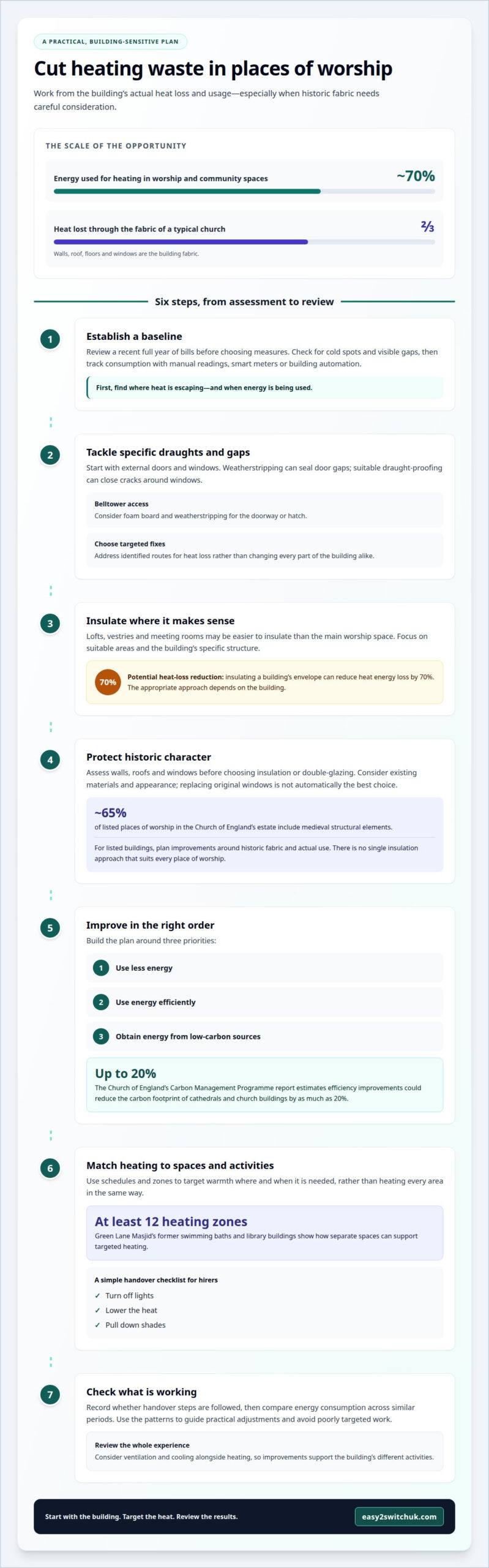
A typical church loses two thirds of its heat through the building fabric: its walls, roof, floors and windows. Start by identifying cold spots and visible gaps, then prioritise practical measures that reduce heat loss without treating every part of the building alike. Around 65 per cent of listed places of worship in the Church of England’s estate include medieval structural elements, so historic fabric needs careful consideration.
Check external doors and windows for draughts that let cold air in and warm air out. Weatherstripping can seal gaps around doors, while suitable draught-proofing can close cracks around windows. In a place of worship with a belltower, consider insulating the doorway or hatch with foam board and weatherstripping. These targeted steps address specific routes for heat loss without requiring changes throughout the building.
Choose insulation areas strategically. Lofts, vestries and meeting rooms can be easier to insulate than the main worship space, and reducing heat loss from these areas can make them more comfortable to use. Insulating a building’s envelope can reduce heat energy loss by 70 per cent, but the right approach depends on the building’s structure.
For historic churches, assess walls, roofs and windows before choosing insulation or double-glazing. Consider whether each measure suits the existing materials and appearance rather than assuming that replacing original windows is best. Careful, targeted upgrades can help retain the building’s character while reducing heat loss. Apply the same principle to heat pumps and other renewable energy: first understand the building’s needs and how it is used.
Tariffs affect the cost of the electricity or gas used for heating: the unit rate determines the charge for energy consumed, while standing charges contribute to the bill regardless of use. The Department for Energy Security and Net Zero lists £7,500 towards a ground source heat pump, including water source heat pumps and those on shared ground loops. Lowering heat demand through draught-proofing and insulation can help limit the energy needed for heating.
2. Advice for energy improvements to historic places of worship
Start a whole-building energy plan by reviewing a recent full year of bills. This establishes energy use and cost before you choose measures. Prioritise using less energy, then using energy efficiently, and finally obtaining energy from low-carbon sources. The Church of England’s Carbon Management Programme report estimates that efficiency improvements could reduce the carbon footprint of cathedrals and church buildings by as much as 20 per cent. Track consumption through manual readings, smart meters or building automation systems to find patterns and avoid expensive, poorly targeted work.
Different buildings need different plans. Green Lane Masjid occupies former swimming baths and library buildings, and has at least 12 heating zones. Its example shows how separate spaces can support targeted heating, rather than warming every area in the same way. Shree Ram Mandir occupies a building originally built between the wars as a cinema. For a building with that history, assess how its current use, layout and windows affect heating needs before recommending changes. These examples are not a typical church template; they show why a building’s past and present uses both matter.
For a listed church, plan heating, ventilation and energy-efficiency improvements around the building’s historic fabric and actual use. Begin with an energy assessment, then consider how proposed changes may affect its features and occupancy. There is no single heating setting or insulation approach that suits every listed place of worship.
Include the groups using the building in your energy-saving plan. Give hirers a short checklist for leaving: turn off lights, lower the heat and pull down shades. Record whether each step is followed, then compare energy consumption across similar periods. This helps identify practical changes without asking guests to manage complex controls. Consider ventilation and cooling alongside heating, so improvements support the building’s varied activities.
For the supply-cost side of a wider charity energy plan, explore charity energy options alongside building improvements.
3. Boiler Upgrade Scheme eligibility for places of worship
The Boiler Upgrade Scheme can help with the cost of replacing a fossil-fuel heating system with a heat pump. According to the Department for Energy Security and Net Zero, current grants include £7,500 towards an air-source heat pump and £7,500 towards a ground source heat pump, including water source heat pumps and those on shared ground loops. A place of worship’s suitability depends on its property and proposed system meeting the scheme’s eligibility requirements.
Before considering an application, assess how the building is heated, how often the congregation uses it and whether a heat pump suits its layout. Heat pumps use electricity to extract heat from outside air or the ground and transfer it indoors. Existing radiators, insulation, glazing and the building’s heat demand all affect the upgrade plan. The grant amount alone does not establish whether a particular church qualifies.
Biomass boilers offer another heating option. They burn wood chips, wood pellets or other biomass fuels to heat water that circulates through the building. As this differs from a heat pump, compare fuel supply, the existing heating system and the building’s use before choosing an upgrade. The Boiler Upgrade Scheme grant facts above relate to heat pumps, not biomass boilers.
Controls can improve how an existing boiler serves different areas. Review timer settings, output temperature and thermostatic controls, and avoid heating and cooling at the same time. If a boiler is more than 15 years old, it’s unlikely to be very efficient. New boilers typically achieve 80 per cent efficiency; condensing gas and oil boilers can exceed 90 per cent.
Infrared heaters warm people and surfaces directly, while gas and electric systems heat spaces or circulate warmth in other ways. Their suitability depends on service patterns, the area to be heated and electricity or gas costs. Compare operating needs with the congregation’s use before changing systems. Solar panels may complement an electrified heating plan, but the building’s demand and suitability should guide any wider upgrade.
4. Heating schedules and temperature control
Match heating schedules to the building’s actual timetable. Systems may start hours before a service or keep running after people leave, wasting energy in empty rooms. A Sunday-only church can be empty for roughly 165 of the 168 hours in a week. Set timers around services, rehearsals and regular community activities, then adjust them when the weekly pattern changes. This makes a church and place of worship heating cost reduction plan more responsive to real use.
Use temperature settings that reflect occupancy rather than keeping every space warm all week. A typical church service temperature is 18-19°C. For churches in frequent use, maintaining around 8-10°C and raising the temperature to 16-18°C when occupied may be more efficient. Review comfort alongside the schedule, especially in high-ceilinged buildings where warm air can rise above seated congregations.
Divide the building into suitable heating zones, such as the nave, hall and meeting rooms. Zone control valves can reduce heating in unoccupied areas, producing savings of 5-10 per cent. Pre-programmed schedules can also coordinate heating with intermittent use. For manual systems, make sure heating and cooling aren’t running at the same time. Adjust existing timer, output-temperature and thermostatic settings before considering more extensive measures.
Lighting controls support wider energy efficiency. Replace traditional incandescent lamps with LEDs, which are 90% more efficient and can last up to four times longer. Install occupancy sensors in offices, classrooms and toilets so lighting switches off when those spaces are empty. This avoids relying on every visitor to remember the switch.
Review the schedule after changes to service times or room use. Record when areas are occupied and compare that pattern with heating periods. This practical step can reveal where controls need adjustment, rather than extending warmth across the whole building. For a church and place of worship heating cost reduction approach that also considers energy supply, charities can explore charity energy brokerage.
Easy2switch UK
Easy2switch UK Ltd can help places of worship review their electricity or gas supply when building improvements alone aren’t enough to manage energy costs. Through Charity Energy Brokerage, it finds suitable contracts from supplier offers and manages the switching process. This is a practical next step for charitable organisations reviewing their energy arrangements alongside heating schedules, insulation or equipment upgrades.
Easy2switch UK Ltd earns commission from the energy supplier a customer chooses to switch to. Its brokerage focuses on the energy contract, not installing insulation or changing heating controls, so it complements rather than replaces building improvements. A suitable contract depends on the organisation’s energy requirements and available supplier offers.
For help considering energy supply options for your place of worship, contact Easy2switch UK Ltd.
Make your next energy decision count
Reducing church and place of worship heating costs requires treating energy use as an ongoing part of building management. As services, community activities and building needs change, review how your organisation buys energy alongside its property plans. This keeps supply decisions connected to how the building is actually used, rather than treating the energy contract and heating plan as separate concerns.
Easy2switch UK Ltd offers Farm Energy Brokerage, Business Energy Brokerage and Charity Energy Brokerage. Its brokerage can help organisations find suitable electricity or gas contracts from supplier offers and manage the switching process. For a charity reviewing its supply arrangements, this can be a useful next step after identifying practical building improvements.
Choose the option that fits your organisation and take a clear next step towards managing your energy supply. Contact Easy2switch UK Ltd today to discuss your energy arrangements and move forward with confidence.
Frequently Asked Questions
Which heating systems are most cost-effective for churches and places of worship?
No single system is the most cost-effective for every place of worship. Compare running costs with the building’s heat demand and pattern of use. A gas or oil boiler may suit an existing wet heating system, while a heat pump may fit a planned low-carbon upgrade. Assess fuel tariffs, system compatibility and how much of the building needs heating. Include maintenance and any necessary building work in the comparison.
How can zoning and heating only occupied areas reduce church heating costs?
Use room controls to heat only the spaces needed for each activity. For example, a weekday meeting in the church hall need not trigger heating throughout the nave. Assign someone to manage the controls before and after bookings, then keep a simple record of room use and settings. This makes it easier to spot schedules that do not match actual occupancy.
What insulation and draught-proofing measures suit historic churches?
Choose measures that suit the building’s materials and preserve its historic features. Reversible options, such as a removable draught excluder at an entrance, can address local discomfort without altering original fabric. Avoid blocking ventilation openings or trapping moisture. Review proposed work in light of the church’s construction and existing ventilation, and monitor affected areas for condensation or damp afterwards.
What UK grants or funding are available for places of worship to improve energy efficiency?
The Boiler Upgrade Scheme offers heat-pump grants: according to the Department for Energy Security and Net Zero, £7,500 towards an air-source or ground source heat pump. Scotland’s CARES fund is described as covering up to 80% of eligible costs, capped at £80,000. The Listed Places of Worship Grant Scheme closed to new applicants on 31 March 2026.
How can churches reduce heating costs without compromising comfort, damp control or historic fabric?
Track comfort and building condition together, rather than judging success by lower energy use alone. Ask people using different rooms to report cold spots, condensation and damp patches, then compare their observations with heating periods. Keep ventilation in the plan and avoid sealing features that help manage moisture. For listed buildings, assess proposed changes in light of the structure and how each space is used.
What steps should a UK church take to assess and reduce its heating costs?
Start by bringing together energy bills, meter readings, heating controls and a calendar of services and bookings. Match consumption to building use, then identify unusual usage periods and avoidable heating when the building is unoccupied. Next, decide whether the priority is the energy contract, changes to how the building is operated or building work. Record changes and review later bills alongside comfort and building condition to guide your next decision.
