
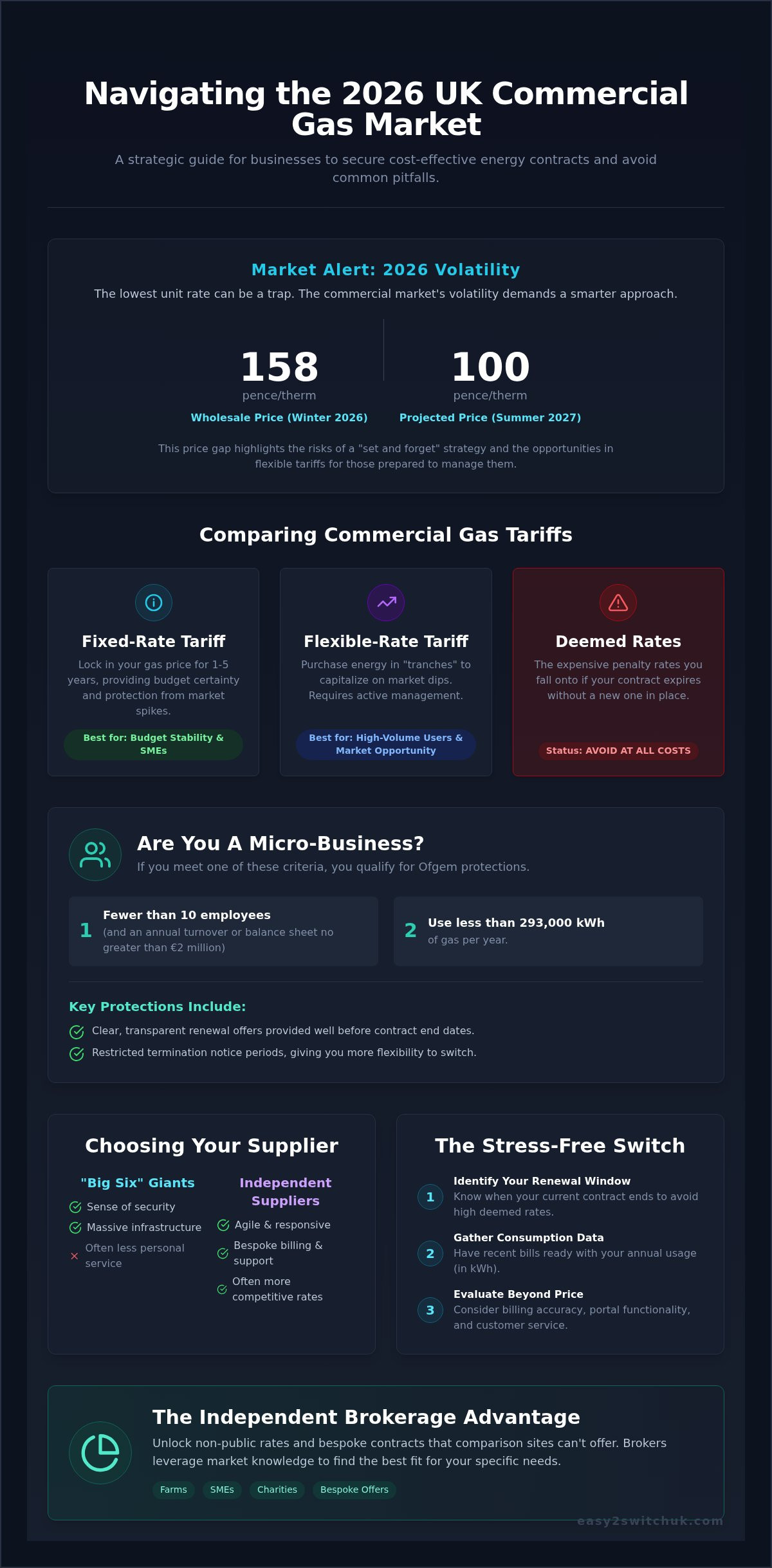
What if the lowest unit rate you are quoted today is actually the most expensive mistake your business makes this year? It is a common trap in a market where “cheap” often masks hidden fees or rigid terms that do not suit your actual operations. Finding the right commercial gas suppliers isn’t just about scanning a comparison site for five minutes; it’s about understanding how your specific usage profile interacts with a volatile 2026 market. With wholesale prices for Winter 2026 sitting around 158 p/therm, the margin for error has never been thinner.
We know the frustration of dealing with opaque pricing structures and the genuine fear of being locked into a contract that looks like a bad deal six months from now. It is time consuming and, frankly, exhausting. This guide is designed to give you back control. You’ll learn how to navigate current tariffs, identify which suppliers offer the best value for your sector, and discover a streamlined path to securing a cost-effective contract. We are moving past the jargon to show you exactly how to protect your business’s budget with confidence and ease.
Key Takeaways
- Gain a clear understanding of the 2026 market landscape and how Ofgem’s latest regulations protect your commercial energy interests.
- Compare the benefits of fixed versus flexible tariffs to find the right balance between budget stability and market opportunity.
- Look beyond the initial quote to evaluate commercial gas suppliers on critical factors like billing accuracy and portal functionality.
- Simplify the switching process by identifying your renewal window and gathering the specific consumption data suppliers require.
- Understand how independent brokerage unlocks non-public rates and bespoke offers specifically for farms, SMEs, and charities.
Understanding the UK Commercial Gas Market in 2026
The UK energy market operates on two distinct tracks. While domestic gas supply is built around standardized price caps to protect households, the commercial sector is a different beast. Business gas contracts are legal agreements where prices are negotiated based on your company’s unique usage profile, credit score, and contract length. There is no universal safety net here. This lack of a price cap means that choosing the right commercial gas suppliers is a high-stakes decision for your bottom line.
In this environment, Ofgem, the UK’s energy regulator, plays a vital role. They ensure the market remains competitive and fair. Their approach to businesses focuses on transparency rather than price control. As of 2026, Ofgem has tightened its oversight, particularly concerning how brokers disclose commissions and how suppliers manage micro-business contracts. This shift is designed to give you more clarity when comparing offers.
Market trends in 2026 show a landscape still reacting to global supply shifts. Wholesale gas prices for Winter 2026 delivery are currently around 158 pence per therm. This volatility is driven by international LNG competition and geopolitical events. It makes a “set and forget” approach risky. You need a strategy that balances immediate costs with long-term stability to avoid overpaying during peak demand periods.
The Difference Between Big Six and Independent Suppliers
Most businesses recognize the “Big Six” giants. These names offer a sense of security and massive infrastructure. However, they often struggle with personalized service due to their scale. In contrast, independent suppliers have gained significant ground by offering bespoke billing and dedicated support. These smaller players are often more agile. They provide competitive rates that the giants might overlook. Increased competition in 2026 means you have more leverage to find a supplier that fits your specific industry needs, whether you are running a farm or a local charity.
Micro-Business Protections and Regulations
If your company employs fewer than 10 people or uses less than 293,000 kWh of gas per year, you likely fall under “micro-business” status. This classification is vital. It grants you specific protections under Ofgem rules, such as restricted notice periods and clearer termination guidelines. In 2026, commercial gas suppliers must provide transparent renewal offers well before your contract ends. Ensuring you are correctly classified means you won’t be trapped by the same rigid terms as a multinational corporation. It gives you the freedom to move when a better deal appears.
Comparing Commercial Gas Tariffs: Which is Right for You?
Selecting the right tariff is the most direct way to control your operational overheads. Most commercial gas suppliers offer a range of products designed to balance risk and reward. Fixed-rate tariffs remain the gold standard for budget stability. They allow you to lock in a price for one to five years, shielding you from the sudden spikes that characterize the 2026 market. If your priority is a predictable monthly bill, a fixed contract is the logical choice.
Flexible or variable-rate tariffs work differently. These allow larger businesses to purchase energy in “tranches” throughout the year. With wholesale prices for Summer 2027 currently projected at approximately 100 p/therm compared to higher Winter 2026 rates, flexible procurement can capture these downward shifts. However, this requires active management. If you do nothing and let your contract expire, you’ll fall onto “deemed” rates. These are often the most expensive rates a supplier can charge, serving as a penalty for inaction. Understanding Ofgem’s role in protecting energy consumers helps you realize that while they ensure fair play, the responsibility to switch away from these high rates rests with you.
For businesses with environmental mandates, green gas options are now widely available. These tariffs either supply biomethane or use carbon offsetting to neutralize the impact of your consumption. While they may carry a slight premium, they are an essential tool for meeting modern ESG goals and appealing to eco-conscious customers.
Fixed-Rate vs. Flexible Contracts
Deciding between a short-term 12-month fix or a longer 36-month contract depends on your view of future market trends. A shorter deal keeps you agile, while a longer one hedges against future inflation. For most SMEs, flexible procurement is unnecessarily risky because it lacks the “set and forget” safety of a fixed rate. A pass-through contract is a flexible arrangement for high-volume users where non-commodity costs like transportation and industry levies are billed at the actual market rate rather than being fixed in advance.
Understanding Standing Charges and Unit Rates
A transparent quote from commercial gas suppliers will always break down the unit rate and the standing charge. The unit rate is what you pay for the gas you actually burn, measured in kWh. The standing charge is a fixed daily fee that covers the cost of maintaining the connection and the meter. If you operate a business with low or seasonal gas usage, a high standing charge can significantly inflate your bills, even if the unit rate looks low. To find the best fit for your specific usage profile, you can compare bespoke supplier offers that balance these two costs effectively.
Evaluating Commercial Gas Suppliers Beyond Price
A low unit rate often comes with a hidden cost in administrative time. If you spend hours on hold to fix a simple billing error, that initial saving quickly evaporates. Reliable commercial gas suppliers invest in intuitive online portals that allow you to track usage in real-time and download VAT-compliant invoices instantly. When you are comparing options, look for “Trustpilot” performance that specifically highlights billing accuracy and the speed of customer support. A supplier that resolves an issue in one phone call is worth a slightly higher premium than one that leaves you in a perpetual loop of automated emails.
Beyond ease of use, you must consider a supplier’s financial resilience. While the UK’s energy regulator sets the baseline for market conduct and consumer protection, it cannot prevent a supplier from struggling during global price surges. The 2022 energy crisis proved that under-capitalized firms can vanish overnight, leading to a stressful transition for their clients. Choosing a stable, well-established partner protects you from the disruption of a forced market exit and ensures your contract remains secure for its full duration.
Specialist Needs for the Farming Industry
Agriculture presents unique challenges that standard office-based suppliers often fail to grasp. Farm sites frequently involve multiple meters spread across large areas, each with vastly different usage patterns. For example, grain drying creates massive demand spikes during harvest, while livestock heating requires a steady, reliable flow throughout the winter. A specialist approach ensures your contract accounts for these seasonal fluctuations without triggering “volume tolerance” penalties. It is about finding a partner that understands rural infrastructure and the specific pressures of the UK farming calendar, ensuring you aren’t penalized for the natural rhythm of your business.
Green Energy and Corporate Responsibility
Sustainability is no longer a niche interest; it’s a core business requirement for 2026. Many commercial gas suppliers now offer 100% renewable gas, primarily sourced from biomethane produced through anaerobic digestion. If direct green gas isn’t viable for your current budget, carbon offsetting plans provide an alternative by funding global projects that reduce emissions. Matching your energy procurement with your corporate values strengthens your brand’s reputation with both customers and stakeholders. It transforms a standard utility bill into a clear statement of intent regarding your business’s environmental footprint and future-readiness.
How to Switch Commercial Gas Suppliers Without the Stress
Switching your energy provider is often seen as a logistical headache, but it is actually a straightforward process if you follow a structured timeline. The most important step is identifying your current contract end date. Most commercial gas suppliers require a formal notice period, which typically falls between 30 and 90 days before your agreement expires. If you miss this window, you risk being moved to expensive out-of-contract rates or rolled over into a new, uncompetitive term.
Once you know your dates, gather your usage data from the last twelve months. You will find your annual kWh consumption on your recent bills. This figure is the most accurate tool you have for securing a better deal. Instead of guessing your needs, you can present commercial gas suppliers with a precise usage profile. This allows them to provide a quote that reflects your actual business operations rather than a generic estimate. Using an independent consultancy during this phase ensures you see a market-wide view of available rates without doing the legwork yourself.
Avoiding Common Switching Pitfalls
The biggest danger in the transition process is the “rollover” contract. This happens when a supplier automatically renews your agreement because they didn’t receive a termination notice in time. To prevent this, submit your notice of intent to leave as soon as your renewal window opens. You should also be prepared for supplier objections. These usually happen due to outstanding debt or a mismatch in business name data. Resolving these minor issues early prevents delays on the day of the switch. Finally, always submit an accurate meter reading on the day of the transfer to ensure your final bill from the old supplier is correct. You can start your free energy review today to ensure every detail of your transition is handled by specialists.
The Role of Letters of Authority (LOA)
A Letter of Authority (LOA) is a simple but essential document that allows a broker to act on your behalf. It removes the burden of administrative back-and-forth, allowing your consultant to gather data and resolve queries directly with commercial gas suppliers. You remain in total control of the final decision, but the LOA handles the paperwork and data gathering that usually eats up your afternoon. A standard LOA is a legal document that authorizes a third party to gather data and negotiate with energy companies on your behalf without transferring the power to sign contracts. This ensures you get the best market insights while maintaining the final signature on any new agreement.
Why Independent Brokerage is the Smartest Choice
Many business owners believe that buying direct from commercial gas suppliers is the only way to save money. This approach ignores the reality of the 2026 market. Suppliers often reserve their most competitive, non-public rates for consultancies that bring them high-volume business. An independent brokerage acts as your advocate, providing impartial advice that is tailored to your specific industry constraints. Whether you are managing a charity budget or a complex farm site, a specialist broker ensures you aren’t just another number in a supplier’s database.
Transparency is the foundation of a reliable partnership. Our service is free to the end-user because we operate on a commission-based model. When you secure a contract, the supplier pays us a fee for managing the acquisition and administrative process. This means our goals are aligned with yours. We want to find you the best fit so you remain a satisfied client for years to come. It removes the bias of a single-supplier sales team and puts the power of choice back in your hands. You get the benefit of expert market analysis without adding a line item to your overheads.
The administrative burden of energy procurement is a significant drain on your time. Dealing with multiple commercial gas suppliers to compare terms, check credit requirements, and verify contract lengths can take days of effort. A “done-for-you” service handles every step of this journey. We manage the back-and-forth, resolve technical queries, and present you with a clear, side-by-side comparison. This allows you to focus on running your business while we ensure your energy costs are handled with professional efficiency.
The Easy2switch UK Ltd Approach to Gas Procurement
We don’t just scan a single database; we analyze hundreds of offers to find your best fit. The team at Easy2switch UK Ltd understands the unique pressures facing the UK’s charitable and agricultural sectors. We know that a charity needs maximum budget certainty, while a farm requires flexibility for seasonal peaks. You can Learn about our farm energy specialism to see how we handle these specific rural challenges. Our commitment is to find the individual solution that matches your operational rhythm, rather than pushing a one-size-fits-all contract.
Getting Your Free Commercial Gas Quote
Taking control of your energy costs is a simple, low-friction process. To get started, you only need a recent bill and a few minutes to talk through your business goals. We pride ourselves on the speed of our support. Whether you prefer a quick phone call or an online inquiry, we move at the pace of your business. This isn’t just about a one-time transaction. It is about building a long-term strategy that empowers you to stay independent and protected from market volatility for years to come.
Secure Your Business Energy Strategy for 2027 and Beyond
Managing your energy shouldn’t be a source of constant stress. By understanding the nuances of the 2026 market and moving beyond a simple price-per-unit comparison, you position your business for long-term stability. The most successful procurement strategies focus on matching your specific usage profile to the right tariff and selecting commercial gas suppliers that offer both financial resilience and transparent service. It’s about taking the complexity of the wholesale market and turning it into a predictable operational cost.
We’ve explored how to avoid the pitfalls of rollover contracts and why independent expertise is vital for navigating complex sector-specific needs. Whether you are managing a charitable trust or a busy farm, the right support makes the transition feel effortless. You now have the knowledge to identify your renewal window, gather your usage data, and demand transparency from your energy partners.
Our independent consultants provide impartial advice and specialist support for UK farmers, ensuring you get the best fit from hundreds of available offers. It’s a free service for our customers that handles the administrative heavy lifting on your behalf. Get a free, impartial commercial gas quote today and take the first step toward a simpler, more cost-effective energy future. You have the tools to take control; let’s put them to work for your business.
Frequently Asked Questions
How do I find the cheapest commercial gas supplier?
You find the best value by comparing quotes that match your specific usage profile rather than just looking at the lowest unit rate. Leading commercial gas suppliers price contracts based on your credit score, location, and annual consumption. Using an independent consultancy allows you to access non-public rates that aren’t available on standard comparison sites. This ensures you see the full market landscape before committing to a long-term agreement.
Is it better to use a business energy broker or go direct?
Using a broker is generally more efficient because they have the infrastructure to compare hundreds of offers simultaneously. While going direct might seem simpler, you often miss out on bespoke deals and the administrative support required to manage the switch. A broker handles the negotiation and paperwork, which saves you significant time. Since the service is often funded by supplier commissions, it provides expert market access without an upfront cost to your business.
What happens if my business gas contract expires?
If your contract expires without a new agreement in place, your supplier will move you onto “deemed” or out-of-contract rates. These prices are significantly higher than standard fixed terms and can drain your budget quickly. You aren’t usually locked into these rates, but they serve as a penalty for inaction. It’s vital to track your renewal window to ensure you transition to a competitive new contract before your current one ends.
Can charities get discounts on commercial gas rates?
Charities often qualify for a reduced VAT rate of 5% instead of the standard 20% on their energy bills. They may also be exempt from the Climate Change Levy if they meet specific criteria for non-business use. While the gas itself isn’t necessarily “discounted” by suppliers, these tax breaks significantly lower the total cost. A specialist broker can help ensure your charity is correctly classified to receive every eligible financial benefit.
How long does it take to switch commercial gas suppliers?
A standard switch typically takes between four and six weeks to complete. This timeline allows for the mandatory notice period with your current provider and the administrative setup with the new one. The process is much smoother if you have your recent bills and meter data ready from the start. Your supply won’t be interrupted during this transition; it’s purely an administrative change that happens behind the scenes while your business operates as usual.
Are business gas prices expected to rise in 2026?
Market data from August 2026 shows wholesale prices for Winter 2026 delivery are around 158 p/therm, which is higher than the projected Summer 2027 rates of 100 p/therm. This suggests seasonal volatility rather than a linear rise. Geopolitical factors and LNG availability continue to influence these fluctuations. Locking in a fixed rate during a market dip is a pragmatic way to protect your business from these unpredictable price shifts over the coming year.
What is the Climate Change Levy (CCL) and do I have to pay it?
The Climate Change Levy is a government tax on commercial energy use designed to encourage energy efficiency. For commercial gas, the rate is 0.801 p/kWh as of 2026. Most businesses must pay this, but you are exempt if your monthly usage stays below 4,397 kWh. Charities and businesses using gas for specific non-taxable purposes may also qualify for exemptions or reductions, so it’s worth verifying your status with a specialist.
What is a Letter of Authority in business energy switching?
A Letter of Authority is a legal document that gives a broker permission to talk to commercial gas suppliers on your behalf. It allows them to gather your usage data, request quotes, and resolve billing queries without you needing to be on every phone call. You retain the final decision-making power and must sign the actual supply contract. It simply streamlines the administrative process so you can stay focused on your core business operations.
