
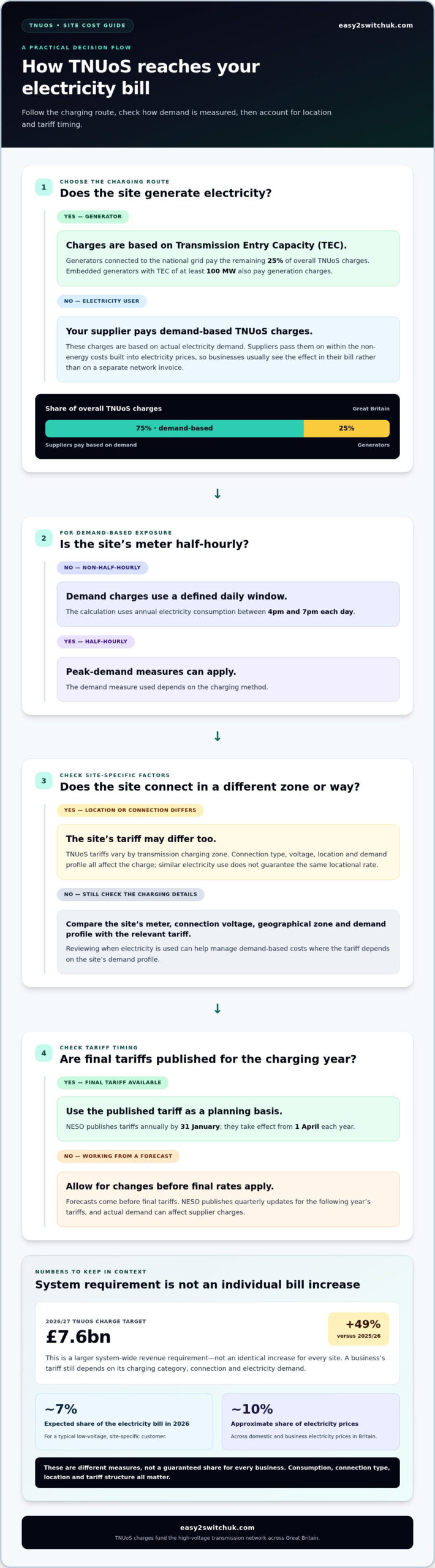
Generators pay the remaining 25% of overall transmission network use of system (TNUoS) charges, while suppliers pay charges based on actual electricity demand. These charges fund the installation and maintenance of the high-voltage transmission network that moves electricity around Great Britain. Suppliers include them in the non-energy costs built into electricity prices.
When electricity costs rise, it can be difficult to see which part of the bill is responsible. This guide explains what TNUoS charges cover, how they are calculated and why network costs can change.
You’ll learn what tariff information is available in advance, why forecasts may differ from final costs, and how usage, location and connection type affect the charge. This makes TNUoS easier to understand and account for when planning your electricity budget.
Key Takeaways
- TNUoS charges help fund the high-voltage electricity network, and suppliers include them in the non-energy costs built into electricity prices.
- Costs can rise as network investment needs and charging arrangements change, so the reasons behind a higher bill may go beyond your electricity use.
- Location, connection type and how demand is measured all affect the charges applied to a site.
- NESO publishes TNUoS tariffs annually by 31 January for them to take effect from 1 April each year, giving businesses a basis for planning ahead.
- Understanding the tariff structure can help you assess energy costs and make more informed decisions about your electricity contract.
Will you know about TNUoS costs in advance?
You can see the tariff structure before the charging year begins, but your final bill depends on how your site uses electricity. According to National Energy System Operator (NESO), TNUoS tariffs are published annually by 31 January and take effect from 1 April each year. Forecasts come before final tariffs, giving businesses time to plan, while actual demand can affect supplier charges.
In Great Britain, suppliers pay demand-based TNUoS charges, and generators pay charges based on their Transmission Entry Capacity. Demand-based tariffs account for 75% of overall TNUoS charges; generators connected to the national grid pay the remaining 25%. Embedded generators with Transmission Entry Capacity of at least 100MW also pay generation charges. Suppliers include TNUoS among non-energy costs built into electricity prices, so businesses usually see the effect through their bills rather than a separate network invoice.
The impact depends on the site’s meter and charging method. For a typical low-voltage, site-specific customer, TNUoS is expected to account for around 7% of the electricity bill in 2026. Across domestic and business electricity prices in Britain, TNUoS makes up approximately 10%. These are different measures, not a guaranteed share for every business: consumption, connection type, location and tariff structure all matter.
Charges vary by transmission charging zone because tariffs reflect the geographical area where a site connects to the network. A business in England may therefore face a different locational rate from one in Scotland, even with similar consumption. For non-half-hourly customers, demand charges use annual electricity consumption between 4pm and 7pm each day; half-hourly charges can use peak-demand measures.
TNUoS funds the high-voltage transmission network. Distribution Use of System (DUoS) charges relate to local electricity distribution, while Balancing Services Use of System (BSUoS) charges recover costs associated with balancing the energy system. These are separate network-related charges, although suppliers may include them in overall electricity prices.
Reforms can change how charges are collected and forecast. Following its Targeted Charging Review Significant Code Review, Ofgem directed changes to demand residual charging. NESO also publishes quarterly updates for the following year’s tariffs, so forecasts may change before final rates are set.
To estimate your business’s exposure, identify its meter type, connection voltage, geographical zone and demand profile, then compare these details with the relevant tariffs. Reviewing when electricity is used can help manage demand-based costs, particularly when peak-period consumption matters. Forecasts remain uncertain because tariffs are updated and actual demand may differ from estimates, so account for both when budgeting.
Drivers of rising network costs
Higher TNUoS forecasts reflect the revenue needed to operate and develop Britain’s transmission network. The charge target for 2026/27 is £7.6 billion, a 49% increase on 2025/26. That figure represents a larger system-wide requirement, not an identical increase for every site. A business’s tariff still depends on its charging category, connection and electricity demand.
Network investment is one reason these charges are needed. New or upgraded transmission infrastructure moves electricity from generators to demand centres, including power generated offshore. Building and maintaining lines, substations and connections requires funding. As the national energy system changes, the network operator must plan for generation and demand patterns that may differ from those the existing network was designed to handle.
Geography also affects the tariff. TNUoS charges partly reflect the geographical zone where a user connects, as transmission costs are allocated across the network. A site’s position relative to generation and demand can therefore affect its locational charge. The same electricity use does not necessarily result in the same tariff across Great Britain.
Charging reforms can change who pays and how costs appear on bills. Following its Targeted Charging Review Significant Code Review, Ofgem directed changes to demand residual charging.
Generation capacity and demand forecasts also affect charges. Generators are charged according to Transmission Entry Capacity, while suppliers’ charges relate to demand. Changes in expected generator output or connection capacity can affect the allocation of network costs. Demand estimates matter too: tariffs are set ahead of the charging year using forecasts and system data.
That makes forecast movement a practical planning issue. Updates for the following year’s tariffs are published quarterly, allowing assumptions to change before final rates apply. Electricity Ten Year Statement publications provide inputs such as week 24 demand data and the generator TEC register. Businesses can use these updates to track tariff direction, then compare their own connection details and consumption profile with the relevant charging category.
For a business, understanding its exposure starts with separating bill components that respond to usage from those reflecting fixed or locational charges. Shifting electricity use may affect demand-related costs where the tariff depends on the site’s demand profile, but it cannot remove the network’s overall revenue requirement. Reviewing meter data, capacity arrangements and tariff forecasts gives you a clearer basis for budgeting.
Purpose of TNUoS charges
TNUoS charges recover the cost of installing and maintaining the high-voltage transmission system. It carries electricity between generators and demand centres across England, Wales, Scotland and offshore. The system includes large transmission lines and substations connecting power stations and other generators to the wider electricity network. The charge helps fund shared infrastructure, not the electricity a particular business consumes. Put simply, transmission network use of system (TNUoS) charges fund the network, separately from the cost of energy itself.
That distinction matters. A supplier’s energy charge relates to the electricity supplied to a site, while TNUoS contributes towards moving electricity across the transmission system. Businesses encounter the charge through their electricity costs, but it supports infrastructure serving many connected users. For example, a line carrying power from an offshore wind farm connects that generation to the wider network, rather than serving just one customer.
Transmission infrastructure must carry power from where it is generated to where it is needed. In England and Wales, transmission lines operate at 400kV or 275kV; Scotland also has a 132kV network classified as transmission. These voltage levels show why transmission differs from local distribution: it handles bulk electricity movement over the network, while distribution takes electricity nearer to individual premises.
These charges also recover allowed transmission costs from electricity market participants. The forecast supports this cost-recovery process; it is not a separate bill for each company. An individual charge depends on the applicable tariff and charging arrangements.
The charging methodology is detailed in Section 14 of the Connection and Use of System Code. This framework sets out how tariffs reflect network costs and allocate them among users. Demand-based tariffs account for 75% of overall TNUoS charges in Britain, while generation charges apply to generators under their relevant arrangements. For businesses seeking to have transmission network use of system (TNUoS) charges explained clearly, this allocation shows why demand and generation are treated separately.
Location is another factor. TNUoS tariffs use geographical zones to reflect how transmission costs are allocated across Great Britain. Electricity generation and demand are unevenly distributed, and the network must connect them. A site’s zone can therefore affect its tariff, even if it uses a similar amount of electricity to a business elsewhere.
In practical terms, TNUoS funds shared infrastructure that moves electricity from generators to users. The tariff is not simply a measure of one site’s network use; it applies a defined method for recovering system costs. Understanding this helps businesses distinguish transmission costs from energy consumption when reviewing bills and comparing contract costs.
What TNUoS charges fund
TNUoS revenue funds the transmission system that carries electricity between generators and consumers. In Great Britain, this means supporting transmission infrastructure in England, Wales, Scotland and offshore. The network includes high-voltage lines and substations connecting power stations, renewable generators and regional networks. TNUoS helps recover the cost of installing and maintaining these shared assets, rather than paying for the electricity a business uses.
Transmission Owners receive revenue through this charging framework. These figures show how forecast revenue is allocated across different parts of the network, including infrastructure serving Scotland and offshore connections.
Connections are another area the charges fund. These charges relate to connecting users to the transmission system, while wider TNUoS charges help recover broader network costs. For example, a generator connecting a new station to the grid needs infrastructure to carry its output beyond the connection point.
That infrastructure must handle changing electricity flows, not just average demand. The system needs capacity for periods of high demand and for power moving from generation regions to demand centres. In Great Britain, a triad consists of the three half-hour settlement periods with the highest system demand. This illustrates why peak demand patterns can matter when charging arrangements allocate transmission costs.
Transmission differs from local distribution in both purpose and scale. England, Wales and Scotland have transmission lines operating at 400kV or 275kV, while Scotland also has a 132kV network classified as transmission. These lines move electricity across wider areas; local distribution networks carry it closer to homes, farms and business premises. TNUoS revenue is directed towards the transmission system, not every cable or local connection a customer uses.
Funding also supports offshore infrastructure connecting generation to the wider electricity network. These links carry electricity generated offshore towards consumers. Without them, that generation could not contribute to demand elsewhere through the national network.
For businesses, the key distinction is between network costs and energy costs. TNUoS contributes to system infrastructure and its upkeep; the energy component pays for electricity supplied to the site. Reviewing a bill with these categories in mind helps explain why a change in consumption does not necessarily affect every network charge in the same way.
What are the current TNUoS tariffs and rates for 2026/27?
National Energy System Operator (NESO) published the final TNUoS tariffs for Great Britain for 2026-27 on 30 Jan 2026. Rates depend on customer type, connection voltage, meter arrangement and location. No single figure represents every business’s charge. To interpret a tariff, identify the site’s charging category and whether its meter is half-hourly. This is the practical context behind transmission network use of system (TNUoS) charges explained for businesses.
Some customers pay a fixed daily charge. The applicable band depends on the business’s consumption category, so these rates are reference points, not a universal charge for every business.
Fixed charges for half-hourly business customers vary by connection type. Voltage and connection classification affect the fixed element.
Demand charges add another layer. Half-hourly tariffs include a locational element across 14 demand zones.
Regional differences matter. The usage-based charge ranges from zero in Scotland and the north of England to its highest level in London and the south-west. Use your business’s location, meter type and connection details to interpret a rate. Comparing a tariff from another region could give you a misleading estimate.
The fixed residual element is also changing. The UK TNUoS fixed residual charge was forecast to rise by over 94% between 2025/26 and 2026/27. That does not mean every site’s total bill rises by the same percentage. Fixed charges and demand-related rates affect customers differently, so separate each tariff component when estimating site exposure. In other words, transmission network use of system (TNUoS) charges explained properly means looking beyond one headline rate.
Easy2switch UK: Farm Energy Brokerage
Easy2switch UK Ltd helps farms review electricity and gas contracts through its Farm Energy Brokerage. It can be useful when rising network charges make it harder to assess the wider energy bill, or when a contract is due for review. The service compares supplier offers and manages the switching process, helping you consider contract options alongside the costs you’ve learned about here.
For other organisations, Easy2switch UK Ltd also offers Business Energy Brokerage and Charity Energy Brokerage. Its energy consultancy earns commission from the supplier a customer chooses to switch to. This gives you a practical route to review available contracts without handling every part of the switch yourself.
If you’d like support reviewing energy contract options for your farm, business or charity, contact Easy2switch UK Ltd to discuss your needs.
Put your next energy decision on a clearer footing
With transmission network use of system (TNUoS) charges explained, the next step is to separate network costs from decisions you can influence, such as reviewing your electricity contract. Consider your organisation’s needs, usage pattern and contract requirements before deciding what to do next. A clear understanding of these priorities makes supplier options easier to compare.
Easy2switch UK Ltd offers Farm Energy Brokerage, Business Energy Brokerage and Charity Energy Brokerage. Its team helps customers compare supplier offers and manages the switching process, so you can focus on finding a contract suited to your organisation. This can be useful when you’re reviewing energy arrangements or preparing for a renewal.
To discuss your farm, business or charity’s energy contract options, contact Easy2switch UK Ltd. Take the next step with a clearer view of the choices available to you.
Frequently Asked Questions
What is TNUoS?
TNUoS means Transmission Network Use of System. It is a charge associated with using Great Britain’s high-voltage electricity transmission network and forms part of the wider costs of moving electricity from generators towards consumers. For a business, it is usually included in supplier pricing rather than billed directly by the network operator. The applicable tariff depends on the customer’s charging category, location and demand arrangements.
How do the TNUoS usage fees work?
Usage-related charges depend on the customer’s meter and tariff design. For non-half-hourly customers, demand charges use annual electricity consumption during the daily 4pm to 7pm period. Half-hourly customers can face demand charges linked to peak system demand, measured through TRIAD periods. A business can use its meter data to understand which calculation applies and whether its operating schedule affects its demand profile.
How much of your energy bill does TNUoS account for?
The share varies by customer and bill structure. In 2026, TNUoS is expected to represent around 7% of a typical low-voltage, site-specific customer’s electricity bill. Across domestic and business electricity prices in Britain, it makes up approximately 10%. These figures describe different typical measures, not a fixed percentage for each account. A business’s tariff, connection and demand profile affect its actual share.
When will TNUoS price rises happen?
Tariff changes take effect from 1 April for the relevant charging year. The 2026/27 TNUoS charges are forecast to collect £7.6 billion, a 49% rise compared with 2025/26. NESO publishes tariffs annually by 31 January, giving customers a view before the new tariff year begins. For budgeting, businesses can compare the upcoming tariff with their current charging category and electricity profile.
Who does this charge apply to?
TNUoS applies to electricity suppliers and generators within Great Britain’s charging arrangements. Suppliers pay demand charges, which can feed into the electricity prices paid by households and businesses. Generators pay generation charges based on Transmission Entry Capacity. Embedded generators with Transmission Entry Capacity of at least 100MW also pay generation TNUoS charges. A business customer generally encounters the cost through its supplier’s bill, not as a separate network invoice.
What are TNUoS charges and what do they pay for in Great Britain?
TNUoS charges recover the cost of installing and maintaining Great Britain’s transmission system, including infrastructure in England, Wales, Scotland and offshore. They are separate from local distribution costs, which relate to networks carrying electricity nearer to individual premises. This distinction helps when reviewing a bill: the transmission element supports the wider electricity system, not a particular site’s local cables or equipment.
How are TNUoS charges calculated for generators and electricity suppliers?
Generators are charged according to their Transmission Entry Capacity, which reflects the capacity they can make available to the transmission network. Suppliers’ demand charges are based on actual demand. The tariff structure allocates costs according to relevant charging categories and location. A generator’s capacity is treated differently from a supplier’s customer demand, so the two participant groups are not charged using the same calculation.
How are TNUoS demand charges set for households and businesses?
Demand charges use tariff structures that reflect meter type and consumption or demand measurement. Non-half-hourly customers are charged using annual consumption during the daily 4pm to 7pm window. Half-hourly customers have tariffs with a locational element and demand rates linked to TRIAD periods. Households and businesses may fall under different charging arrangements, and the applicable tariff can depend on the customer’s circumstances.
