
A supplier failure doesn’t automatically mean a business loses its energy supply. Ofgem’s supplier of last resort (SoLR) process for business customers allows Ofgem to appoint a replacement supplier, so gas or electricity can continue flowing. The original contract ends, and the replacement supplier places the business on a holding tariff.
It’s understandable to worry about what happens next when a familiar contract and supplier disappear at once. The transfer protects continuity of supply, but it doesn’t necessarily preserve the old contract or resolve questions about costs and credit balances.
This guide explains how Ofgem appoints a Supplier of Last Resort, what the transition means for business energy, and which costs may arise. It also covers what happens to a failed supplier’s credit balances and how to assess the replacement tariff, helping you make an informed decision about your next energy contract.
Key Takeaways
- Ofgem weighs whether a prospective supplier can take on business customers and secure enough energy without significant costs for them.
- Business credit balances don’t receive the same automatic protection as household and micro-business balances, so understand how the administrator and replacement supplier may handle yours.
- SoLR-related industry costs are assessed against criteria including whether they were directly incurred, unrecoverable and economic.
- Once you understand the transfer terms, energy brokerage can help you compare business contracts and take control of your next procurement decision.
What is Supplier of Last Resort (SoLR)?
Ofgem’s supplier of last resort (SoLR) process for business energy customers transfers a failed supplier’s gas and/or electricity customers to a replacement supplier. Ofgem appoints a Supplier of Last Resort to protect continuity of supply and service. The business’s original contract ends, and the replacement supplier usually places it on a holding tariff.
Ofgem considers whether the failed supplier served businesses when choosing a replacement. Energy companies bid to take on customers, and Ofgem assesses whether each prospective supplier can manage the transfer without significantly affecting its existing customers. The new supplier must also show it can secure enough gas and electricity without significant cost to transferred customers.
The scale of transfers varies. Octopus Energy took on 580,000 customers from Avro Energy, while British Gas took on 9,000 from MoneyPlus Energy. During the supplier failure wave from autumn 2021 to summer 2022, around 4.3 million UK customers moved to Suppliers of Last Resort.
Credit balances are treated differently across business sizes. Micro-business customers have the same automatic credit-balance protection as domestic customers, but larger non-domestic customers don’t. Ofgem may choose a replacement supplier able to cover some or all outstanding business credit. Protected balances are usually refunded within 4 to 12 weeks of transfer.
After you’re notified, take a meter reading that day and keep it with your bills and account records. Don’t cancel your Direct Debit before the replacement supplier gives instructions. The UK Government says businesses usually don’t need to cancel it when their supplier goes out of business.
SoLR is not a newly negotiated contract that carries over the failed supplier’s terms. After the transfer, a business can review the replacement tariff and its credit position separately. Keeping these issues distinct helps owners track supply, billing and any outstanding balance.
Ofgem’s appointment of a Supplier of Last Resort
When an energy supplier fails, Ofgem can appoint a replacement to take over some or all affected customers. In Great Britain, Ofgem makes this decision case by case, usually after the failed supplier’s licence is revoked.
Choosing and Appointing a Replacement Supplier
Ofgem appoints a Supplier of Last Resort through a bidding process in which energy companies offer to take on customers. The appointed supplier must manage the transfer while maintaining service for its existing customers.
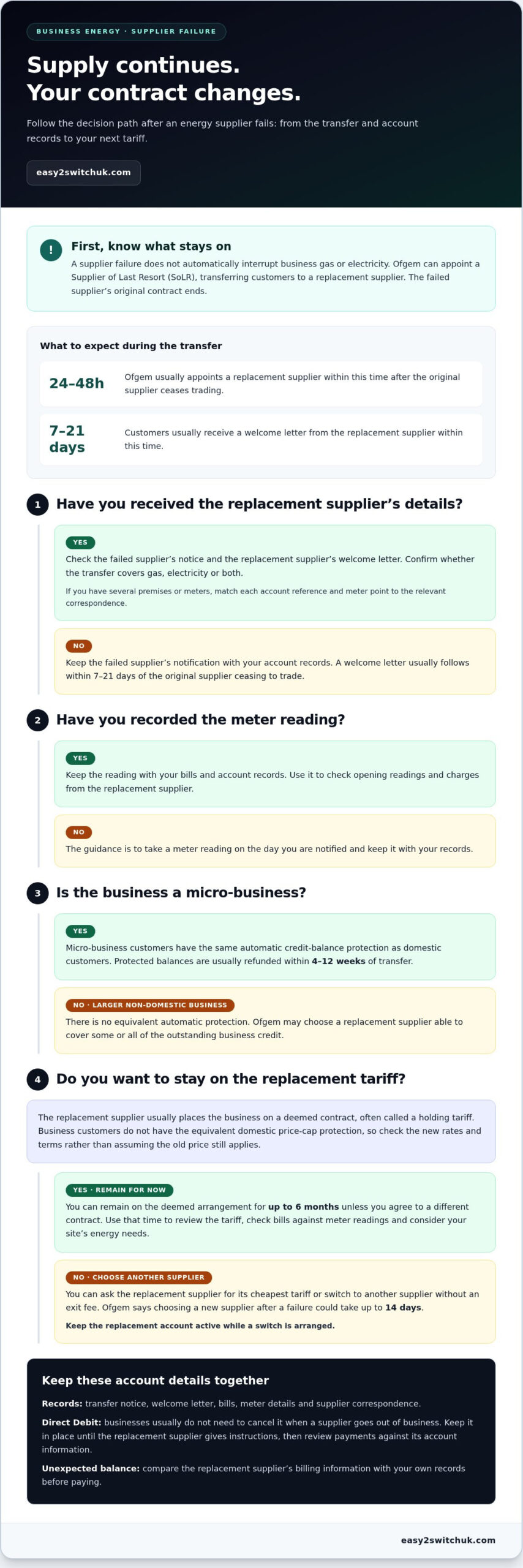
Ofgem assesses whether a prospective supplier can take on new customers without significant impact on its current customers. It must also show it can secure enough gas and electricity without significant cost to those transferred. Ofgem usually appoints the replacement within 24 to 48 hours of the original supplier ceasing to trade.
Finding the Appointed Supplier
The appointed supplier is the company Ofgem selects to take over affected energy accounts. Knowing its identity helps a business direct supply, billing and account queries to the right place.
Look for the failed supplier’s notification and follow-up communications from the replacement supplier. Customers usually receive a welcome letter within 7 to 21 days of the original supplier ceasing to trade. The letter should identify the new supplier and explain how the account will be handled.
Ofgem may appoint a supplier to take over gas, electricity or both, so check which supplies each notice covers. Keep the notification and welcome letter with your account records. If your business has multiple premises or meters, match each account reference and meter point to the relevant correspondence before raising a billing query.
Appointment doesn’t mean the failed supplier has been bought or rescued. Ofgem prefers a trade sale where possible, but that route isn’t always available; if SoLR cannot be used, Ofgem may apply for an Energy Supply Administration Order. To compare business contract options after the transfer, review business energy choices.
Business supply continuity after supplier failure
A business’s gas or electricity supply won’t be cut off because its supplier fails for financial reasons. The Supplier of Last Resort process transfers supply to a replacement, allowing operations to continue while account arrangements change. This protects continuity, but the failed supplier’s original contract doesn’t remain in place.
After transfer, the replacement supplier places the business on a deemed contract, often called a holding tariff. The business can remain on that arrangement for 6 months unless it agrees to a different contract. That period gives time to review the new terms, check bills against meter readings and decide whether the tariff suits the site’s energy needs.
There’s no equivalent domestic price-cap protection for business customers. So, a business should look at the replacement tariff’s rates and contract terms rather than assume its previous price still applies. It can ask the new supplier for its cheapest tariff or switch to another supplier without an exit fee. Ofgem says choosing a new supplier after a failure could take up to 14 days, so keep the replacement account active while a switch is arranged.
Keep the transfer notice, bills, meter details and correspondence from the failed supplier together. These records help match opening readings and charges to the right business account and support efforts to recover a disputed amount. Before paying an unexpected balance, compare the replacement supplier’s billing information with your own records.
Direct Debit arrangements also need care. The UK Government says businesses usually don’t need to cancel their Direct Debit when their supplier goes out of business. Keep it in place until the replacement supplier provides instructions, then review payments against its account information. This helps avoid interrupting payments during the handover and gives the business a clear record of what it has paid.
Costs associated with supplier failures
Supplier failures can create costs across the energy system, but those figures aren’t an individual business’s bill. These estimates cover different periods, so don’t treat them as identical totals.
Ofgem assesses a Supplier of Last Resort’s costs against specific tests. Claimed costs must be additional, directly incurred through the SoLR role, otherwise unrecoverable and economic. Ofgem also decides case by case whether allowing recovery is in consumers’ interests. Claims are assessed, not automatically passed through.
The Last Resort Supply Payment (LRSP) process helps eligible suppliers recover certain costs. Under the temporary process, a Supplier of Last Resort can submit an initial claim for immediate costs, then later true-up claims for additional costs. The temporary process applies to Suppliers of Last Resort appointed since 1 September 2021. In August 2025, Ofgem made the multi-claim process permanent through licence changes.
Relevant gas and electricity network operators pay LRSPs and recover the costs through charges to suppliers. Costs claimed through the SoLR Levy Offset rule remain liabilities of failed suppliers and may be recovered through insolvency proceedings where assets are available. If Ofgem identifies an overpayment in an earlier claim, the appointed supplier must repay the excess through the same industry processes. The recovery process takes account of the failed supplier’s financial position and any assets available.
For a separate decision about your next business contract, compare business energy options once you understand the replacement supplier’s terms.
Easy2switch UK: Farm Energy Brokerage
Easy2switch UK Ltd helps farms review electricity and gas contracts through its Farm Energy Brokerage. If your business has moved onto a replacement tariff after a supplier failure, its Business Energy Brokerage can help you compare available supplier offers and consider a suitable next contract. Charities can use its Charity Energy Brokerage for energy procurement support.
Easy2switch UK Ltd manages the switching process and earns commission from the energy supplier a customer chooses. This gives you a practical route from understanding the SoLR transfer to reviewing your longer-term energy arrangements. Compare the replacement contract’s terms with your business needs before deciding whether to switch.
Contact Easy2switch UK Ltd to discuss energy brokerage for your farm, business or charity.
Plan your next energy decision with confidence
Use the supplier transfer as an opportunity to reconsider how energy procurement fits your operating plans. Understanding Ofgem’s supplier of last resort (SoLR) process for business provides useful context, while your next contract decision can take account of seasonal demand, site changes and budget priorities.
Easy2switch UK Ltd supports farms through Farm Energy Brokerage, businesses through Business Energy Brokerage, and charities through Charity Energy Brokerage. Its brokerage service helps compare supplier offers and manages the switching process, so you can focus on choosing an arrangement suited to your organisation.
Before settling on a contract, bring together your energy requirements and operational plans. This helps keep the decision grounded in how your organisation uses energy, rather than headline rates alone. For support with your next business energy decision, discuss your contract options with Easy2switch UK Ltd. A clear view of your needs can help you move forward with greater confidence.
Frequently Asked Questions
What is the purpose of this guidance?
This guide explains how a supplier failure affects a business and what decisions follow the transfer. The SoLR regime aims to protect affected customers by maintaining energy supply and service. Distinguish the immediate transfer from later choices about tariffs, account records and credit balances so you can focus on the action relevant to your business.
When does Ofgem appoint a SoLR for a failed business energy supplier?
Ofgem can appoint a Supplier of Last Resort when an energy supplier goes out of business. In Great Britain, it makes the decision case by case after revoking the supplier’s licence, usually because the supplier is insolvent. Ofgem usually appoints a replacement within 24 to 48 hours after the original supplier stops trading, allowing the transfer process to begin promptly.
How does Ofgem select a SoLR and what rules must it follow?
Ofgem selects a replacement through a bidding process in which energy companies offer to take on customers. It considers whether the failed supplier served businesses, whether the bidder can manage new accounts without significantly affecting existing customers, and whether it can secure enough gas and electricity without significant cost to transferred customers. These tests assess operational capacity and customer impact.
What happens to a business’s gas and electricity supply when its supplier fails?
The business’s supply continues, and a Supplier of Last Resort can take over its gas, electricity or both. If your business receives both fuels, check the transfer notice to see which accounts moved, and keep separate meter readings for each supply. Record the readings and retain the failed supplier’s final bill to help identify differences in later statements.
Are business energy contracts, prices and exit fees transferred to the SoLR?
No. The failed supplier’s original contract ends, and the replacement supplier places the business on a holding tariff. The old contract’s price and terms don’t simply carry over, so compare the new tariff with your usage and budget. You can ask the replacement supplier about its cheapest tariff or switch to another supplier without an exit fee.
Can a business switch away from its appointed SoLR, and are there restrictions or fees?
Yes. A transferred business can ask its appointed supplier about its cheapest tariff or switch to another supplier without an exit fee. Before choosing, compare the replacement tariff’s rates and terms with the proposed contract, including how each fits your expected energy use. Keep your new account details and meter information to hand during the switch so billing can be matched to the correct supply.
