
An out-of-contract tariff is usually a reason to review your options, not a sign that your energy supply is about to stop. So, is it safe to stay on out-of-contract energy rates? Your supply doesn’t stop simply because a contract ends, but your charges and the predictability of your bills may change.
Your tariff status matters. Household default tariffs are covered by Ofgem’s price cap, while business energy has no equivalent cap. This guide explains the difference between deemed and out-of-contract rates, what to check on your bill and contract, and why exit fees matter before switching from a fixed deal. Any savings may outweigh early-termination costs, but compare them with the fee first.
Easy2switch UK Ltd provides free comparison and advice, with no cost or obligation to use the service. If you choose a tariff through Easy2switch, the supplier pays commission built into the selected tariff’s price. A dedicated personal Account Manager can help you review your options. Easy2switch abides by the Data Protection Act, FCA, TPI Code of Practice and Business Protection from Misleading Marketing Regulations 2008. It treats customers with respect, is honest, open and fair, remains impartial, delivers what it promises and acts in customers’ best interests.
Key Takeaways
- Wondering “is it safe to stay on out-of-contract energy rates”? Staying on these rates doesn’t automatically stop your energy supply, but it’s worth understanding the tariff you’re on.
- Compare your actual unit rate, standing charge and energy use to understand the financial impact. The tariff label alone doesn’t tell you what you’ll pay.
- Deemed, out-of-contract and rollover rates describe different situations. Use your bill, contract and account notices to identify which terms apply.
- Review your tariff name, contract status, meter details and latest charges before deciding what to do. If you’re on a fixed contract, check exit fees before switching.
- Easy2Switch can compare a wide range of supplier offers and provide advice free, with no cost or obligation. The supplier pays commission built into the selected tariff’s price.
What Does It Mean to Stay on Out-of-Contract Energy Rates?
Staying on an out-of-contract rate does not automatically mean your energy supply will stop. If you’re asking, “is it safe to stay on out-of-contract energy rates?”, separate the tariff terms you’re paying under from the physical supply to your property. A fixed deal can end while you continue using gas or electricity under the terms that then apply to your account.
An out-of-contract tariff generally means the supplier’s terms that apply after a fixed-term contract ends without a replacement agreement. The tariff name and details depend on the supplier and the agreement attached to your account. For households, this may be a standard variable or default tariff; business customers may move onto different default terms. Don’t assume the same label means the same rates or conditions across suppliers.
For general background on how energy arrangements sit within the wider sector, the overview of Energy Law and Contracts provides context. Your bill and contract are the practical references for understanding the terms attached to your account.
What does “out of contract” mean on an energy account?
A fixed-term agreement has an end date. If it expires and you haven’t agreed a replacement, you may continue using energy under the applicable account terms rather than a newly chosen fixed deal. Look at your latest bill or online account for the tariff name and any notice about the contract ending. The end of a fixed deal is a change in contract status, not confirmation that your supply will be interrupted.
Does staying on a default tariff mean your supply is unsafe?
No. The tariff status alone doesn’t mean your supply is about to stop. A default tariff describes the terms applying to your account, while supply continuity is a separate matter. If you receive a separate message about your account or supply, read it on its own terms rather than assuming it’s caused by the contract ending.
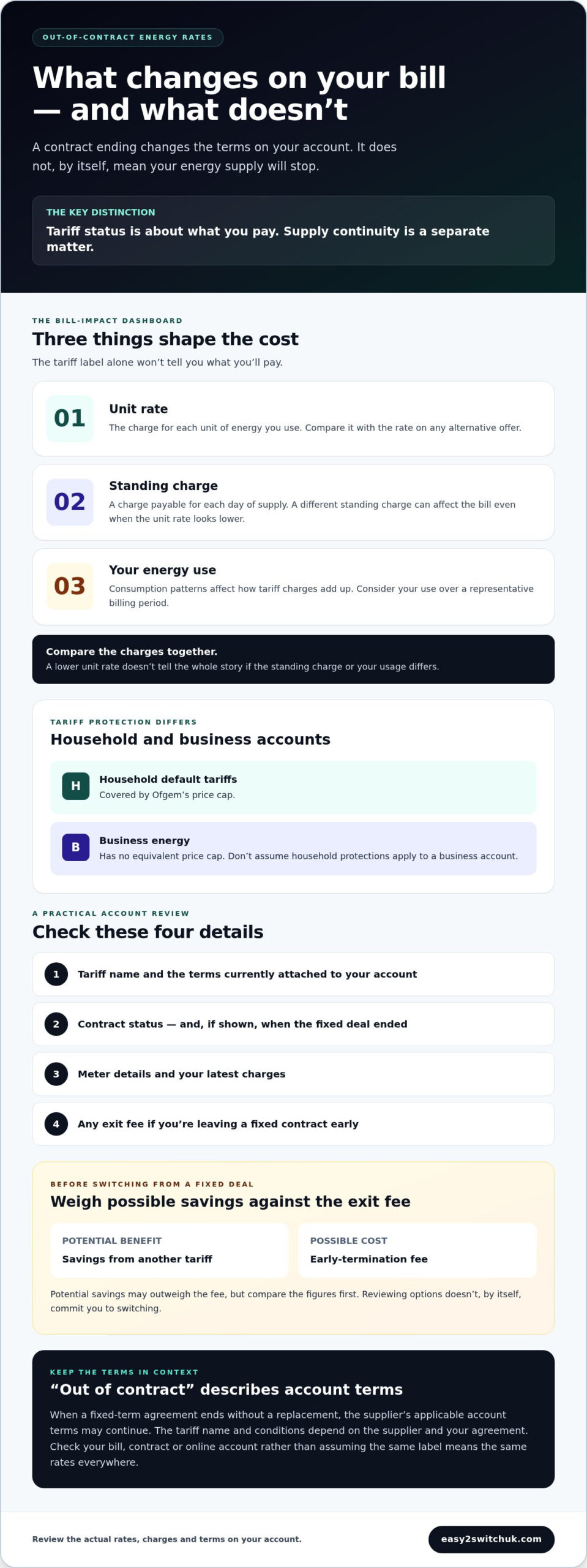
In short, an out-of-contract tariff can change what you pay, but its label alone doesn’t mean your energy supply is about to stop. The financial effect depends on your actual unit rates, standing charges, usage and tariff conditions. In the UK, domestic default tariffs and business energy rates can also be treated differently, so don’t assume a household price cap applies to a business account.
For a clear first check, find the tariff name and, if shown, the date your fixed contract ended. Compare those details with your latest bill or online account to see which terms currently apply. Then review the charges and options before making a decision.
Easy2Switch’s values underpin its approach to energy advice: treating customers with respect, being honest, open and fair, remaining impartial, delivering what it promises and acting in customers’ best interests. Easy2Switch abides by the Data Protection Act, FCA, TPI Code of Practice and Business Protection from Misleading Marketing Regulations 2008.
What Can Change When You Remain on an Out-of-Contract Tariff?
The effect on your bill depends on the terms attached to your account and how much energy you use. An out-of-contract tariff isn’t automatically more expensive in every case, so look at your actual charges rather than judging by the label. If the tariff information or account notices say rates can vary, note how and when charges could change.
How might an out-of-contract tariff affect your bills?
Start with the two main charges: the unit rate, which applies to each unit of energy used, and the standing charge, which is payable for each day of supply. Compare both with any alternative offer and consider your consumption over a representative billing period. A lower unit rate may not tell the whole story if the standing charge differs or your usage is concentrated at particular times.
Tariff suitability depends on the unit rates, standing charges and your pattern of consumption. For example, a property with low energy use may be affected differently by a change in standing charge than a site that uses substantial energy throughout the day. An advertised rate or headline comparison may not show what a tariff means for your own bills.
Reviewing options is a comparison, not a decision to switch. It doesn’t, by itself, interrupt your energy supply. You can gather the details, compare possible costs and decide what suits you without treating the review as a commitment. If you’re considering leaving a fixed contract rather than remaining on an out-of-contract tariff, check for exit fees. Potential savings may outweigh early-termination costs, but compare the figures first.
What should households, farms and businesses consider?
Different customer types can have different contract terms and comparison needs. Household bills are usually assessed around domestic usage and the tariff terms for a home. For a business or farm, the picture may include several sites, separate meters, seasonal demand or energy use that changes with operating schedules. A useful comparison reflects those circumstances rather than assuming one rate or switching route will fit everyone.
Before comparing, gather the information that will make the assessment more meaningful:
- List each property or site included in the account and note its meter details.
- Review recent bills to understand how much energy each site uses and when demand changes.
- Record the current unit rates and standing charges, along with any information about rate changes.
- Read the contract conditions, including relevant notice requirements or exit fees.
For farms and businesses, keeping site information together makes it easier to assess whether an option fits actual operations, not just a headline figure. Easy2Switch compares a wide range of supplier offers, and its comparison and advice are free, with no cost or obligation. If you choose a tariff through the service, the supplier pays commission built into the selected tariff’s price. A dedicated personal Account Manager can help you review the options. Compare energy tariff options when you’re ready to assess what may suit your usage.
It treats customers with respect, is honest, open and fair, remains impartial, delivers what it promises and acts in customers’ best interests.
Out-of-Contract, Deemed and Rollover Rates: How Do They Differ?
These terms describe different ways energy may be supplied or a contract may continue, but suppliers don’t always use labels in exactly the same way. Your bill, contract and account notices are the best clues to what applies to your account. The distinction matters because terms, charges and options for ending or changing an arrangement can differ.
| Term | General context | What to check |
|---|---|---|
| Out of contract | A fixed-term agreement has ended and no replacement has been agreed; the supplier’s subsequent terms apply. | Tariff name, current rates, standing charges and contract status. |
| Deemed | Energy is being used without a contract the customer actively agreed to, such as after moving into premises. | Why the account is considered to be on these terms, and the applicable rates and conditions. |
| Rollover | A contract may continue or renew into another term under provisions in the original agreement. | Renewal notices, contract wording, term details and any exit conditions. |
What is the difference between deemed and out-of-contract rates?
In general, an out-of-contract arrangement follows the end of a previously agreed fixed contract. A deemed arrangement can apply when energy is used without the customer having actively agreed a contract with the supplier, for example after taking on a property. These are broad descriptions, not universal definitions. Check the wording in your account and any supplier communications to identify which terms apply.
Protections and notice requirements can depend on the customer and arrangement. Before relying on a rule, verify current guidance with an authoritative source such as Ofgem and read the relevant contract terms. Don’t assume that a rule for a household account applies to a business, farm or charity account.
How are rollover terms different?
Rollover refers to a possible outcome described in a contract, where a customer may move into another contract term if the original agreement ends without a different arrangement being made. It isn’t simply another name for every out-of-contract tariff. Review renewal notices and the contract itself to see whether a new term applies, what its conditions are and whether any exit charges or notice conditions affect your options.
To work out which situation you’re in, compare the language in your latest bill with the original agreement and any messages about its end or renewal. Keep relevant contract terms and notices with your records. This can help you make a sound comparison without treating a contract label as a complete description of your rights or costs.
So, is it safe to stay on out-of-contract energy rates? The label alone doesn’t answer that question. First establish whether the account is out of contract, deemed or under rollover terms, then review the applicable charges and conditions. Identifying the arrangement gives you a clearer basis for deciding whether to stay or explore another option.
How to Check Your Tariff and Decide What to Do Next
A few account details can turn tariff uncertainty into a practical decision. Whether you’re asking “is it safe to stay on out-of-contract energy rates?” or simply want to know if your current deal still fits, check your records before comparing. Reviewing options doesn’t commit you to switching, and switching doesn’t disrupt your energy supply.
Which details should you gather before comparing options?
Use a recent bill or account record where possible, so you’re working from actual information rather than estimates. Collect these details before you assess alternatives:
- Your current supplier and the exact tariff name shown on your bill or account.
- Whether a fixed contract has ended, and any recorded end date or renewal information.
- Recent energy usage for the relevant period, plus meter details for each property or site.
- Your current unit rates and standing charges, along with any other charges shown on the bill.
- For a fixed agreement, the applicable exit fee and any contract conditions that affect leaving early.
Having those details together makes it easier to compare like with like. A household’s needs may differ from those of a farm or business with several meters, sites or changing patterns of use. For a broader walkthrough of the comparison process, use this 2026 energy comparison guide.
When should you compare or seek contract support?
Consider comparing when your fixed deal has ended, your charges or circumstances have changed, or you want to check whether your current terms still suit your use. Compare the full cost structure, including unit rates and standing charges, rather than relying on one figure. If you’re on a fixed contract, check exit fees before acting. Potential savings may outweigh early-termination costs, but weigh the actual figures and terms rather than assuming a particular outcome.
Business customers and farms may need to factor in site-specific usage, meter information and contract requirements. If you’re reviewing business gas options, this guide to comparing gas suppliers can help you understand what to consider. Switching usually takes 2-3 weeks, depending on the supplier, and doesn’t disrupt your energy supply.
Before you decide, confirm your tariff, contract status, meter details, recent usage and charges, then compare any exit fees with the terms of an alternative. Easy2Switch’s comparison and advice are free, with no cost or obligation. The supplier pays commission built into the selected tariff’s price. A dedicated personal Account Manager can support your review. Compare energy options with Easy2Switch when you’re ready to assess suitable offers.
How Easy2Switch Can Help You Review Your Energy Options
Once you know which tariff and contract terms apply, an independent comparison can help you decide whether to stay or consider alternatives. Easy2Switch compares a wide range of supplier offers for home, business and farm energy. A dedicated personal Account Manager can help you review options and understand contract decisions, so you can make an informed choice without pressure. Comparing is a way to assess your position, not a commitment to switch.
What support can Easy2Switch provide?
Support is tailored to the type of account and energy needs involved. A household may want to review its current tariff, while a farm or business may need to consider multiple sites, meters or patterns of energy use. Easy2Switch can help compare relevant offers and provide contract support. Its service also includes billing and dispute help, and water deregulation where relevant to the customer’s needs.
Over 90% of proposed contracts are accepted. This is a record of proposed contracts, not a promise that a particular supplier will accept every proposal or that a specific tariff will be available. Your Account Manager can help you consider the terms presented and support you through comparison and switching decisions. The choice to proceed remains yours.
If the question on your mind is “is it safe to stay on out-of-contract energy rates?”, advice can help you understand your options without treating a comparison as an urgent switch. Review what’s available alongside your current terms and decide whether taking action makes sense for your circumstances.
How does the free comparison service work?
There’s no cost or obligation to receive a comparison or advice from Easy2Switch. If you choose a tariff through the service, the supplier pays commission, which is built into the selected tariff’s price. This funding model is explained openly, so you can consider the tariff terms with a clear understanding of how the service is paid for.
Easy2Switch treats every customer with respect, is honest, open and fair, remains impartial, delivers what it promises and acts in customers’ best interests. It abides by the Data Protection Act, FCA, TPI Code of Practice and Business Protection from Misleading Marketing Regulations 2008.
If you’ve gathered your account details and want to assess suitable options, Review your energy options with Easy2Switch. A comparison can give you a clearer basis for deciding what to do next, without guaranteeing savings or a particular tariff outcome.
Make Your Next Energy Decision with Confidence
Knowing is it safe to stay on out-of-contract energy rates is only part of the decision. The next step is to decide whether your current arrangement still works for your needs, based on clear information rather than pressure or uncertainty. You don’t have to make that choice in a hurry. A considered comparison can help you see the options and decide what suits your home, farm or business.
Easy2Switch has a TrustPilot rating of 4.6 from 49 reviewers. Its independent advice is designed to help you review your choices, with a dedicated personal Account Manager available to support the process. A comparison is a way to get clarity, not a commitment to change your tariff.
Take control at your own pace. Get a free energy comparison with Easy2Switch, then decide on your next step with greater confidence.
Frequently Asked Questions
Is it safe to stay on an out-of-contract energy rate?
Usually, yes: being on an out-of-contract rate alone doesn’t mean your supply is about to stop. The practical concern is whether the tariff’s charges and terms still suit you. Check your account for the rate that applies now, and read any separate notice about account or supply issues on its own terms. The tariff label by itself doesn’t explain a separate supply concern.
Can my energy supply be cut off if I stay out of contract?
Not simply because a fixed deal has ended. A tariff change and a supply interruption are different matters, so don’t assume one follows automatically from the other. If you receive a warning about payment, meter access or another account issue, respond to that notice promptly and follow its instructions. The exact circumstances matter; the tariff label by itself doesn’t explain a separate supply concern.
Are out-of-contract rates always more expensive than fixed tariffs?
No. The label doesn’t establish whether a tariff costs more than a fixed offer. Compare the actual unit rates and standing charges, then consider how your own usage affects the total. For example, a tariff with a lower unit rate may not suit a low-use property if its standing charge is higher. Compare the full terms, and don’t assume an advertised fixed rate guarantees lower overall bills.
What is the difference between deemed, out-of-contract and rollover rates?
Out-of-contract terms generally follow the end of a fixed deal without a replacement; deemed terms may apply when energy is used without a contract the customer actively agreed to, such as after moving into premises. Rollover refers to a possible continuation or renewal under contract provisions. Review your agreement and account notices, since terminology and conditions can vary. Look for renewal dates and any exit terms.
Can I switch energy supplier while on an out-of-contract tariff?
In general, customers on deemed or out-of-contract tariffs can usually switch without an exit fee. Business switches may require 28 days’ notice, so review the terms that apply to your account and allow for the relevant process. Before agreeing to a new contract, compare its charges and conditions with your current ones. A comparison doesn’t itself commit you to switching, and the change won’t interrupt your energy supply.
Do I have to pay an exit fee if my fixed energy contract has ended?
If the fixed term has genuinely ended and you’re now on default terms, an early-exit fee for that expired fixed term would not usually apply. But don’t rely on the label alone: a rollover or renewed agreement may have different conditions. Check the contract end date, any renewal notice and the terms currently attached to your account. If leaving a live fixed agreement early, check its exit fee before deciding.
How long does switching energy supplier usually take?
Switching through Easy2Switch usually takes 2-3 weeks, depending on the supplier. The timing can vary, so treat this as a typical timeframe rather than a fixed completion date. Keep your latest bill and account details handy, and review any messages about the change. Switching doesn’t disrupt your energy supply, so there’s no need to arrange a separate interruption to service.
Is it free to compare energy tariffs with Easy2Switch?
Yes. Easy2Switch’s comparison and advice are free, with no cost or obligation to receive them. If you choose a tariff through the service, the supplier pays commission, which is built into the selected tariff’s price. The comparison service isn’t billed to you separately. Review the tariff’s rates and conditions before deciding, as the right option depends on your circumstances and energy use.
