
Adding EV charging points can raise a business’s electricity use and create sharper peaks in demand, especially when several vehicles charge at once. The impact of EV charging points on business electricity demand depends on charger power, charging patterns and the site’s existing electrical capacity. A single 50 kW rapid charger can have the same impact on the electrical network as 25 gas-heated flats.
It’s easy to focus on how many chargers a site needs, but when they draw power matters just as much. This guide explains how workplace and customer charging affect electricity demand, what a capacity assessment can reveal, and how smart charging and off-peak use can help businesses plan. You’ll also see how matching charging schedules to operating hours can make demand easier to manage.
Key Takeaways
- Assess your site’s electrical capacity before planning charger numbers or power levels; a site survey can show where existing infrastructure may limit expansion.
- Part S of the UK Buildings Regulations came into force in June 2022, according to the UK Government. Understand how building requirements relate to your charging plans.
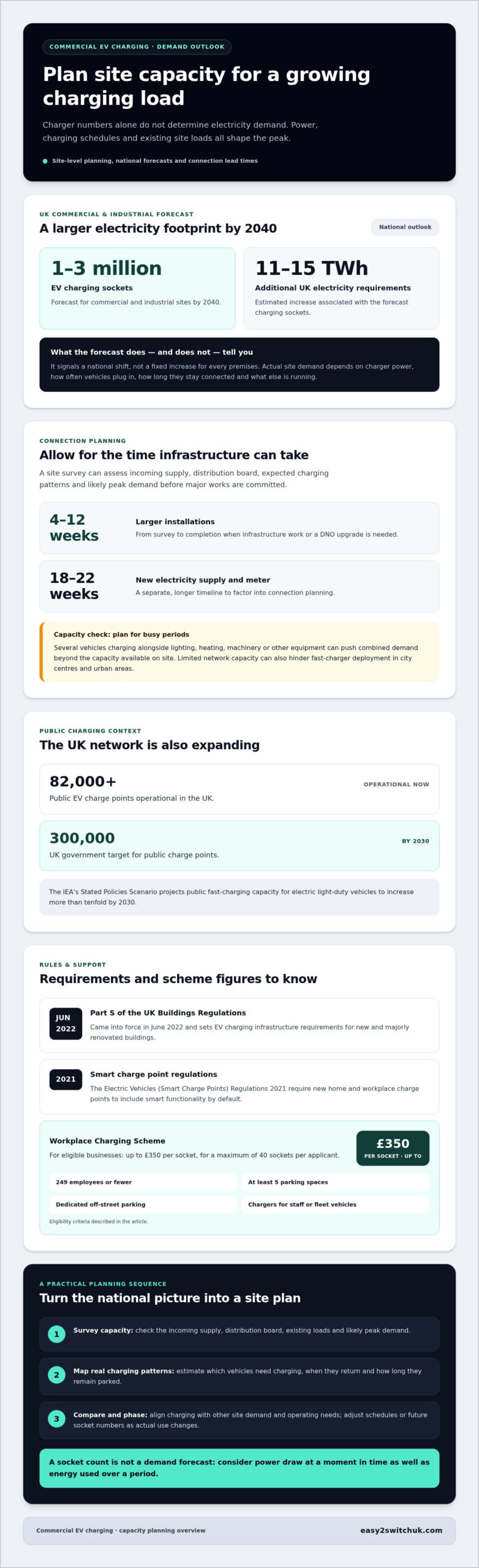
- Commercial and industrial sites are expected to have 1-3 million EV charging sockets by 2040, adding an estimated 11-15 TWh to UK electricity requirements.
- Match charging schedules to how your business operates. Smart charging and off-peak use can help manage demand rather than letting chargers create avoidable peaks.
- Consider how a short period of high power demand can affect your electricity costs, and plan charging alongside your wider site load.
Assessing existing electrical capacity and infrastructure
Start with a site survey to identify existing capacity, likely peak demand and the infrastructure needed for planned chargers.
Grid Capacity and Peak Demand
Grid capacity is the electricity a site can draw while meeting its existing and additional loads. Chargers add demand alongside lighting, heating, machinery and other equipment, so available capacity matters as much as the number of charge points. A survey should assess the incoming supply, distribution board and expected charging pattern. Limited network capacity in city centres and urban areas can also hinder fast-charger deployment.
Plan for busy periods, not just average use. If several vehicles charge while other equipment is running, their combined load may exceed the capacity available on site. A supply or network upgrade may then be necessary.
Avoiding Unnecessary Upgrades
To avoid unnecessary upgrades, size charging infrastructure to the site’s actual electrical capacity and operating needs. A survey can establish whether the existing supply can support the planned chargers or whether the design needs adjusting. For example, a business where vehicles are parked for longer periods may not need the same charging setup as a site requiring rapid charging.
Compare the expected charging schedule with existing site demand before committing to major works. A phased installation can also align new infrastructure with actual business requirements. Larger installations that need infrastructure work or a DNO upgrade can take 4-12 weeks from survey to completion, while arranging a new electricity supply and meter can take 18-22 weeks.
UK rules depend partly on the building project. Part S of the UK Buildings Regulations came into force in June 2022, according to the UK Government, and sets requirements for EV charging infrastructure in new and majorly renovated buildings. The Electric Vehicles (Smart Charge Points) Regulations 2021 require new home and workplace charge points to include smart functionality by default.
For eligible businesses, the UK Workplace Charging Scheme offers up to £350 per socket, for a maximum of 40 sockets per applicant. The described criteria include 249 employees or fewer, at least five parking spaces, dedicated off-street parking, and chargers used by staff or fleet vehicles.
More than 82,000 public EV charge points are operational in the UK. The government target is 300,000 public charge points by 2030, while the IEA’s Stated Policies Scenario projects public fast-charging capacity for electric light-duty vehicles to increase more than tenfold by 2030. That growth makes early capacity planning useful, especially where urban network constraints affect connection options.
Forecast growth in commercial charging sockets and electricity demand
Commercial charging is expected to become a larger part of UK electricity use as EV adoption rises. Forecasts indicate that commercial and industrial sites could have 1-3 million EV charging sockets by 2040, adding an estimated 11-15 TWh to UK electricity requirements.
Those figures describe a broad national change, not a fixed increase in demand for every premises. A warehouse with fleet vehicles, a workplace car park and a customer-facing site will each use charging differently. The number of sockets alone does not show how much energy a business will consume. Charger power, how often drivers plug in and how long vehicles remain connected all shape actual use.
What the forecast means for business planning
The projected 11-15 TWh addition signals that electricity planning needs to account for transport alongside existing business loads. A site expecting to expand its fleet can consider charging demand within its wider energy forecast. For example, charging overnight may create a different load pattern from topping up vehicles during working hours, even if both sites have the same number of sockets.
Use the forecast as context, then relate it to your own operations. Estimate which vehicles need regular charging, when they return to the site and how long they stay parked. Compare those patterns with other electricity uses, such as production equipment or heating. This turns a national forecast into a practical picture of rising demand at your premises.
Demand, energy use and commercial opportunity
Electricity demand describes how quickly chargers draw power at a given time; energy use describes consumption over a period. Both matter. Several high-power chargers operating together can create a concentrated peak, while vehicles charging for longer periods may spread consumption throughout the day. This distinction explains why socket totals alone cannot predict a business’s electricity profile.
Charging may support customer service or fleet operations, while public-facing chargers can offer a potential revenue stream. The business case depends on utilisation, electricity costs, operating needs and the charging offer. Forecast growth does not guarantee income. It does, however, show why commercial sites should assess likely demand and the purpose of each socket before expanding.
Review the plan as operations change. Compare expected charging activity with actual use, then adjust schedules or future socket numbers accordingly. A growing fleet, longer opening hours or a new customer facility can change the pattern. The UK forecast of 1-3 million commercial and industrial sockets by 2040 provides a reason to plan ahead, while site-level demand should guide each decision.
OLEV grants can cover up to 75% of UK EV charging installation costs, capped at £350 per socket.
How workplace and customer charging can affect electricity demand
Charging adds electricity use and can change when a business draws power. The effect depends on charger rating, vehicle dwell time and other site loads.
Charging Demand and Peak Load
Peak load is the highest electricity demand a site reaches when its equipment and chargers operate together. It matters because simultaneous charging can create a sharper demand peak than vehicles charging at different times. A 24-hour supermarket with shift workers may see vehicles arrive throughout the day, unlike a traditional office with a concentrated arrival period.
A single 50 kW rapid charging unit could have the same impact on the electrical network as 25 gas-heated flats. This comparison shows why charger power and timing matter, not how much electricity every business will use. Several vehicles charging together can add to existing demand from lighting, refrigeration or machinery.
Effects on Electricity Bills and Charges
EV charging can increase bills through the electricity consumed. Standing and network charges depend on the supply arrangement and applicable tariff. A standing charge is generally a fixed charge for maintaining the supply, so additional charging does not automatically increase it. Changes to a connection or tariff can affect charges.
Network-related costs may also reflect a site’s peak demand. Some EV charging demand charges use the highest power draw during an interval as short as 15 minutes. A single peak charging event can therefore affect demand charge costs for the billing cycle. Businesses should distinguish energy-use charges from standing and demand-related charges when reviewing bills.
Workplace Charger Electricity Use
A charger’s daily electricity use depends on how long it operates and how much power it delivers. Multiply its power rating in kilowatts by charging hours to estimate energy in kilowatt-hours; for example, a 7 kW charger operating at full power for one hour uses 7 kWh.
Annual use depends on operating days, vehicle charging needs and how often chargers are used. A charger’s rating alone cannot provide a meaningful daily or yearly total. Comparing actual charging sessions with the charger’s maximum rating gives a clearer estimate for a workplace with staff vehicles or a customer car park.
Charger Type and Power Rating
Power rating indicates how quickly a charger can draw electricity, so higher-powered units can create greater demand while operating. A 3.6 kW charger draws less power at a time than a 7 kW or 22 kW unit. The right comparison depends on the time vehicles remain parked and how quickly they need to recharge.
A 50 kW rapid charger can deliver substantial power over a shorter charging period. For a site with several vehicles, charger type influences both the combined peak and the timing of electricity use. Consider expected dwell times alongside vehicle needs, rather than choosing charging stations by rating alone.
Smart charging and off-peak electricity use
Smart charging shifts an electric vehicle’s charging time or power to better fit site demand. Instead of every vehicle charging at full power as soon as it arrives, a business can coordinate sessions around operating needs and available capacity. That can help smooth demand peaks while still preparing vehicles for their next journey.
The Electric Vehicles (Smart Charge Points) Regulations 2021 require new home and workplace charge points in the UK to include smart functionality by default. For businesses, smart charging can help make charging operationally manageable: fleet vehicles can be prioritised for earlier departures, while vehicles parked longer can charge later. The aim is to coordinate electricity use, not simply delay every session.
Shift charging to match site demand
Map vehicle arrival and departure times against the site’s busiest electricity periods. For example, an office can schedule staff vehicles to charge later if they remain parked through the afternoon. A depot can prioritise vehicles leaving first, then allocate remaining capacity to those staying longer. This links charging decisions to real operational needs.
Smart charging can also limit simultaneous charging. If several vehicles plug in together, a control system can stagger sessions or adjust charging power, potentially reducing the combined load at a particular moment. Set priorities according to departure times, required charge and existing site use, rather than treating every connected vehicle the same.
Make off-peak use work for the business
Off-peak charging shifts electricity use to periods when demand or the applicable tariff is lower. A fleet returning in the evening, for instance, may be able to charge overnight before the next working day. The practical benefit depends on vehicle availability, business hours, tariff terms and whether the site can control charging times.
Shifting charging to a lower-demand period can help avoid adding to a daytime peak, but it won’t automatically reduce every bill. Compare the tariff’s time bands with vehicle schedules and other site loads. If vehicles must leave before an off-peak period ends, charging priorities need to account for that constraint.
Effective demand management strategies can reduce total energy costs by 20% to 40% for EV charging networks. This figure describes charging networks, not a guaranteed saving for each business. The result depends on how charging is managed and the energy costs involved. A business can track charging patterns, identify overlapping sessions and adjust schedules as its fleet or operating hours change.
Review the plan against actual use. Compare charging sessions with departure requirements and site demand, then revise priorities if vehicles are ready too early or charging overlaps with busy operations. Smart controls and off-peak periods work best as part of one operational plan: vehicles get the charge they need, while charging activity fits the business’s electricity profile.
Planning charging around business electricity demand
Plan charging as part of the site’s overall electricity profile, not as a separate load. Growing EV use can increase demand when heating, production or customer operations already draw power. A useful plan connects vehicle schedules, charger use and tariff structure, then considers how each affects daily operations and electricity costs.
Typical UK business electricity prices for EV charging in the guide range from 20p/kWh to 45p/kWh. The cost of charging at a particular premises depends on its tariff, energy use and applicable standing and network charges. To estimate running costs, multiply the electricity used for charging by the unit rate, then account for other charges shown on the bill.
Plan against the site’s real operating pattern
Start with a representative operating schedule. Record when vehicles arrive, when they must leave and which journeys take priority. Then compare those periods with existing site demand. A depot with early departures may need vehicles ready before the working day, while a workplace with longer parking periods can spread charging across more hours.
Account for seasonal and operational changes. For example, adding vehicles or extending opening hours may create a different demand profile. Review charger activity alongside the site’s electricity use, rather than treating socket numbers as a direct measure of consumption. This helps distinguish regular charging needs from occasional peaks.
Consider peaks, tariffs and network constraints
Check how the electricity tariff treats energy use and peak demand. Demand charges can use the site’s highest power draw during an interval as short as 15 minutes, and one peak charging event can affect charges for the billing cycle. Scheduling sessions around other major loads can therefore matter, especially where vehicles tend to plug in together.
Consider the local network too. Limited capacity in city centres and urban areas can hinder fast-charger deployment, while connection work may affect project timing. If the planned charging load exceeds the site’s available capacity, adjust charger power or schedules before settling on infrastructure changes. Keep future demand in view, but base the initial design on actual vehicle and business requirements.
Use a simple review cycle: compare charging sessions with departure needs, check electricity bills for demand patterns, and revise schedules when operations change. This turns the impact of EV charging points on business electricity demand into a manageable planning question, rather than an assumption based on charger count alone. For help reviewing business energy contracts alongside a charging plan, compare business energy options with Easy2switch UK Ltd.
Integrate this planning into an ongoing part of site management. A traditional 9-5 office may have different charging requirements from a business operating extended hours, so schedules should reflect when vehicles are actually on site and when they are needed. Revisit those requirements as operating patterns change.
Easy2switch UK: Farm Energy Brokerage
Easy2switch UK Ltd helps businesses review electricity and gas contracts through its Business Energy Brokerage. If you’re planning EV charging or your electricity use is changing, the brokerage can help you compare supplier offers and manage the switching process. Farms can use Farm Energy Brokerage, while charities can access Charity Energy Brokerage.
Energy contracts are one part of the planning picture. Charger capacity, charging schedules and site infrastructure still shape how much electricity your premises needs. Reviewing your contract as demand changes can help you make an informed choice for your organisation’s energy supply.
For support with business energy contracts, contact Easy2switch UK Ltd or visit easy2switchuk.com.
Make your next energy decision with confidence
The impact of EV charging points on business electricity demand is not a one-off calculation. As your fleet, operating hours or charging arrangements change, your energy needs can change too. Treat each change as a prompt to review whether your electricity contract still fits the way your organisation uses power.
That review can sit alongside your wider charging plans. Easy2switch UK Ltd offers Business Energy Brokerage for businesses, Farm Energy Brokerage for farms and Charity Energy Brokerage for charities. Reviewing supplier options can help you make an informed decision about your energy contract as your operations develop.
Take the next step when you’re ready. Contact Easy2switch UK Ltd today to discuss your organisation’s energy requirements.
Frequently Asked Questions
How can smart charging and load management reduce peak demand and electricity costs?
Smart charging can stagger vehicle sessions or cap their power so chargers don’t all draw at full capacity at once. For example, a site can prioritise vans leaving early and schedule vehicles staying overnight later. Load management can also coordinate charging with existing equipment use. To assess cost effects, compare the tariff’s time bands and demand-related charges with the revised charging pattern, rather than assuming that shifting sessions will always lower bills.
How can businesses assess local capacity, site suitability and charger demand before installation?
Begin with a site survey of the incoming supply, electrical distribution equipment and proposed charger locations. Then map vehicle arrival times, departure deadlines and charging needs against existing electricity use. To assess local network capacity, identify whether the proposed connection or increased load needs input from the distribution network operator. This helps distinguish a premises constraint from a wider network constraint before finalising the installation design.
What are the risks of adding EV charging points to a business electricity supply?
The main risks are increased electricity consumption, sharper demand peaks and a mismatch between charger availability and vehicle schedules. If the premises or local network cannot support the planned load, connection work or infrastructure upgrades may be needed, affecting project timing. A poorly matched tariff can also make charging more costly than expected. Reduce these risks by aligning charger power and schedules with vehicle use, existing loads and contract terms.
