
What if your loyalty to a standard variable tariff is costing you an extra £238 a year by the time the April 2026 price cap takes effect? It’s frustrating when you’re staring at a bill trying to decipher why standing charges are rising while unit rates fluctuate. You shouldn’t need a degree in energy economics just to compare gas and electric rates for your home, farm, or business.
We understand that the fear of hidden exit fees and the time-consuming nature of manual comparisons keep 65% of UK bill-payers stuck on overpriced plans. This guide provides a clear framework to master the 2026 energy market, helping you secure price certainty through a bespoke fixed-rate deal. We’ll break down the latest Ofgem regulations and show you how to achieve a lower monthly bill through a seamless, “done-for-you” switching experience that puts you back in control of your utility costs.
Key Takeaways
- Navigate 2026 price volatility by understanding the difference between the “loyalty tax” and the financial benefits of active market engagement.
- Learn how to accurately compare gas and electric by decoding your kWh consumption, standing charges, and the latest price cap regulations.
- Evaluate whether a dual fuel discount or a fixed-rate tariff provides the best long-term security and cost-efficiency for your specific household or business needs.
- Use our actionable 2026 checklist to simplify the data-gathering process and ensure a seamless, stress-free transition between energy suppliers.
- Discover how a specialist broker can provide a bespoke “done-for-you” service that secures better rates for farms and complex commercial properties than standard comparison sites.
Why Comparing Gas and Electric is Essential in 2026
The 2026 energy landscape is defined by a new kind of stability, yet it remains far more expensive than the pre-2022 era. While the extreme price spikes of the mid-2020s have subsided, wholesale volatility still impacts your monthly outgoings. For residents in Worcester, the ability to compare gas and electric prices is no longer just a way to save a few pounds; it’s a necessary strategy to protect your household budget from sudden market shifts.
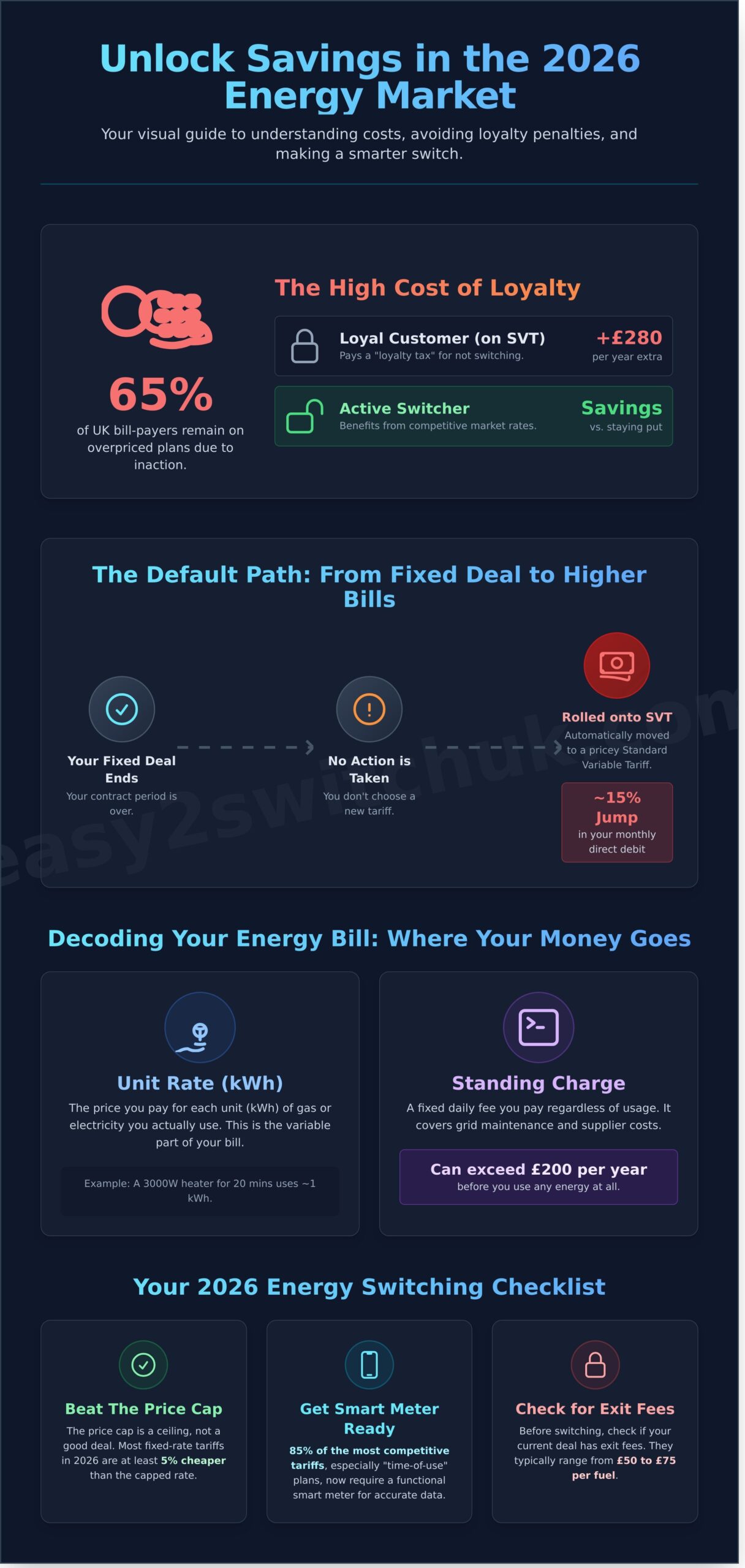
Recent figures from the January 2026 price cap announcement highlight that while the market has stabilized, the average annual bill remains 30% higher than 2020 levels. The UK energy market continues to face pressure from global supply chains, even as domestic renewable generation hits record highs of 48% of the total mix. Staying with a single provider for years often leads to a “loyalty tax,” where long-term customers pay roughly £280 more per year than those who actively switch. Taking control of these overheads provides peace of mind and ensures you aren’t subsidizing the cheaper rates offered to new customers. We believe in transparency and empowerment, giving you the tools to see exactly where your money goes.
The Cost of Inaction: What Happens if You Stay Put?
If you don’t act when your current fixed-term contract ends, your supplier will move you onto a Standard Variable Tariff (SVT) or a “deemed rate” automatically. These tariffs are usually set at the maximum limit allowed by the price cap, which is currently averaging £1,850 for a typical dual-fuel home in 2026. Rolling off a fixed deal without a plan can result in an immediate 15% jump in your monthly direct debit. Suppliers rarely offer their most competitive bespoke rates to existing customers without a prompt. This makes it vital to compare gas and electric options at least 30 days before your contract expires. Passive consumers are the most profitable for big energy firms, while active switchers enjoy the benefit of market optimization and lower margins.
2026 Market Trends: What to Watch For
The 2026 market is seeing a massive shift toward “time-of-use” tariffs, particularly for electric users with smart meters. These tariffs offer lower rates during off-peak hours when renewable energy is plentiful. Wholesale gas prices still influence 60% of retail costs, but the rising role of green energy levies means that pricing structures are more complex than they were five years ago. Understanding these trends helps you choose a plan that aligns with your actual usage patterns. Optimization of your utility spend requires looking beyond the headline price to find a tariff that rewards your specific habits. Whether it’s charging an EV or running appliances overnight, the 2026 market offers specialized solutions for those willing to look. Our goal is to make this process seamless and hassle-free, removing the confusion of technical jargon.
- Price Cap Awareness: The cap is a ceiling, not a target. Most fixed deals in 2026 now beat the cap by at least 5%.
- Smart Meter Benefits: 85% of the most competitive tariffs now require a functional smart meter for data accuracy.
- Exit Fees: Always check if your current 2026 contract has exit fees, which typically range from £50 to £75 per fuel.
Understanding the Components: Unit Rates, Standing Charges, and the 2026 Price Cap
Your energy bill is more than just a final total at the bottom of the page. It’s built on two primary pillars: the unit rate and the standing charge. The unit rate is measured in kilowatt-hours (kWh). This represents the actual energy you consume. For context, running a 3,000W immersion heater for 20 minutes uses roughly 1kWh. When you look at your statement, the unit rate tells you exactly what you’re paying for every hour of power or gas you use.
Standing charges are different. These are fixed daily costs that cover the maintenance of the national grid and the physical pipes supplying your Worcester home. You pay this fee regardless of whether you turn on a single light. During 2024, these charges have been a point of contention, with some electricity standing charges exceeding 60p per day. This means you could spend over £200 a year before you’ve even boiled a kettle.
Understanding the 2026 Price Cap is vital because it sets a ceiling on what suppliers can charge for these components. The 2026 Price Cap is a limit on the maximum price per unit of energy and the daily standing charge, not a cap on your total annual bill. If your household consumption is high, you’ll still pay more than the headline “cap” figure mentioned in national news reports. Most residents in the UK opt for dual-fuel plans, where gas and electricity come from one provider. While this is convenient, it’s still smart to compare gas and electric rates individually to see if the bundle truly offers the best value.
Decoding Your Energy Bill
Flip to the second page of your statement to find your “Annual Consumption” figures. This data is the most accurate tool for a comparison because it accounts for seasonal spikes. Relying on “estimated” readings rather than “actual” readings can lead to significant debt or overpayment. If you don’t have a smart meter, providing a manual reading today ensures your next quote is based on reality rather than a guess. The 2026 Price Cap is a limit on unit rates, not total bills.
Unit Rates vs. Standing Charges: Which Should You Prioritise?
Your usage profile dictates your strategy. If you live in a small apartment and use very little energy, a tariff with a low standing charge is often better, even if the unit rate is slightly higher. For large families with high consumption, the unit rate is the priority. A difference of just 2p per kWh can result in an extra £230 on a typical gas bill of 11,500 kWh. It’s a calculation that makes a real difference to your monthly disposable income.
Farms and local businesses face a different reality. They often deal with kVA capacity charges and half-hourly metering, which makes their bill structures more complex than a standard domestic setup. To find your “effective rate,” divide your total monthly bill by the number of units used. This gives you a clear, honest picture of what you’re really paying. It’s a simple way to compare gas and electric offers without getting lost in the technical jargon. Taking five minutes to check these figures now can prevent hundreds of pounds in unnecessary costs over the next year.
Strategic Comparison: Dual Fuel vs. Single Fuel and Fixed vs. Variable
Choosing the right energy structure is just as vital as finding a low unit price. You need to weigh the administrative ease of a single provider against the financial gains of splitting your utilities. When you compare gas and electric options side-by-side, the best choice for your Worcester home or business depends on your specific consumption patterns and your tolerance for market shifts.
Is Dual Fuel Still the Best Option?
Most UK households stick with one supplier for both fuels. It’s straightforward. You manage one account, one direct debit, and one point of contact. In 2026, dual fuel discounts typically average around £35 annually. This is a modest incentive for your loyalty. However, the “cheapest rate” reality is often different. Market data from early 2026 shows that 14% of consumers could save an additional £65 by sourcing gas and electricity from different providers.
Taking the time to compare gas and electric rates separately is particularly beneficial if you have a high-demand appliance like an electric vehicle or a heat pump. In these cases, a specialist electricity tariff might save you more than a dual fuel discount ever could. You should consider splitting your suppliers if the individual savings on each fuel outweigh the convenience of a single bill. It’s a simple calculation of time versus money.
Fixed vs. Variable in a 2026 Economy
Variable tariffs offer maximum flexibility. You aren’t tied down by a long-term commitment. These rates follow the official Ofgem price cap explanation, which adjusts every three months based on wholesale costs. This is an excellent choice if you believe energy prices will drop in the coming months. You can leave at any time without paying a penny in exit fees.
Fixed-rate tariffs provide a different kind of value: certainty. By March 2026, fixed deals have become the primary tool for budget stability in a fluctuating market. You lock in a price for 12 or 24 months. While you might pay a small premium today, you’re shielded from sudden winter price spikes. For a local Worcester charity or a small business, this predictability is essential. It prevents a sudden £250 jump in monthly outgoings during a cold snap. You aren’t just “locked in”; you’re protected. Current exit fees for these deals average £75 per fuel, so ensure your projected annual savings exceed that figure before signing.
Bespoke contracts are the gold standard for Worcestershire’s agricultural sector and larger commercial enterprises. An “off-the-shelf” tariff rarely suits a dairy farm with high-voltage machinery or a manufacturing plant with 24-hour operations. Standard rates don’t account for the unique kVA requirements or seasonal peaks of a working farm. Bespoke contracts use your actual consumption profile to build a custom rate. This tailored approach typically cuts 19% off the bills of local businesses compared to standard commercial rates. It ensures you only pay for the energy you actually need, when you need it.
- Dual Fuel: Best for simplicity and modest £30-£40 discounts.
- Single Fuel: Best for high-usage homes looking to shave an extra £60+ off bills.
- Fixed Rate: Essential for SMEs and charities needing 100% budget certainty.
- Variable Rate: Ideal for those who want to avoid exit fees and track market drops.
- Bespoke: The only viable option for farms and industrial units with complex loads.
Our team at Easy2switch UK Ltd handles these comparisons for you. We look at the data, analyze the 2026 market trends, and present a clear path forward. Whether you’re a homeowner in Barbourne or a business owner in the city centre, we ensure your energy structure matches your goals.
How to Compare and Switch Without the Stress: A 2026 Checklist
Energy management in 2026 is faster than ever. The industry-wide adoption of the 5-working-day switching guarantee has replaced the sluggish three-week waits of the early 2020s. This speed means you need your data ready before you begin the process. Start by gathering your Worcester postcode, the name of your current supplier, and your actual annual usage in kilowatt-hours (kWh). Relying on estimated monthly spends can lead to inaccurate quotes. Check your last four seasonal bills to find your total yearly consumption. If you’ve just moved to a new property, use the 2026 UK average of 11,500 kWh for gas and 2,700 kWh for electricity as your starting point.
When you compare gas and electric, the broker you select acts as your primary filter against market volatility. A reliable broker should provide access to at least 90% of the active UK retail market. They must also disclose their commission clearly. In 2026, reputable services use direct API links to supplier databases, which ensures the price you see on your screen remains valid for the duration of your application. This level of transparency eliminates the “price creep” that often frustrated consumers in previous years.
The Step-by-Step Switching Process
Step 1: Perform a comprehensive market search. Use a digital comparison tool or speak with a specialist to evaluate fixed-rate versus time-of-use tariffs. Focus on the unit rate and standing charge rather than the projected monthly payment. Step 2: Review the “Key Facts” sheet for every offer. This document highlights exit fees, which currently average between £50 and £85 per fuel. Step 3: Confirm your details and let the new supplier handle the heavy lifting. They’ll coordinate with your existing provider to ensure the 5-day transition occurs without a break in your energy supply.
Avoiding Common Switching Mistakes
Don’t overlook “hidden” administrative costs. Some budget tariffs now include a £15 annual surcharge for those who require paper statements instead of digital billing. It’s also vital to verify that your smart meter is SMETS2 compliant. While 96% of Worcester homes now have these updated units, older SMETS1 meters can occasionally lose “smart” functionality during a switch, requiring you to return to manual readings. Finally, remember your 14-day cooling-off period. This statutory right allows you to cancel any agreement without a penalty if you find a more competitive deal shortly after signing.
Finalizing the switch requires one last bit of admin on day five. Take a clear photo of your gas and electric meters and submit the readings to both your old and new providers. This prevents estimated final bills, which accounted for 18% of all customer complaints in 2025. Your previous supplier is regulated to return any credit balance on your account within 10 working days of the final bill being issued. This ensures your transition is financially clean and provides immediate peace of mind. If you’re unsure who currently supplies your property, our guide on how to find my supplier in 2026 can help you identify your energy provider before you begin the switching process.
Ready to find a better deal for your home? Compare gas and electric prices with our specialist team and start saving on your utility bills today.
Beyond the Algorithm: Why a Specialist Broker is Your Best 2026 Energy Ally
Automated comparison sites serve a purpose for the average residential flat, but they often struggle with the nuances of complex energy profiles. By 2026, the UK energy market is projected to be more data-driven than ever; however, algorithms still can’t account for the specific operational quirks of a local business or a rural estate. When you compare gas and electric through a standard portal, you’re often seeing a filtered selection of the market. These sites typically prioritize suppliers that pay for “featured” slots, which can hide smaller, more competitive providers that might offer better value for your specific postcode.
Easy2switch operates differently. We provide a “done-for-you” service that digs deeper than a simple web form. Our team analyzes your actual usage patterns to find bespoke contracts. We maintain relationships with over 30 suppliers, giving us access to hundreds of price points that aren’t always visible to the public. You won’t face any hidden fees either. Our service is entirely free for you because we receive a commission from the supplier you choose. This model ensures total transparency while keeping our interests aligned with yours: finding the lowest possible rate to secure your loyalty.
- Access to off-market rates from over 30 UK energy suppliers.
- Full management of the switching process, from notice of termination to new contract live dates.
- Direct contact with UK-based energy experts instead of automated ticket systems.
- Regular audits to ensure your 2026 renewals are handled before seasonal price spikes occur.
The limitation of a machine-led search is its inability to negotiate. If your business has multiple sites or a high-voltage connection, a standard algorithm will likely reject your application or provide an inflated “safety” quote. Our brokers speak directly to underwriters. We’ve seen cases where manual intervention saved clients up to 22% compared to the best price found on a generic comparison engine. This human element is what makes the difference between a standard deal and a truly optimized one.
Tailored Solutions for the Farming Industry
Agricultural operations face energy challenges that a city-based algorithm cannot comprehend. With over 100,000 farm holdings across the UK, the demand for high-capacity grain drying, refrigerated storage, and milking parlours creates volatile load profiles. A generic site won’t recognize that your peak usage happens at 4:00 AM. Our bespoke brokerage identifies these patterns to match you with a supplier that understands rural infrastructure. You can learn more about Saving Energy on Your Farm to see how we cut costs for local producers.
The Easy2switch Promise: Simple, Fast, and Seamless
Utility management shouldn’t be a second job. Our UK-based team provides a level of accountability that a chatbot simply cannot replicate. We handle the paperwork, resolve billing disputes, and monitor the market so you don’t have to. This proactive approach saved our clients an average of 18% on their annual bills in the last fiscal year. It’s about giving you back your time. You can Get a free energy review for your business or home today and let us handle the heavy lifting while you focus on running your life.
When you compare gas and electric with us, you’re not just looking at a screen; you’re partnering with a specialist who understands the Worcester landscape. We make sure your transition is seamless, ensuring that you never pay more than necessary for the power that keeps your world moving.
Take Control of Your 2026 Energy Strategy
Navigating the UK energy market requires more than a quick glance at a monthly bill. With the April 2026 Price Cap projections suggesting continued wholesale volatility, understanding the balance between unit rates and standing charges is vital. You’ve seen that dual fuel isn’t always the cheapest path; sometimes splitting your providers offers better value. It’s time to stop overpaying and start optimizing your household or business budget.
Easy2Switch UK brings a pragmatic approach to your utility management. As an independent UK-based consultancy, we provide specialist expertise for the farming and charity sectors where energy needs are often complex. We don’t just rely on a basic algorithm. Our specialists offer a free service with zero hidden fees to ensure you get a deal tailored to your specific usage patterns. When you compare gas and electric through our team, you’re gaining a reliable ally that understands the local landscape. We handle the paperwork and the stress so you can focus on what matters most. Peace of mind is just a conversation away.
Let our experts find your best energy deal for free
You’ve got the tools to lower your bills, and we’re here to make the transition seamless.
Frequently Asked Questions
Is it cheaper to have gas and electric with the same supplier in 2026?
Yes, opting for a dual fuel tariff often remains the most cost-effective choice in 2026. Most UK suppliers provide a dual fuel discount, typically ranging from £40 to £60 per year, for managing both accounts. However, you should still compare gas and electric prices separately; occasionally, picking two different providers can lead to lower overall costs if one has a particularly aggressive rate. We help you find the best fit for your specific Worcester household.
How much can I actually save by switching energy suppliers?
The average UK household can save approximately £280 per year by switching from a standard variable tariff to a fixed-rate deal. These savings depend on your Worcester postcode and current consumption levels. Since price differences between the cheapest and most expensive suppliers can exceed £350 annually, regular market reviews ensure you aren’t overpaying. It’s a simple way to regain control over your monthly household budget without changing your daily habits or routines.
What is the Ofgem energy price cap for 2026?
For the period starting January 2026, the Ofgem energy price cap is set at £1,742 per year for a typical dual-fuel household paying by direct debit. This cap limits the unit rate and standing charge that suppliers can levy on standard variable tariffs. It’s updated every three months, so checking the rate in April, July, and October is essential. The cap isn’t a total bill limit; your actual costs depend on your specific energy usage.
Can I switch energy suppliers if I am a tenant?
You have the legal right to switch energy suppliers if you’re responsible for paying the utility bills directly. This applies to 100% of tenants in the UK unless the landlord pays the supplier and charges you a bundled rent. While you don’t need your landlord’s permission to change, it’s polite to inform them. Check your tenancy agreement for clauses regarding returning the meter to the original supplier at the end of your lease agreement.
How long does it take to switch gas and electric providers?
Most switches now take just 5 working days to complete under the Energy Switch Guarantee. This industry standard ensures a fast, seamless transition between providers. Once you’ve chosen a new deal, your new supplier handles the entire process, including contacting your old provider. You have a 14-day cooling-off period to cancel the switch if you change your mind, providing total peace of mind throughout the process. It’s a hassle-free way to optimize your spending.
Will my energy supply be interrupted during a switch?
No, your energy supply won’t be interrupted at any point during the switching process. Both your gas and electricity will continue to flow through the same pipes and wires that currently serve your Worcester home. The only change you’ll notice is the name on your bill and the price you pay. It’s a purely administrative transfer that requires zero technical work or physical changes to your property’s infrastructure, ensuring your home remains warm and powered.
What information do I need to compare gas and electric prices?
To compare gas and electric accurately, you’ll need your Worcester postcode and a recent energy bill. The most important data points are your annual consumption in kWh or your monthly spend in pounds. Having your current supplier’s name and the name of your existing tariff helps calculate exact savings. If you don’t have a bill, we can estimate your usage based on the number of bedrooms and occupants in your home to provide a bespoke quote. If you’re unsure who your current provider is, read our step-by-step guide on how to find my supplier before starting your comparison.
Are there exit fees for switching energy tariffs?
Exit fees typically apply if you leave a fixed-term contract more than 49 days before its end date. These fees usually range from £25 to £50 per fuel, meaning a dual-fuel customer might pay £100 to switch early. You can switch without penalty during your switching window, which starts 49 days before your contract expires. Always check your latest statement to see if these charges apply to your current plan before making a move to a new provider.
