
B Corp certification is a whole-business framework for social and environmental performance, transparency and accountability, not a carbon label. Awarded by B Lab, it considers a company’s impact on workers, communities, customers and the environment. For energy procurement for B-Corp certified businesses, the practical connection is how energy choices can support environmental goals and strengthen the evidence behind them.
It’s understandable to want energy decisions to do more than manage bills. The right procurement approach can help align contract choices with your organisation’s purpose and carbon priorities, but it doesn’t replace emissions reporting or prove B Corp compliance on its own.
This article explains what B Corp certification involves, how it balances purpose with profit, and where energy use fits into environmental performance and net-zero planning. You’ll also learn how to treat procurement as one part of a credible ESG approach, while recognising what an energy contract can and cannot demonstrate.
Key Takeaways
- Understand how B Corp certification assesses a business as a whole, rather than certifying a product or acting as a standalone carbon label.
- See how stakeholder-focused governance can help a business balance commercial decisions with its social and environmental purpose.
- Connect energy use to wider emissions planning, including the supplier and customer impacts that may sit within Scope 3.
- Use clear, supportable environmental evidence to strengthen ESG communication and avoid overstating what an energy contract proves.
- Learn how procurement choices can support environmental priorities while remaining one part of a broader B Corp and carbon strategy.
B Corp certification
B Corp certification recognises businesses that meet standards for social and environmental performance, transparency and accountability. B Lab, a global non-profit, awards certification after assessing a company’s effects on people and the planet. It is a whole-business framework, not a carbon standard, climate label or product certification. That distinction matters: certified businesses still need relevant emissions reporting and evidence for other commitments.
UK business electricity and gas prices, standing charges and contract fees vary between organisations. Costs depend on factors such as energy use, site location, contract terms and market conditions. Compare the full contract structure, not just the quoted unit rate.
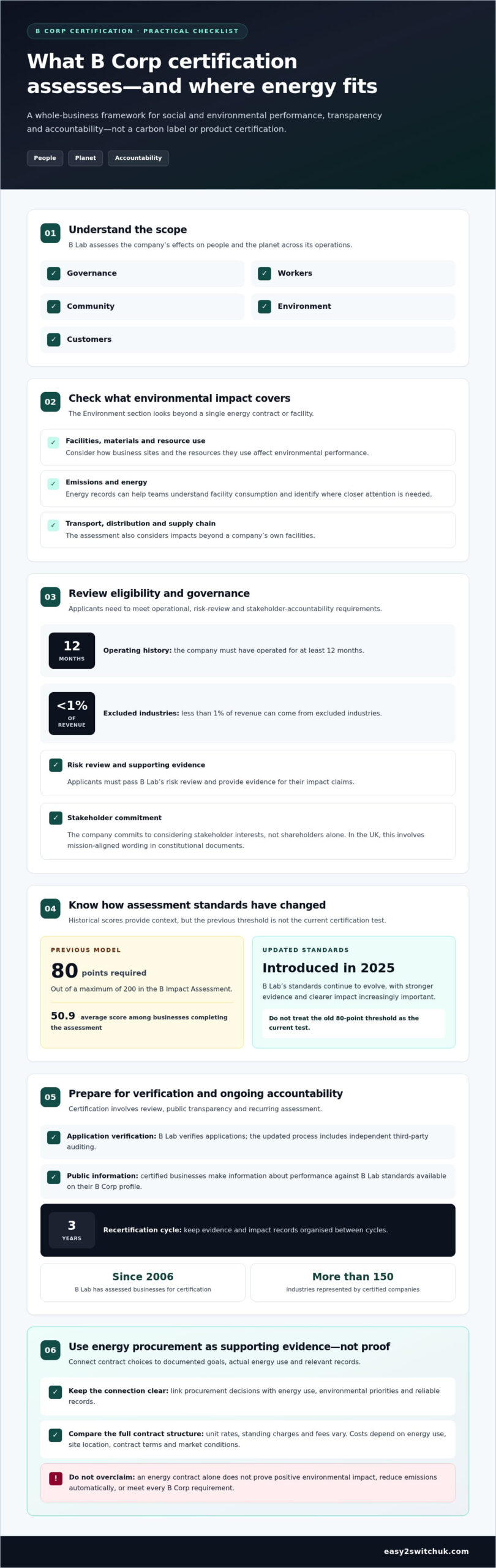
The B Impact Assessment is central to B Corp certification. It examines a company’s impact across governance, workers, community, environment and customers. In the Environment section, businesses consider facilities, materials, emissions, resource and energy use, transport, distribution and supply chain impacts. Energy records, for example, can help a business understand facility consumption and identify where its environmental performance needs closer attention.
The framework has changed over time. Under the previous model, businesses needed at least 80 points in the B Impact Assessment, which had a maximum of 200. The average score among businesses completing the assessment was 50.9 points. B Lab introduced new standards in 2025, so the old score threshold shouldn’t be treated as the current certification test. The standards continue to evolve, with stronger evidence and clearer impact increasingly important.
Eligibility and governance also shape the process. A company must have operated for at least 12 months, and less than 1% of its revenue can come from excluded industries. Applicants must pass B Lab’s risk review and provide supporting evidence for their impact claims. They also make a legal commitment to consider stakeholder interests, rather than shareholders alone. In the UK, this commitment involves mission-aligned wording in constitutional documents.
B Lab verifies applications before granting certification, and the updated process includes independent third-party auditing. Certified businesses must make information about their performance against B Lab standards publicly available on their B Corp profile. Recertification takes place every three years, making it useful to keep evidence and impact records organised between cycles. B Lab has assessed businesses for certification since 2006, and certified companies work across more than 150 industries.
For energy procurement for B-Corp certified businesses, the assessment provides a practical lens: connect contract decisions with energy use, environmental priorities and reliable records. A contract alone doesn’t prove positive environmental impact or meet every B Corp requirement. It can form part of a wider commitment when procurement choices align with documented goals and the business can explain their relevance to its facilities and supply chain.
Balancing profit with purpose
Purpose-led business does not mean setting commercial performance aside. B Corp certification asks organisations to connect business decisions with social and environmental responsibility while maintaining public transparency and legal accountability. In practice, consider who benefits from a decision, who could be affected, and how the choice aligns with stated policies. A climate commitment, for example, carries more weight when purchasing decisions and internal responsibilities support it.
UK company directors already operate within a legal framework. Under the Companies Act 2006, directors owe duties to promote the company’s success for the benefit of its members while having regard to specified stakeholders and the environment. B Corp certification adds a formal commitment to consider stakeholder interests, not only shareholder interests. That can help make purpose part of governance, rather than an informal ambition that changes with individual priorities.
Turn that commitment into decision-making criteria. When reviewing an energy contract, compare the financial terms with how the choice fits your climate policies and operational needs. Set out a clear rationale, such as why a particular contract supports the organisation’s energy strategy, without claiming it automatically reduces emissions. This keeps commercial and environmental objectives in view together.
Accountability also depends on who owns each decision. Finance teams may assess contract costs, operations teams understand site requirements, and sustainability teams track environmental goals. Agreeing responsibilities can prevent conflicting policies. For example, a procurement policy can ask decision-makers to record commercial considerations and relevant environmental criteria, then explain how they weighed them.
Transparency makes improvement easier to demonstrate. Record the goal, decision, evidence considered and outcome, then review whether the policy works in practice. If actual energy use differs from expectations, investigate operational changes rather than presenting the original decision as proof of success. Clear records also give employees and stakeholders a more accurate account of progress.
Purpose needs to withstand commercial pressure. If a lower-cost option conflicts with an environmental priority, document the trade-off and the reasoning behind the final choice. If a preferred option costs more, assess its operational value and fit with the organisation’s commitments before deciding. This avoids treating every environmental choice as automatically positive, while making the business’s priorities visible and open to review.
For energy decisions, a practical next step is to set procurement criteria that reflect both business needs and stated commitments. A structured approach to energy contract choices can help frame the commercial comparison; the organisation remains responsible for assessing its broader climate impact and reporting it accurately.
Carbon reduction and net-zero targets
B Corp climate transition plans should align with limiting global warming to 1.5°C. For a business, that means connecting its climate ambition to practical changes across operations, energy use and relevant suppliers. A target becomes more useful when teams can explain what it covers, which actions support it, and how progress will be assessed.
The UK’s net-zero emissions target is 2050, but an organisation’s own pathway needs nearer-term actions too. Start by identifying major sources of emissions and the business activities behind them. For a company operating several sites, compare energy use across facilities and investigate differences in operating hours, equipment or building use. This gives sustainability planning a practical starting point, rather than relying on a distant end goal alone.
Energy procurement is one part of the journey, not a complete carbon-reduction plan. Contract terms and supplier choices can shape how a business manages energy purchasing, but a contract does not by itself establish lower emissions. Keep procurement records alongside energy-use information, then assess whether each decision supports the organisation’s climate objectives. Separate documented actions from intended outcomes to keep reporting accurate.
For larger companies, Scope 3 emissions include emissions generated by suppliers and customers. That wider boundary can make supply-chain engagement relevant to carbon planning. For example, a business might review how purchased goods or outsourced activities relate to its climate priorities. Energy records can inform the facilities picture, while supplier information helps build a broader assessment. Avoid treating one energy decision as evidence for emissions across the entire value chain.
A useful review can connect target, action and evidence:
- Target: State the climate outcome the business is working towards and its relationship to the 1.5°C-aligned transition plan.
- Action: Record the operational or procurement change intended to support that outcome.
- Evidence: Keep the relevant contract, consumption information or supplier data together.
- Review: Compare later evidence with the original position and identify the next improvement.
This structure helps distinguish verified progress from plans still in development. It also clarifies responsibilities: facilities teams can track site energy, procurement teams can document contract decisions, and sustainability teams can bring relevant evidence into the wider assessment. A community-facing organisation, for instance, can explain how facility management contributes to its climate work without claiming that procurement alone delivers its full target.
During each review, check whether the organisation’s policies, operations and available evidence still support its stated direction. If a site’s use changes, revisit the assumptions behind its energy data. If a supplier relationship affects Scope 3 reporting, include that connection in the assessment. These steps make carbon planning more specific, support transparent communication, and link everyday energy decisions with broader environmental and standards of social responsibility.
ESG credentials and brand trust
ESG credibility depends on whether public claims match a company’s practices and evidence. A B Corp profile gives stakeholders access to information about performance against B Lab’s standards. That transparency can help customers, workers and business partners understand the organisation’s stated impact. It does not automatically verify every environmental claim, so precise wording and supporting records still matter.
Use the impact assessment to organise evidence, not as a blanket endorsement of every activity. For example, when discussing emissions, distinguish measured energy use from estimates, planned reductions and completed improvements. This helps readers see what the organisation has done and what remains part of its journey. It also reduces the risk of presenting an ambition as a proven result.
Energy decisions can provide useful evidence, especially when records connect a contract or procurement choice with the relevant site and business objective. A company might explain that it reviewed its energy arrangements as part of a broader environmental programme. It should not imply that a contract alone proves lower emissions or delivers B Corp certification. Clear boundaries make ESG communication more credible.
Consistency matters across audiences. Customers may want to understand a product’s environmental impact, while workers may look for meaningful action behind internal commitments. Suppliers may need clear information about emissions expectations. Tailor each explanation to its audience, but keep the underlying facts consistent. For instance, use the same reporting period and definitions when describing energy data in an impact report and a customer response.
Certified B Corps need to publish an annual impact report between certification cycles. They must also make information about performance against B Lab’s standards publicly available on their B Corp profile. Treat these channels as part of an ongoing accountability process. A useful report links each claim to evidence, explains changes in practices, and identifies the next improvement without overstating progress.
Before publishing an ESG statement, review its evidence trail:
- Define the claim: Say whether it describes a measured result, a current practice or a future commitment.
- Match the evidence: Use records that relate directly to the claim, such as relevant energy data for a facilities statement.
- Explain the boundary: Clarify which sites, activities or emissions the statement covers.
- Keep it current: Align public wording with the latest impact assessment and reporting period.
These checks help businesses communicate positive change without implying that one credential covers every ESG issue. B Corp certification doesn’t replace separate carbon reporting, customer-specific disclosures or sector standards. For example, a tender requesting emissions figures still requires a response tailored to that request. Clear boundaries build trust by helping readers distinguish B Lab’s whole-business framework from other reporting needs.
Global audiences may use different ESG terminology, but evidence remains the practical anchor. Connect each claim to a specific business practice, explain what it demonstrates, and state what action comes next. This helps stakeholders assess progress towards environmental goals while preserving accountability across the organisation.
Energy procurement and B Corp certification
Energy procurement connects operational needs with a business’s social and environmental mission. For B Corps, the aim is to make contract choices that support governance and stakeholder priorities without overstating their impact.
Business Energy Contract Structures
Fixed contracts set agreed rates for a defined term, flexible contracts allow purchasing decisions over time, and multi-site contracts manage energy across several locations. The right structure depends on consumption patterns, budget priorities, risk appetite and how consistently sites operate. Compare contract terms with the organisation’s mission and practical requirements, rather than assuming one structure suits every business. For multiple sites, consider whether different usage profiles call for separate arrangements.
Renewable Electricity and Verification
Renewable electricity procurement means choosing a supply arrangement that makes a renewable-source claim, then examining the evidence behind it. Ask for relevant certificate details, including issuer, generation source, volume and period, and how the attributes relate to your purchased electricity. Request the emissions reporting method and its boundaries too. These records help sustainability teams explain what the procurement demonstrates without treating a renewable tariff as proof of wider emissions reductions.
Assessing Supplier Sustainability Claims
Assess a supplier’s sustainability claims by matching each statement to specific evidence and a clear reporting boundary. Ask what the claim covers, which generation or emissions data supports it, and whether the information relates to your contract. Be wary of broad phrases such as “green energy” without supporting detail. Renewable tariffs, power purchase agreements and broker arrangements can have different terms and risks, including price exposure, contract complexity and unclear responsibilities. Read the relevant terms and identify who carries each obligation.
Tendering and Contract Negotiation
A tender is a structured comparison of supplier proposals against the business’s energy needs and procurement criteria. First, gather site details, usage records, contract dates and decision priorities. Then request comparable offers, review unit rates, standing charges, contract terms and sustainability evidence, and negotiate points affecting cost, flexibility or reporting. Before signing, check the obligations and exit terms. Reduce demand by reviewing operating practices and energy use. Assess on-site solar or battery storage separately against site suitability, expected use, investment requirements and how each option complements purchased supply, drawing on insights from energy storage infrastructure specialists such as Foton Energy (Foton Pty Ltd) to understand equipment viability and performance.
For B Corps, the comparison should reflect operational needs and stakeholder commitments. A broker can help compare supplier offers. Clarify how the broker is remunerated and what role it takes in the process. Renewable tariffs and power purchase agreements also differ in structure, so assess their specific pricing, duration, volume and delivery terms. No single contract proves progress towards the organisation’s full climate mission.
For support comparing business supply offers, explore Business Energy Brokerage as one practical part of your procurement process.
Easy2switch UK Ltd: Farm Energy Brokerage
Easy2switch UK Ltd helps purpose-led organisations compare business energy contracts through its Business Energy Brokerage. It also offers Farm Energy Brokerage and Charity Energy Brokerage. These services can help when your organisation wants support reviewing electricity or gas supplier offers and managing a switch.
The brokerage compares supplier offers and supports the switching process. Easy2switch UK Ltd earns commission from the energy supplier a customer chooses, so this is useful context for your procurement decision. Energy purchasing can support wider environmental aims, while B Corp assessment and emissions reporting remain part of your organisation’s responsibility.
If you’re ready to discuss your organisation’s energy procurement, contact Easy2switch UK Ltd.
Put your purpose into your next energy decision
Make your next procurement review a practical expression of your organisation’s priorities. Set out the commercial factors that matter, identify the environmental evidence you need, and keep a clear record of how you reached your decision. This gives your team a useful basis for assessing future contracts and explaining choices to stakeholders. Energy procurement for B-Corp certified businesses works best as part of this wider, evidence-led approach, not as a substitute for your organisation’s own climate planning or reporting.
Easy2switch UK Ltd offers Farm Energy Brokerage, Business Energy Brokerage and Charity Energy Brokerage to help organisations compare energy supplier offers. If a contract review is your next step, contact Easy2switch UK Ltd today to discuss your energy procurement needs. A clear process can help you take greater control of purchasing while keeping your purpose in view.
Frequently Asked Questions
What is B Corp certification?
B Corp certification is a whole-company certification awarded by B Lab to businesses that meet social and environmental standards. It assesses governance and the organisation’s effects on workers, communities, customers and the environment, rather than approving a single product. Applicants support claims with evidence and commit legally to considering stakeholders. In the UK, certification therefore involves operational practices and governance, not simply adopting a sustainability label.
What are the practical considerations?
Match contract structure to energy use, site needs and appetite for price risk. Gather bills, meter details, renewal dates and site information before comparing proposals. Review unit rates alongside standing charges, termination terms, volume commitments and broker remuneration. If a fixed contract is active, account for exit fees before switching, as savings may outweigh early-termination costs. For sustainability claims, request source and emissions documentation that matches the purchased energy and reporting period.
What energy procurement options are available to B Corp certified businesses in the UK?
UK businesses can compare fixed or flexible supply contracts, as well as arrangements covering multiple sites. Renewable electricity tariffs and power purchase agreements are other procurement routes, while on-site solar or battery storage can complement purchased energy. Contract terms affect price exposure and purchasing control; generation and storage depend on site suitability, demand patterns and investment requirements. Compare the overall arrangement, not its label alone.
How can energy procurement support B Corp standards and improve a company’s B Impact Assessment score?
Energy purchasing can support the Environment section of the B Impact Assessment by providing evidence about facilities, energy use, emissions management and supplier impacts. Record the reasons for procurement choices, the supporting data and how the organisation tracks energy use. The assessment considers the whole company, so a contract alone does not increase a score. Documented practices and outcomes are more meaningful than a renewable label by itself.
