
The date that matters most may be the end of your current contract, not the first day of term. Energy contracts for independent schools can be timed to start with the academic year, but the switch needs to fit the existing agreement. If the dates do not line up, the school may move onto an interim rate, depending on when the current contract ends.
It is understandable to want predictable costs and a contract that fits the school calendar. But timing is only part of the decision: contract length, notice terms and purchasing arrangements also affect your flexibility.
This guide explains how to plan contract dates, what to look for in break clauses, and how schools and trusts can approach purchasing. It also compares full and partial tendering, so you can see which route may suit your organisation and what to consider before making a decision.
Key Takeaways
- Schools and trusts in England aren’t required to join Energy for Schools and can use alternative procurement arrangements, including brokers.
- For the April 2027 basket, submit the required information before 26 October 2026; the deadline to join is 6 November 2026.
- Compare contract length, break clauses and notice terms to understand how much flexibility your school or trust has.
- Set your purchasing strategy ahead of October changes, then decide whether a full or partial tender best fits your procurement needs.
Ready to discuss Energy for Schools and Multi-Academy Trusts?
Schools and trusts in England can choose Energy for Schools or alternative procurement arrangements, including brokers. Their decision should reflect site needs, contract dates and who approves the purchase.
Procurement and stakeholder involvement
Start by bringing together the business manager, finance lead, estates team and decision-maker. The finance lead can set budget priorities, while estates staff can explain meter arrangements, heating needs and usage patterns across school sites.
For a multi-academy trust, compare each site’s contract end date and energy needs before deciding whether to procure together or separately. For the April 2027 Energy for Schools basket, submit the required information before 26 October 2026, the strongly recommended date. The deadline to join is 6 November 2026.
Contract options and school energy needs
The Department for Education says schools and trusts in England are not required to participate in Energy for Schools and may use alternative procurement arrangements, including energy brokers. Terms depend on the chosen route and agreement, so compare contract duration, renewal timing and exit provisions before deciding.
Boarding schools may need to account for continuous heating, catering and residential demand. Sports facilities can have distinct usage patterns around pool heating, lighting or event schedules. Multi-site schools and trusts should map meters and contract dates by site, then assess whether a combined purchase suits each location’s needs.
Framework eligibility and contract protections
An independent school’s eligibility for a public-sector purchasing framework depends on the framework’s stated scope and admission criteria. Participation in Energy for Schools is not compulsory for schools and trusts in England; they may use alternative procurement arrangements, including brokers.
Before signing, review the written agreement’s rates, renewal process, notice period, exit terms, billing arrangements and any broker fees or commission. These details help you understand the terms of a business energy contract. For deemed or out-of-contract supply, identify how rates are set and the steps and timing for moving to an agreed contract.
Typical electricity and gas prices
There is no single typical 2026 electricity or gas price that applies to every independent school. A school’s quoted price depends on its location, consumption, meter profile, contract timing and chosen terms; the price is given after a quote request.
To manage demand, review meter data and operating schedules, then identify avoidable energy use in buildings and facilities. Assess whether energy-efficiency improvements, solar panels or battery storage suit the site’s usage and available space. Compare expected generation or storage with the school’s demand profile before investing.
Contract lengths and break clauses
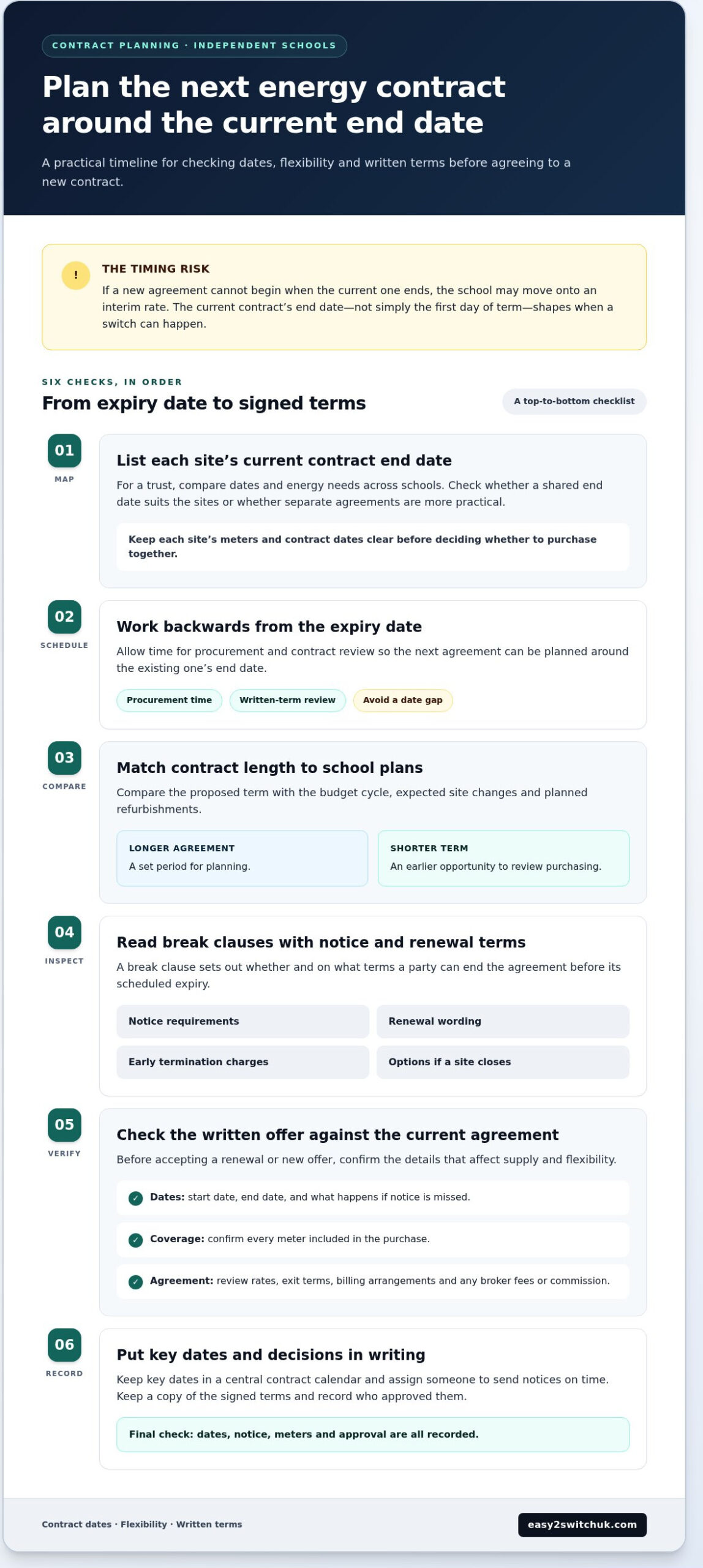
The current contract’s end date shapes when a school can move to a new supplier. If the next agreement cannot begin when the existing one ends, the school may move onto an interim rate. Map each site’s end date first, then work backwards to allow time for procurement and contract review.
Contract length affects budget planning and flexibility. A longer agreement gives you a set period for planning, while a shorter term may bring an earlier opportunity to review purchasing. Compare the proposed length with the school’s budget cycle, expected site changes and planned refurbishments. For a trust, check whether each school’s needs support a shared end date or separate agreements. These factors help align energy contracts for independent schools with practical operating needs.
A break clause explains whether, and on what terms, a party can end an agreement before its scheduled expiry. Read it alongside notice requirements, renewal wording and any early termination charges. Record key dates in a central contract calendar and assign someone to send notices on time. For example, a school planning a site closure should check whether its agreement allows supply changes or termination.
Before accepting a renewal or new offer, compare the written terms with the current agreement. Confirm the start and end dates, what happens if notice is missed, and whether the contract covers every meter included in the purchase. Keep a copy of the signed terms and record who approved them. When comparing energy contracts for independent schools, these details help business managers and trust finance teams spot mismatched dates before they affect supply arrangements.
For schools reviewing their next agreement, business energy contract options can be considered alongside contract dates and exit terms.
Developing a purchasing strategy
A clear strategy links the contract choice to the school’s budget priorities and energy use. Compare purchasing routes before October changes affect procurement decisions.
Comparing contract types
Fixed contracts set agreed prices for a defined term, helping schools plan around known unit rates. Flexible contracts allow purchasing decisions at different points, which may suit organisations seeking to manage market exposure. Variable contracts can change under the supplier’s terms, so review how and when rates may move.
Compare each option against your school’s appetite for price movement, need for budget certainty and capacity to oversee decisions. A school seeking predictable budgeting may prioritise fixed pricing; a trust with several sites may assess flexible purchasing against each site’s needs. According to the Energy Consultants Association, trusts weighing up procurement options should consider them ahead of the October changes. Record the preferred approach and decision-maker before requesting or assessing offers.
Check what each proposal fixes and what it leaves open. Compare unit rates, standing charges, contract duration and the process for changing purchasing decisions. A headline rate alone does not explain how the full agreement will work.
Estimating energy use and costs
Build an annual estimate from each site’s meter data, previous bills and consumption records. Separate electricity and gas, and organise the information by meter so a trust can compare sites without obscuring differences in usage. Note changes such as altered opening hours or a new building, as past consumption may not reflect future demand.
Use the consumption estimate to compare supplier quotations on a like-for-like basis. Apply the quoted unit rate to expected usage, then account for standing charges and the contract period. Keep assumptions visible: a boarding school’s evening demand, for example, may differ from a day school’s. If a site has incomplete records, flag the estimate and use available meter readings to improve it.
Finally, prepare budget scenarios for the contract options under consideration. Keep forecast consumption separate from quoted rates, and record the assumptions behind each total. This lets governors, finance staff and estates teams review the same figures and understand the basis for a purchasing decision.
Full or partial tendering
A full tender invites offers for all the school’s included energy requirements, such as electricity and gas across several sites. A partial tender covers selected supplies or locations, allowing a trust to address one contract or site while retaining other arrangements. Define the scope first, including meters, supply types and contract start dates.
Full tendering can simplify oversight when sites have similar needs and contract timings. It also gives the procurement team one broad set of offers to compare. Partial tendering may suit a trust with different renewal dates, unusual site requirements or an existing agreement covering some meters. For example, a trust could tender electricity across its schools while handling a separate gas contract on its own schedule.
Set clear comparison criteria before inviting offers. Consider quoted rates and charges alongside contract length, renewal terms, exit conditions, billing and how each meter will be managed. Give every bidder the same information and assess each response against the same criteria, then record why the selected offer fits the trust’s requirements. This creates a transparent decision trail for finance teams and governors.
Independent energy brokers also compete for schools’ and trusts’ business. The Energy Consultants Association says this competition helps keep prices honest across the market. A tender can include broker proposals as well as supplier offers, provided the trust compares each route consistently and understands how procurement is managed.
Before launching, assign an internal lead and agree who will approve the final decision. Give the business manager responsibility for coordinating documents, while finance and estates colleagues review budgets and site requirements. For a trust, gather each school’s meter details and contract information centrally, then confirm which sites are included. A defined scope reduces gaps between the request and the offers received.
Ready to discuss a school or trust tender? Discuss your energy procurement options.
Easy2switch UK: Farm Energy Brokerage
Easy2switch UK Ltd offers Business Energy Brokerage for organisations reviewing electricity or gas contracts. For an independent school or trust comparing procurement options, it can help find a suitable contract from supplier offers and manage the switching process.
This may be useful when a contract is approaching renewal, a trust is coordinating supply across sites, or the procurement team wants support comparing offers. Easy2switch UK Ltd earns commission from the energy supplier a customer chooses to switch to, so the chosen supplier arrangement is relevant to how its service is funded.
To discuss your school’s energy requirements and purchasing options, contact Easy2switch UK Ltd.
Make your next procurement decision with confidence
The next step is to turn your school’s priorities into a clear procurement brief. Bring together the people responsible for finance, estates and approval, then agree what a suitable agreement needs to deliver. That shared view can help keep the decision focused on your organisation’s requirements, rather than a headline offer alone.
For schools reviewing energy contracts for independent schools, Easy2switch UK Ltd offers Farm Energy Brokerage, Business Energy Brokerage and Charity Energy Brokerage. Its brokerage helps organisations compare supplier offers and manage the switching process. You can explore whether that support fits your school’s next contract decision.
Start a conversation about school energy and take a practical next step towards a procurement plan that works for your organisation.
Frequently Asked Questions
Can contracts be aligned to the academic year?
Yes, a school can seek a contract start date that fits its academic-year planning, provided the current agreement’s end date and notice terms allow it. Identify when the existing supply ends, then discuss a suitable start date during procurement. If the dates do not match, the school may move onto an interim rate, so consider the timing before agreeing to a new contract.
How can a school tender for an electricity or gas contract and compare supplier quotes?
A school can tender by preparing a consistent request for electricity or gas offers and sharing the same requirements with each bidder. Include the meters and sites in scope, expected consumption, preferred start date and contract requirements. Compare each response against those details, checking unit rates, standing charges and terms. Record the reasons for the selected offer so the decision is clear to governors and finance staff.
What contract terms, renewal deadlines and termination fees should schools check?
Check the contract’s end date, notice deadline, renewal wording and any fee for ending the agreement early. If a school is considering a move before expiry, compare any termination charge with the proposed contract’s terms and potential savings before deciding. Also confirm which meters the agreement covers and how changes are handled. Keep these dates and conditions together in the school’s contract records, and assign someone to manage renewal actions.
What protections and energy regulations apply to UK business energy contracts for schools?
Before signing, review the written rates, renewal process, notice period, exit terms and billing arrangements, along with any broker fees or commission. Framework eligibility depends on its stated scope and admission criteria; schools and trusts in England are not required to use Energy for Schools and may choose alternatives.
What are the risks of broker fees, deemed rates and out-of-contract energy supply for schools?
Check any broker fees or commission in the written agreement. For deemed or out-of-contract supply, identify how rates are set and the steps and timing for moving to an agreed contract. A school may also move onto an interim rate if its next contract cannot start when the current one ends.
