
A farm energy discount isn’t automatic, but eligible agricultural businesses can receive around 92% relief on the Climate Change Levy component through a Climate Change Agreement. Energy contracts for arable and crop farms commonly run for 1-3 years, while switching electricity supplier typically takes four to eight weeks from signing to the new tariff going live. The right option depends on how and when the farm uses energy.
That timing matters on arable farms, where grain drying can push electricity demand sharply higher during a wet harvest. A tariff suited to steady use may not fit seasonal peaks, multiple sites or equipment that can run at night.
This guide explains how farm energy discounts and relief work, what fixed and multi-rate contracts mean, and which termination terms to review. You’ll also learn how consumption and delivery schedules are used, what can affect switching times, and how to weigh contract length against flexibility. The aim is to make the terms easier to understand, so you can compare options in light of your farm’s energy needs.
Key Takeaways
- Separate energy supply terms from land or renewable-project agreements, and understand how tenancy arrangements can affect your plans.
- Compare fixed and multi-rate options against your farm’s operating pattern; night rates may suit flexible loads such as grain drying.
- Check how contracted quantities and delivery schedules account for seasonal demand, especially harvest-related peaks.
- Read termination clauses for notice periods, exit costs and the process for ending or renewing the agreement.
- Compare unit rates, standing charges and levy relief together to understand what drives the total bill.
Contract duration and early termination
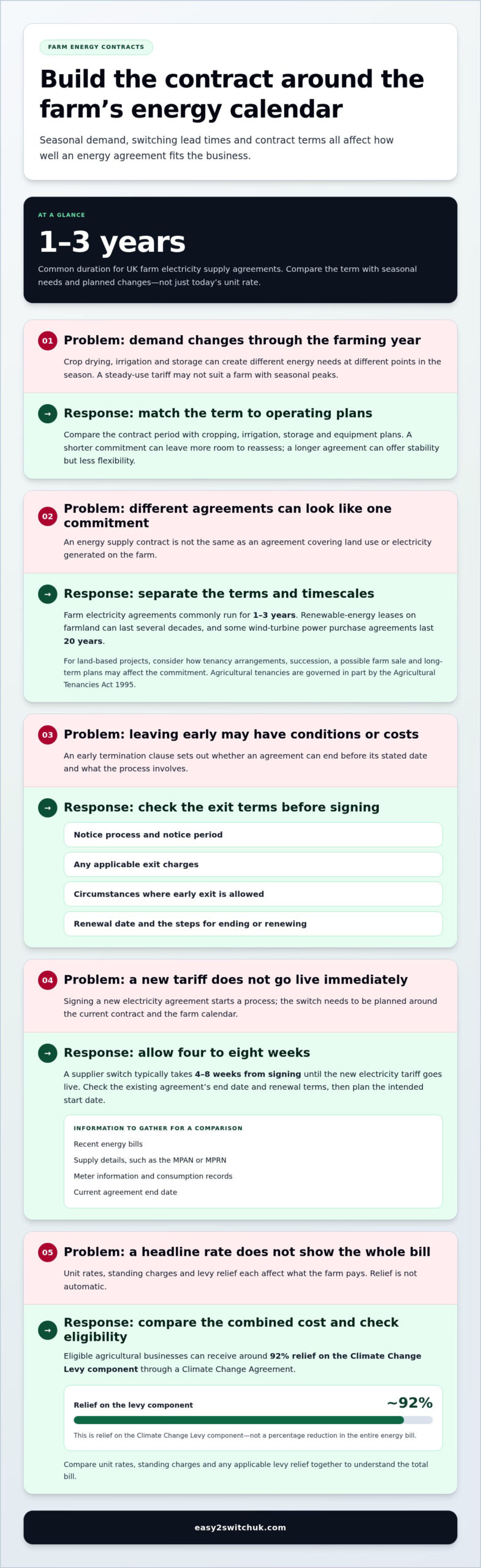
Farm electricity agreements commonly last 1-3 years, while renewable-energy and land agreements can run much longer. The duration affects how well a contract fits seasonal demand, future farm plans and changing income needs.
Farm Energy Agreement Periods
A farm energy agreement sets the period and conditions for supplying electricity or gas. Its length matters because crop drying, irrigation and storage can create changing demand throughout the farming year. Compare the term with your operating plans rather than treating the unit rate as the only consideration.
UK electricity supply agreements commonly run for 1-3 years. Renewable energy leases on farmland can commit land for several decades, and some wind-turbine power purchase agreements last twenty years. These are different agreements: one buys energy for the farm, while another may govern land use or electricity sold from a generation asset.
UK legislation register states that agricultural tenancies are governed in part by the Agricultural Tenancies Act 1995. For a farm considering solar panels or another land-based scheme, the tenancy and energy agreement may affect different rights and timescales. Consider succession, a possible farm sale and long-term carbon plans before accepting an extended commitment.
Ending an Agreement Early
Early termination means ending an agreement before its stated end date. The termination clause explains the notice process, any applicable exit charges and whether an early exit is allowed in specific circumstances. Review these terms alongside the renewal date so a seasonal change or planned sale doesn’t catch the business out.
Some biomass contract penalties may be unenforceable, so agreements should encourage performance rather than rely on penalties or termination threats. For wind power purchase agreements, weigh the stability of a longer term against the flexibility of a shorter one. The contract should also explain how curtailment, turbine downtime and maintenance responsibilities affect income.
Which UK energy suppliers offer contracts for farms and agricultural businesses? Suppliers offering business energy tariffs provide electricity and gas contracts to farms. Suitable options depend on the farm’s supply, meter setup and consumption pattern.
What information and documents do farms need to get an energy contract quote? Gather recent energy bills, supply details such as the MPAN or MPRN, meter information, consumption records and the current agreement’s end date. These details help show the farm’s actual usage and support a like-for-like comparison.
How can arable farms reduce energy costs for irrigation, grain drying, storage and refrigeration? Match operating schedules to suitable tariffs, review equipment use and assess whether on-roof solar can offset daytime demand. Grain drying can increase energy demand by 400% during wet harvest conditions, and drying grain can use over 10,000 kWh in a single season, so harvest planning and consumption patterns matter.
Contract length and switching timelines
Choosing a contract term means balancing price certainty against flexibility as farm operations change. For UK farmers, the switch itself typically takes four to eight weeks from signing until the new electricity tariff goes live.
Choosing a Contract Length
A contract length is the period for which the agreed energy terms apply. It matters when demand or farm plans may change. Match the term to your agricultural business’s operating pattern, renewal dates and plans for equipment or land.
Electricity contracts commonly run for 1-3 years, giving farmers a defined period for budgeting. A shorter commitment can leave more room to reassess after a change in cropping, irrigation or storage. A longer agreement can provide stability, but may be less flexible if the farm changes direction.
Consider the business’s climate and seasonal demands, not only its current bill. For example, a farm adding grain drying may have a different electricity profile from one focused on storage. Livestock operations, renewable generation and changes to refrigeration can also affect future requirements.
Farmers developing renewable projects should distinguish the energy supply agreement from any power purchase agreement. Some wind-turbine power purchase agreements last twenty years. A longer commitment may provide stability, while a shorter agreement can preserve flexibility. The farm’s succession plans and possible sale also matter.
Compare the contract end date with expected changes in the sector and on the farm. A planned shift in crops, new machinery or a climate change project can alter energy needs. Avoid choosing a term based only on current consumption if a specific change is already planned.
Planning a Supplier Switch
A supplier switch is the transfer to a new electricity contract, and its timeline matters for aligning the start date with the existing agreement. Allow four to eight weeks from signing to the new tariff going live.
Start by noting the current contract’s end date and renewal terms. Then gather recent bills, meter details and consumption records before comparing offers. Accurate information helps match the proposed agreement to the farm’s actual supply and usage.
Plan around key dates in the farming calendar. For instance, a farm relying on irrigation during a dry period should not assume a new tariff begins immediately after signing. Allow for the typical switching period so the change can be coordinated with the intended start date.
Before signing, check that the proposed start date, contract term and supply details match the agreement. If several farm buildings or meters are involved, keep the details for each supply together. Clear records help prevent confusion between sites during the transition.
For a switch timed around cropping or renewable plans, farm energy agreement comparisons can help bring contract options into one decision.
Fixed, multi-rate and multi-site contracts
Farm tariffs differ in how they price electricity and organise supply across meters. The right structure depends on when each site uses power and whether it also generates electricity.
Fixed-Rate Contract Options
A fixed-rate contract keeps the agreed unit rate steady for the contract term, helping farms plan electricity spending. It can suit production with predictable demand, though seasonal use still affects total consumption. Compare the unit rate and standing charge, then consider whether the agreement fits expected changes in equipment, crops or environmental projects.
A fixed unit rate doesn’t mean every part of the bill stays unchanged. For example, the Climate Change Levy rate on electricity and gas is 0.801p/kWh from April 2026. Eligible agricultural businesses may receive roughly 0.7 p/kWh in Climate Change Levy relief. Check how relief applies alongside the quoted supply terms.
Multi-Rate and Multi-Site Arrangements
A multi-rate tariff charges different unit rates at different times, while a multi-site arrangement manages supply for more than one location. Both may be relevant if a farm can shift electricity use or operates separate stores, workshops and irrigation sites.
Economy 7’s night-rate window is typically midnight to 7am. A suitable load can be 30-40% cheaper at night, so flexible grain drying or pumping may benefit if operations can use that window. A half-hourly meter records consumption in 30-minute intervals, giving a clearer view of when demand occurs. Time-of-use rates work best when actual usage aligns with cheaper periods.
How do smart meters, half-hourly metering and time-of-use tariffs affect farm energy contracts? Half-hourly data shows how electricity use varies throughout the day, while time-of-use tariffs price different periods differently. This can help a farm assess whether shifting flexible loads, such as pumping, fits its schedule.
For multiple meters, compare the rates and standing charges for each supply point. One farm may have a grain store with seasonal peaks and a workshop with steadier use. Comparing those patterns separately can make contract options easier to assess.
Farm Energy Prices and Charges
Farm energy costs combine unit rates, standing charges and applicable levies. Their effect depends on consumption, meter arrangements and when electricity is used. Compare the full contract terms, not just the headline unit rate.
What energy contract options are available for farms with on-site renewable generation or export? Farms can arrange electricity imports for the power they use and export agreements for surplus generation. Wind-turbine owners can export surplus electricity to the grid, and aligning import and export arrangements can be worth 1-2 p/kWh.
For a site with solar panels, compare daytime generation with the farm’s daytime demand. For a wind project, consider how export terms handle pricing and periods when electricity cannot be accepted. The import contract and export arrangement should reflect the farm’s actual generation and consumption profile.
Contracted quantities and delivery schedules
Farm energy agreements use expected consumption to match supply and billing to a site’s needs. For arable businesses, seasonal peaks matter as much as annual totals.
Start with recent bills and meter readings, then compare them with the farm calendar. Irrigation, grain drying, refrigeration and storage can each create a different demand pattern. A single annual estimate may hide a harvest-period increase, so separate regular use from seasonal loads where records allow.
Grain drying can increase energy demand by 400% during wet harvest conditions, and drying grain can consume over 10,000 kWh in a single season. Those figures show why a forecast based only on quieter months may not represent actual annual use. Include the drying season when assessing the quantity a contract needs to accommodate.
Half-hourly metering records electricity consumption in 30-minute intervals. This gives a farm a clearer picture of when demand occurs, such as pumps running during irrigation or dryers operating after harvest. Use those readings alongside bills to identify peak periods and compare them with the proposed contract’s pricing structure.
Choosing energy contracts for arable and crop farms means matching expected demand, including seasonal production peaks, to the agreed quantities. A delivery schedule describes when a product or agreed quantity is supplied. Grid electricity and gas reach the farm through the network, and the meter records consumption rather than a truck arriving with a scheduled load. Biomass supply agreements differ: their terms can specify feedstock delivery timing and quantities, which need to align with generation requirements and storage capacity.
For an on-site renewable energy project, consider both imported electricity and exported generation. A farm may draw power when solar or wind output is low, then export surplus when generation exceeds immediate needs. Aligning import and export arrangements for a typical UK farm can be worth 1-2 p/kWh, so the timing and treatment of both flows deserve attention.
For energy contracts for arable and crop farms, accurate records help make the agreed quantity more representative of actual operations. Bring together:
- Recent bills and meter readings for each supply point.
- Seasonal production dates for irrigation, drying and cold storage.
- Half-hourly readings, where available, to identify changing demand.
- Renewable generation and export records, if the farm produces electricity.
- Biomass delivery requirements and storage capacity, where feedstock is involved.
These records help distinguish baseline use from a harvest spike. For example, a farm with steady storage demand and short, intensive drying periods can present both patterns clearly. That helps show how contracted quantities and delivery terms relate to the operation, rather than relying on a simplified annual figure.
What are current UK farm electricity and gas prices, standing charges and contract terms?
There isn’t one farm-wide electricity or gas price: a quote reflects the supply and the farm’s usage profile. The quoted price depends on the individual supply and usage details. Key factors include annual consumption, meter arrangements, contract length and when energy is used.
Compare the unit rate with the standing charge. The unit rate applies to each unit consumed, while the standing charge is payable for the supply, even when consumption is low. A low unit rate may not mean a lower overall bill if the standing charge is higher. Review both charges for each meter and site, then assess them against actual use.
Farm electricity contracts commonly have terms of 1-3 years. The tariff may be fixed or variable, so read how the unit rate can change during the agreement. Check the start and end dates, renewal arrangements, notice requirements and any terms that apply if the farm needs to leave early. These details affect both budgeting and flexibility.
The Climate Change Levy also affects eligible farm bills. From April 2026, the UK rate on electricity and gas is 0.801p per kWh. Eligible agricultural businesses with a Climate Change Agreement can receive around 92% relief on the Climate Change Levy component, with the relief value stated at roughly 0.7 p/kWh. This relief applies to the levy component, not the supplier’s unit rate or standing charge.
To compare offers, bring the relevant details together for each supply point:
- Recent bills and annual consumption for electricity and gas.
- Meter type and usage patterns, including seasonal peaks.
- Unit rates and standing charges shown separately.
- Contract term, renewal date, notice period and exit conditions.
- Climate Change Levy treatment and applicable relief.
For example, a farm with low winter use and intensive harvest demand should compare its seasonal profile, not just its annual total. A half-hourly meter can show when electricity is used, helping reveal whether a tariff fits the farm’s operating pattern. Compare gas separately, as its consumption and contract terms may differ from electricity.
Use those details to compare the complete cost structure, rather than choosing from a headline rate alone. Compare farm energy contract options with the farm’s usage and supply details in view.
Easy2switch UK: Farm Energy Brokerage
Easy2switch UK Ltd helps farms compare electricity and gas contracts through its Farm Energy Brokerage. It reviews supplier offers to help identify options suited to the farm’s consumption, seasonal demand and contract requirements.
This can be useful when a renewal is approaching, harvest demand has changed, or several supply details need comparing. Easy2switch UK Ltd handles the switching process, helping reduce the administration involved in moving to a chosen supplier. The supplier pays Easy2switch UK Ltd a commission when a customer switches, rather than the farm paying a brokerage fee to Easy2switch UK Ltd.
Share your farm’s energy requirements to explore contract options that fit your operation. You’re welcome to contact Easy2switch UK Ltd or visit easy2switchuk.com.
Make your next energy decision with confidence
Your next contract can do more than make bills predictable. It can give your farm room to adapt as cropping plans, equipment and energy use evolve. Before deciding, consider what the business needs from its energy agreement now and what could change during the contract term.
That perspective helps make energy contracts for arable and crop farms a practical part of managing the operation, rather than just an administrative renewal. Easy2switch UK Ltd’s Farm Energy Brokerage can help compare supplier offers and manage the switching process, giving you a clearer route from reviewing options to choosing a contract.
Take the next step when you’re ready: contact Easy2switch UK Ltd about farm energy contracts. A considered choice can put you in better control of your farm’s energy arrangements.
Frequently Asked Questions
Do farms qualify for any electricity discounts or relief?
Some eligible agricultural businesses can receive around 92% relief on the Climate Change Levy component through a Climate Change Agreement. This reduces that levy element, not the supplier’s unit rate or standing charge. Eligibility and the agreement’s scope matter, so distinguish levy relief from a discounted energy tariff when comparing bills. For example, a lower levy charge won’t automatically make a tariff with a higher unit rate cheaper overall.
How long does a farm electricity switch usually take?
A UK farm electricity switch typically takes four to eight weeks from signing the contract to the new tariff going live. The start date should fit the existing agreement’s end date and any notice requirements. For example, if a farm wants a new tariff in place before a busy operating period, it should allow time for the switch to complete rather than assuming signing triggers an immediate change.
Should farm cottages be on the same contract as the farm meters?
Usually, assess farm cottages separately from business meters because their use and account arrangements may differ. A cottage occupied as a home has domestic consumption patterns, while a workshop or grain store serves the farm business. Keeping supplies distinct can make bills and contract responsibilities clearer. For a property with mixed use, consider who occupies it, which activities use the supply and how each meter is registered.
What types of energy contracts are available to UK arable and crop farms?
UK farms can consider fixed-rate, variable-rate, multi-rate and multi-site supply agreements, depending on meter setup and usage. A farm with flexible pumping may assess a time-of-use tariff, while separate buildings may need a multi-site arrangement. Farms generating renewable electricity can also arrange export terms for surplus power. These options address different needs, so compare the contract structure with the farm’s actual operations.
How do business electricity and gas tariffs for UK farms compare, including fixed and variable rates?
Electricity and gas tariffs price separate supplies, so compare each unit rate and standing charge against its own consumption. A fixed tariff holds the agreed rate steady for its term, while a variable tariff can change under its terms. For example, a farm with heavy electric grain drying should assess electricity separately from gas used for heating. Overall costs depend on usage, charges and contract conditions.
How can a UK farm compare energy quotes and switch business energy supplier?
Compare quotes using the same supply details, consumption records and contract assumptions. Review unit rates, standing charges, term length, renewal date and exit conditions together. Then match the proposed start date to the current agreement and the farm’s operating calendar. For example, a farm with several meters should compare each supply point rather than treating the whole site as one uniform load. This makes the offers easier to assess fairly.
What rules apply to business energy contracts, renewals and termination in the UK?
Business energy agreements set their own terms for renewal, notice and termination, so the signed contract is central to understanding those obligations. Record the end date and any notice deadline, then review renewal terms before the agreement rolls forward. Early termination may involve charges if the contract provides for them. Agricultural land arrangements are separate from energy supply agreements and can affect a farm’s longer-term plans.
What are the risks of fixed, variable and deemed energy rates for UK farms?
A fixed rate can limit flexibility if the farm’s needs change during the agreed term. A variable rate can change, making future bills less predictable. A deemed rate may apply when a site uses energy without an agreed contract, so leaving renewal arrangements late can expose the farm to terms it hasn’t actively selected. Compare each rate type against budget certainty, operational changes and contract exit conditions.
