
Navigating the UK energy market in 2026 can feel like an uphill battle. Between rising standing charges and the ongoing confusion over fixed versus variable rates, it is easy to feel overwhelmed by the sheer volume of choices. You shouldn’t have to spend your limited free time researching hundreds of suppliers or worrying about hidden broker fees. In today’s climate, the decision to compare energy prices with a specialist eye is the most effective way to reclaim control over your utility costs and protect your budget from market volatility.
In this guide, we provide the clarity you need to master the 2026 energy landscape, whether you are managing a household, a farm, or a business. You will discover how expert-led comparisons can secure lower monthly bills and provide price certainty for the next 12 to 24 months. At Easy2switch UK Ltd, our goal is to make the switching process seamless and transparent, handling the complexities on your behalf. By the end of this article, you will have a clear, stress-free path to optimizing your energy rates and achieving the peace of mind that comes with a truly bespoke service.
Key Takeaways
- Understand why the 2026 price cap still leaves room for significant savings and how to secure lower rates through expert-led market auditing.
- Learn to look beyond headline figures by balancing unit rates against standing charges to find the most cost-effective tariff for your specific needs.
- Identify the most effective way to compare energy prices by choosing between self-service aggregators and the bespoke consultancy of a specialist broker.
- Master the pro switching checklist to gather essential data like MPAN/MPRN numbers and avoid the financial trap of expensive “Deemed Rates.”
- Discover how a UK-based specialist can streamline your utility management, providing a fast and stress-free path to long-term energy independence.
Understanding the 2026 Energy Market: Why Comparison is Vital
In 2026, the ability to compare energy prices is no longer just a administrative chore-it is a vital financial strategy for any UK business. At its core, energy comparison is the process of auditing your current tariffs against the wider UK energy sector wholesale market. By benchmarking what you currently pay against real-time market data, you can identify where your supplier may be overcharging and where bespoke savings can be found.
While many headlines focus on the domestic market, commercial energy procurement operates on a different cycle. Businesses require a more nuanced approach, moving beyond simple price switching toward “energy optimization.” This involves not just finding a lower unit rate, but ensuring your contract structure aligns with your specific usage patterns and operational goals for the year ahead.
The State of UK Wholesale Energy in 2026
The energy landscape in 2026 remains influenced by global supply volatility and the UK’s ongoing transition toward a greener grid. Many business owners make the mistake of “waiting for prices to drop further,” but in a volatile market, this hesitation can be a risky strategy that leads to higher out-of-contract rates. The 2026 Price Cap is defined as the maximum rate suppliers can charge customers on standard variable tariffs. While this provides a ceiling, it rarely offers the competitive value found in a proactive, fixed-term contract.
Why “Standard Variable” is Rarely the Best Option
If you haven’t reviewed your energy contract in over 12 months, you have likely fallen onto a Standard Variable Tariff (SVT). This often carries a heavy “loyalty penalty,” where prices are significantly higher than those available to new or renewing customers. For farms, factories, and SMEs, being on a variable rate means your overheads are at the mercy of sudden market spikes.
- Budget Certainty: Fixed-rate contracts lock in your pence-per-kWh, allowing for seamless financial planning.
- Reduced Exposure: Commercial users are more exposed to market shifts than residential users; a fixed deal provides a vital buffer.
- Empowerment: Taking control of your procurement now prevents the stress of emergency switching later.
To secure your business’s future, it is essential to compare energy prices today. Moving away from the unpredictability of variable rates toward a transparent, bespoke agreement ensures you pay only for the energy you need, at a price that makes sense for your bottom line.
Deciphering Your Bill: Tariffs, Charges, and kWh
Understanding your energy bill is the first step toward regaining control of your overheads. To effectively compare energy prices, you must look beyond the total amount due and focus on the two primary figures: the unit rate and the standing charge. The unit rate is the price you pay per kilowatt-hour (kWh) of energy consumed, while the standing charge is a fixed daily fee that covers the cost of maintaining the national grid and supplying energy to your premises.
A common mistake for UK businesses is being lured by a record-low unit rate, only to find that a high daily standing charge inflates the final bill. Furthermore, most commercial invoices include the Climate Change Levy (CCL). This is a government tax on energy used by businesses to encourage efficiency. While most SMEs pay this, certain agricultural businesses or charities may qualify for exemptions or a reduced VAT rate of 5%, making it vital to ensure your business classification is accurate.
Finally, consider your fuel mix. Green Tariffs are increasingly popular for 2026, providing peace of mind that your energy is backed by renewable sources like wind or solar. While standard mixes are often cheaper, the gap is narrowing as the UK shifts toward a net-zero infrastructure.
Fixed vs. Variable: Which Strategy Wins in 2026?
In the current market, a 12-month or 24-month fixed deal offers bespoke protection against wholesale price volatility. For smaller enterprises, this budget certainty is invaluable. However, larger commercial entities with high energy demands might consider a “pass-through” or flexible contract. This allows you to buy energy in tranches, though it requires more active management. Before switching, always calculate your “break-even” point: if the savings from a new deal outweigh the exit fees of your current contract within a few months, the transition is financially sound. Following Ofgem’s official switching guidance can help you navigate these contract terms with confidence.
The Role of Standing Charges in Your Total Cost
Standing charges have risen across the UK due to increased infrastructure investment. For 2026, the average standing charge for a UK SME is projected to range between £0.85 and £1.20 per day, depending on your region and meter type. When you compare energy prices, your usage profile should dictate your choice:
- Low-Usage Properties: For seasonal farm buildings or workshops with minimal daily draw, look for deals with the lowest possible standing charge, even if the unit rate is slightly higher.
- High-Usage Sites: If your machinery or office runs 24/7, a low unit rate is the priority, as the standing charge will represent a smaller percentage of your total expenditure.
By identifying these nuances, you can secure a contract that mirrors your actual operational needs rather than a generic market average.
Comparison Sites vs. Energy Brokers: Finding the Best Fit
When you decide to compare energy prices for your business, you generally face two distinct paths: the “Self-Service” aggregator model and the “Consultancy” broker model. Comparison sites are useful for quick, surface-level snapshots, but they often rely on standardized algorithms that may overlook the nuances of a commercial profile. Because business energy is rarely “off-the-shelf,” an instant online price can sometimes be misleading.
Most suppliers require a bespoke quote based on your specific half-hourly data, credit score, and geographical location. This is where the consultancy model excels. While some fear the “Free Service” myth, transparency is key: brokers are typically compensated via a small commission included in the unit rate from the supplier. This fee covers the expert analysis required to navigate hundreds of potential offers, ensuring you receive impartial advice rather than just the first result on a list.
Why Farms and Charities Need Specialist Brokers
Niche sectors often have complex requirements that standard platforms ignore. For instance, agricultural businesses must manage intense seasonal consumption patterns; viewing current farm electricity prices UK helps, but a broker can tailor a contract to those peaks. Similarly, many charities are unaware they may qualify for a reduced 5% VAT rate and exemptions from the Climate Change Levy (CCL). A specialist ensures these legal discounts are applied, preventing significant overpayment.
The Human Element: Beyond the Algorithm
Algorithms are efficient, but they cannot negotiate. As your “Reliable Specialist,” a broker can contact suppliers directly to secure “hidden” rates that aren’t published on public comparison portals. While following a structured Energy Saving Trust switching checklist is a great way to prepare your data, the “done-for-you” service of a broker removes the administrative burden.
At Easy2switch UK Ltd, we prioritize this human connection. Having a dedicated point of contact means you aren’t just a policy number in a database. We demystify the market by providing:
- Direct Negotiation: Leveraging volume to lower your unit rates.
- End-to-End Management: Handling the termination of old contracts and the setup of new ones.
- Clarity: Translating complex jargon into plain English so you can compare energy prices with total confidence.
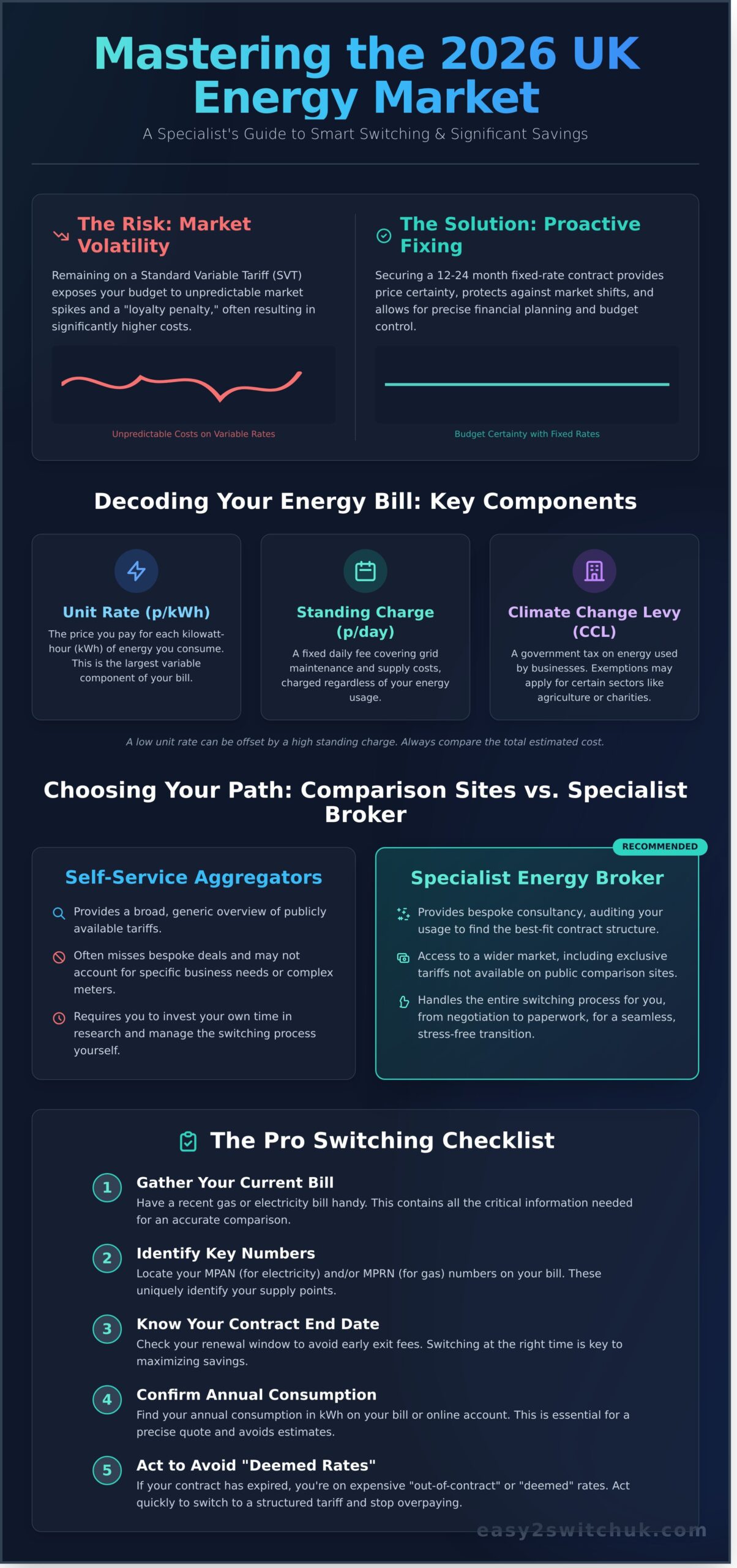
The Pro Switching Checklist: How to Compare Like an Expert
Navigating the UK energy market requires a structured approach to ensure you don’t leave money on the table. When you compare energy prices, following a professional framework ensures you secure a deal that offers both transparency and long-term value. Use this five-step checklist to take control of your procurement:
- Step 1: Gather your data. Locate your MPAN (electricity) or MPRN (gas) numbers and your total annual consumption in kWh. These are found on your most recent invoice.
- Step 2: Identify your contract end date. Knowing exactly when your current deal expires is the only way to prevent a seamless transition from becoming a costly oversight.
- Step 3: Cast a wide net. Do not settle for the first quote. Compare at least 10+ suppliers to identify market outliers and bespoke regional offers.
- Step 4: Scrutinise the T&Cs. Check for hidden “uplifts,” standing charge variations, or restrictive clauses that could penalise your business for usage fluctuations.
- Step 5: Execute and monitor. Once the switch is initiated, monitor the transition period to ensure your final bill from the old supplier and the first bill from the new one align perfectly.
Avoiding the “Deemed Rate” Trap
A “deemed rate” is the expensive tariff applied by suppliers when a fixed-term contract expires without a new agreement in place. These rates are often 80% higher than standard contracted rates, acting as a significant drain on your cash flow. To maintain peace of mind, we recommend you compare energy prices and begin the renewal process at least six months before your current expiry date to lock in a competitive rate before you are rolled onto these default tariffs.
What Information Do You Actually Need?
Accuracy is key to a hassle-free switch. A recent bill is the most reliable source of information for your usage profile. However, if you have recently moved into new business premises, you can estimate your consumption based on the previous tenant’s data or industry benchmarks for your sector. To streamline the process, many businesses use a Letter of Authority (LOA). This simple document empowers the specialists at easy2switchuk.com to negotiate with suppliers on your behalf, removing the administrative burden while ensuring you receive a truly optimized energy solution.
Take Control with Easy2switch: Seamless Energy Management
Navigating the volatile utility market shouldn’t be a burden on your time or resources. At Easy2switch, we provide a fast, simple, and stress-free switching experience designed specifically for the modern landscape. Our specialist focus spans across UK farms, businesses, and residential homes, ensuring that every sector of the community has access to fairer rates. As we move into 2026, our commitment to transparency is stronger than ever, focusing on delivering bespoke solutions that reflect your actual usage rather than generic market averages.
We invite you to take advantage of our free energy review. This no-obligation service is designed to identify immediate savings and highlight where your current contract may be falling short of the current market potential. By choosing to compare energy prices with our expert team, you gain a reliable partner dedicated to your long-term financial health.
The Easy2switch Process: From Phone Call to Savings
Our transition process is engineered for zero friction. We understand that your priority is running your business or managing your home, not chasing suppliers. The journey is straightforward and efficient:
- Provide a Bill: Simply share a recent statement so we can analyze your current spend and kVA requirements.
- Get a Comparison: We scan the market to find the most competitive, transparent rates available for 2026.
- Confirm the Switch: Once you select your preferred plan, we handle the administrative heavy lifting.
We guarantee no interruption to your supply during the transition. Furthermore, our Worcester-based team provides a level of local accountability and trust that ensures you are supported by real people. We are UK-based experts who understand the specific challenges of the domestic market, from rising standing charges to the need for green energy options.
Ready to Start Your Comparison?
Whether you are looking to protect the margins of a local charity, reduce the overheads of a large commercial enterprise, or simply cut costs at home, the time to act is now. As an established business energy broker UK, we have the tools and the direct supplier relationships to secure the best possible terms for your specific needs.
Take the first step toward energy independence and price stability. Don’t leave your budget to chance in a fluctuating market. Compare energy prices and save today by using our streamlined quote tool or speaking with one of our friendly specialists for a personalized consultation.
Take Control of Your Energy Future
Navigating the UK energy market in 2026 requires a proactive approach to ensure you aren’t overpaying for essential utilities. By mastering your bill’s components and following a professional switching checklist, you can move from uncertainty to total transparency. The most effective way to safeguard your budget is to regularly compare energy prices, ensuring your tariff remains competitive as market conditions evolve and new opportunities emerge.
At Easy2switch, we simplify this process through our independent consultancy. With specialist expertise in the UK farming and charity sectors, our UK-based team provides personalized, hassle-free support tailored to your specific requirements. We scan hundreds of supplier offers to find your ideal match, handling the complexities so you can focus on what matters most. Whether you are looking for bespoke savings or long-term price stability, our goal is to provide the professional authority and approachable help you deserve.
Don’t leave your savings to chance. Get a Free, Impartial Energy Quote from Easy2switch today and experience seamless energy management designed around you. We are here to help you take control with confidence and ease.
Frequently Asked Questions
How much can I realistically save by comparing energy prices in 2026?
In the current 2026 market, UK businesses can realistically reduce their annual energy expenditure by up to 30% simply by switching from standard variable rates. For a typical small-to-medium enterprise, this often equates to savings of over £1,200 per year. By taking the time to compare energy prices, you move away from expensive “out-of-contract” rates and secure a competitive deal that protects your bottom line from market volatility.
Is it better to choose a fixed or variable energy tariff right now?
For most businesses seeking budget stability, a fixed-rate tariff is the pragmatic choice. Locking in your unit rates for 12 to 36 months provides essential protection against wholesale price spikes, giving you total peace of mind for your financial planning. While variable tariffs offer more flexibility to leave, they often result in higher long-term costs. We recommend a bespoke fixed deal to ensure your overheads remain predictable and manageable.
How long does it take to switch energy suppliers in the UK?
The switching process is now faster and more seamless than ever, typically taking around 15 working days to complete. Thanks to improved industry regulations and the Energy Switch Guarantee, the transition is handled entirely behind the scenes. Once you have selected your new plan, your new provider coordinates with your current one. Our team manages the administrative details to ensure the entire experience is hassle-free and efficient for you.
What is the difference between a price comparison site and an energy broker?
A comparison site provides a generic list of available rates, but an energy broker like Easy2Switch UK offers a more personalized, expert service. We don’t just show you prices; we negotiate directly with suppliers to find bespoke contracts that aren’t always available to the public. While sites are useful for quick checks, a specialist broker provides deeper market transparency, handles all the paperwork, and ensures long-term contract optimization for your specific needs.
Will my energy supply be cut off during the switching process?
Absolutely not. There is zero risk of your supply being interrupted during a switch. The change is purely administrative, meaning the same wires and pipes will continue to deliver gas and electricity to your premises without any downtime. You won’t need any new meters or equipment installed. The only difference you will notice is a different name on your bill and the satisfaction of paying a much lower price for your energy.
Are there any hidden fees when using an energy comparison service?
At Easy2Switch UK, we pride ourselves on transparency and simplicity. There are no hidden fees or direct charges for using our comparison and switching service. We are remunerated via a small commission paid by the energy supplier once your new contract is live. This results-oriented model ensures our goals are perfectly aligned with yours: finding the most cost-effective solution for your business without adding any extra financial burden to your transition.
What happens if my current energy supplier goes bust?
If a supplier fails, Ofgem’s “Safety Net” ensures your lights stay on. You will be automatically moved to a “Supplier of Last Resort” to maintain continuity. However, these emergency tariffs are often the most expensive on the market. In this situation, you should compare energy prices immediately to move from the default rate to a competitive fixed-rate deal, allowing you to regain control over your costs and secure a better long-term rate.
How often should I compare energy prices to ensure I am on the best deal?
We recommend reviewing your energy options at least once a year, or roughly six months before your current contract is due to expire. Most business contracts have a specific renewal window; missing this can result in being rolled onto expensive default rates. By proactively checking the market annually, you can lock in lower rates early. This regular health check ensures your business is always benefiting from the most current and competitive market pricing.
