
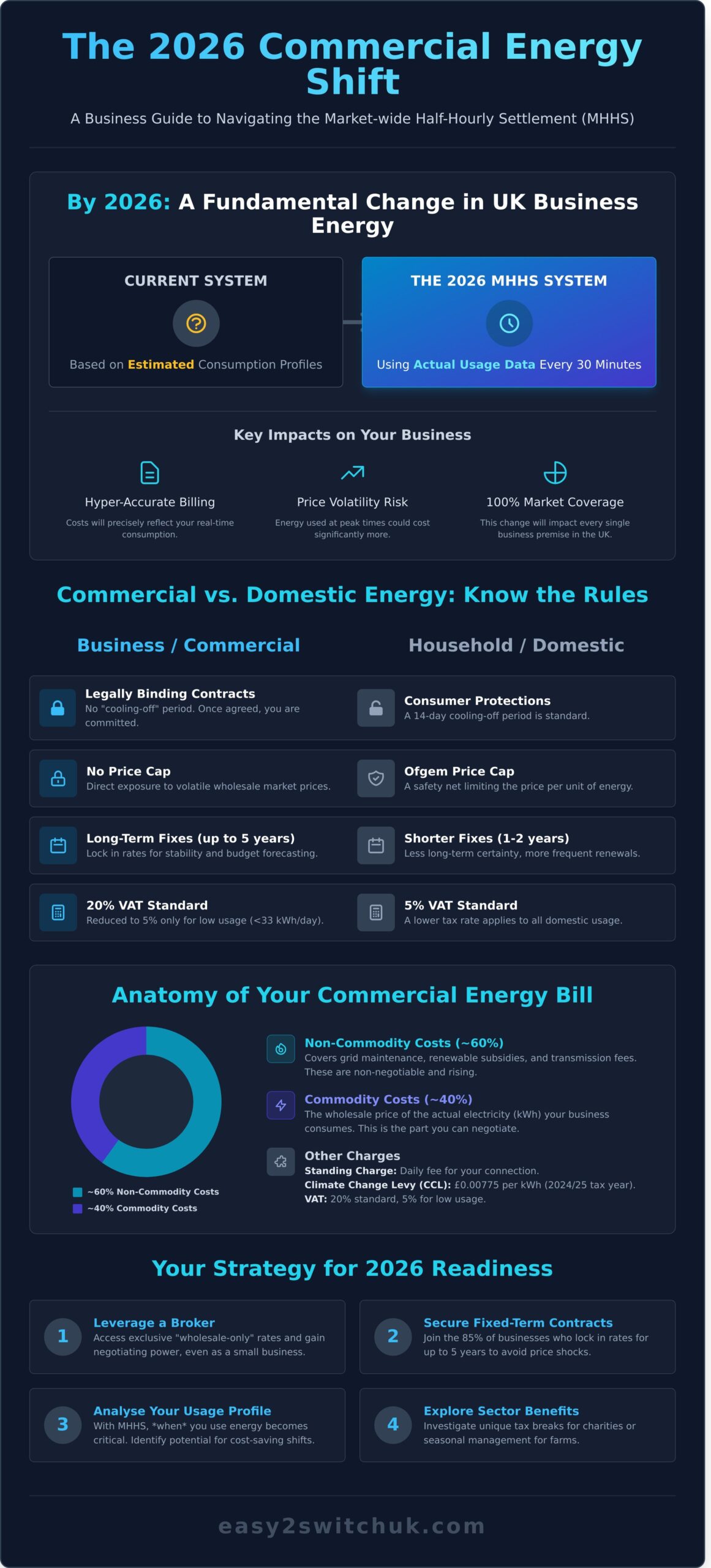
By 2026, the Market-wide Half-Hourly Settlement (MHHS) programme will impact 100% of UK business premises, fundamentally changing how your electricity costs are calculated every 30 minutes. Managing commercial energy in this shifting landscape shouldn’t feel like a gamble. You’re likely already feeling the pressure of unpredictable price spikes and the dread of being locked into a high-rate contract with no cooling-off period. It’s frustrating to watch your overheads climb while the fine print of energy regulations gets more complex and less transparent. Every penny counts when you’re trying to maintain a healthy bottom line in a volatile economy.
We understand that your priority is running your company, not decoding utility legislation. We agree that energy procurement should be seamless and bespoke to your specific needs rather than a source of constant stress. This guide ensures you master the 2026 market and secure the most competitive rates for your business with our expert guidance. We’ll show you how to achieve fixed-rate security and a lower annual spend through a hands-off switching process that replaces anxiety with peace of mind. We’re covering everything from MHHS compliance to the best strategies for long-term price protection.
Key Takeaways
- Understand how the 2026 Market-wide Half-Hourly Settlement (MHHS) will impact your billing and create new opportunities for cost optimization.
- Navigate the critical differences between business and domestic contracts to avoid the “no cooling-off” trap while securing long-term price stability.
- Identify sector-specific benefits, such as seasonal usage management for farms and unique tax breaks available specifically for UK charities.
- Learn how to leverage a professional market tender to secure the most competitive commercial energy rates for your business.
- Discover how our “done-for-you” approach at Easy2switch UK Ltd removes the administrative burden, providing expert guidance from our Worcester headquarters.
What is Commercial Energy and Why is the 2026 Market Different?
Commercial energy is a bespoke contract-based utility service tailored to business volume. Understanding What is Commercial Energy requires a look at how power moves from the grid to non-domestic premises. This category covers everything from small Worcester high street shops to large industrial farms and registered charities. Unlike domestic accounts, these agreements are firm legal contracts with no cooling-off periods. They’re designed to handle the higher demands and specific load profiles of a working environment.
The 2026 landscape introduces a significant shift for every UK business owner. By December 2026, the Market-wide Half-Hourly Settlement (MHHS) initiative will be fully operational. This program changes how the industry processes electricity data. Instead of using estimated consumption profiles based on generic user types, the system will use actual data recorded every 30 minutes. It’s a move toward a more flexible, digital grid. For your business, this means billing will become more accurate, but it also means your price could fluctuate based on the exact time you flick the switch.
You won’t find the safety net of a price cap here. Ofgem’s domestic price cap does not apply to commercial energy. While households have a ceiling on what they pay per unit, businesses are exposed directly to the volatility of the wholesale market. If global gas prices rise, your next contract offer will reflect that increase immediately. This lack of protection is why 85% of businesses now opt for fixed-term contracts to avoid sudden price spikes that could destabilize their annual budgets. Exploring comprehensive business energy solutions is the most effective way to navigate this exposure and secure long-term price stability.
Key Components of Your 2026 Commercial Energy Bill
Your bill is split between unit rates and standing charges. The unit rate is what you pay for the actual power used, while the standing charge covers the cost of maintaining the connection. If you’re a low-energy user, a high standing charge can disproportionately inflate your costs. You also need to account for the Climate Change Levy (CCL). For the 2024/25 tax year, the CCL rate for electricity is £0.00775 per kWh. Most businesses pay 20% VAT, but if your firm uses less than 33kWh of electricity per day, you might qualify for the reduced 5% rate. Non-commodity costs, which cover grid maintenance and renewable subsidies, now make up roughly 60% of your total bill. These costs are non-negotiable and rising.
The Role of a Commercial Energy Broker
A specialist broker acts as your bridge to the wholesale market. Many suppliers offer “wholesale-only” rates that aren’t listed on their public websites or direct sales lines. We access these prices by leveraging the collective buying power of our entire client base. This gives even a small Worcester office the same negotiating weight as a much larger corporation. At Easy2switch, we operate on a transparent commission-based model. This means our service is free for you to use; we’re paid a small fee by the supplier once your new contract is live. In a volatile 2026 market, having an independent consultant ensures you aren’t just taking the first renewal offer your current supplier sends. We compare the entire market to find the specific fit for your consumption profile, giving you back control over your overheads.
Commercial vs. Domestic Energy: Understanding the Critical Differences
Managing a business in Worcester requires a sharp shift in mindset compared to handling a household budget. While domestic energy users enjoy a safety net of consumer protections, the world of commercial energy operates under different rules. Suppliers view businesses as professional entities capable of making informed, binding decisions. This distinction changes everything from how you sign a contract to how much tax you pay on every kilowatt-hour used. Understanding these nuances is the first step toward taking control of your overheads.
One of the most significant advantages for businesses is the ability to secure long-term price stability. While residential customers are often limited to one or two-year fixes, businesses can lock in rates for up to five years. In a volatile market where wholesale prices can jump 20% in a single month, this 60-month certainty is a powerful tool for financial forecasting. However, this stability comes with a trade-off. There’s no “cooling-off” period in the commercial sector. Once you agree to a contract, whether over the phone or via email, you’re legally bound. There is no 14-day window to change your mind, making it vital to be certain before you commit.
Suppliers also treat credit risk differently for businesses. Before offering a contract, a supplier will run a comprehensive credit check on your company. If your credit score is below 40 out of 100, you might find your options limited to just two or three providers, or you may be asked to pay a security deposit. Official data on Commercial vs. Domestic Energy consumption shows that businesses often have much higher, more concentrated demand, which is why suppliers are so cautious about your ability to pay. Additionally, businesses don’t get “dual fuel” discounts. You’ll need to manage your gas and electricity as two separate contracts, often with different end dates and different suppliers, to ensure you’re getting the most competitive rate for each.
The Legal Reality of Business Contracts
The lack of a 14-day cancellation period isn’t the only legal hurdle. You must also proactively manage your termination window. Most commercial contracts require you to give notice between 30 and 90 days before the contract ends. If you miss this window, your supplier will move you onto “deemed rates.” As of early 2024, these out-of-contract rates can be 80% more expensive than a standard fixed deal. To manage this, most businesses use a Letter of Authority (LOA). This simple document allows a specialist to speak to suppliers on your behalf, ensuring you never miss a deadline or get rolled onto expensive rates. You can start a quick comparison to see how your current rates stack up against the latest market offers.
VAT and CCL Exemptions
Many Worcester business owners don’t realize they might be overpaying on their energy taxes. While the standard VAT rate for commercial energy is 20%, many organizations qualify for a reduced rate of 5%. This applies to charities, non-profit organizations, and small businesses that use less than 33kWh of electricity or 145kWh of gas per day. Qualifying for this lower VAT rate also exempts you from the Climate Change Levy (CCL), which added £0.00775 per kWh to electricity bills as of April 2024. This isn’t applied automatically; you must submit a VAT Declaration Certificate to your supplier to claim these savings and potentially backdate them for up to four years.
Sector-Specific Energy Needs: From Farms to Charities
Every business in Worcester has a unique consumption profile that dictates its ideal commercial energy contract. A high-street retailer doesn’t share the same load requirements as a cold-storage facility or a village primary school. Since the energy price cap doesn’t apply to businesses, understanding your specific sector’s requirements is the only way to prevent overpaying for daily operations. We see a 15% difference in unit rates between sectors simply because of how and when they draw power from the grid.
Small and Medium Enterprises (SMEs) often prioritise price stability. Since April 2024, standing charges for many small business electricity contracts have risen by over 10%, making it vital for SMEs to balance a fixed-rate security with the need for low daily standing charges. Conversely, industrial users with high-volume requirements are moving toward flexible, market-reflective pricing. This allows them to purchase energy in “tranches” when wholesale prices dip, rather than being locked into a single high rate for 24 months.
- SMEs: Focus on reducing fixed standing charges to protect thin margins.
- Industrial: Use “basket” purchasing to take advantage of wholesale market fluctuations.
- Retail: Align contract end dates with seasonal peaks to avoid renewals during high-demand months like December.
Agricultural Energy Challenges in 2026
Worcestershire’s farming community faces distinct logistical hurdles. Many farms operate with “out-of-area” meters, which are located on rural infrastructure where maintenance and distribution costs are higher. This means farm energy prices UK often carry a premium compared to standard urban commercial rates. By 2026, the push for rural grid upgrades will likely change how multi-site meters are billed, making it essential to consolidate these under a single “bespoke” contract now.
Approximately 70% of UK farmers now invest in renewable generation like solar or wind. If you’re generating your own power, your contract must be structured to handle export as well as import. We help farmers integrate these renewable outputs with their commercial energy supply, ensuring that surplus energy isn’t wasted and that the “import” rate remains competitive during low-generation periods in winter.
Energy Solutions for Non-Profits and Charities
Charities and non-profit organisations often leave money on the table because they aren’t aware of specific tax breaks. Most registered charities qualify for a reduced VAT rate of 5% on their energy bills, rather than the standard 20%. They’re also frequently exempt from the Climate Change Levy (CCL), which can shave another 5% to 10% off the total invoice. It’s not just about the rate; it’s about the tax status.
Efficiency is the first step toward budget control. A well-executed energy audit can identify waste that typically accounts for 20% of a building’s total utility expenditure. Technical resources regarding commercial building energy efficiency show that even minor adjustments to HVAC systems and lighting can yield immediate ROI. For organisations with limited resources, our Charity Energy Brokerage service specialises in identifying “Social Enterprise” tariffs. these products are designed specifically for the third sector, offering “fair-usage” terms that don’t penalise organisations for unexpected spikes in demand during community events.
How to Compare and Switch Commercial Energy Suppliers
Securing a better deal on your commercial energy starts with a clear understanding of your current usage. You can’t optimize what you don’t measure. Begin by locating your most recent bill to identify your Estimated Annual Consumption (EAC) in kWh and your specific contract end date. Statistics from the energy sector suggest that 40% of UK businesses overpay simply because they lose track of these two data points. Once we have this information, we launch a market tender. This involves inviting over 30 different suppliers to bid for your contract, creating a competitive environment that forces prices down.
Comparing offers requires a focus on the total cost of ownership rather than just the unit rate. While a low pence-per-kWh figure looks attractive, high daily standing charges can quickly erode any perceived savings. We analyze the full contract term, whether it’s 12, 24, or 36 months, to ensure the math actually works in your favor. When you’re ready, the transition is final. In the business sector, a digital signature or verbal agreement is a legally binding “Point of No Return.” Unlike domestic energy, there’s no cooling-off period, so precision is vital before you commit. Our guide to comprehensive business energy solutions for UK firms provides a deeper strategic framework for evaluating these decisions with confidence.
- Data Collection: Gather 12 months of kWh usage and your current Meter Point Administration Number (MPAN).
- Tender Process: We reach out to a broad panel of suppliers to secure bespoke pricing.
- Validation: We check for hidden clauses or restrictive terms in the fine print.
- The Switch: We manage the transfer with your new supplier to ensure zero loss of supply.
Avoiding Common Switching Pitfalls
Missing your renewal window is a costly mistake. If you roll onto “Deemed” or “Out-of-Contract” rates, you’ll likely pay 80% more than a negotiated tariff. Suppliers may also object to a switch if there’s an outstanding balance as small as £50 or if the registered business name has a minor typo. You should also reject the first renewal quote from your current provider. These initial offers are typically 15% to 20% higher than the best available market rates.
Fixed vs. Flexible: Which is Right for 2026?
Choosing a contract structure depends on your risk appetite for 2026. A 3-year fixed rate at approximately £0.24/kWh provides total budget certainty, protecting you from sudden global price spikes. Conversely, flexible contracts allow businesses consuming over 100,000 kWh annually to buy energy in “tranches.” This means purchasing portions of your power when market prices dip. Expert data from Cornwall Insight indicates that market volatility remains a threat, so relying on professional analysis is safer than a gut feeling.
Ready to take control of your overheads? Compare commercial energy rates today and see how much your Worcester business could save.
Why Easy2switch is the Reliable Specialist for Your Business
Managing utilities often feels like a full-time job. We started Easy2switch at our Worcester headquarters to change that. Our team provides impartial advice tailored specifically to the local economy. We don’t just look at numbers on a screen; we understand the specific challenges facing West Midlands enterprises. Our expertise extends beyond water to the broader commercial energy landscape, ensuring your business isn’t overpaying for essential resources.
Our “Done-for-You” approach means we take over the tedious paperwork that usually stops business owners from switching. We handle the Letters of Authority (LOA), manage termination notices with your current suppliers, and verify every line of your new contract. This allows you to focus on your daily operations while we handle the data entry and supplier negotiations. We’ve found that 85% of businesses stay with expensive “out-of-contract” rates simply because the admin feels too heavy. We remove that barrier entirely.
Agriculture is a core part of our identity. We specialize in the farming industry because we understand the land, not just the meter. Farming requires a deep knowledge of seasonal demand and high-volume usage points that standard brokers often miss. Whether you’re managing a dairy farm or a large-scale arable operation, we tailor our search to find suppliers that accommodate the unique infrastructure of rural businesses.
Transparency isn’t just a buzzword for us; it’s our operating model. We guarantee no hidden fees or surprise charges. We’re upfront about how we work and exactly what you’ll save. By providing clear, side-by-side comparisons of the market, we give you the data needed to make an informed decision without the typical sales pressure found in the utility sector.
The Easy2switch Process: Simple, Fast, Effective
Our method is built on three pillars: speed, accuracy, and zero cost to the client. We operate on a commission-based model paid by the suppliers, which keeps our service free for you. This doesn’t compromise our impartiality. We compare dozens of providers to find the best fit for your specific usage profile. Our “Peace of Mind” guarantee ensures we manage the entire supplier legwork from the initial quote to the final contract signature. It’s a streamlined journey designed to take minutes of your time, not hours of research. Take control of your energy costs today with a free review.
Real Results for UK Businesses
The impact of professional brokerage is best seen through real-world savings. In July 2023, we helped a family-run poultry farm in the UK secure a 5-year fixed-rate contract. This strategic move protected them from a 40% projected price hike in the commercial energy market, saving them over £12,000 in annual overheads. Local accountability matters in a global market. Because we’re based in Worcester, you aren’t dealing with an anonymous call center; you’re working with specialists who are accessible and accountable. For deeper insight into our niche expertise, visit our Farm Energy Brokerage pillar to see how we optimize costs for the agricultural sector.
Take Control of Your 2026 Energy Strategy
The 2026 energy landscape requires a shift from passive renewal to active procurement. Understanding the technical differences between domestic and business contracts is vital for protecting your profit margins. Whether you’re managing a local charity or a large-scale farm, your commercial energy strategy needs to account for sector-specific volatility and unique consumption profiles. Waiting for renewal notices often leads to higher costs; starting your comparison early is the most pragmatic way to ensure long-term stability.
Easy2Switch UK is a UK-based independent consultancy that simplifies this entire process. We provide specialist expertise for farming and charity sectors, offering you access to hundreds of supplier offers with zero hidden fees. Our team removes the complexity of market analysis, delivering bespoke options that fit your specific operational goals. You don’t have to navigate the 2026 price shifts alone. We’re here to provide the professional authority and approachable support your business deserves.
Get your free, no-obligation commercial energy quote today and see how much your business can save. Let’s get your utilities sorted so you can focus on what you do best.
Frequently Asked Questions
Is there a cooling-off period for commercial energy contracts?
Most business energy contracts don’t have a cooling-off period. Once you’ve signed the agreement, it’s a legally binding document that takes effect immediately. The only exception applies to micro-businesses, which Ofgem defines as firms using less than 100,000 kWh of electricity or 293,000 kWh of gas per year. If your Worcester company exceeds these limits, you must be certain of your choice before committing to the deal.
How much can a business energy broker save my company?
A specialist broker can typically reduce your annual utility bills by up to 40% compared to expensive out-of-contract rates. We compare prices from 20 different UK suppliers to find bespoke deals that aren’t available to the general public. For a local business spending £5,000 annually, this optimization could result in a direct saving of £2,000. It’s a seamless way to protect your bottom line with total transparency.
What is the Climate Change Levy (CCL) and does my business have to pay it?
The Climate Change Levy is a UK tax on energy delivered to businesses to encourage better energy efficiency. Most firms pay this, with 2024 rates set at 0.775p/kWh for electricity and 0.672p/kWh for gas. You might be exempt or pay a reduced rate if your business uses very low amounts of energy or operates in a specific energy-intensive sector. Checking your VAT status often reveals hidden savings for your company.
Can I switch my business energy supplier if I’m in a fixed-term contract?
You cannot switch suppliers until your current fixed-term contract enters its official renewal window. This window usually opens between 6 and 12 months before your current end date. While you can’t leave early without paying heavy exit fees, you can secure your next commercial energy contract today to take effect when your current one expires. This proactive approach locks in lower rates before market prices fluctuate again.
How do commercial energy rates differ from domestic rates in 2026?
Business rates don’t benefit from the Ofgem price cap that protects domestic households. By 2026, market forecasts suggest commercial prices will remain more volatile because they’re bought in bulk directly from the wholesale market. While domestic users pay a flat rate, your business pays a unit price based on your specific usage profile and credit score. This means a bespoke quote is the only way to ensure you’re getting a fair price.
What information do I need to provide to get a commercial energy quote?
You only need three key pieces of information: your recent energy bill, your contract end date, and your MPAN or MPRN numbers. These unique identifiers are found on your invoice and tell us exactly which meters serve your Worcester premises. Providing an annual consumption figure in kWh allows us to provide a more accurate, hassle-free quote tailored to your actual business needs rather than a rough estimate.
Why should I use a broker instead of going directly to an energy supplier?
Using a broker gives you access to a wider range of tariffs that suppliers don’t offer to the general public. We handle the complex negotiations and paperwork, saving the average business owner 15 hours of administrative work. Because we manage thousands of accounts, we have the leverage to secure better commercial energy rates than a single business could get alone. It’s about gaining expert support while you focus on your growth.
What happens if my business energy contract expires and I haven’t switched?
You’ll be automatically moved onto out-of-contract or deemed rates, which are often 80% more expensive than fixed-term deals. These rates are designed to be temporary and expensive, penalizing businesses that don’t take action. In 2024, some businesses saw their costs double overnight just by missing a renewal deadline. We recommend starting your search 6 months early to maintain control and provide peace of mind for your budget.
