
A Capacity Market charge is a pass-through cost that helps fund reliable electricity capacity and support security of supply in Great Britain. If you’re wondering what a capacity market charge on my bill means, it is generally listed among non-energy or system charges, rather than as a charge for the electricity your business has used.
An unfamiliar charge can make it harder to see what is driving your bill. It is not a penalty: it reflects the cost of maintaining capacity that can help meet electricity demand. This article explains what the Capacity Market does, how its costs reach business bills, and which businesses may pay them.
You’ll also see how the charge differs from other electricity costs, why the amount can vary, and what to consider when reviewing your contract. This context can help you distinguish a market-wide cost from charges based on your business’s energy use.
Key Takeaways
- The Capacity Market helps secure electricity supply by supporting reliable capacity, and its costs can appear among non-energy or system charges on business bills.
- Understand why the charge is separate from the electricity your business uses, and what affects how suppliers pass it through.
- Learn how contracted demand and capacity agreements connect to the costs shown on a bill.
- See which non-domestic businesses may pay the charge, and when sector-specific relief may apply.
- Use the article’s examples to make sense of daily and annual capacity costs before reviewing your electricity arrangements.
How the Capacity Market charge appears on business electricity bills
If you’re asking what a Capacity Market charge on your bill means, separate it from the cost of your electricity use. The charge helps fund capacity that supports security of supply across Great Britain.
Payments for Reliable Capacity
The Capacity Market pays reliable capacity providers to help ensure electricity can be supplied when demand is high. These providers may generate electricity or offer other dependable capacity to the system. The payments support security of supply, rather than paying for the electricity your business consumes. For businesses, that distinction explains why a Capacity Market cost can appear even when usage hasn’t changed.
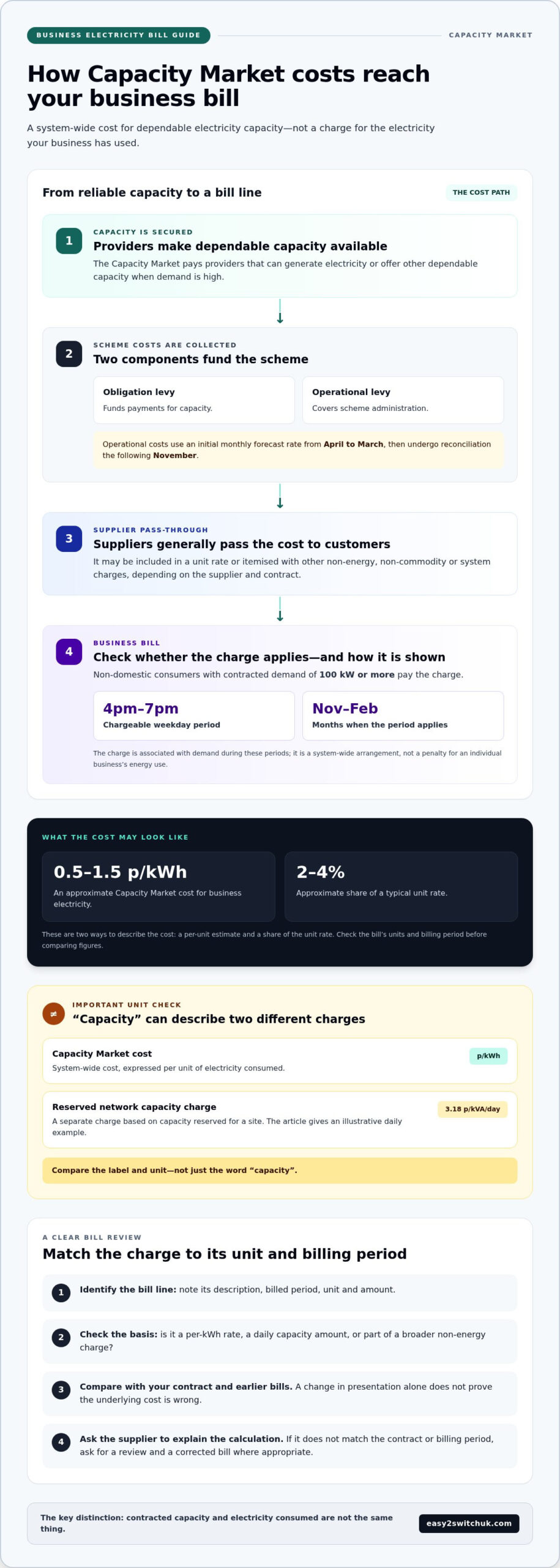
Costs are associated with demand during chargeable periods: 4pm to 7pm on weekdays from November to February. The charge therefore reflects a system-wide arrangement, not a penalty for an individual business’s energy use. Suppliers may show it as part of a non-energy, non-commodity or system charge.
Passing Costs to Customers
Electricity suppliers pay Capacity Market costs and generally pass them through to business and domestic customers. The cost may be included in a unit rate or itemised with other non-energy charges, depending on the supplier’s bill and contract. Non-domestic consumers with contracted demand of 100 kW or more pay the charge.
For business electricity, Capacity Market costs are around 0.5 to 1.5 p/kWh and account for 2 to 4 per cent of a typical unit rate. These figures describe different ways to understand the cost: a per-unit estimate and a share of the unit rate. Check the bill’s units and billing period before comparing its line with a quoted per-kWh figure.
Differences from Other Bill Charges
A Capacity Market charge funds payments for dependable capacity. Network charges, by contrast, cover the cost of transporting electricity through local and national networks. Other policy costs fund separate energy policies, so these charges serve different purposes even when grouped under non-energy costs.
Some business bills also show capacity-related charges based on reserved network capacity, which are distinct from the Capacity Market’s system-wide costs. For example, an illustrative daily capacity charge is 3.18 p per kVA per day. The unit matters: p/kWh relates to energy consumed, while p per kVA per day relates to reserved capacity. Compare the label and unit, not just the word “capacity”.
Checking a Bill Charge
If a Capacity Market line looks incorrect, compare its billed period, description and unit with your contract and earlier bills. Check whether it is shown as a per-kWh rate, a daily amount or part of a broader non-energy charge. A change in how the charge is presented does not, by itself, mean the underlying cost is wrong.
Ask your electricity supplier to explain the calculation and how it applies to your account. Include the bill date, charge label, unit and amount in question. If the explanation does not match your contract or the stated billing period, ask the supplier to review the charge and issue a corrected bill where appropriate.
What is the Capacity Market?
A Capacity Market charge is a supplier-recovered cost that supports capacity available to protect electricity security. The calculation and bill presentation depend on the cost component and the units used.
Recovering Capacity Market Costs
Suppliers recover Capacity Market costs through two main components: an operational levy and an obligation levy. The operational levy covers administration; the obligation levy funds capacity payments. This distinction helps explain why a bill may show separate amounts or combine them into a broader charge.
Operational costs use an initial monthly forecast rate from April to March, then undergo reconciliation the following November. In Great Britain, the Department for Energy Security and Net Zero says T-1 auctions take place a year before the delivery year. These auctions help determine capacity procurement within the government’s energy security scheme.
Daily and Annual Cost Examples
An illustrative daily capacity charge is 3.18 p per kVA per day. These figures show how a daily rate can accumulate across a full year, even though the business’s electricity consumption varies.
Capacity Market costs may be calculated on a different basis from the network-capacity example. This is an illustrative calculation, not the same basis as the kVA network-capacity example.
If a business later needs more agreed supply capacity, network studies or connection charges may follow. A battery or another change in site demand can affect planning, but does not by itself determine the capacity required. The key distinction is between contracted capacity and electricity consumed.
Cost Types and Pass-Through Measurement
Obligation costs fund capacity payments, while operational costs fund scheme administration. Because the charge is expressed per unit consumed, compare it with the bill’s kWh figures, not a daily kVA charge.
To assess pass-through costs, identify whether each line is a unit rate, a daily capacity charge or an annual amount. Then match its unit, billing period and contracted demand to the calculation shown.
Capacity Market reform and auction outcomes can change the underlying costs passed through by suppliers. For context when reviewing your wider business energy arrangements, explore business energy options.
Capacity agreements and provider obligations
Capacity agreements commit providers to make dependable electricity capacity available during a delivery period. These contracts support the Capacity Market. Agreed Supply Capacity on a business bill, by contrast, concerns the network capacity reserved for a site.
Capacity Agreements and Provider Obligations
Capacity agreements are awarded under the Capacity Market Rules, not through private commercial contracts between providers and businesses. Depending on technology, agreements last from 1 to 15 years. Successful bidders in a T-1 auction typically receive one-year agreements, while providers must meet their agreed obligations during the relevant delivery period.
Providers that fail to deliver when called on pay a penalty. Commitments can involve different forms of capacity, including generation and other resources that help meet electricity demand. For business customers, these agreements explain the market mechanism behind supplier costs. They do not mean the customer has signed an agreement with a generator.
Electricity suppliers pay the Capacity Market supplier charge to the Settlement Body for each delivery year. According to the UK Government website, legislation.gov.uk, the Settlement Body calculates monthly payments on account. This settlement process underlies costs suppliers may pass through on electricity bills.
Agreed Supply Capacity
Agreed Supply Capacity is the amount of network capacity reserved for a business site. It differs from a provider’s Capacity Market agreement: one concerns the site’s connection, while the other supports capacity across the wider electricity market. This distinction matters because reducing a site’s agreed capacity may affect its network charges, not the supplier’s market-wide payment obligation.
A business can review its Authorised Capacity against its actual demand. For example, one illustration gives maximum demand of 140 kVA against 200 kVA of agreed capacity. It suggests reducing the agreement to 150 kVA, retaining a margin above the recorded demand.
Reducing Agreed Supply Capacity
Businesses whose electricity use consistently stays below agreed capacity may request a reduction from their Distribution Network Operator. In the example above, the difference between 140 kVA demand and 150 kVA proposed capacity leaves a buffer, rather than matching the agreement exactly to recorded peak demand.
Reducing agreed capacity is normally an administrative process and, in most cases, requires no physical network work. However, a site that later needs more capacity may face network studies or connection charges. Reviewing demand patterns alongside site requirements helps businesses weigh lower reserved capacity against the need to retain room for operations.
Purpose of the Capacity Market
Great Britain’s Capacity Market is designed to support security of electricity supply by paying capacity providers for dependable availability. It addresses a practical system need: electricity must be available when demand rises, including when some generation is unavailable. For businesses, this explains why a market-wide capacity cost can appear separately from charges for electricity consumed.
The government sets the amount of capacity needed years ahead, with advice from the National Energy System Operator (NESO). Auctions then procure commitments for future delivery periods. The T-4 auction secures most of the requirement, while the T-1 auction supplements it closer to the delivery year. This forward planning gives providers time to arrange generation or other capacity.
The scheme is technology-neutral: generators, batteries and factories offering to reduce demand can compete on the same terms. Demand-side response means adapting electricity demand to better match available supply. For example, a factory may be able to reduce consumption when the system needs support. Capacity providers are paid for their commitments, not simply for the electricity they generate.
This range of eligible resources matters as the electricity system changes. A battery can provide stored electricity, a generator can supply power, and an industrial site can offer to reduce demand. New Capacity Market entrants must demonstrate low carbon emissions or grid support value. These criteria link the scheme’s energy security purpose with the need to support a changing generation mix.
Capacity Market auctions began in 2014, and the first delivery year was 2017-18. A Capacity Market year runs from October to September, giving providers a defined period for their commitments. The Energy Act 2013 enables Electricity Market Reform, including the Capacity Market. Together, the auction process and delivery commitments establish how the scheme secures capacity before it is needed.
The market also gives the system a structured way to contract for availability, rather than relying only on electricity consumption at the moment of use. The Great Britain T-4 auction procures most required capacity, and the T-1 auction provides an additional opportunity to meet the requirement nearer delivery. This combination helps align contracts with future supply needs.
For business customers, the purpose is system resilience, not a promise that every provider will generate continuously. Capacity agreements create obligations, and providers that fail to deliver when called on pay a penalty. No Capacity Market Stress Events have occurred in Great Britain to date. The charge funds an availability mechanism, not an event that has already happened.
Which businesses pay the charge
In Great Britain, the Capacity Market charge applies to non-domestic consumers with contracted demand of 100 kW or more. The threshold concerns contracted demand, not simply the electricity a business uses over a billing period, so a low-consumption month doesn’t by itself determine whether the charge applies.
This can include businesses across different industries when their contracted demand reaches the threshold. A site’s electricity bill and supply arrangement provide useful context: compare the contracted-demand figure with the Capacity Market charge description. A business below 100 kW contracted demand should not assume that a charge labelled “capacity” refers to the Capacity Market, because network capacity charges are a separate bill item.
This distinction matters for industrial businesses with high electricity demand. The Capacity Market charge supports system capacity, while a site’s peak demand and agreed capacity can affect separate network charges. A business’s network charges may also depend on the capacity reserved for its premises, under a separate arrangement. These figures relate to different arrangements.
Capacity Market costs also relate to demand during chargeable periods, from 4pm to 7pm on weekdays from November to February. A business’s actual electricity consumption at other times doesn’t change those defined periods. The winter timing reflects when the system’s capacity requirement is assessed for charging purposes, rather than a special charge limited only to businesses operating in winter.
Some businesses in particular industrial sectors or operating under climate schemes may qualify for relief from UK Capacity Market charges. Eligibility depends on the business’s sector and scheme status, not just its electricity use. Distinguish a possible relief category from an automatic exemption: the charge threshold and any applicable relief are separate considerations.
For a practical bill review, establish whether the account is non-domestic, the contracted-demand figure, the charge label, and whether a relevant sector or climate scheme applies. Then compare the charge’s unit and billing period with the contract. This helps distinguish a Capacity Market pass-through from network capacity costs, which may use similar terminology.
If your business is reviewing its electricity contract alongside these bill components, review business electricity options to assess the wider arrangement.
Easy2switch UK: Farm Energy Brokerage
Easy2switch UK Ltd can help if you’re reviewing a farm’s electricity or gas arrangements after understanding your bill. Its Farm Energy Brokerage compares supplier offers to help find a contract suited to your energy needs. Business Energy Brokerage and Charity Energy Brokerage are also available for organisations reviewing their energy contracts.
Easy2switch UK Ltd manages the switching process for customers who choose a new supplier. It earns commission from the selected energy supplier, built into the customer’s tariff. Reviewing a contract can help you consider your wider energy arrangements alongside Capacity Market costs, without assuming every bill charge can be removed.
Contact Easy2switch UK Ltd to discuss your energy arrangements and possible next steps.
Make Your Next Energy Decision With Clarity
Knowing what a capacity market charge on my bill means gives you a clearer starting point for reviewing your business energy arrangements. Next, consider how your contract fits your organisation’s needs and wider energy costs. Understanding the full arrangement can help you make informed choices about your supply contract.
Easy2switch UK Ltd offers Farm Energy Brokerage, Business Energy Brokerage and Charity Energy Brokerage. If you’re considering a contract review or switching supplier, its brokerage service can help you compare supplier offers and manage the switch. A review can help you assess your arrangements, not simply react to an unfamiliar bill line.
Contact Easy2switch UK Ltd to discuss your energy arrangements and take a clear next step towards a contract that suits your organisation.
Frequently Asked Questions
How does the UK Capacity Market work?
The UK Capacity Market uses auctions to secure capacity for future electricity supply. Providers can include generators, batteries and businesses able to reduce demand. The T-4 auction takes place four years before the delivery year, while T-1 auctions procure additional capacity a year ahead. Successful providers receive payments for making capacity available under agreements. If a provider fails to deliver when called on, it faces a penalty. This process helps prepare the electricity system for future demand.
How much does the Capacity Market add to a typical UK electricity bill?
These figures use different calculation bases, so the amount on a particular bill depends on its tariff and pass-through method.
Is a Capacity Market charge shown as a separate line on UK energy bills?
Not always. A business owner asking, “What is a capacity market charge on my bill?” may find it itemised as a Capacity Market or system charge, or included in a broader non-energy charge or unit rate. Check the description, unit and billing period. A p/kWh amount applies to electricity consumption, while a daily p/kVA amount relates to reserved capacity. Your contract can clarify how non-commodity costs are passed through.
Can households avoid or reduce Capacity Market charges?
Households generally cannot opt out of Capacity Market costs passed on by suppliers. A household customer might ask, “What is a capacity market charge on my bill, and can I avoid it?” If the cost is included per kWh, using less electricity reduces the consumption it applies to, but does not remove the charge altogether. Compare how your tariff presents non-energy costs and distinguish them from network fees or other policy-related costs.
What are the current UK Capacity Market rates and rules?
Chargeable demand periods run from 4pm to 7pm on weekdays from November to February. The stated threshold applies to non-domestic consumers with contracted demand of 100 kW or more. The rate and bill treatment depend on the auction price and supplier pass-through.
