
A business energy debt doesn’t always close the door on switching, but it can affect the process. If you’re asking, “can you switch business energy supplier with debt”, the answer depends on your contract and circumstances. A supplier may object if arrears remain or you’re still within a fixed-term deal. Different rules can apply if your business is on a deemed contract, where debt alone can’t prevent a switch. A disputed bill needs careful handling too.
It’s understandable to worry that changing supplier could leave your premises without power or gas. A supplier change doesn’t interrupt your energy supply, but it’s sensible to understand whether an objection could delay the transfer and what balance, if any, is outstanding.
This guide explains which details can affect your eligibility, what to review and record before taking action, and how discussing a balance or repayment arrangement with your current supplier may help. If you’re in a fixed contract, check for exit fees too, as potential savings may outweigh early-termination costs. Easy2switch UK Ltd compares business energy offers and supports switching, including contract support and billing and dispute help in most cases, so you can assess suitable options with practical support.
Key Takeaways
- Can you switch business energy supplier with debt? It depends on factors such as the balance, whether it’s disputed, your contract terms and the supplier’s process.
- Before taking action, gather recent bills, account references, meter identifiers and any dispute correspondence, then review your contract and possible exit fees. Savings may outweigh early-termination costs.
- Compare the practical routes: enquire about switching, stay temporarily while addressing the balance, or pursue a billing dispute. Each option may leave questions to resolve with your current supplier.
- Easy2Switch compares business electricity and gas offers and supports switching, but doesn’t supply energy. Its service is free to use, and commission is paid by the selected supplier and built into the tariff.
- Easy2Switch commits to treating customers with respect, acting honestly, openly and fairly, remaining impartial and putting customers’ best interests first. It abides by the Data Protection Act, FCA, TPI Code of Practice and Business Protection from Misleading Marketing Regulations 2008.
Can you switch business energy supplier with debt? The short answer
Sometimes, but business energy debt doesn’t affect every switch in the same way. If you’re asking, “can you switch business energy supplier with debt”, the answer depends on what’s owed, whether the amount is disputed, the terms of your current contract and the supplier’s process. An outstanding balance can lead to an objection that delays or blocks a transfer, but don’t assume every business account or type of debt will be treated alike.
Contract status matters too. A supplier may object if you’re still within a fixed-term agreement, so check its end date and any exit fees before deciding what to do. A different position can apply if your business moved into premises and is on a deemed contract without having agreed a contract: the current supplier cannot prevent a switch on the grounds of debt. Check which arrangement applies to your account rather than relying on a general rule.
In short: debt may affect a business switch, but your account, contract and the supplier’s process determine what happens next. Changing supplier doesn’t automatically clear an old balance or resolve a billing disagreement. Treat the existing debt and the terms of a proposed new contract as separate matters.
What does business energy debt mean for a switch?
An unpaid billed balance is different from an amount that hasn’t yet been billed or that you’ve formally disputed. For example, a business may accept some charges but challenge a particular bill. Keep the bills, account statements and correspondence so you can show what you agree with and what remains unresolved. Don’t assume that a dispute automatically removes an objection, or that an estimated, unbilled amount will be handled like arrears. The supplier’s process and the details of your account can affect the next step.
If the balance appears wrong, ask your current supplier for a clear breakdown and raise the issue through its billing process. Record dates, reference numbers and any response. These records give you a factual basis for discussing the account and considering your options, but don’t guarantee that a switch will proceed.
Why business and household switching advice can differ
Household switching guidance doesn’t automatically apply to non-domestic accounts. Domestic protections, including rules that may help some household customers with debt, have specific conditions and shouldn’t be treated as a blanket entitlement for a business. Business account type and contract terms matter. Ofgem regulates Great Britain’s electricity and gas markets; its role is outlined by Ofgem, the government regulator for the electricity and natural gas markets in Great Britain. For your case, use guidance relevant to business energy and consider the supplier’s process rather than relying on household advice alone.
Start by confirming whether the balance is billed, disputed or still being calculated, then establish whether you’re on a fixed-term or deemed contract. These details help you have a more focused conversation with your supplier and assess whether to explore a switch, address the balance first, or take both steps in parallel.
How an outstanding energy balance can affect a business supplier switch
A supplier switch changes who provides energy going forward; it doesn’t wipe the slate clean with your current supplier. Any existing balance is separate from charges that may build up under a new contract. Debt responsibility and the arrangements for supplying energy are separate questions. A transfer might be delayed or objected to under the relevant supplier process, while the former supplier may still seek payment for amounts it says are due.
There isn’t a single debt threshold that applies to every non-domestic account. The type of contract, the status of the balance and the supplier’s process can all affect what happens. Don’t treat a household switching rule or another business’s experience as a guarantee for your account. Confirm the process for your circumstances before relying on a general explanation.
Does a disputed bill change the situation?
A billing dispute and switching eligibility may need to be handled separately. If you think a bill is incorrect, identify the exact charge you’re challenging and why. Keep copies of the bill, meter readings or usage information you have, account statements, and messages or letters exchanged with the supplier. Ask for a breakdown in writing and record dates and reference numbers. A genuine dispute doesn’t, by itself, determine how a supplier will treat a switch request.
Citizens Advice explains household switching guidance in its guide to switching energy suppliers with debt. That can provide useful context, but household guidance shouldn’t be assumed to determine the outcome for a business account. Easy2Switch provides billing and dispute help in most cases, alongside business energy contract support.
What happens to the existing balance after a switch?
In general, an outstanding amount remains a matter to resolve with the former supplier after the supply arrangement changes. The old account may need to be reviewed for charges up to the transfer date, but the timing and method of final billing depend on the account and supplier process. Check how your supplier will handle the account, what amount it considers outstanding, and how to challenge any remaining figure. Keep its response with your records.
A switch is not debt cancellation, and it doesn’t automatically approve a repayment plan. If you’re proposing instalments, get the supplier’s agreement and terms clearly recorded rather than assuming that a switch request changes existing payment arrangements. This helps keep the old balance distinct from new usage and charges under a replacement contract.
If you want to assess business energy options while keeping the outstanding account in view, compare business energy offers with Easy2Switch. Easy2Switch is independent of suppliers and doesn’t provide gas or electricity directly. Its service is free to use for a quote or advice, with no obligation, and the chosen supplier pays commission built into the tariff.
Switching, staying, or resolving the balance: compare your practical options
There isn’t one best route for every business with an outstanding energy balance. You can explore a switch, remain with your current supplier while reviewing the account, or focus first on a billing dispute. The right next step depends on your contract, the status of the balance and what the supplier says about its process. Use the comparison below to see what each route can help you assess and what it won’t resolve by itself.
| Route | What to check | Decision factors and what remains unresolved |
|---|---|---|
| Make a switch enquiry | Check whether your contract permits a move, whether an objection may apply, and any fixed-term end date or exit fees. | Comparing offers can show whether a different contract may suit your business. A quote doesn’t confirm that a switch will proceed, and the existing balance still needs separate attention. |
| Stay temporarily | Review your current terms, upcoming contract dates, bills and any payment arrangement already agreed. | This may give you time to understand the account before deciding. Staying doesn’t clear the balance, settle a dispute or guarantee that your current terms are the best fit. |
| Address a billing dispute | Identify the specific charge you’re challenging and gather bills, account records and relevant correspondence. | A clearer account may help you consider your options. The dispute and switch eligibility may still require separate handling under the supplier’s process. |
When might exploring a switch make sense?
It may be useful to compare options if your contract and account circumstances allow you to explore a move, even if you’re still clarifying a balance. A comparison can help you assess available business energy offers alongside your current terms, without assuming that a transfer will be accepted. Easy2Switch provides a quote or advice free of charge and without obligation. Its business energy comparison guide explains factors to consider when assessing offers.
If you’re on a fixed-term contract, check the exit fees before making a decision. Compare any potential savings with the early-termination costs: savings may outweigh those costs, but the figures and terms depend on your circumstances. Don’t treat a quote as a promise of savings or approval to switch.
When should you address the account before deciding?
Pause to get clarity if the balance is unclear, a bill is disputed or your contract has exit fees you haven’t reviewed. Ask your current supplier for an account breakdown and keep a written record of the response. This can help you compare routes with better information, but delaying or switching won’t itself settle the amount owed.
If gas is part of your business supply, include its contract and usage in your review. The guide to comparing gas suppliers can help you understand what to consider when comparing gas offers. To assess suitable business energy options, you can also explore a business energy comparison with Easy2Switch.
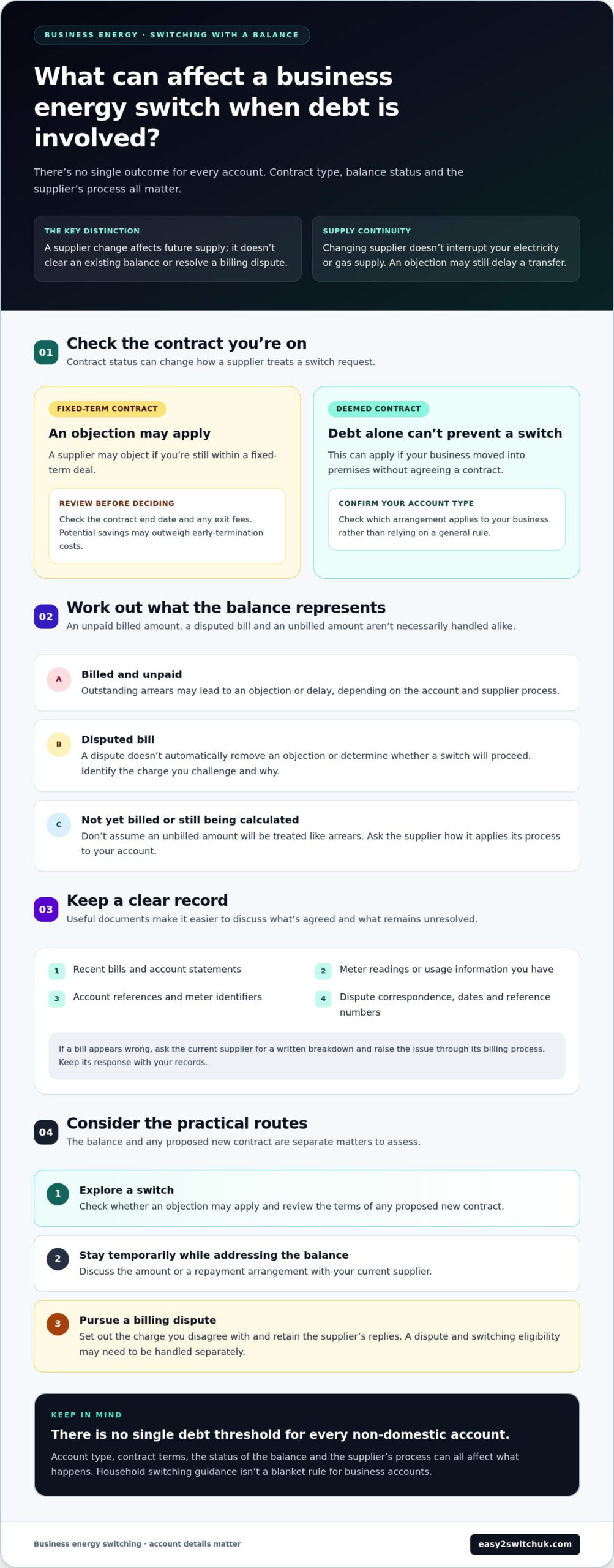
What to check before switching business energy with an outstanding balance
A little preparation can make it easier to understand your account and discuss realistic next steps. If you’re wondering whether you can switch business energy supplier with debt, work through these checks in order. They won’t guarantee that a switch will go ahead, but they can help you identify missing information and avoid confusing an old balance with a new offer.
Use this ordered checklist
- Identify the account. Confirm the business name and supply address shown on your latest bill, and note the account reference. If applicable, record the electricity MPAN and gas MPRN so the supplies can be identified accurately.
- Verify the balance. Compare the supplier’s stated amount with recent bills and payments. Separate billed charges from amounts you dispute or that are still being calculated. Keep the relevant bills, account messages and dispute correspondence together, with dates and reference numbers.
- Review the contract. Check whether the agreement is fixed-term, when it ends, and what the terms say about leaving early. If there are exit fees, weigh them against potential savings, which may outweigh early-termination costs. Don’t assume a lower quoted rate will automatically make a move worthwhile.
- Explore suitable options. Once you have the account details and contract information, consider whether to enquire about a switch, resolve an account query first, or do both in parallel. A supplier’s process and the circumstances of the balance may affect whether a transfer can proceed.
Gather the business energy account information
Keep a single folder, digital or paper, for the latest bills, contract details, account reference and any records of payments or disputed charges. Note which figures you accept and which you’re questioning. If the supplier has sent messages about the balance or a switch request, save them with the date received. Clear records help you explain the issue consistently and track what has been answered and what remains open.
Review contract terms and ask for tailored support
Easy2Switch provides contract support on timing, suitability and set-up monitoring. A switch usually takes 2-3 weeks, depending on the supplier, and an outstanding balance or supplier objection may affect the process. The energy supply continues during a supplier switch, so the transfer itself doesn’t mean your premises lose gas or electricity. That doesn’t resolve an old balance, so keep following up on it separately.
Quick summary: identify the account, verify what’s owed, review contract terms, then explore your options with the relevant details to hand. For tailored business energy support as you assess your next step, explore business energy support.
How Easy2Switch can help you explore business energy options
Working out whether you can switch business energy supplier with debt can involve two separate questions: what options may suit your business, and what needs to happen with your current account. Easy2Switch helps you compare electricity and gas offers from a wide range of suppliers while keeping contract details and account questions in view. It’s an independent broker, not an energy supplier, so your gas or electricity continues to come from the supplier you choose.
There’s no charge or obligation to receive a quote or advice through Easy2Switch. If you choose an offer, the selected supplier pays commission, which is built into the tariff price. This is how the brokerage service is funded. Easy2Switch aims to remain impartial and act in customers’ best interests as it compares suitable business energy options.
What support can a business expect?
You’ll have access to a dedicated personal Account Manager who can provide direct telephone support. Easy2Switch also provides contract support and billing and dispute help in most cases. This can help you understand contract timing, suitability and set-up, or organise the information relevant to a billing query. Your Account Manager can guide you through the process while you continue to deal with your current supplier about an outstanding account balance.
Over 90% of proposed contracts are accepted. That figure describes proposed contracts overall; it isn’t a promise that a specific offer will be accepted, especially where account circumstances or supplier processes affect the decision. If an outstanding balance is involved, keep that issue distinct from comparing future energy terms and continue dealing with the current supplier about the account.
How to take the next step with confidence
Bring the relevant details together before comparing: your latest bills, account reference, supply identifiers, contract end date and any correspondence about a balance or dispute. These details help make the comparison more relevant and give your Account Manager context for discussing contract timing and suitability. A quote or advice is free to use and doesn’t commit you to taking an offer.
Easy2Switch promises to treat customers with respect, be honest, open and fair, remain impartial, deliver what it promises and act in customers’ best interests. It abides by the Data Protection Act, FCA, TPI Code of Practice and Business Protection from Misleading Marketing Regulations 2008. Its Trustpilot rating is 4.6 from 49 reviewers.
Use the comparison to understand possible options, then decide at your own pace. Get a free business energy comparison with no obligation.
Take the next step with a clearer picture
Debt can make an energy decision feel like an all-or-nothing choice. It doesn’t have to. You can separate the question of what your current supplier says is owed from the question of whether another contract could suit your business. That gives you a practical way to move forward without assuming a switch will be accepted or waiting for every uncertainty to disappear.
If you’re still asking, “can you switch business energy supplier with debt”, use your account information to explore the options relevant to your circumstances. Be ready to explain what’s outstanding, what you dispute and what your current contract allows. A comparison can help you decide what to investigate next, while you continue addressing unresolved account matters through the appropriate process.
Take the next step at your pace. Get a free business energy comparison and explore suitable options with support from Easy2Switch. A clearer view of your choices can help you make a considered decision for your business.
Frequently Asked Questions
Can a business energy supplier refuse a switch because of debt?
It may, but there’s no single answer for every business account. The balance, contract status, type of debt and supplier’s process can all matter. Before deciding whether to proceed, compare the supplier’s explanation with your contract and account records. Easy2Switch provides contract support and billing and dispute help in most cases to help you understand your options.
Does switching business energy clear an outstanding balance?
No. A supplier change shouldn’t be treated as cancelling debt. The former supplier may still contact your business about an amount it believes remains due, so keep a record of payments and any challenge to the account. Request a statement that separates charges, payments and credits, then query discrepancies in writing. Any repayment arrangement is a separate matter, so keep its terms clear and recorded.
Can I switch business energy if I dispute the bill?
Possibly, but a dispute alone doesn’t tell you whether a switch will be accepted. Keep the invoice, account messages, relevant meter details and evidence that supports your position, such as a payment record or reading. Ask the supplier to identify which amount is disputed and which it considers payable. This helps you discuss the billing issue clearly while checking switching eligibility as a separate question.
Can I switch a business energy supplier during a fixed contract if I owe money?
Check the contract end date, termination terms and any exit fees before making a decision. Debt and the fixed-term agreement are distinct issues, and either may affect the next step. Compare any potential savings with early-termination costs, as savings may outweigh those costs depending on the figures and terms. Don’t assume the switch can proceed until the relevant contract conditions and supplier process have been considered.
Will switching business energy with debt interrupt my supply?
No. A supplier switch causes no downtime or disruption to the energy supply, so your business shouldn’t expect its electricity or gas to stop during the transfer. That’s separate from whether a supplier will accept or object to a particular switch request. Keep the balance or dispute discussion focused on account handling, rather than treating it as a reason to expect an interruption.
How long does a business energy switch take if there is an outstanding balance?
Easy2Switch says a switch usually takes 2-3 weeks, depending on the supplier. That’s a general timeframe, not a guaranteed completion date for an account with debt. An outstanding balance or supplier objection may affect the process, so discuss the circumstances of your account with your Account Manager as you consider your options.
Is it free to get help comparing business energy suppliers when my account has debt?
Yes. Easy2Switch’s quote and advice service is free to use and creates no obligation. Easy2Switch compares electricity and gas offers from a wide range of suppliers but doesn’t supply energy itself. If you select an offer, the chosen supplier pays commission, which is built into the tariff. You can explore options without paying for a quote while keeping your existing balance as a separate issue.
