
One renewal date can bring a multi-site clinic’s electricity portfolio under one supplier. Business energy contracts for private healthcare clinics can be switched, and a healthcare group can consolidate electricity purchasing across sites. Changing the retail supplier does not change the site’s physical energy supply.
Continuity for staff and patients matters, as does keeping energy costs under control. A coordinated contract approach can make renewals easier to manage across several properties, rather than treating every site as a separate decision.
This guide explains how switching works, what to compare between contracts, how broker commission disclosure fits into the process and what can influence energy costs across healthcare properties. You’ll also see how centralised procurement can help bring contracts into line, and when a tailored business energy brokerage service may be a practical next step.
Key Takeaways
- Review each site’s contract and renewal timing together to spot opportunities to align procurement and avoid unmanaged renewals.
- Understand how broker commission is disclosed, then compare contract terms and overall fit rather than focusing on the unit rate alone.
- Use each property’s energy use and operating pattern to guide procurement decisions and identify practical ways to manage costs.
- Consider Business Energy Brokerage when coordinating energy contracts across healthcare properties would simplify the process.
Can a healthcare provider switch electricity supplier?
Yes. A healthcare organisation can switch its electricity supplier and review contract dates across its premises. Changing the retail supplier does not alter a site’s physical supply or backup generation.
Electricity Contract and Renewal Reviews
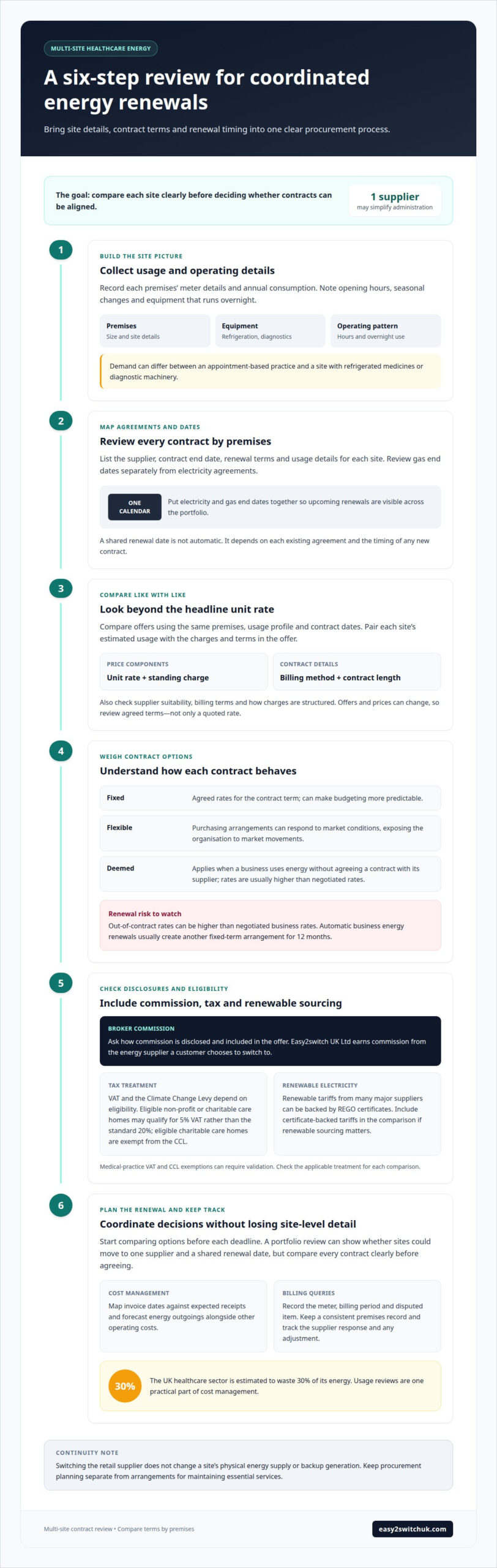
Review each electricity agreement alongside its renewal date, site and usage details. A dental practice group, for example, may have separate suppliers and contract dates across its premises. A portfolio review can show whether contracts could move to one supplier and a shared renewal date. Before planning a switch, check the agreed end date and renewal terms for each supply.
Common renewal dates are not automatic: they depend on each existing agreement and the timing of any new contract. Review each site’s commercial gas contract end date separately from its electricity agreement. Renewable electricity tariffs from many major suppliers can be backed by REGO certificates. If renewable sourcing matters to your organisation, include the certificate-backed tariff in your comparison.
Contract Renewal Risks
Out-of-contract rates can be higher than negotiated business rates, so a missed renewal can affect a clinic’s costs. Automatic business energy renewals can create another fixed-term arrangement, usually for 12 months. Put electricity and gas end dates into one renewal calendar, then begin comparing options before each deadline.
Offers and prices can change, so compare the agreed terms and renewal timing, not just a quoted rate. Supplier failure is a separate issue from switching: changing the retail supplier does not change a site’s physical supply or backup generation. Keep procurement planning separate from the clinic’s arrangements for maintaining essential services.
For a multi-site group, organise electricity and gas reviews by premises, supplier and contract end date. One supplier and one renewal date can simplify administration, but compare each contract clearly before agreeing to it. Microbusiness suppliers must provide renewal-price information before a contract ends. Start your review early enough to assess the terms and avoid an automatic rollover.
Commission disclosure and contract comparisons
A useful comparison goes beyond the headline electricity rate. For healthcare practices, billing terms, contract type, supplier suitability and any broker commission all matter.
Healthcare Tariff and Supplier Comparisons
Compare tariffs using the same premises, usage profile and contract dates. Check the unit rate, standing charge, billing method and agreed contract length. A dental practice with refrigeration or diagnostic equipment may use energy differently from an office-based clinic, so compare like with like.
Ask how broker commission is disclosed and included in the offer. Easy2switch UK Ltd earns commission from the energy supplier a customer chooses to switch to. That commission should be clear when you assess the available contract and its overall value.
Available Business Energy Contracts
UK clinics can consider fixed, flexible and deemed contracts. A fixed contract sets agreed rates for its term; a flexible contract allows purchasing arrangements to respond to market conditions. A deemed contract applies when a business uses energy without agreeing a contract with its supplier, and its rates are usually higher than negotiated rates.
Terms vary by supplier and offer. Compare how charges are structured, which elements can change and how billing works. A fixed rate can make budgeting more predictable, while flexible purchasing exposes an organisation to market movements. Weigh these trade-offs against the clinic’s priorities.
VAT and the Climate Change Levy (CCL) depend on eligibility. Eligible non-profit or charitable care homes may qualify for 5% VAT rather than the standard 20%, and eligible charitable care homes are exempt from the CCL. Medical practices can have VAT and CCL exemptions requiring validation, so account for applicable tax treatment in each comparison.
Energy needs also vary by premises. Refrigerated medicines and diagnostic machinery can contribute to electricity demand, while extended opening hours can shift when a clinic uses energy. Compare tariffs with the actual operating pattern, including evening or overnight use, rather than assuming a dental practice and a larger medical centre need the same arrangement.
A broker-led business energy contract comparison can bring tariff terms and commission into one review.
Energy procurement and cost management for healthcare providers
One annual energy average cannot guide every UK private clinic. Consumption depends on premises size, opening hours, equipment, heating, ventilation and refrigeration. Estimate usage from each meter’s annual consumption, then pair it with the contract’s unit rates and standing charges. Reviewing business energy contracts for private healthcare clinics this way gives providers a more relevant view of consumption and potential bills.
Procurement starts with a reliable picture of demand. Group electricity and gas bills by site, note seasonal changes, and identify equipment that runs overnight. A clinic with medicine refrigeration or diagnostic machinery may use power differently from an appointment-based practice. The UK healthcare sector is estimated to waste 30% of its energy, making usage reviews a practical part of cost management.
Protect cash flow by mapping energy invoice dates against expected receipts. Patient payments or insurer reimbursements may arrive on different schedules, so forecast energy outgoings alongside other operating costs. If a bill looks wrong, record the meter, billing period and disputed item. Send a clear query with supporting details, then track the supplier’s response and any adjustment against the next statement.
Manage billing queries with a consistent record for every premises. Log the account reference, issue, submission date, supporting meter information and resolution. This helps finance teams spot repeated billing errors across the estate and distinguish an estimated reading from an actual one. Assign an owner to each open query and track it through to resolution.
When comparing business energy contracts for private healthcare clinics, match each site’s demand profile to the proposed terms, not just its latest bill. Check that opening hours, seasonal demand and essential equipment are reflected in the usage assumptions. Review the results across all premises before agreeing procurement terms. This helps your organisation budget with a clearer view of site-level differences.
Consolidating energy contracts across healthcare properties
A central procurement plan can bring separate healthcare premises into one portfolio review. A group may have different electricity suppliers, contract terms and renewal dates at each site. Consolidation means assessing those contracts together, then considering whether one supplier and a shared renewal date suit the organisation. It does not mean every meter or bill becomes one account.
Start with a property schedule listing each site’s supplier, fuel, contract end date, meter details and consumption. Compare the records to identify mismatched terms and renewal windows. Then assess whether each premises can join a common purchasing arrangement or needs an individual contract. A dental clinic and a larger site with extended operating hours may have different demand profiles, even within one group.
Portfolio purchasing can make contract administration more consistent, but comparisons still need site-level detail. Review unit rates, standing charges, contract lengths and billing arrangements across the estate. Keep patient-facing operations in view when planning contract changes, and coordinate intended start dates with each site’s needs. A shared renewal date can simplify future reviews, while individual consumption still needs monitoring.
That example shows why timing and combined demand can matter, but it isn’t a forecast for clinics. An energy broker can assess the portfolio and explain the available contract options. Include any broker commission in the comparison, noting who pays it and how it affects the offer.
For a multi-property organisation, the practical takeaway is to centralise the review while preserving each site’s usage and contract details. This makes differences visible before agreeing a portfolio approach. Arrange a multi-site energy contract review to explore procurement across healthcare properties.
Easy2switch UK Ltd: Business Energy Brokerage
Easy2switch UK Ltd helps healthcare organisations compare electricity and gas contracts through its Business Energy Brokerage service. It reviews supplier offers to find options suited to the organisation’s needs, then supports the switching process. This can help when several premises have different contracts or a renewal is approaching.
Easy2switch UK Ltd earns commission from the energy supplier a customer chooses to switch to. This arrangement is useful context when assessing a comparison and the contract together. Share the relevant site and contract details to discuss your requirements and procurement priorities.
Contact Easy2switch UK Ltd to discuss energy contracts for your healthcare properties.
Make your next energy review work across every site
Reviewing business energy contracts for private healthcare clinics is a useful opportunity to improve how energy decisions are managed. Instead of treating each renewal as an isolated task, set a process for tracking contract dates, comparing offers and aligning procurement with each site’s needs. This gives your organisation a clearer basis for planning future decisions.
Choose a next step that fits your current position. If a renewal is approaching, gather the relevant contract and site information. If your properties have different suppliers or terms, start by building a joined-up view. Clear priorities make it easier to compare options and keep energy procurement connected to wider operational planning.
Easy2switch UK Ltd offers Business Energy Brokerage to support businesses reviewing their energy contracts. Start a conversation with Easy2switch UK Ltd about your healthcare properties and procurement priorities. A considered review can help you take a more organised approach to the next energy decision.
Frequently Asked Questions
Can multi-site healthcare groups consolidate electricity?
Yes, a group can procure electricity across multiple healthcare premises as a portfolio. For example, a central finance team can coordinate tender timing while site managers provide meter and usage records for each location. The supplier may still issue separate bills for individual meters. Treat consolidation as a shared purchasing strategy, then confirm how each site will be contracted and billed.
Can you manage multiple sites under one agreement?
Sometimes, but a single portfolio arrangement does not always mean one contract covers every meter. Suppliers may structure offers around site eligibility, consumption or existing contract dates. A group with clinics and diagnostic centres can request a portfolio proposal, then compare its terms with site-by-site offers. Check whether additions, closures or changes to a location’s use affect the agreement.
How To Save On Energy Bills In Healthcare?
Start with avoidable consumption, without compromising patient care or equipment requirements. Review heating schedules, lighting, and whether rooms remain lit or heated when unused. Turning thermostats down by 1° can save up to £60 per year. Assign facilities staff to record recurring out-of-hours use, then compare meter readings before and after each change to see where further action makes sense.
How does a broker get lower rates than a direct quote?
A broker does not automatically secure a lower rate than a direct supplier quote. The practical benefit is comparing offers from different suppliers against the same usage and contract requirements. For a clinic, compare the broker’s available terms with any direct offer, including standing charges and contract conditions. Assess the full proposal, not just an advertised unit rate.
How do business electricity and gas prices for UK healthcare clinics compare by supplier and contract type?
There is no single standard price for UK clinics. Supplier offers vary with consumption, meter details, contract start date and contract type. A fixed tariff sets rates for an agreed term, while flexible purchasing can respond to market movements; deemed rates are usually higher than negotiated rates. Compare electricity and gas separately, using the same site data and proposed start period.
How can a private healthcare clinic compare business energy quotes and suppliers?
Give each supplier the same premises information, annual usage and intended contract start date. Compare electricity and gas separately, then assess unit rates, standing charges, payment terms and exit conditions together. For example, a clinic with evening appointments should avoid comparing a quote based on daytime-only assumptions. Record the full projected charges and terms in one table before selecting an offer.
