
Could a single document be the difference between a rejected budget and thousands of pounds in annual savings? With transmission network charges rising by 94% this year, simply presenting a cheaper unit rate isn’t enough to satisfy a board of directors anymore. You need a structured business case template for switching energy supplier that addresses market volatility and non-commodity costs head-on. It’s understandable if you’re feeling overwhelmed by the sheer volume of tariffs or the fear of hidden exit fees, especially when you have to explain these technical variables to non-specialist stakeholders.
We agree that procurement shouldn’t feel like a gamble. You deserve a clear, evidence-based path to lower overheads without the stress of complex market jargon. This article provides you with a professional framework designed to secure stakeholder approval by demonstrating clear ROI and robust risk mitigation. We’ll walk you through the essential components of a 2026 energy proposal, from calculating the impact of the new 0.801p/kWh Climate Change Levy to streamlining your transition for maximum efficiency.
Key Takeaways
- Align your energy procurement with Net Zero targets to transform a simple supplier switch into a strategic, board-level corporate priority.
- Utilise a structured business case template for switching energy supplier to present a professional argument that secures budget approval and stakeholder buy-in.
- Quantify the true financial impact of your transition by calculating total ROI, including the effects of rising network charges and the 2026 Climate Change Levy main rates.
- Mitigate commercial risks by identifying key contract terms and supplier viability markers that protect your organization from hidden fees and exit penalties.
- Streamline your implementation plan with a management framework that leverages specialist expertise in the UK farming and SME sectors for a seamless transition.
The Strategic Case: Aligning Energy with Business Goals
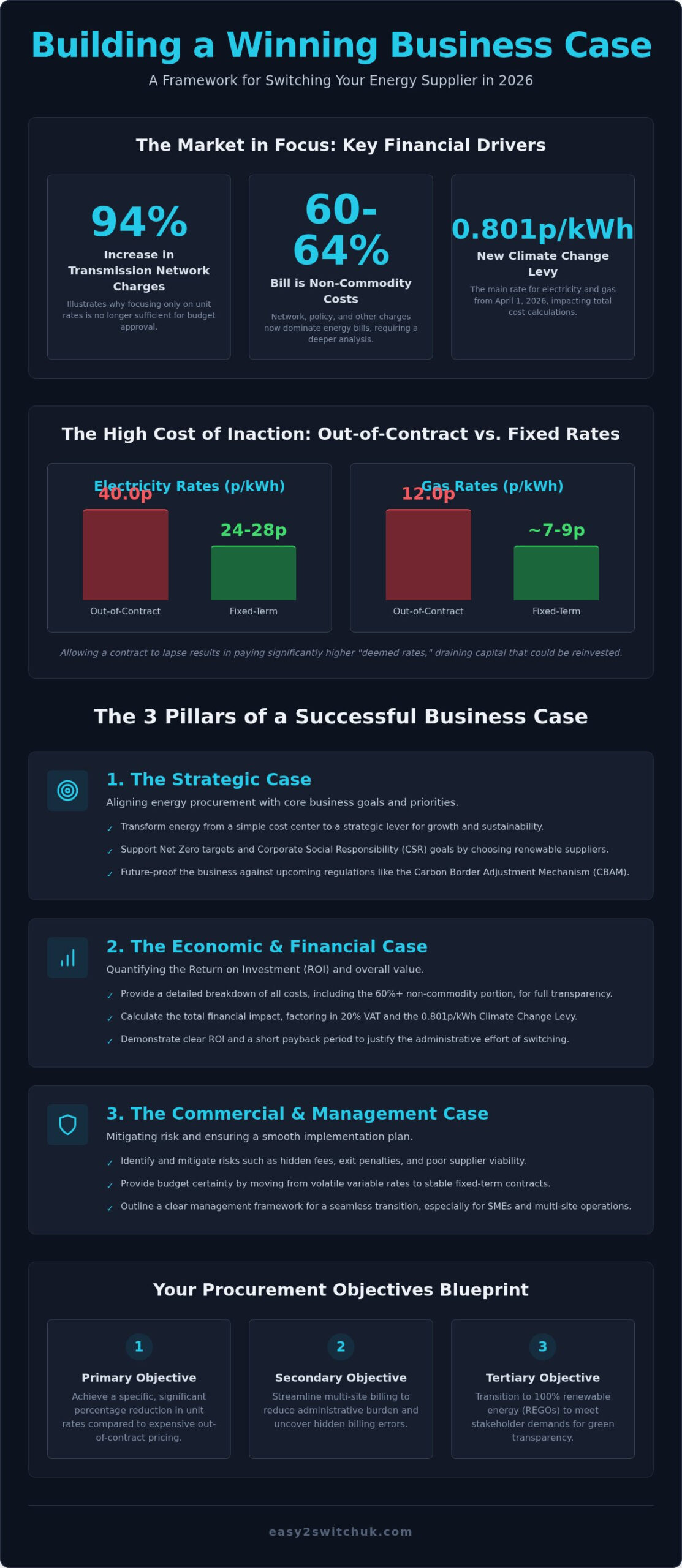
In 2026, energy procurement has moved from a back-office admin task to a critical board-level priority. Wholesale markets remain volatile, and non-commodity costs, including network and policy charges, now make up approximately 60-64% of a typical business electricity bill. This section of your business case template for switching energy supplier must explain why energy isn’t just a cost center, but a strategic lever for growth. The strategic case serves as the bridge between utility costs and business growth, ensuring that every pound spent on energy supports your long-term operational goals.
Aligning your procurement with Net Zero targets is no longer a luxury for large corporations; it’s a requirement for many modern supply chains. Switching supports your corporate social responsibility (CSR) goals by moving your operations toward carbon neutrality. By selecting suppliers with high renewable mixes, you’re future-proofing your brand against upcoming regulations like the Carbon Border Adjustment Mechanism (CBAM) arriving in 2027. Gaining a deeper understanding energy market competition allows you to see that a switch is a tool for consumer independence rather than just a financial transaction.
Identifying the Problem Statement
The cost of inaction is often the highest price a business pays. If you’ve allowed your previous contract to lapse, you’re likely paying “deemed rates” or out-of-contract prices. In July 2026, out-of-contract electricity rates are approximately 40.0p per kWh, compared to fixed-term rates in the 24-28p band. For gas, the gap is equally stark, with out-of-contract rates around 12.0p per kWh. This financial drain isn’t just a line item; it’s capital that could be reinvested into your team or equipment. Addressing these “Deemed Rates” immediately stops the unnecessary outflow of cash.
Setting Clear Procurement Objectives
A successful business case requires measurable targets. When you use a business case template for switching energy supplier, your objectives should be tiered to address different levels of the organization:
- Primary Objective: Achieving a specific percentage reduction in unit rates, typically targeting a significant drop compared to expensive out-of-contract pricing.
- Secondary Objective: Streamlining multi-site billing. For farms or regional franchises, managing dozens of separate invoices is an administrative nightmare that often hides costly billing errors.
- Tertiary Objective: Transitioning to 100% renewable energy certificates (REGOs) to satisfy stakeholder demands for green energy transparency.
Moving from volatile variable rates to fixed-term stability provides the budget certainty your finance team craves. It protects your bottom line from global market spikes and ensures that your operational resilience remains high by partnering with reputable Tier 1 suppliers. This proactive approach allows you to take control of your overheads before market shifts dictate your profitability.
The Economic and Financial Case: Quantifying the ROI
Your business case template for switching energy supplier must distinguish between economic value and immediate financial impact. While the economic case assesses “Value for Money” (VfM) by looking at long term stability and supplier service levels, the financial case focuses on the hard numbers hitting your bank account. In 2026, a professional proposal requires more than a simple price comparison; it needs to account for the fact that non-commodity costs, such as network and policy fees, now represent over 60% of your total bill. By providing a detailed breakdown of these variables, you demonstrate to stakeholders that you’ve accounted for the full scope of the current energy market.
Calculating the payback period is essential for justifying the administrative time spent on the transition. You’ll need to factor in the 20% VAT rate applicable to most businesses and the Climate Change Levy (CCL), which rose to 0.801p/kWh for both electricity and gas on April 1, 2026. Following official Ofgem switching guidance ensures your process remains compliant and transparent throughout the procurement cycle. Our specialists at Easy2switch UK Ltd can provide the raw data required to populate these financial models, ensuring your ROI projections are grounded in current market realities rather than estimates.
Total Cost of Ownership (TCO) Analysis
A true TCO analysis looks beyond the headline unit rate (p/kWh) to evaluate the total annual spend. For larger industrial sites or intensive farming operations, capacity charges can significantly inflate costs if they aren’t managed correctly during the tender process. You must also identify any potential exit fees from your current provider. Many suppliers include these penalties in the fine print of “evergreen” contracts, so identifying and mitigating these costs early is vital for a clean break. Comparing a fixed rate of 24 to 28 p/kWh against the standard 40.0p per kWh out-of-contract rate provides the clear evidence of savings needed for board approval.
Sensitivity Analysis: Preparing for Market Volatility
Market conditions in 2026 remain reactive to global events, making sensitivity analysis a requirement for any robust financial forecast. By creating “Best Case” and “Worst Case” scenarios, you show stakeholders how your budget holds up under different wholesale price points. For a 100,000 kWh annual user, a 1p difference in the unit rate results in a £1,000 variance in annual spend before taxes and levies are applied. This level of detail proves that your procurement strategy is resilient. Whether you choose the security of a fixed term or the potential upside of a flexible contract, your financial case must reflect a commitment to taking control of your energy future.
The Commercial and Management Case: Risk and Implementation
The transition from financial projections to practical execution requires a robust commercial and management strategy. In a professional business case template for switching energy supplier, the commercial case evaluates whether a supplier is a viable long term partner. It’s easy to be distracted by the lowest unit rate, but a failure to assess a provider’s creditworthiness or customer service record can lead to administrative headaches later. We focus on ensuring that your contract terms are transparent and that any security deposit requirements are identified well before you sign on the dotted line.
The management case outlines the “who, how, and when” of the procurement process. It addresses the common anxiety regarding potential downtime or loss of supply during the transition. It’s vital to reassure stakeholders that the physical flow of gas or electricity never stops. The switch is purely an administrative update to the national registry, and the wires and pipes remain exactly as they are. By documenting these safeguards, you move the project from a perceived risk to a controlled business improvement.
Supplier Due Diligence
Your selection criteria must balance cost with reliability. While a Tier 2 supplier might offer a slightly lower rate, their customer service ratings or billing accuracy might not meet your operational standards. Understanding the “Terms and Conditions” is paramount; some contracts include clauses regarding credit check requirements that could trigger a request for a security deposit. We help you navigate these complexities by verifying that your chosen supplier offers a “No-Interruption” guarantee. This ensures that your business stays powered while your overheads decrease.
Resource Allocation and the “Done-for-You” Model
A significant hurdle in any management case is the demand on internal staff. Without external support, your finance team could spend dozens of hours comparing hundreds of tariffs and chasing supplier documentation. By utilizing an energy broker, you effectively gain an outsourced procurement department at no upfront cost. The primary requirement from your side is a Letter of Authority (LOA). This document empowers us to gather your usage data and manage the transition on your behalf, reducing your internal workload to a few simple approval emails. From the moment the LOA is signed, the timeline to live supply typically follows a structured path of 15 to 30 days, depending on your current contract status and the new supplier’s onboarding speed.
Business Case Template: A Section-by-Section Blueprint
To move from a conceptual idea to a signed contract, your proposal needs a logical structure that speaks the language of your board. Using a standardized business case template for switching energy supplier ensures that no critical detail is overlooked, from the initial audit to the final sign-off. This blueprint provides a clear roadmap for presenting your findings, allowing stakeholders to see the transition as a controlled, low-risk improvement to the company’s financial health. By following this sequence, you transform a complex procurement task into a straightforward decision for your directors.
Copy-Paste Content for Your Executive Summary
The executive summary is your “elevator pitch.” It should be concise, focusing on the bottom-line benefits and the ease of the transition. We recommend using active phrasing like “mitigating market exposure” and “optimising overheads” to align with corporate growth strategies. It’s vital to highlight the “zero cost” management model early. Because our brokerage service earns commission from the suppliers, there are no upfront fees for the business case or the switch itself. This effectively removes the primary budget objection before the board even reaches the financial breakdown.
The Options Appraisal Framework
A professional business case template for switching energy supplier must include a comparison of different paths. Presenting a three-option table is the most effective way to demonstrate due diligence. We suggest weighting your criteria to reflect modern business priorities: 60% for Price, 20% for Reliability, and 20% for Sustainability. Your table should compare the following:
- Option 1: Do Nothing. Continue on expensive out-of-contract rates, which often leads to significant budget leakage.
- Option 2: Direct Negotiation. Attempting to contact suppliers individually, which is time-intensive and often limits your access to niche agricultural or SME-specific tariffs.
- Option 3: Independent Consultancy. Partnering with a specialist like Easy2switch UK Ltd to access hundreds of supplier offers and impartial market expertise at no cost to your business.
Your “Proposed Solution” section should then detail the chosen supplier and the projected savings against your current spend. Finally, the “Recommendation and Approval” section must provide a clear call to action. Don’t leave the board wondering what to do next; provide a signature block and a defined deadline for the switch. This creates a sense of momentum, moving your business quickly from curiosity to confidence in its new energy strategy.
Executing Your Business Case with Easy2switch UK Ltd
Transitioning from a theoretical blueprint to actual market execution requires access to precise, real-time data. While your business case template for switching energy supplier provides the necessary structure, Easy2switch UK Ltd delivers the specific market intelligence needed to populate it. We don’t just provide headline rates; we offer a comprehensive analysis that accounts for the complex non-commodity variables discussed earlier. This level of granular detail ensures your proposal is robust enough to withstand rigorous questioning from your finance director or board of trustees.
As a Reliable Specialist, we bring a level of regional accountability that generic comparison sites simply cannot match. We understand that a dairy farm in the countryside has vastly different peak-load requirements than a high-street charity or a city-based SME. By leveraging our expertise in niche agricultural tariffs and business-specific energy profiles, we help you identify the best individual fit for your organization. We take on the entire Management Case burden, handling the supplier communications and administrative hurdles so you can focus on your core operations while we secure your savings.
Our Done-for-You Switching Process
We’ve streamlined the procurement journey into three logical stages that mirror the efficiency of our service. First, the Free Energy Review establishes your baseline by auditing your current consumption patterns and identifying your specific contract end dates. Next, we move to Market Tendering, where we access hundreds of offers from across the UK market to find the most competitive fixed-term contracts. Finally, we manage the Transition, overseeing the handover to your new supplier to ensure the process is effortless and entirely friction-free for your team.
Take Control of Your Energy Costs Today
The transition to a new energy supplier is more than just a financial transaction; it’s a way for your business to take control of its own independence. Moving from a passive payer to an active procurer allows you to mitigate the risks of market volatility and rising network costs before they impact your bottom line. Our commission-based model ensures that you receive professional consultancy and specialist support without any upfront fees. Get your free energy review and template data from Easy2switch UK Ltd to move your business from curiosity to confidence today.
Take Control of Your 2026 Energy Strategy
Securing board approval for a supplier transition doesn’t have to be an uphill battle. By using a structured business case template for switching energy supplier, you’ve laid the groundwork for a more resilient, cost-efficient organization. You now have the framework to align utility costs with Net Zero goals while protecting your bottom line from market volatility. Remember that the “cost of inaction” is often your highest expense; staying on out-of-contract rates can drain thousands from your budget before you even realize a notice period has passed.
Our team at Easy2switch UK is here to simplify the remaining steps. We provide no-obligation energy reviews and specialist support for UK farmers and SMEs, ensuring your data is accurate and your transition is seamless. Because we operate a zero-fee brokerage model, you gain access to hundreds of tariffs without adding a penny to your procurement budget. It’s time to move from being a passive payer to an empowered procurer. Download Your Data for the Business Case – Get a Free Quote today and start your journey toward lower overheads with confidence.
Frequently Asked Questions
What are the 5 cases in a business case for energy switching?
A professional proposal follows the standard UK procurement model, consisting of the Strategic, Economic, Financial, Commercial, and Management cases. These sections ensure you address everything from corporate Net Zero goals to the practical implementation and risk mitigation of the switch. Using this structured approach helps secure board approval by proving the decision is grounded in logic rather than just a lower unit rate.
How much can a business typically save by switching energy suppliers in 2026?
Savings vary based on your consumption, but moving from out-of-contract rates to a fixed 2026 tariff offers a significant reduction in overheads. In July 2026, out-of-contract electricity rates are approximately 40.0p per kWh, while fixed rates for small businesses sit in the 24-28p per kWh band. This price gap allows many organizations to reduce their unit costs by over 30% while locking in budget certainty for the year ahead.
Do I need a business case for a small SME energy switch?
Yes, even smaller organizations benefit from a basic framework to justify the decision to partners or for internal financial records. A business case template for switching energy supplier helps an SME owner track ROI and identify hidden costs like the 0.801p/kWh Climate Change Levy. It transforms a routine admin task into a strategic move that protects tight profit margins from market volatility.
How long does it take to write a professional business case for energy?
Writing a comprehensive case can take several days if you are manually auditing bills and comparing hundreds of tariffs across the market. However, when you partner with a specialist to provide the raw data and market analysis, the process is streamlined significantly. Most businesses can finalize their proposal in a few hours once they have the baseline consumption data and verified 2026 market rates in hand.
Can I switch energy suppliers if my business is currently in debt?
You can generally switch if the debt has been on your account for less than 28 days. If the debt is older, your current supplier has the right to object to the switch until the arrears are cleared. It’s usually best to settle outstanding balances or agree on a repayment plan before initiating the transition to ensure a smooth handover between providers.
What is a Letter of Authority (LOA) and why is it in the business case?
A Letter of Authority is a legal document that empowers a broker to gather usage data and negotiate with suppliers on your behalf. It’s a vital part of the Management Case because it proves you have a plan to outsource the administrative burden. By signing an LOA, you reduce the internal workload for your finance team, allowing specialists to handle the complex data gathering required for a successful switch.
Is a business energy broker really free to use?
Yes, many reputable brokers operate on a commission-based model where the energy supplier pays the fee directly. This means there are no upfront costs or consultancy fees for your business to pay. The commission is typically a small, transparent part of the unit rate, which allows you to access expert market knowledge and “done-for-you” management at zero cost to your organization.
What happens to my energy supply during the switch?
Your physical energy supply will not be interrupted at any point during the transition to a new provider. The switch is a purely administrative update to the national registry, so you’ll continue to use the same wires, pipes, and meters you have now. There’s no need for any engineers to visit your site, and your business remains fully operational throughout the entire process.
