
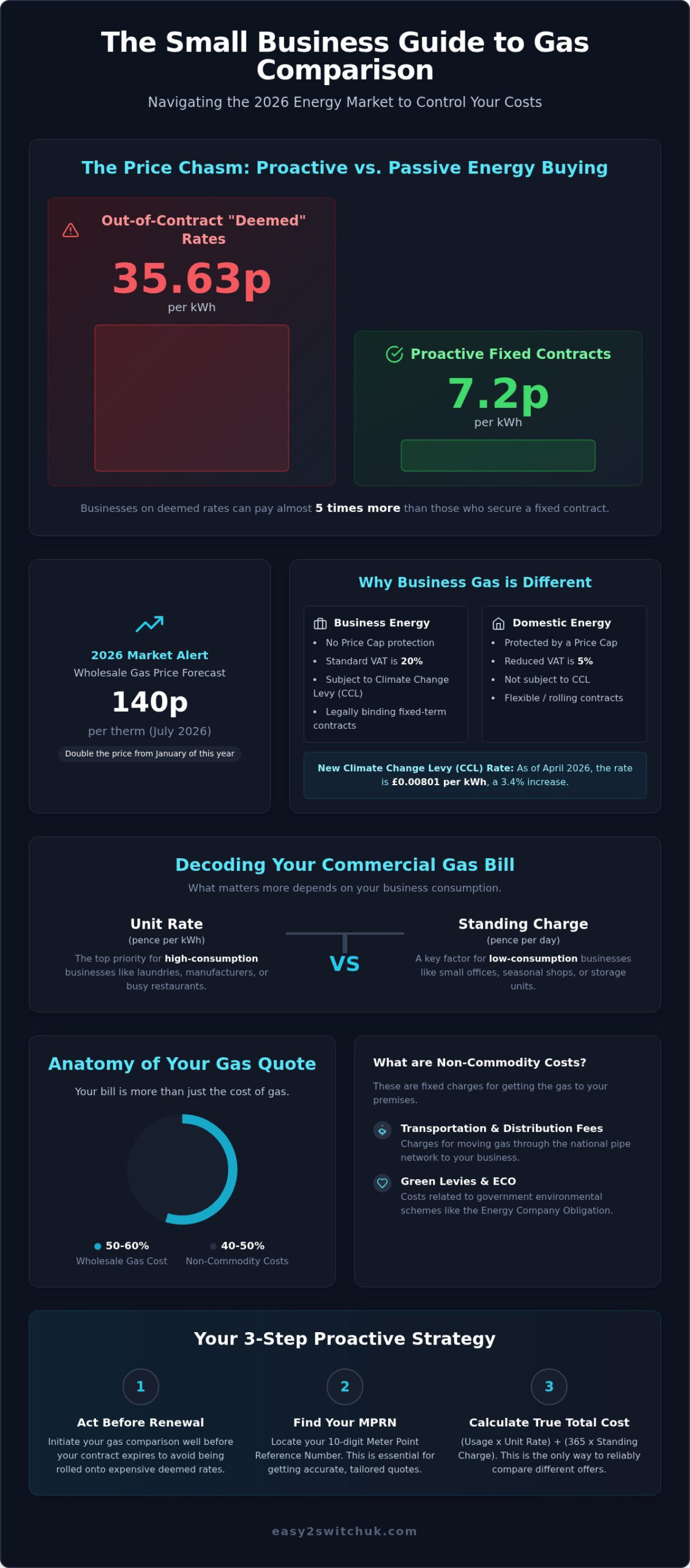
Did you know that businesses caught on “deemed” rates are currently paying an average of 35.63p per kWh, while proactive firms are securing fixed contracts for as little as 7.2p? With wholesale gas prices hitting 140p per therm in July 2026, the gap between being prepared and being overcharged has never been wider. It’s exhausting to manage rising overheads when pricing structures feel intentionally opaque and your schedule is already stretched thin.
We understand that your priority is running your business, not monitoring global energy markets. This guide simplifies the small business gas comparison process by providing a pragmatic framework to help you master market complexities. You’ll learn how to secure the most competitive rates and achieve long-term budget certainty without the usual administrative headache. We’ll examine the impact of the latest Climate Change Levy increases, explain how to avoid expensive out-of-contract traps, and outline a streamlined path to lower annual expenditure through a managed switching process that puts you back in control of your bottom line.
Key Takeaways
- Learn why a proactive small business gas comparison is essential in 2026 to navigate market volatility and secure long-term budget stability.
- Identify the hidden costs in commercial energy bills and discover how to steer clear of expensive “deemed” or out-of-contract rates.
- Apply our expert 5-point framework to look beyond headline unit rates and calculate the true total value of any gas contract offer.
- Discover how sector-specific insights and a managed switching service remove the administrative burden while locking in the best individual fit for your business.
Navigating the 2026 Small Business Gas Market
Approaching your energy procurement as a strategic exercise rather than a simple chore is the first step toward long-term savings. In 2026, the market has shifted dramatically. Wholesale costs have surged to approximately 140p per therm, which is double the price seen in January of this year. This volatility means that a passive approach to renewals is no longer viable. A thorough small business gas comparison ensures you aren’t just looking for the lowest headline figure, but are instead evaluating the total value of a contract, including standing charges and term flexibility. A commercial gas comparison is a tool for financial independence, allowing you to reclaim control over your overheads in an unpredictable economy.
Why Business Gas Differs from Domestic Energy
Unlike the residential market, there is no standard price cap to protect small businesses from sudden spikes. This lack of a safety net makes comparison essential. Most businesses also face different tax obligations. While domestic users pay 5% VAT, most commercial entities pay 20%, alongside the Climate Change Levy (CCL). As of April 1, 2026, the main CCL rate for natural gas is £0.00801 per kWh, a 3.4% increase that directly impacts your bottom line. Because business contracts are legally binding for their full term, often ranging from one to five years, the stakes for choosing the right deal are significantly higher than they are at home.
The Impact of Market Volatility on SME Overheads
Global events continue to drive fluctuations in Natural gas prices, and these shifts eventually filter down to your monthly statement. If you wait until your current contract expires, you risk being rolled onto “deemed” rates, which currently average a staggering 35.63p per kWh. This “cost of waiting” can be devastating for a small firm’s cash flow. By initiating a small business gas comparison well before your renewal window opens, you can lock in a fixed-rate contract. These deals act as a financial shield, providing the budget certainty you need to plan your growth for 2026 without worrying about the next wholesale price hike.
Taking control of your energy costs doesn’t have to be a solo effort. Understanding these market drivers allows you to make informed decisions that protect your margins. When you treat energy as a manageable variable rather than a fixed burden, you position your business to thrive even when market conditions are challenging.
Understanding Commercial Gas Tariffs and Charges
Deciphering your energy statement is the first step toward reducing your overheads. Most business owners focus solely on the total amount due, but a successful small business gas comparison requires a closer look at the individual components of your tariff. Your bill is primarily split into two parts: the unit rate, which is the price you pay for every kilowatt-hour (kWh) of gas consumed, and the standing charge, a fixed daily fee that covers the cost of maintaining the connection. If you’ve allowed your previous contract to expire without renewing, you’re likely paying “deemed” or out-of-contract rates. These are the single biggest cost-traps in the industry, with prices often reaching 35.63p per kWh compared to negotiated rates that are significantly lower.
To begin a comparison, you’ll need your Meter Point Reference Number (MPRN). This unique 10-digit code identifies your specific gas supply point and allows brokers to access accurate data about your historical usage. Without it, quotes are based on estimates that might not reflect your actual needs. If you’re unsure where to find this, a business energy brokerage can help you locate your MPRN and handle the technical details of the switch for you.
Unit Rates vs. Standing Charges: Which Matters More?
The “best” deal depends entirely on how much gas your business uses. For high-consumption businesses, such as laundries or food manufacturers, securing the lowest possible unit rate is the priority because the volume of gas used far outweighs the daily standing charge. Conversely, a seasonal business or a small office with minimal heating needs might benefit from a slightly higher unit rate if it comes with a much lower standing charge. Calculating the “effective” cost involves multiplying your annual usage by the unit rate and adding 365 days of standing charges. This total figure is the only reliable way to compare two different quotes side-by-side.
The Hidden Components of Your Gas Quote
The price you see on a quote isn’t just the cost of the gas itself. Approximately 40% to 50% of your bill consists of non-commodity costs. These include transportation and distribution fees, which are the costs of moving gas through the national network of pipes to your premises. Suppliers also factor in green levies and the Energy Company Obligation (ECO). Finally, your business credit score plays a role in the final price. Suppliers often price-in risk for businesses with lower credit ratings, which can lead to higher security deposits or slightly inflated unit rates. Working with a specialist ensures these variables are managed transparently, giving you a clear path to a fair deal.
The 5-Point Framework for Comparing Gas Quotes
Many online platforms suggest that a simple postcode search is enough to find a deal. This is a mistake. A truly effective small business gas comparison requires a multi-layered approach to ensure you aren’t lured in by a teaser rate that hides high standing charges or restrictive terms. To find the genuine total contract value, you must look beyond the headline figure and evaluate how each supplier handles your specific consumption patterns. This framework provides the structure you need to move from curiosity to a confident decision.
Step 1: Accurate Data Collection
Data is the foundation of any procurement strategy. Without an accurate Annual Quantity (AQ) from your latest bill, you’re essentially guessing your future overheads. Estimated bills are a common pitfall; they often lead to inaccurate quotes that don’t reflect your actual usage. Before you start, locate your current contract end date and your Meter Point Reference Number (MPRN). Having these details ready ensures that the quotes you receive are bespoke to your meter rather than generic industry averages.
Step 2: Evaluating Contract Terms and Flexibility
In the volatile 2026 market, the structure of your contract is just as important as the price. Fixed-rate contracts are currently the preferred choice for SMEs seeking budget certainty, but you must check the fine print for auto-renewal clauses. These can trap you in expensive cycles if you miss a narrow termination window. Some suppliers now offer “blend and extend” options. These allow you to lower your current rate by extending your commitment if market prices drop, providing a rare opportunity for flexibility in a rigid market.
Step 3: Assessing Supplier Stability and Support
The cheapest supplier isn’t always the best partner for your business. Reliable specialists look for providers with strong service ratings and UK-based customer support. If a billing error occurs, you don’t want to be stuck in an automated phone queue. Consider these factors during your small business gas comparison:
- Smart Meter Compatibility: Does the supplier support automatic readings to end the cycle of estimated billing?
- Online Management Tools: Can you track your usage in real-time to identify potential wastage?
- Financial Stability: Given recent market exits, choosing an established supplier protects you from the stress of a sudden “Supplier of Last Resort” transition.
Normalizing your quotes is the final piece of the puzzle. This means calculating the total annual cost (usage multiplied by unit rate, plus 365 days of standing charges) for every offer. Only then can you see which supplier provides the best individual fit for your business goals.
Tailoring Gas Deals to Your Industry Sector
Treating every SME as a identical entity is a common mistake made by many generic comparison sites. Your energy needs are dictated by your daily operations, and a retail shop’s consumption profile looks nothing like that of a commercial greenhouse or a community center. A truly effective small business gas comparison recognizes these nuances. By identifying sector-specific savings, you can move beyond generic quotes and secure a contract that mirrors your actual usage patterns. For businesses operating across multiple locations, managing various meters under a single multi-site agreement can also simplify administration and provide stronger leverage during negotiations.
Farming and Agricultural Gas Needs
Agricultural businesses face unique challenges, particularly regarding extreme seasonality. Whether you’re managing high-volume gas use for grain drying in the autumn or maintaining consistent temperatures for livestock throughout the winter, your demand isn’t linear. Reliable specialists understand the rural energy landscape and the infrastructure limitations that often come with it. We focus on linking your gas procurement to wider farm sustainability goals, ensuring your contract provides the flexibility needed for fluctuating production cycles. If your farm has a Climate Change Agreement (CCA), you may even be eligible for an 89% discount on the Climate Change Levy, a significant saving that generic brokers often overlook. You can explore tailored options for your holding at easy2switchuk.com.
Charities and Non-Profit Organizations
Charities often operate on tight margins where every pound saved on utilities can be redirected toward core missions. One of the most frequent errors we see is non-profit organizations paying the standard 20% VAT rate. Most charities should only be paying 5% VAT on their energy bills, provided the gas is used for non-business purposes. Additionally, qualifying organizations are often entirely exempt from the Climate Change Levy (CCL). Securing these exemptions isn’t always automatic; it requires specific “charity-friendly” terms and the correct declaration certificates. A specialized small business gas comparison ensures these tax benefits are baked into your quote from day one, preventing the headache of claiming back overpaid tax later.
Taking control of your energy costs means understanding the specific levers available to your industry. When you stop viewing gas as a fixed overhead and start seeing it as a manageable variable, you empower your business to thrive. Industry-specific insights don’t just lower your unit rate; they protect your cash flow by ensuring you never pay more than your legal obligation.
Why an Independent Broker Simplifies the Switch
Managing a business is a full-time commitment, and finding hours to research energy markets often feels impossible. This time-poverty is exactly why an independent broker is a valuable asset. A professional small business gas comparison shouldn’t be another burden on your to-do list. Instead, it should be a streamlined experience where a specialist handles the heavy lifting. Because we are an independent consultancy, we provide impartial advice that looks across hundreds of supplier offers rather than pushing a single provider’s agenda. This ensures the focus remains entirely on finding the best individual fit for your specific operational needs.
Transparency is the foundation of a reliable partnership. Many business owners worry about hidden fees, but the brokerage service is free for you to use. We are funded through commissions paid by the energy suppliers themselves. This model ensures you get expert market access and professional negotiation without adding a single penny to your overheads. It’s a pragmatic solution that aligns our success with your savings, making the procurement process feel accessible and low-friction.
The Managed Switching Process
The journey from your initial review to a final signature is designed to be effortless. Once you provide a Letter of Authority (LOA), we take over the administrative tasks. This document allows us to speak with suppliers on your behalf, gathering data and negotiating rates while you focus on your customers. We handle the termination of your old contract and the setup of the new one, preventing any overlap or double-billing. The support doesn’t end when the contract starts. We monitor the transition to ensure your first bill is accurate and remain available for troubleshooting throughout the life of your agreement.
Taking Control of Your Energy Future
There is a significant psychological benefit to knowing your overheads are optimized. By partnering with a broker, you gain consumer independence from aggressive supplier marketing and complex renewal cycles. You’re no longer reacting to price hikes; you’re proactively managing them. This sense of control is the ultimate goal of a thorough small business gas comparison. It transforms energy from a source of anxiety into a stable, predictable part of your budget. This calm efficiency allows you to plan for 2026 with confidence, knowing your energy costs are in capable hands.
Ready to simplify your procurement? Take control of your gas costs with a free review and see how a managed transition can protect your margins for 2026 and beyond.
Taking Control of Your Commercial Energy Strategy
Navigating the 2026 energy landscape requires more than just a quick search; it demands a strategic approach to risk management. By moving away from expensive deemed rates and utilizing a rigorous small business gas comparison, you protect your margins from the volatility of the wholesale market. Whether you’re managing a seasonal farm or a local charity, understanding your specific tariff components and tax exemptions is the key to long-term budget certainty. You’ve worked hard to build your business, and your utility costs should support that growth rather than hinder it.
You don’t have to face these market complexities alone. As an independent consultancy with specialist expertise in the UK farming sector, we provide the impartial advice needed to find the best fit from hundreds of available deals. Our service is funded entirely by supplier commissions, meaning there are no hidden fees for your business. We handle the administrative burden of the switch, allowing you to focus on your daily operations while we secure your energy future with calm efficiency.
Get your free, impartial business gas review today and start your journey toward a simpler, more cost-effective energy contract. Taking control of your overheads is the first step toward true consumer independence.
Frequently Asked Questions
Is it free to use a business energy broker for gas comparison?
Yes, using a broker for a small business gas comparison is a free service for the customer. Brokers are funded by a commission paid directly by the energy supplier once your new contract is successfully live. This arrangement allows you to access expert market insights and a managed switching process without any upfront fees or hidden consultancy charges.
How much can a small business save by switching gas suppliers in 2026?
Savings vary based on your current tariff, but the difference between default rates and negotiated deals is substantial. Businesses on “deemed” rates are currently paying an average of 35.63p per kWh, whereas 2-year fixed contracts in early 2026 are available for approximately 7.2p per kWh. Moving off a default rate can reduce your annual gas expenditure by more than 70% in some cases.
What information do I need to compare business gas prices?
You’ll need a recent energy bill to provide the most accurate data for a quote. Key details include your Meter Point Reference Number (MPRN), your current contract end date, and your Annual Quantity (AQ) in kWh. Providing precise consumption figures ensures that the quotes you receive are bespoke to your business needs rather than based on broad industry estimates.
Can I switch gas suppliers if I am currently in a fixed-term contract?
You cannot usually move to a new provider until your current fixed-term agreement reaches its end date. However, you can secure a new rate well in advance. Most businesses can lock in a future contract up to six months before their current one expires, which provides protection against wholesale price spikes while you wait for the transition date.
How long does the business gas switching process actually take?
The transition typically takes between 15 and 30 days once the new contract is signed. This timeline depends on your current supplier’s notice requirements and the speed of the administrative transfer between providers. A managed service handles these communications for you to ensure there is no interruption to your gas supply during the move.
What happens if my business gas supplier goes bust?
Your gas supply will not be disconnected if your supplier ceases trading. Ofgem will assign your account to a “Supplier of Last Resort” to ensure your business continues to receive energy. Once this happens, you should perform a small business gas comparison immediately, as the emergency tariff you are placed on will likely be much higher than a negotiated fixed rate.
Do I need a smart meter to get the best business gas rates?
A smart meter isn’t strictly mandatory, but it can open the door to more competitive tariffs. Suppliers favor smart meters because they provide automated, accurate readings that eliminate the costs associated with estimated billing. This reduced administrative risk often allows providers to offer lower unit rates to businesses that have smart technology installed.
What is the difference between a micro-business and a small business for gas?
A micro-business is specifically defined by Ofgem as an organization that uses less than 293,000 kWh of gas per year or has fewer than 10 employees. These smaller entities receive extra regulatory protections, such as a maximum 30-day notice period for ending a contract. Larger small businesses may consume more energy but don’t always fall under these specific micro-business billing protections.
