
A single hidden fee in an energy contract can silently drain your budget, especially since non-commodity charges now account for over 60% of a typical business electricity bill in 2026. With Ofgem introducing new transparency regulations this year, you have more power than ever to demand clarity. Knowing the specific questions to ask a commercial energy broker is the most effective way to ensure you aren’t being overcharged and to confirm that your consultant is working solely in your best interests.
It’s exhausting to spend hours comparing hundreds of UK suppliers only to be met with confusing jargon like ‘kVA’ and ‘deemed rates’. You need a partner who understands that a farm has different requirements than a high-street shop or a charity. This guide will show you how to secure a transparent, zero-cost brokerage service that handles the entire switching process for you. We will explore how to identify sector-specific specialists and the essential steps to locking in the best possible rates for your business’s future.
Key Takeaways
- Understand why the 2026 UK market requires a consultancy approach rather than simple price comparison to navigate rising non-commodity costs.
- Master the critical questions to ask a commercial energy broker to uncover hidden commissions and ensure you are accessing the whole market.
- Learn why going direct to suppliers often limits your options and how brokers access exclusive wholesale-only tariffs not available to the public.
- Discover how specialist knowledge in farming and charities can unlock specific savings through CCL exemptions and VAT reductions.
- Transition to a done-for-you switching model that simplifies procurement and protects your business from expensive out-of-contract rates.
What is a Commercial Energy Broker and Why Use One in 2026?
A commercial energy broker acts as a specialist bridge between your business and the complex UK energy market. Unlike the domestic sector, where price caps offer a safety net, the business market is entirely deregulated. This means you’re responsible for negotiating your own rates and managing long-term contracts that can span several years. Understanding What is a Commercial Energy Broker is the first step toward taking control of your overheads. In 2026, the role has evolved from a simple comparison tool into a strategic consultancy service.
The 2026 market is defined by volatility and shifting regulations. While wholesale prices might fluctuate based on global events, non-commodity costs like network charges now make up over 60% of your total bill. A broker doesn’t just find a cheap number; they help you understand why your bill is rising and how to mitigate those costs. This is why the specific questions to ask a commercial energy broker have shifted from “who is the cheapest?” to “how will you manage my long-term risk?”. The primary goal is no longer just a transaction. It’s about securing your supply and managing market volatility through expert guidance.
The Core Responsibilities of a Modern Energy Consultant
Modern consultants monitor market data to identify “buy windows.” These are specific periods when wholesale prices dip before a seasonal spike. They also translate the dense legal language found in commercial contracts. For instance, many businesses are caught out by ‘take-or-pay’ clauses, which penalise you if your energy usage falls below a certain threshold. A reliable specialist handles these negotiations and the heavy administrative lifting of the switching process, ensuring you stay focused on your daily operations.
Who Benefits Most from Professional Brokerage?
Certain sectors face unique challenges that require more than a one-size-fits-all solution. Professional brokerage is particularly vital for:
- Agricultural Operations: Farms often have intense, seasonal power needs for drying crops or climate control. Managing these spikes requires bespoke contracts that standard suppliers rarely offer.
- Charities and Non-profits: These organisations often qualify for VAT reductions or Climate Change Levy (CCL) exemptions. A specialist broker ensures these discounts are applied correctly from day one.
- SMEs: Small and medium enterprises often lack a dedicated energy manager. Using a broker provides expert-level procurement without the salary cost of an internal hire.
By partnering with a specialist, you gain access to wholesale-only tariffs that aren’t available to the general public. This allows you to leverage bulk-buying power, even if you’re a single-site business. It’s about making procurement feel accessible and empowering you to make decisions with confidence.
How Commercial Energy Brokers Secure Better Rates
Securing a competitive rate in the 2026 market isn’t just about finding a low number on a screen. It’s about leverage. Individual businesses often struggle to get the attention of major suppliers, but brokers consolidate the energy needs of a vast national portfolio. This collective bargaining power allows even a small farm or local charity to benefit from rates usually reserved for industrial giants. By representing thousands of meters across the UK, a specialist can access ‘wholesale-only’ tariffs that are never published on supplier websites or standard comparison tools.
Transparency is the foundation of this process. When considering the right questions to ask a commercial energy broker, you should always inquire about how they use your historical consumption data. Many businesses unknowingly fall onto ‘deemed rates’ (expensive out-of-contract prices) because they lack a clear view of their usage patterns. A broker uses your data to build a profile that makes your business attractive to lenders. To facilitate this, they use a Letter of Authority (LOA). This document empowers your consultant to gather data and negotiate on your behalf without you having to manage every phone call. Consulting Ofgem’s guide to energy brokers can help you understand the standard protections and expectations you should have when signing an LOA.
The 4-Step Procurement Framework
Efficiency is key to a successful switch. A structured approach ensures nothing is missed:
- Step 1: Data Audit – We analyse your current usage and meter types, identifying any hidden inefficiencies.
- Step 2: Market Tendering – We solicit bids from hundreds of UK suppliers to find the best fit for your specific sector.
- Step 3: Strategy – We evaluate whether a fixed-rate or flexible contract is safer for your 2026 budget.
- Step 4: Transition – We manage the entire move to the new supplier, ensuring there’s zero downtime for your operations.
Navigating the 2026 Energy Landscape
Flexible energy contracts serve as a sophisticated tool for risk management in 2026 by allowing businesses to purchase energy in smaller ‘tranches’ rather than all at once. This strategy protects you from locking in high prices during market peaks. Additionally, many businesses now prioritise green tariffs to meet corporate sustainability goals, often finding that the price gap between renewable and brown energy has narrowed significantly. Beyond the unit rate, a specialist will help you manage non-commodity costs and standing charges, which have become a dominant part of the bill in the post-crisis market. If you want to take control of your costs, you can start your free energy audit here to see where savings are hiding.
Broker vs. Going Direct: A Cost-Benefit Comparison
Choosing between a broker and a direct supplier often feels like a choice between convenience and cost. However, going direct is rarely the cheaper route. When you call a supplier directly, you’re speaking to an internal sales team whose only goal is to lock you into their specific standard rates. They won’t alert you if a rival company is offering a significantly better deal. An independent broker, by contrast, provides impartial advice that counters this inherent bias. They scan the entire market to find the best fit for your unique consumption profile, ensuring you aren’t limited to a single provider’s narrow offerings.
The idea that you’re ‘saving the commission’ by going direct is a common myth. In reality, the cost of customer acquisition is built into almost every energy contract. If you don’t use a broker, that margin often stays with the supplier to fund their own internal marketing and sales operations. By using a specialist, you redirect that value into professional market analysis and contract management. This is why one of the most vital questions to ask a commercial energy broker is how their fee is structured. Total transparency here ensures you understand exactly how the service is funded and where your money is going.
Understanding the ‘Free’ Brokerage Model
Most commercial energy consultancies operate on a supplier-paid commission basis. This means the broker adds a small ‘uplift’, typically measured in pence per kilowatt-hour (p/kWh), to the unit rate. For the business or charity, this results in zero upfront costs. This model is highly efficient for SMEs because it provides access to expert procurement without an invoice hitting your desk. To maintain a healthy partnership, ensure your broker is transparent about their specific commission structure before you commit to a contract. This clarity prevents any surprises later in the term.
Added Value Beyond the Unit Rate
A broker’s value extends far beyond the initial contract signature. Professional consultants provide bill validation services to identify historical overcharging, which can lead to significant rebates for your business. They also take control of your termination notices. Missing a renewal window can result in your business being rolled onto expensive ‘out-of-contract’ rates, which are often significantly higher than standard prices. For those in eligible sectors, such as agriculture or the third sector, a broker can also advise on Climate Change Levy (CCL) exemptions and VAT reductions. These technical adjustments often save more money than the unit rate negotiation itself.
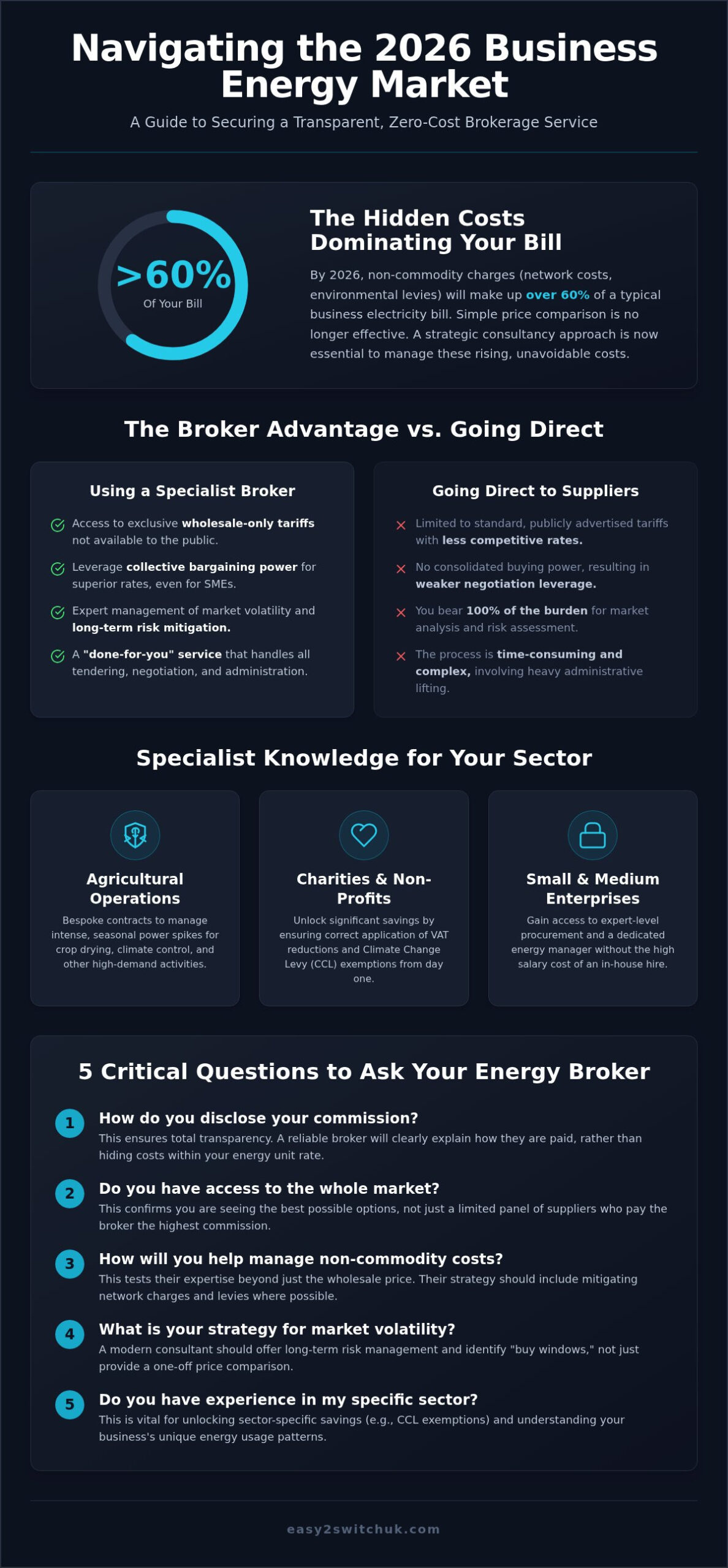
The 5 Essential Questions to Ask a Commercial Energy Broker
Selecting a partner to manage your utility spend requires due diligence. To protect your bottom line, you must move beyond surface-level quotes. The following questions to ask a commercial energy broker will help you separate professional consultancies from simple sales agents. In 2026, the complexity of the UK market means that a wrong choice can lead to years of inflated costs and administrative headaches.
- How exactly is your service funded and what is your commission? A transparent broker will explain the p/kWh uplift clearly. If they hesitate to disclose their fee, they aren’t the right partner for your business.
- Which suppliers do you compare; is it the Big Six or the whole market? Access to the whole market is critical. With dozens of active business energy suppliers in the UK, limiting your search to the largest providers often means missing out on competitive niche tariffs.
- Do you have specific experience in my industry? Sector knowledge isn’t optional. Farming and charities have unique tax and usage profiles that generalist brokers often overlook, leading to missed savings.
- Do you adhere to the TPI Code of Practice for transparency? This signals a commitment to ethical standards and ensures you have access to a redress scheme if things go wrong.
- What ongoing support do you provide after the contract is signed? Your needs don’t end when the contract starts. You need help with bill validation, meter issues, and proactive renewal tracking to avoid expensive ‘deemed’ rates.
Sector-Specific Expertise: Why It Matters
Farming operations require a broker who understands that power needs aren’t flat throughout the year. For instance, grain drying creates massive, short-term demand spikes that can trigger expensive penalties if your contract isn’t structured correctly. Similarly, charity brokers must be experts in navigating VAT reductions and CCL exemption eligibility to ensure your non-profit status is reflected in your energy costs. The TPI Code of Practice is a voluntary set of standards that ensures energy brokers behave ethically, and in 2026, it remains the primary benchmark for broker transparency before mandatory Ofgem licensing is fully enforced.
Red Flags to Watch Out For
Be wary of pressure tactics. If a broker claims an offer will vanish in an hour, they’re likely trying to prevent you from doing your own research. Brokers who refuse to disclose the list of suppliers they work with or those who lack a verifiable UK track record should be avoided. A professional specialist will always encourage you to verify their credentials and track record before you sign any Letter of Authority. This transparency is the hallmark of a reliable partner who values your independence as much as your business.
Easy2switch UK Ltd: Reliable Energy Specialism for UK Businesses
Easy2switch UK Ltd brings a pragmatic and reassuring approach to the often stressful world of utility management. We understand that for many UK business owners, energy is a significant overhead that feels increasingly out of control. Our mission is to act as your Reliable Specialist, handling complex market variables with calm efficiency. While we serve clients across the country, we maintain a neighborly, personalised feel that ensures you’re never just another account number in a database.
When you’re considering the right questions to ask a commercial energy broker, the answer should always lead back to sector-specific expertise. We don’t believe in one-size-fits-all solutions. Our focus remains firmly on the UK farming industry and charitable sectors, where energy needs are unique. From managing seasonal grain drying peaks to securing VAT reductions for non-profits, we provide the deep regional knowledge required to protect your specific bottom line. Our ‘done-for-you’ service is designed to remove the administrative burden of utility procurement entirely.
Empowering Your Business to Take Control
Achieving financial independence from rising energy costs starts with having the right information. Easy2switch UK Ltd moves you away from the anxiety of fluctuating rates and into a position of strength. We focus on finding the best individual fit for your operation, whether you’re a small SME or a large agricultural estate. You can access our free service easily via a quick telephone call or through our simple online platform. This streamlined experience is designed to give you back your time while we handle the heavy lifting of market tendering and supplier negotiations.
The Easy2switch UK Ltd Promise for 2026
The 2026 market demands transparency and speed. Our promise is a simple, fast switching process with absolutely no hidden fees. We’re funded by supplier commissions, meaning our expert consultancy comes at zero upfront cost to your business or charity. Beyond the initial switch, we provide continuous support throughout the duration of your contract, tracking renewals and validating bills to ensure you’re always on the most efficient tariff. It’s time to stop worrying about your meters and start focusing on your growth.
Take control of your energy costs with a free Easy2switch UK Ltd review
Take Control of Your Business Energy Future
Managing commercial energy in 2026 doesn’t have to be a source of constant anxiety. By mastering the right questions to ask a commercial energy broker, you move from being a passive consumer to an empowered decision-maker. You now understand that transparency, sector-specific knowledge, and whole-market access are the keys to avoiding hidden costs and securing long-term stability for your operations. Whether you’re running a busy farm or a local charity, the power to lower your overheads starts with choosing the right partner.
Easy2switch UK Ltd is here to simplify this transition. As specialist UK farming energy consultants, we provide free impartial advice with no hidden fees. We give you direct access to hundreds of competitive supplier offers, ensuring your contract fits your specific needs rather than a generic template. It’s time to stop overpaying for essential utilities and start focusing on your core mission. Secure your business energy savings with Easy2switch UK Ltd today. We look forward to helping your business thrive in a more transparent and predictable energy market.
Frequently Asked Questions
Is it really free to use a commercial energy broker in the UK?
Yes, most brokers operate a ‘done-for-you’ service that is free at the point of use because they are funded by supplier commissions. This commission is typically a small uplift built into the unit rate you pay. It’s one of the standard questions to ask a commercial energy broker to ensure they are transparent about how much that uplift is. This model allows SMEs and charities to access expert procurement without paying upfront consultancy fees.
How do I check if an energy broker is legitimate and trustworthy?
You should check if the broker adheres to the TPI Code of Practice and is registered with an approved redress scheme like the Energy Ombudsman. In 2026, you can also look for their status regarding upcoming Ofgem mandatory registrations. Legitimate brokers will always provide a physical UK office address and a verifiable track record of working with established suppliers. Avoid any consultant who uses high-pressure sales tactics or refuses to disclose their commission structure.
What is a Letter of Authority (LOA) and why does my broker need it?
A Letter of Authority is a legal document that gives your broker permission to contact energy suppliers and gather data on your behalf. It doesn’t mean they can sign a contract without your final approval. It simply allows them to request your consumption history and current contract end dates. This is essential for accurate tendering, as it ensures the quotes you receive are based on your actual usage rather than estimates.
Can a broker help me if I am still mid-contract with my current supplier?
Yes, a broker can help you secure a new rate up to 12 months before your current contract expires. This is known as “future-dating” a contract. It allows you to lock in a competitive rate during a market dip, protecting you from future price spikes. By planning ahead, you ensure a seamless transition to your new supplier the moment your existing deal ends, preventing any time spent on expensive out-of-contract rates.
How long does the business energy switching process take in 2026?
The actual technical switch usually takes between 15 and 30 days once the new contract is signed. However, the preparation phase often starts much earlier. Most businesses begin the process 90 days before their current contract ends to allow for a full market tender and the required notice period. Modern digital systems in 2026 have made the administrative side much faster, ensuring there’s zero downtime or interruption to your power supply.
Do brokers only work with the ‘Big Six’ energy suppliers?
Independent brokers typically compare hundreds of offers from across the entire UK market, well beyond the traditional ‘Big Six’ providers. This includes smaller, niche suppliers who often offer more competitive rates for specific sectors like agriculture or green energy. Accessing the whole market is one of the most important questions to ask a commercial energy broker to ensure you aren’t missing out on wholesale-only tariffs that aren’t advertised to the general public.
Can a broker help my charity get a lower VAT rate on its energy bills?
Yes, a specialist broker can identify if your charity is eligible for the reduced VAT rate of 5% instead of the standard 20%. Many non-profits and charities unknowingly overpay because their supplier has them on a default business rate. A consultant will also check your eligibility for Climate Change Levy (CCL) exemptions. These adjustments can often lead to significant historical rebates and lower ongoing costs for your organisation.
What happens if my energy supplier goes bust while I’m using a broker?
If your supplier fails, Ofgem’s ‘Supplier of Last Resort’ (SoLR) process ensures your energy supply is never cut off. You will be automatically moved to a new supplier, though your previous contract rate might not be protected. In this scenario, your broker acts as a vital advocate, helping you navigate the transition and quickly tendering the market to find a new, competitive contract. They handle the administrative stress so you can focus on your business.
