
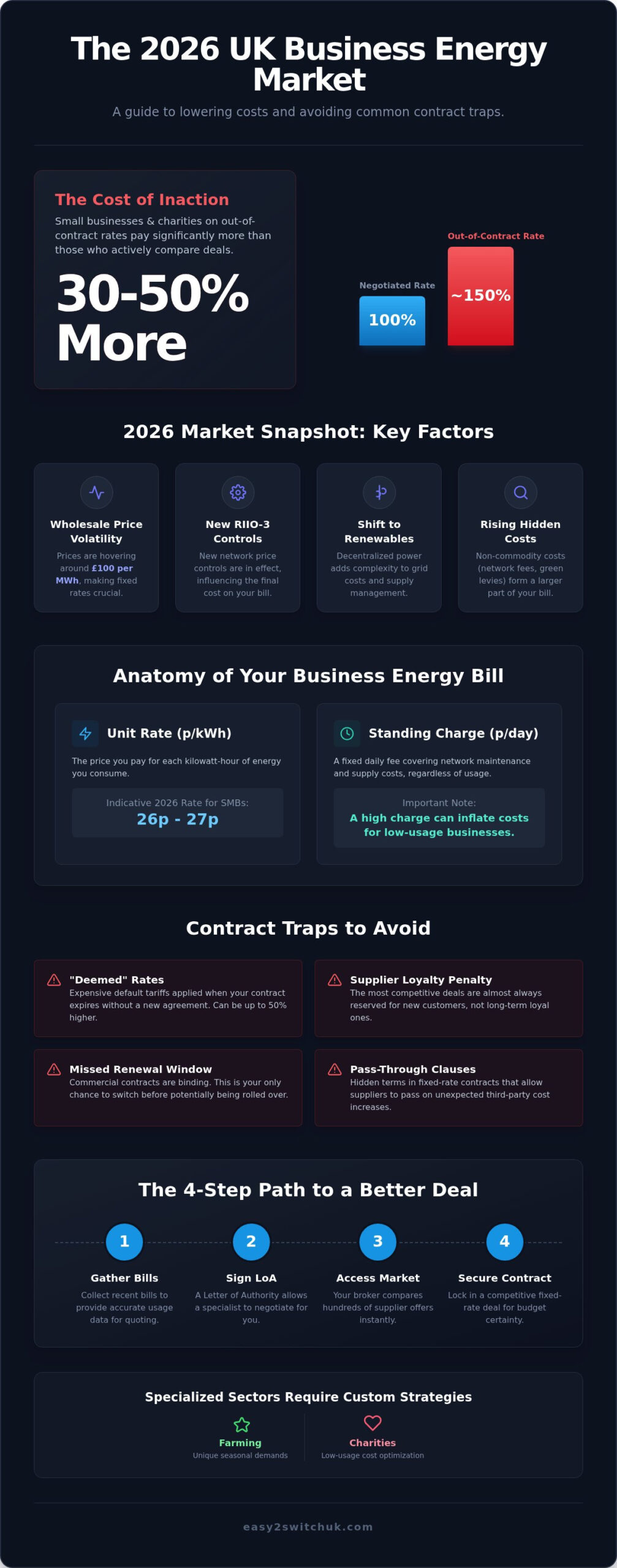
Did you know that UK small businesses and charities stuck on out-of-contract rates often pay 30% to 50% more than those who actively compare business energy deals? It is a frustrating reality in a 2026 market that feels increasingly volatile. With wholesale electricity prices hovering around £100 per MWh and new RIIO-3 price controls now in effect, keeping track of your overheads can feel like a full-time job. You shouldn’t have to decode complex jargon or worry about being rolled onto expensive “deemed” tariffs just because you’re busy running your farm or company.
We understand that you need clear answers and practical help to manage your utility costs. This guide shows you exactly how to secure competitive gas and electricity rates that provide genuine price certainty. We will break down the latest 2026 market trends, explain how to avoid common contract traps, and show you how a managed switching process can lower your annual expenditure. By the end of this article, you’ll have a simple, low-friction path to taking control of your energy costs and protecting your bottom line.
Key Takeaways
- Understand why traditional supplier loyalty often leads to inflated costs and how to spot when you’re being moved to expensive out-of-contract rates.
- Learn to balance unit rates against standing charges to ensure your business energy deals provide the best overall value for your specific usage.
- Discover why specialized sectors like farming and charities require custom procurement strategies to handle unique seasonal demands.
- Master the efficient process of gathering bills and using a Letter of Authority to access offers from hundreds of suppliers at once.
- See how a professional brokerage handles the entire switching process on your behalf, saving you time while keeping the service free for your business.
Navigating the 2026 Business Energy Market for Better Deals
The UK energy market in 2026 is defined by a shift toward decentralized power and a heavy reliance on renewables. While this transition is positive for the environment, it introduces new complexities for your bottom line. Many business owners believe that staying loyal to their current supplier will result in better treatment or preferential rates. In reality, the most competitive business energy deals are almost always reserved for new customers or those who actively negotiate through a specialist. The UK energy policy framework continues to evolve, focusing on net-zero targets and grid modernization, which means non-commodity costs like network charges are becoming a larger portion of your bill. A specialist consultancy helps you identify these hidden fees, ensuring you aren’t overpaying for the infrastructure that delivers your power.
Comparing energy for a business is not like checking rates for your home. Domestic consumers enjoy the protection of an Ofgem price cap, but commercial entities do not. Your business is exposed to the raw volatility of the wholesale market. This makes 2026 a crucial year for securing a fixed-rate contract. Locking in your rates now provides a buffer against sudden market spikes caused by geopolitical shifts or supply chain disruptions. It’s about taking control of your overheads rather than leaving them to chance.
Why Business Energy Comparison is Different in 2026
Current global trends have a direct impact on UK commercial tariffs, often with very little warning. Unlike a household, a business cannot simply switch with a few weeks’ notice whenever they feel like it. Commercial contracts are legally binding for their full duration; the “renewal window” is your only chance to make a move. If you miss this specific period, you might find yourself locked into another year of sub-optimal rates. We track these windows for you, ensuring you have the data needed to act when the market is in your favor.
The Financial Impact of “Deemed” and Out-of-Contract Rates
The cost of inaction is high. If your current contract ends and you haven’t signed a new agreement, your supplier will move you to “deemed” rates. Deemed rates are the default, non-contracted tariff applied when a deal expires without a new agreement. These rates are significantly higher than negotiated business energy deals, sometimes costing up to 50% more per unit of electricity or gas. Businesses often fall onto these variable rates unknowingly, seeing their monthly expenditure skyrocket overnight. By proactively managing your transition, we ensure you maintain price certainty and avoid these expensive, unnecessary traps.
Decoding Business Energy Contract Types and Hidden Costs
Understanding the structure of your energy bill is the first step toward securing the most effective business energy deals. Most commercial contracts are split into two primary charges: the unit rate and the standing charge. The unit rate is what you pay for every kilowatt-hour (kWh) of energy you consume. In early 2026, indicative rates for small businesses have hovered around 26p to 27p per kWh. The standing charge is a fixed daily fee that covers the cost of maintaining the energy network and supplying your premises. It’s easy to focus solely on the unit rate, but a high standing charge can significantly inflate the annual cost for a low-usage office or a small charity.
Beyond these basic figures, your bill includes non-commodity costs that are often passed through to the consumer. These include network charges and social obligations that fund government environmental schemes. For a detailed breakdown of how these components are regulated, you can consult Ofgem’s business energy guide. In 2026, green energy tariffs have also become more sophisticated. Instead of simple carbon offsetting, many suppliers now offer “matched” renewable energy, where every unit you use is backed by a Renewable Energy Guarantee of Origin (REGO) from UK wind or solar farms.
Fixed-Rate vs. Variable Business Energy Deals
Most businesses opt for fixed-rate contracts, which lock in the price you pay per unit for one, two, or three years. This provides vital budget certainty in a volatile market. However, you must read the fine print regarding “pass-through” clauses. These allow suppliers to increase your rates if third-party costs, like government levies, rise unexpectedly during your term. Variable-rate deals are rarer but can suit businesses that are planning to move premises or those that have highly seasonal usage patterns and want to avoid long-term commitment. If you aren’t sure which structure fits your operational cycle, it’s worth having an expert review your current usage profile to find the right match.
Taxes, Levies, and Exemptions for Businesses
The Climate Change Levy (CCL) is a tax on energy delivered to non-domestic users, designed to encourage energy efficiency. While it’s a standard addition to most bills, not every organization pays the full amount. Charities and some small businesses may qualify for a reduced 5% VAT rate on energy. This reduction usually applies if your business uses less than 33kWh of electricity or 145kWh of gas per day. Ensuring you are correctly classified can save your organization thousands of pounds over the life of a contract. We help our clients navigate these exemptions, ensuring that “hidden” costs don’t undermine the value of their business energy deals.
How to Compare Business Energy Deals Across Different Sectors
A generic comparison engine often ignores the nuances of your specific industry. While a high-street shop has predictable energy needs, a cold-storage facility or a busy workshop requires a more tailored approach. Finding the best business energy deals involves looking beyond the headline price to see how a contract aligns with your operational hours. For larger industrial sites, this often means managing half-hourly meters, which record consumption every 30 minutes to provide a precise picture of demand. Ofgem’s official guidance for businesses highlights that understanding these usage patterns is essential for avoiding peak-time surcharges that can silently drain your budget. Small and medium enterprises (SMEs) often benefit from simpler fixed-term contracts, but as your operations scale, the complexity of your procurement strategy must scale with it.
Securing Specialized Farm Electricity Prices
Agriculture presents a unique challenge for energy procurement. Whether you’re running milk cooling systems, grain dryers, or climate-controlled livestock housing, your demand is rarely flat. We recognize that farm energy brokerage is a distinct discipline because rural infrastructure often faces constraints that urban businesses don’t encounter. Seasonal fluctuations mean your heaviest usage might occur during a few intense weeks of the year. Working with a specialist who understands these cycles allows you to secure a deal that doesn’t penalize you for these necessary spikes in consumption. It’s about matching your contract to the rhythm of the land and ensuring your machinery stays powered without unexpected costs.
Energy Solutions for Charities and Non-Profits
Charities and non-profit organizations have a responsibility to make every penny count. Beyond the VAT reductions mentioned in previous sections, many suppliers offer specific ethical or “social responsibility” tariffs that align with your organization’s values. These specialized business energy deals can sometimes offer better long-term value by pairing competitive rates with a supplier that understands the non-profit landscape. When presenting options to a board of trustees, having a clear, impartial comparison is vital for transparent decision-making. We help charities audit their current standing to ensure they aren’t missing out on sector-specific grants or lower tariffs designed for the third sector. It’s about finding a partner that respects your mission while protecting your financial health.
A Step-by-Step Guide to Securing Your Next Energy Contract
Securing a new contract isn’t just about picking a number off a screen. It requires a structured approach to ensure the deal you sign is actually the deal you get. First, you need to gather your most recent bills. You’ll also need a signed Letter of Authority (LOA). This document doesn’t commit you to a contract; it simply gives us permission to gather data from your current supplier and scout the market for the best business energy deals. Without it, we can’t see your actual usage history, which is vital for an accurate, realistic quote.
Once we have your data, we cast a wide net across hundreds of supplier offers. We don’t just look at the headline price. We validate technical details like your meter type and kVA capacity. If your kVA is set too high, you’re paying for capacity you don’t use. If it’s too low, you risk financial penalties. We check these details before execution to ensure a smooth transition with zero interruption to your operations. Reliability is our priority throughout this entire process.
What Information Do You Need to Get a Quote?
To get a precise quote, we need your unique meter identifiers. For electricity, this is the MPAN, while gas uses an MPRN. Your MPAN is a unique 21-digit number found on your electricity bill used to identify your supply point. Along with these numbers, your Estimated Annual Consumption (EAC) is the most critical piece of data. Suppliers base their pricing tiers on how much energy you use over a year. If your EAC is inaccurate, your quotes won’t reflect your actual costs, leading to budget shocks later. We ensure your data is clean before we even start the comparison.
Managing the Transition and Avoiding Supplier Objections
The switching process should be seamless, but hurdles can appear. Your current supplier might object to the switch if there’s an outstanding balance on the account or if you haven’t provided the correct notice. This is where a specialist adds the most value. We manage the “done-for-you” process, identifying these hurdles early and resolving them on your behalf. You won’t have to spend hours on hold with customer service departments. Instead, you can start your switch today and let us handle the paperwork. When your first bill arrives from the new supplier, we can even help you check it to ensure the rates match your agreement exactly. This level of support turns a complex market transaction into a simple, managed experience.
How Easy2switch UK Simplifies Your Energy Procurement
The Easy2switch philosophy is built on the belief that managing your utilities should be simple, fast, and entirely stress-free. We know that as a business owner or farm manager, your time is your most valuable asset. Spending hours on hold with suppliers is not a productive use of your day. Our approach centers on calm efficiency, where we handle the heavy lifting of market analysis so you don’t have to. We act as your reliable specialist, providing a personalized service that ensures your energy procurement is handled by capable hands.
Transparency is the cornerstone of our relationship with our clients. Many people ask how our service remains free for businesses, charities, and farms. The answer is straightforward: we operate on a supplier-paid commission model. When we help you secure one of the many business energy deals available on the market, the supplier pays us a fee for managing the transition. This means you get expert advice and a fully managed switch without any direct cost to your organization. It’s a pragmatic solution that aligns our success with your savings.
Impartial Advice and Market-Wide Access
We provide impartial advice by scanning hundreds of deals from a vast panel of UK suppliers. Our commitment isn’t just to find any contract, but to identify the most appropriate one for your specific operational needs. Whether you’re managing a local charity or a large-scale agricultural enterprise, we look for terms that offer long-term stability. This isn’t a one-off transaction; we aim to build a partnership that supports your future renewals. You won’t be talking to a chatbot or a generic call center. Instead, you’ll have access to a human expert who understands the regional industry landscape and the unique pressures you face.
Take Control of Your Overheads Today
There is no reason to continue overpaying for your gas or electricity when better options are available. By taking a proactive step today, you can move away from volatile rates and secure the price certainty your budget requires. We’ve helped countless organizations across the UK transition from complex, expensive contracts to streamlined, cost-effective agreements. Getting started is easy and begins with a simple review of your current usage. Take control of your energy costs with a free, impartial review from Easy2switch UK and discover how much your business could be saving.
Take Control of Your 2026 Energy Overheads
Securing competitive business energy deals in 2026 requires a proactive approach rather than a reactive one. By identifying your renewal window early and auditing your current VAT status, you can avoid the financial trap of expensive out-of-contract rates. Remember that a “one-size-fits-all” comparison often misses the nuances of specialized sectors like farming and the third sector. Professional brokerage ensures that your specific usage patterns are matched with the most appropriate supplier on the market.
Easy2switch UK acts as your reliable specialist, offering a done-for-you service with no hidden fees. We provide access to deals from hundreds of UK suppliers and specialize in the unique needs of farms and charities. You don’t have to navigate this volatile market alone; our team is ready to manage the entire transition for you. Get a free, impartial business energy quote today and start protecting your bottom line. Taking charge of your utility costs is a simple way to gain independence and focus on what you do best.
Frequently Asked Questions
Is the Easy2switch service really free for businesses?
Yes, our consultancy service is completely free for your business, farm, or charity. We’re funded by commissions paid directly by the energy suppliers once your new contract is live. This allows us to provide impartial advice and a fully managed switching process without adding any extra fees to your overheads or charging for our time.
How long does it take to switch business energy suppliers in 2026?
Most switches in 2026 are completed within five working days due to improved industry data synchronization. The exact timeline depends on your current contract’s notice period and whether your existing supplier raises any objections. We handle all the communication with both parties to ensure the transition is smooth and involves zero interruption to your supply.
Can I switch energy suppliers if I am still in a contract?
You cannot leave a fixed-term contract before its end date without paying termination fees, but you can secure your next contract early. Most providers allow you to agree to new business energy deals up to six months before your current agreement expires. This proactive approach lets you lock in favorable rates while the market is stable, providing future budget certainty.
Do I need to install a new meter if I switch suppliers?
No, switching suppliers does not require any physical changes to your pipes, wires, or meters. Your energy is delivered through the same local network regardless of which company sends your bill. If you choose to upgrade to a smart meter or a half-hourly meter to better track your usage, we can coordinate that installation with your new provider as part of the switch.
What is the difference between business and domestic energy deals?
Business energy contracts are more complex because they don’t have an Ofgem price cap like domestic bills. Commercial rates are tailored to your specific usage profile, location, and credit score. While households pay a flat 5% VAT, most businesses pay 20% VAT and additional levies like the Climate Change Levy, unless they qualify for specific exemptions.
How much can a typical farm save by switching energy deals?
A farm or SME currently on out-of-contract “deemed” rates can often save between 30% and 50% by moving to a negotiated fixed-term deal. Because agricultural operations often have high demand for cooling, lighting, or machinery, even a small reduction in the unit rate results in substantial annual savings. We analyze your peak usage to find the most competitive business energy deals for your sector.
What happens if my energy supplier goes bust after I switch?
If a supplier fails, Ofgem’s “Supplier of Last Resort” process ensures your energy supply is never cut off. You’ll be automatically moved to a new supplier, and any credit balance on your account is protected. While your rates might change under the new provider, we can immediately help you compare the market again to find a more cost-effective long-term contract.
Can charities get a discount on the Climate Change Levy (CCL)?
Yes, charities can often claim a 100% exemption from the Climate Change Levy (CCL) for energy used for non-business purposes. Many non-profit organizations also qualify for a reduced 5% VAT rate instead of the standard 20%. We help you audit your status and submit the required declarations to ensure you aren’t paying unnecessary taxes on your monthly utility bills.
