
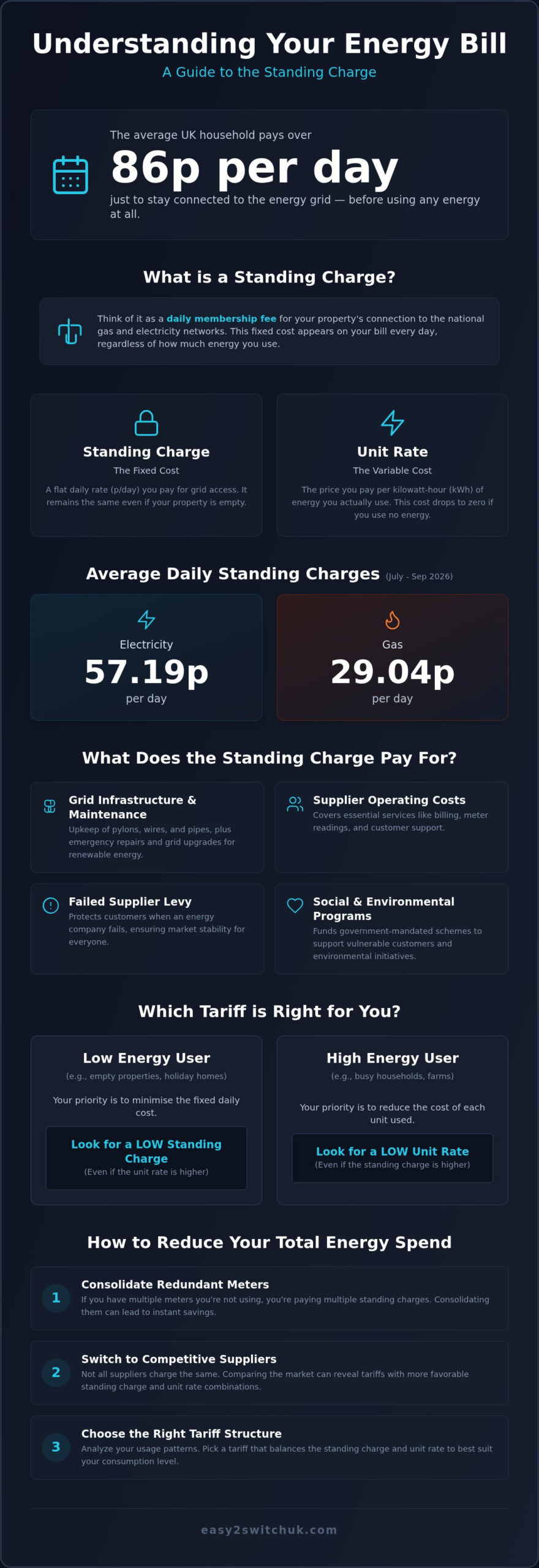
Did you know that as of July 2026, the average UK household pays over 86 pence every single day just for the privilege of being connected to the energy grid? This cost hits your bill before you’ve even turned on a light or boiled the kettle. It’s frustrating to see your monthly costs climb despite your best efforts to cut back on usage. Many people find themselves asking, what is a standing charge, especially when these fixed daily fees feel like hidden obstacles to saving money.
We believe that managing your utilities should be straightforward and stress-free. This guide provides the clarity you need to take back control of your energy spend. You’ll learn exactly what those daily pence are funding and how the recent 13% price cap increase changes the math for your home or business. We’ll also provide a practical strategy for balancing these fixed fees against unit rates. This ensures you can select a tariff that lowers your total expenditure and fits your specific usage needs perfectly, whether you are running a household or a commercial farm.
Key Takeaways
- Understand exactly what is a standing charge and why this fixed daily fee appears on your bill even when your energy usage is zero.
- Learn how these fees support the essential upkeep of the National Grid and cover the operational costs required to keep your property connected.
- Explore how business and farm tariffs use different calculations, including the significant impact that available capacity has on your daily commercial rates.
- Identify whether a high or low standing charge tariff is the most cost-effective choice based on your specific daily energy usage patterns.
- Discover actionable steps to reduce your total expenditure, such as consolidating redundant meters and switching to suppliers with more competitive fee structures.
Understanding the Basics: What is a Standing Charge?
When you open your energy statement, you’ll see two main figures. One changes based on how much power you use. The other stays exactly the same every single day. If you’ve ever wondered what is a standing charge, think of it as a connection fee for your property. It is a fixed daily cost that you pay to your supplier simply to remain connected to the National Grid. Whether you are running a busy dairy farm or leaving a flat empty for a month, this charge applies to both your gas and electricity accounts.
Most suppliers list this fee in pence per day (p/day). For the period between 1 July and 30 September 2026, the average daily standing charge for electricity is 57.19 pence, while gas sits at 29.04 pence for those on a standard variable tariff. These small daily amounts add up. Over a full year, they represent a significant portion of your total energy spend before you’ve even flipped a switch. It’s the “other half” of your bill that works alongside your unit rate to form your total monthly cost.
Standing Charge vs. Unit Rate
To get a clear picture of how electricity bills are structured, you need to look at the relationship between your fixed and variable costs. The unit rate is your “pay-as-you-go” cost. You are charged for every kilowatt-hour (kWh) of energy you consume. If you turn off all your appliances, your unit rate cost drops to zero. It’s the variable part of the equation that you can control through efficiency.
The standing charge is different. It acts like a membership fee for grid access. It covers the supplier’s overheads and the physical infrastructure required to get energy to your door. In the current UK market, you usually cannot have one without the other. While “zero standing charge” tariffs exist, they are rare. They typically balance the lack of a daily fee by charging a much higher unit rate, which can actually increase costs for high-usage households or businesses.
How it Appears on Your Bill
Locating this fee on your invoice is usually straightforward. Most UK suppliers place it in the “Charges” or “Usage Breakdown” section. It might be labeled as a “Daily Charge,” “Fixed Fee,” or simply “SC.” On business or farm invoices, you might see more technical abbreviations depending on the complexity of your meter setup. We recommend checking this figure first when comparing new quotes.
Calculating the monthly impact is simple math. You take the daily rate and multiply it by the number of days in that billing period. For example, a 30-day month at the current average electricity rate of 57.19p would cost you roughly £17.16 in standing charges alone. Understanding this calculation helps you spot errors and compare different supplier offers with confidence. It moves you from being a passive payer to an informed consumer who knows exactly where every penny goes.
What Does the Standing Charge Actually Pay For?
Understanding what is a standing charge requires looking beyond your own property line. While your unit rate covers the raw energy you consume, the daily fee funds the massive logistical operation required to keep that energy available 24/7. It’s a bundle of different costs that suppliers pass on to consumers to ensure the lights stay on and the gas keeps flowing across the entire country. Most of these costs are fixed, meaning they don’t change whether you use one unit of power or a thousand.
One specific component that often surprises people is the “failed supplier” levy. When an energy company goes out of business, the cost of protecting those customers and moving them to a new provider is shared among all UK bill-payers. This ensures market stability. Additionally, your daily fee covers basic supplier overheads like customer service, accurate billing, and the administrative costs of managing your account. If these layers of cost feel complex, our independent experts can help you take control of your energy procurement to find a more transparent deal.
Infrastructure and Maintenance
The physical cost of the energy network is a major part of your bill. This money goes toward the upkeep of thousands of miles of pylons, underground wires, and gas pipes. It also funds emergency repair teams who work through storms to restore power. As the UK works toward future energy goals, a portion of this fee is also used to upgrade the grid. These upgrades allow the network to handle more renewable energy from wind and solar farms, which is vital for long-term grid stability.
Social Obligations and Levies
The UK government mandates that energy suppliers help fund social and environmental programs. These costs are “socialised,” meaning they are spread across all energy bills rather than just targeting high users. This includes funding for the Warm Home Discount, which supports vulnerable households during the winter months. These environmental levies also support the transition to Net Zero by subsidising green technology and energy efficiency schemes. While these are essential for a fairer energy system, they are a primary reason why standing charges have remained high even when wholesale prices fluctuate.
By breaking down these components, you can see that your daily fee isn’t just an arbitrary “hidden” cost. It’s a payment for a reliable, maintained, and socially responsible energy network. Our team at Easy2switch specializes in demystifying these figures for farms and businesses, ensuring you never pay more than necessary for your essential connection.
Standing Charges for Businesses and Farms
While domestic consumers often look at their bills and ask what is a standing charge to understand a small daily fee, business owners face a far more complex reality. Commercial standing charges are typically much higher than residential equivalents. This isn’t just an arbitrary price hike; it reflects the increased pressure that commercial operations put on the local network. Whether you are running a manufacturing plant or a large charity, the infrastructure required to support your energy needs is more robust, and the costs to maintain it are passed directly to you.
For seasonal businesses, these fixed fees can become a “hidden killer” for profitability. A holiday park or a seasonal farm might see energy usage drop to near zero during the winter months, but the standing charge remains constant. You’re paying for the connection every day, regardless of whether you’re actually drawing power. Understanding this fixed cost is essential for accurate cash flow forecasting, especially when wholesale prices are volatile.
Capacity and Half-Hourly Metering
Larger commercial operations don’t just pay for the energy they use; they pay for the “right” to draw massive amounts of power at any given moment. This is often managed through Half-Hourly (HH) meters, which send usage data to suppliers every thirty minutes. These meters often come with specific capacity charges that aren’t found on standard domestic bills.
A critical part of this is your kVA rating. Available Capacity is the maximum demand a site can handle. If your agreed capacity is set too high, you are paying for space on the grid that you never use. Conversely, if it’s too low and you exceed it, you could face significant financial penalties. We help businesses audit these levels to ensure they aren’t overpaying for unused capacity.
Multi-Site and Agricultural Considerations
Farms face a unique challenge known as “Meter Multiplication.” It’s common for a single farm to have five or six different meters spread across barns, grain dryers, outbuildings, and the main farmhouse. Each of these meters carries its own daily standing charge. Over a year, paying multiple fixed fees for one business can drain thousands of pounds from your budget.
Consolidating these contracts is one of the most effective ways to simplify your administration and lower your total fixed fees. Easy2switch specialises in the UK farming industry and understands these complex agricultural energy structures. We provide impartial advice from hundreds of supplier offers to help you find a deal that respects the unique layout of your site. By taking control of these multiple charges, you can significantly reduce your overheads without changing a single piece of equipment.
Choosing the Right Tariff: High vs. Low Standing Charges
Selecting the best energy deal isn’t just about finding the lowest unit rate. It requires a pragmatic look at how that rate balances against the fixed daily fee. When you’re assessing what is a standing charge in the context of a new contract, you’re really looking for the “breakeven point.” This is the specific level of energy usage where one tariff becomes cheaper than another. Choosing the wrong structure can lead to hundreds of pounds in unnecessary costs every year, particularly for businesses with unconventional usage patterns.
You should be wary of “Zero Standing Charge” offers. These deals often appear attractive because they eliminate the daily fee entirely. However, suppliers frequently compensate for this by applying a much higher “Tier 1” unit rate for the first portion of energy you use each day. This can result in a bill that is actually more expensive than a standard tariff. To avoid these traps and find the most efficient fit for your property, you can compare hundreds of supplier offers with our impartial brokerage service.
The Usage Threshold Strategy
Your ideal tariff structure depends almost entirely on your annual consumption. If you operate a high-consumption site, such as a dairy farm with cooling systems running 24/7, a high standing charge is often your best friend. In this scenario, paying a higher fixed daily fee allows you to access a significantly lower unit rate, which saves more money over thousands of kilowatt-hours. Conversely, a small office or a holiday home that remains empty for weeks at a time should prioritse the lowest possible standing charge to keep costs down during periods of inactivity.
Regional Variations in the UK
It’s a common frustration that energy costs aren’t uniform across the country. Standing charges are typically higher in North Wales, the South West, and Scotland compared to London. This isn’t due to supplier greed; it’s driven by the Distribution Network Operators (DNOs). These organisations manage the local cables and towers. In regions with lower population density or more challenging terrain, the cost of maintaining the infrastructure per customer is simply higher. We help you navigate these regional variables by providing a clear, localized view of the market, ensuring you don’t pay a “location penalty” without exploring every available alternative.
By understanding these trade-offs, you move from simply paying a bill to actively managing a budget. Taking control of your tariff structure is the most direct way to lower your total energy spend without needing to reduce your actual consumption. Our specialists are ready to handle the complex math for you, making the transition to a better deal feel effortless and rewarding.
How to Reduce the Impact of Standing Charges
Reducing the weight of fixed costs on your budget requires a proactive strategy. While you cannot eliminate the connection fee entirely, you can ensure you aren’t paying for redundant infrastructure. Start by auditing your physical site for multiple meters. As we discussed earlier, farms often suffer from “meter multiplication,” where separate fees are paid for barns or outbuildings that could be consolidated. Removing a single redundant meter can save you over £200 a year based on current 2026 average rates.
Switching suppliers remains the most effective way to find a more competitive fixed-fee structure. However, the best commercial deals are rarely found on public comparison websites. Once you understand what is a standing charge and how it impacts your specific usage profile, you can leverage a specialist broker to access “off-market” rates. These bespoke contracts are often negotiated directly with suppliers to provide better terms for high-capacity users or specific industries like agriculture and charity work.
The Done-For-You Switching Process
Easy2switch simplifies the transition by handling the complex market variables for you. We analyze hundreds of supplier offers to find the perfect fit for your business or home. This process is designed to be entirely stress-free. Because we earn our commission from the energy suppliers, our consultancy is provided at no direct cost to you. This impartial approach ensures that our focus remains on finding the best individual fit for your needs rather than a one-size-fits-all solution. We provide the professional authority you need to navigate the recent 13% price cap increase with confidence.
Next Steps for Your Business or Home
Taking control of your energy spend starts with a clear view of your current data. You don’t need to be an industry expert to lower your bills; you just need the right information at your fingertips. Follow these steps to begin your review:
- Gather your most recent bills to identify your current daily standing charge and annual kWh usage.
- Check for any redundant meters on your property that could be consolidated.
- Verify your contract end dates to avoid expensive “out-of-contract” rates.
A professional energy review can identify hidden savings in your current tariff structure and help you move toward a more sustainable financial future. Don’t let complex terminology or administrative hurdles stand in your way. Let Easy2switch find your best energy deal today and experience the ease of a service designed around your independence.
Take Control of Your Energy Strategy Today
Gaining a clear understanding of what is a standing charge is the first step toward reclaiming control over your monthly utility bills. You’ve seen that these fixed fees support the essential national infrastructure and that the right tariff depends entirely on your specific usage profile. Whether you’re managing a high-consumption dairy farm or a low-usage small office, finding the right balance between fixed daily costs and unit rates is the key to minimizing your total expenditure.
Comparing hundreds of supplier deals can feel overwhelming, but you don’t have to handle it alone. As an independent consultancy, we provide the specialist expertise needed to navigate complex agricultural and business energy markets. Our service is completely free for you to use; we’re paid by the suppliers, ensuring our advice remains impartial and focused on your best interests. We’ll take the administrative burden off your plate so you can focus on running your business or home with total confidence.
Get a free, no-obligation energy quote from Easy2switch and start seeing the benefits of a tailored energy strategy. We’re here to help you find a reliable, cost-effective solution that fits your life perfectly.
Frequently Asked Questions
Can I avoid paying a standing charge altogether?
You can find “zero standing charge” tariffs, but they are rarely the cheapest option for the average user. These deals usually have a much higher unit rate to compensate for the lack of a daily fee. They only make financial sense for properties with very low usage, such as a holiday home or a storage shed. Understanding what is a standing charge trade-off is essential before switching to one of these niche products.
Why are standing charges different depending on where I live in the UK?
Regional rates vary because of the physical cost of maintaining the local energy network. Distribution Network Operators (DNOs) charge more in areas with lower population density or difficult terrain. This is why a rural farm in North Wales or the Scottish Highlands will naturally have a higher standing charge than a flat in central London. These costs reflect the infrastructure required to keep your specific region connected.
Do I still pay a standing charge if my property is empty?
You must pay the daily fee as long as your energy account remains active. Even if you turn off every appliance and use zero units of power, the supplier still charges you for maintaining the connection to the grid. The only way to stop this charge entirely is to have the meter officially disconnected or the account closed, which may involve reconnection fees later.
How much is the average energy standing charge in 2026?
For the period between 1 July and 30 September 2026, the average daily standing charge for electricity is 57.19 pence. For gas, the average is 29.04 pence for customers on a standard variable tariff paying by Direct Debit. These rates are set under the Ofgem price cap and can vary slightly based on your payment method and where you live in the UK.
Is the standing charge included in the Ofgem Price Cap?
Yes, the Price Cap limits both the unit rate and the daily standing charge. Ofgem sets a maximum daily amount that suppliers can charge for these fixed fees on default tariffs. Knowing what is a standing charge limit helps you verify that your supplier isn’t overcharging you. It provides a vital safeguard for households on standard variable rates during periods of market volatility.
Why have standing charges increased so much recently?
Recent increases are largely due to the cost of failed energy suppliers and the shifting of social levies. When a supplier goes bust, the expense of protecting their customers is shared across all UK energy bills. Additionally, the government has moved some environmental scheme costs from unit rates into fixed standing charges. This ensures that the funding for green energy initiatives remains stable regardless of how much energy people consume.
Do smart meters make standing charges cheaper?
A smart meter won’t lower your standing charge rate, but it does ensure you aren’t overpaying through estimated bills. It automatically sends your actual usage data to the supplier, which eliminates the risk of human error in meter readings. While this helps you manage your unit rate costs more effectively, the fixed daily fee remains the same regardless of your meter type.
What is the difference between a domestic and business standing charge?
Business standing charges are not protected by the Ofgem price cap and are often structured differently than domestic bills. They can be significantly higher and may include kVA capacity fees based on the maximum power your site can draw. While domestic rates are standardized, business rates are negotiated through bespoke contracts. This makes it crucial for companies to compare multiple supplier offers to find the best fit.
